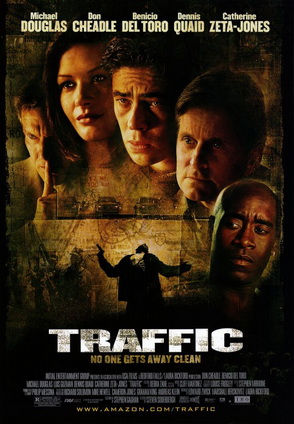
Shattered Politics #69: Traffic (dir by Steven Soderbergh)


Traffic2000Poster

I have mixed feelings about Steven Soderbergh.  On the one hand, his talent cannot be denied and you have to respect the fact that he’s willing to take chances and make films like The Girlfriend Experience and The Informant.  On the other hand, he’s also the director who has been responsible for overrated messes like Contagion and utter pretentious disasters like Haywire.  And it doesn’t help that Soderbergh’s fanbase seems to be largely made up of the type of hipsters who end up leaving comments under the articles at The A.V. Club.  Some people mourned Soderbergh’s retirement.  Personally, I think he made the right decision.  He retired before his misfires ended up outnumbering all of his masterpieces.

The thing about Soderbergh is that his good films are so good that it makes it all the more frustrating to watch his failures.  If Soderbergh was just your typical bad director than a film like Contagion wouldn’t be as annoying.  But this is the man who also gave us Traffic!

And Traffic is a very good film.

First released in 2000, Traffic attempted to deal with the American war on drugs, a war that the film suggests might not even be worth fighting.  (Full disclosure: I support the legalization of drugs and, for that matter, just about everything else.  And yes, I am biased towards films that agree with me.  So is every other film critic out there.  The difference is that I’m willing to admit it.)  Traffic won four Oscars, including Best Director and Best Supporting Actor for Benicio Del Toro.  It was also nominated for best picture but lost to Gladiator.

Traffic tells three, barely connected stories.  Each story is given its own distinct look, feel, and color scheme.  And while it takes a few minutes to get used to film’s visual scheme, it ultimately works quite well.  Though all of the film’s characters share the same general existence, they live in different worlds.  The only thing linking them together is drugs.

Judge Andrew Wakefield (Michael Douglas) is a judge on the Ohio Supreme Court who has recently been named as the new drug czar.  However, while Judge Wakefield is going around the country and talking to politicians (Harry Reid shows up playing himself and is just as creepy as always), his daughter Caroline (Erika Christensen) is dating Seth (Topher Grace) and getting addicted to cocaine and heroin.  When Caroline run away, Judge Wakefield recruits Seth and, using him as a guide, searches the ghetto for his daughter.

The Wakefield scenes are bathed in cold and somber blues.  They’re beautiful to look at but, in some ways, they’re also some of the weakest in the film.  The whole plotline of Caroline going from being an innocent honor’s student to being a prostitute who sells her body for heroin feels a lot like the notorious anti-drug film Go Ask Alice.  At the same time, it’s interesting and a little fun to see Topher Grace playing such a little jerk.  Grace gets some of the best lines in the film, especially when he attacks Wakefield’s feelings of smug superiority.

In the film’s second storyline, two DEA Agents (Don Cheadle and Luis Guzman) arrest drug trafficker Eddie Ruiz (Miguel Ferrer).  Eddie works for the Ayala syndicate and, once he’s arrested, he turns informant.  Drug lord Carlos Ayala (Steven Bauer) is arrested.  While Carlos sits on trial, his pregnant wife (Catherine Zeta-Jones) and his sleazy business associate (Dennis Quaid) struggle to hold together the business and find a way to kill Ruiz before he can testify.

This storyline is filmed in bright and vibrant colors and why not?  The Ayalas are rich and, unlike the Wakefields, they don’t feel the need to hide their material wealth.  This is actually probably my favorite storyline, largely because it’s the best acted and the most entertaining.  Miguel Ferrer, in particular, steals every scene that he’s in.  The scene where he explains the economics of being a drug trafficker is fascinating to watch.

The Ayala storyline may be my favorite but the film’s most thought-provoking storyline is the third one.  Taking place in Mexico, it stars Benicio Del Toro as Javier Rodriguez, a casually corrupt police officer who gets recruited to work for General Salazar (Tomas Milian), who is heading up Mexico’s war on the cartels.  Following the orders of Salazar, Javier captures assassin Frankie Flowers (Clifton Collins, Jr.) who is then savagely tortured by Salazar until he turns informer.  Javier comes to realize that Salazar is actually working for one of Mexico’s cartels.  When he decides to inform on Salazar, he puts his own life at risk.

The Mexico storyline is also the harshest and visually, it reflects that fact.  The heat literally seems to be rising up from the desert and the streets of Tijuana.  It takes a few minutes to adjust to the look of the Mexico scenes but, once you do, they become enthralling.

And Traffic, as a film, is undeniably enthralling as well.  Soderbergh deftly juggles the multiple storylines and brings them together to create a portrait of a society that’s being destroyed by the efforts to save it.  Hopefully, if Soderbergh ever does come out of retirement, he’ll give us more films like Traffic and less films like Contagion.

 

Film Review: In the Blood (dir by John Stockwell)


in-the-blood-1

Do you remember Haywire?

Haywire was an action film that came out in 2011.  It briefly got a lot of attention because it starred MMA fighter Gina Carano in her feature film debut and it was directed by Steven Soderbergh.  I have to admit that I didn’t care much for Haywire.  Some of that is because Gina Carano herself didn’t seem to be a very good actress but my main issue with the film was with Steven Soderbergh.  Don’t get me wrong — I know that Soderbergh can be a genius.  However, he’s also a remarkably pretentious filmmaker.  Sometimes that pretension works, like with The Girlfriend Experience.  But, in the case of Haywire, all the pretension served to do was to make a thin story even more annoying.

John Stockwell, on the other hand, is a director who is the very opposite of pretentious.  Whereas Soderbergh often makes genre films that try too hard to be art, Stockwell makes genre films that are so unapologetic about being genre that they often become art despite themselves.  Stockwell may never be as acclaimed as Soderbergh but, on the whole, he’s a much more consistent filmmaker.

Take In The Blood for instance.  In the Blood came out earlier this year, got thoroughly mediocre reviews, and disappeared from theaters pretty quickly.  When I watched it last night, I had very low expectations.

But you know what?

In the Blood isn’t bad.

In fact, it’s a perfectly entertaining and, ultimately, rather empowering film.

In In The Blood, Gina Carano plays Ava.  Ava, we quickly learn, has led a difficult life.  Raised in extreme poverty by a father who taught her early how to fight and how to defend herself, Ava is a former drug addict.  When she goes to rehab, she meets and falls in love with fellow addict Derek (Cam Gigandet).  Once they’re both clean, Ava and Derek marry despite the concerns of Derek’s wealthy father (Treat Williams).

For their honeymoon, Derek and Ava go to the type of Caribbean island where bad things always happen in movies like In The Blood.  They meet Manny (Ismael Cruz Cordova), who agrees to be their guide on the island.  One night, Manny takes them out to a club where Ava ends up getting into a huge fight with literally everyone on the dance floor, including a local gangster played by Danny Trejo.  The next morning, Manny takes them zip lining but Derek ends up plunging from the zip line and crashing down to the ground below.  He’s rushed to the hospital where he promptly vanishes.

Despite being ordered to return to America by police chief Luis Guzman, Ava is determined to figure out what has happened to her husband and she’s willing to beat up the entire island to do it…

Obviously inspired (much like almost every other low-budget action film released over the past few years) by Taken, In The Blood is a familiar but enjoyable burst of pulp fiction.  As opposed to Soderbergh’s approach to Haywire, Stockwell doesn’t worry about trying to disguise the genre roots of In The Blood.  Instead, he simply tells the story and he tells it well.  In The Blood is a film that’s full of beautiful island scenery, villainous character actors, and enjoyable melodramatic dialogue.  The pace never falters and the action is exciting.  In a few years, the club fight scene will be remembered as a classic of action cinema.

And best of all, Gina Carano kicks ass!  In The Blood gives her a chance to show what she can actually do when she has a director who is willing to get out of her way.  As opposed to Haywire, where she often seemed to get lost amongst all of Soderbergh’s showy techniques, Gina Carano gives a confident and determined performance in In The Blood.  After having to sit through countless action films where every female character is either a victim or a pawn, there is something so wonderful about seeing a movie where a woman gets to do something more than whimper and beg.  Regardless of how predictable the film’s plot may be, the fact that it’s a woman — as opposed to a man — who is getting to kick ass (and look good while doing it!) serves to make In The Blood something of a minor masterpiece of the pulp imagination.

If nothing else, In The Blood shows that sometimes it’s best to keep things simple.

Guilty Pleasure No. 10: The Substitute (dir. by Robert Mandel)


the-substitute-movie-poster-1996-1020204941

The most recent entry in the Guilty Pleasure series had Lisa Marie waxing poetically about the idealistic teacher in the “jungle” film The Principal. I counter and follow this up with a similar-themed film called The Substitute that came and went very quickly in the theaters (I’m not even sure if it did or just went straight to video) in 1996.

The Substitute stars veteran actor Tom Berenger (you may remember him in such films as Platoon, Major League and Sniper) as a Vietnam vet mercenary who ends up substituting as the substitute teacher for his girlfriend’s high school class as she recovers from an attack that has left her unable to teach. The girlfriend was played by one Diane Venora who in the very same year was in another little film called Heat by Michael Mann. These two polar opposite films in terms of their “quality” just shows you that when it comes to acting, unless one was a recognizable name then any role is a good role it seems.

Getting back to the film, Berenger’s character is the titular substitute in one of Miami’s worst inner-city high schools where, as the film’s tagline proudly proclaims, the most dangerous things about it was the students. That is until Berenger’s character shows up to find out who attacked his girlfriend and bring down the wrath of God himself (or at least Berenger’s character and members of his old mercenary team).

The film isn’t what one would call very subtle. We clearly see either two types of teachers in this school. There’s Berenger and his girlfriend who care for the young teens (the former woth tough love and the latter going about it in a more liberal sense) and then there are those who have given up on the school and just cashing in on a paycheck. This goes to the extreme with the school’s principal (played by Ernie Hudson) who begins to suspect that the new substitute might be more than he appears.

It’s the passive-aggressive interaction between the two roles played by Berenger and Hudson that made for some of the more hilarious sequences in the film.

Oh, another thing the film also involves a dangerous high school gang that uses the school as if it’s their own little fiefdom and the local drug kingpin using it as a way station to move heroin into the Miami inner-city school system. Oh, did I happen to mention that Marc Anthony plays the leader of the high school gang, because he sure does.

The Substitute almost plays out like how a teacher fed up with the inattentiveness of his students and the stress of doing a thankless job imagines the perfect scenario to “clean-up” the high school. It’s not through coddling and talking things out with the students. It’s about using military tactics to take out the dangers of gangs and drug dealers and tough love on those who are still worth saving.

Some have called the film as blatantly racist while others have pointed out how it is just an extreme version of the longstanding storyline of the educated and civilized white man saving the “natives” from themselves. What this film has over other school films of similar themes is how it doesn’t try to sugarcoat and hide behind ideals when it comes to it’s story. Plus, it’s such a guilty pleasure to see a typical 80’s action flick dressed up to be a late 90’s film. They really don’t make films like this anymore.