Brad reviews DONATO AND DAUGHTER (1993), starring Charles Bronson & Dana Delany!


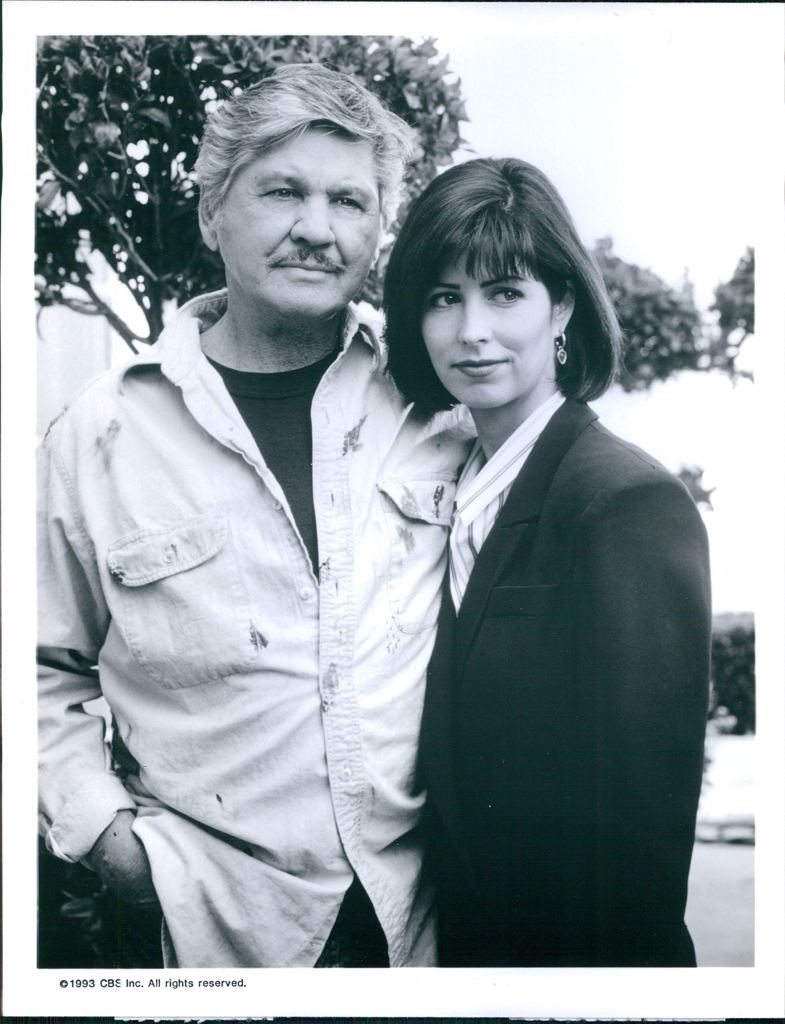
DONATO AND DAUGHTER tells the story of Los Angeles Police detectives, Mike Donato (Charles Bronson), and his daughter Dena Donato (Dana Delany). The two have a strained relationship mainly due to the mysterious death of Dena’s brother, Tommy, and Mike’s unwillingness to discuss the circumstances surrounding his death with her. When a serial killer (Xander Berkeley) begins targeting nuns, brutally raping and murdering them, Dena is asked to lead a task force to catch the killer. Her supervisor not-so-subtly requires that she include her father, a tough-as-nails and experienced cop, as part of the team. The remainder of the story focuses on two elements: 1) The investigation as it closes in on the extremely dangerous serial killer and 2) The family drama as Mike and Dena deal with their relationship issues. The two worlds eventually collide when the killer goes after Dena! 

While he did work on a couple of theatrical films in the 1990’s, like Sean Penn’s THE INDIAN RUNNER (1991) and DEATH WISH 5: THE FACE OF DEATH (1994), Charles Bronson spent most of the decade making made-for-TV movies. Of course, as his biggest fan, I would always watch the movies on the night they premiered on TV, with THE SEA WOLF (1993) being the only exception as we didn’t have cable TV in Toad Suck. That means on September 21st, 1993, I was glued to my television set as the latest Charles Bronson film, DONATO AND DAUGHTER, premiered to a national TV audience on CBS. I specifically remember the network running warnings due to the disturbing and violent content of the movie. I also remember enjoying that first viewing, and I still enjoy the film to this day. 

Even though he was in his early 70’s at the time, Charles Bronson still looked great in DONATO AND DAUGHTER. He gives a strong performance as both the cop trying to catch the killer and as the dad who doesn’t know how to open up to his successful, adult daughter who needs him more than he can comprehend. Dana Delany is an excellent actress, and she is able to balance her character’s determination to be the best cop possible to “show her dad,” with the vulnerability of a daughter who just needs to know he loves her. Their relationship has to work for the movie to work, and I think they both do a great job. The other standout performance in the film belongs to Xander Berkeley. His portrayal of a husband and businessman, who also happens to be a vicious serial killer, is truly creepy and gives the movie a disturbing edge. On a side note, Berkeley’s “wife” in the film is played by actress Kim Weeks. She and Charles Bronson would get married in 1998, and they would be together until his death in 2003.

Overall, I think DONATO AND DAUGHTER is well worth watching as both a cop thriller and a family drama, although I do think the thriller elements work the best. It’s not the most groundbreaking or original story you’ll ever see, but the film is elevated greatly by the iconic presence of Charles Bronson and the strong performances by Dana Delany and Xander Berkeley. I give it a solid recommendation! The trailer is included below:
Retro Television Review: St. Elsewhere 1.21 “Baron von Munchausen”


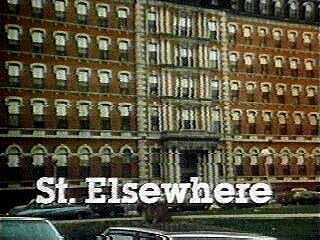
Welcome to Retro Television Reviews, a feature where we review some of our favorite and least favorite shows of the past! On Fridays, I will be reviewing St. Elsewhere, a medical show which ran on NBC from 1982 to 1988.  The show can be found on Hulu and, for purchase, on Prime!

This week’s episode is a much better Dr. Craig episode than last week’s.

Episode 1.21 “Baron von Munchausen”

(Dir by Victor Hsu, originally aired on April 19th, 1983)

Anthony Rizzo (Louis Giambalvo) seems like a nice guy.  He’s admitted to the hospital with complaints of stomach pain and a high fever.  Dr. Morrison can’t find anything wrong with him but he does notice that Rizzo has a lot of scars.  Rizzo explains that he’s had a lot of surgeries over the course of his life and he’s got a story to go with each one of them.  Morrison brings in Ehrlich for a consult.  Ehrlich, who loves to perform surgery, suggests opening Rizzo up and doing an exploratory.  Morrison thinks it’s too early for that,  Rizzo, however, loves the idea.  Rizzo then proceeds to die on the operating table.

Ehrlich is shaken.  Morrison is angry.  However, Westphall and Craig take one look at the case and deduce that Rizzo suffered from Munchausen’s Syndrome.  For whatever reason, he was addicted to going to the hospital and having surgery.  He knew all the tricks, from using a light blub to make it look like he had a fever to pricking his finger with a needle to convince the doctors that there was blood in his urine.  It turns out that he died because of the drugs that he had been taking to help him fake his symptoms.  Both Morrison and Ehrlich are relieved to learn that Rizzo’s death was not their fault.

“So, Ehrlich lost his first patient today,” Craig says to Westphall.  “It won’t be his last.”

This was a good episode for Dr. Craig, especially after all that nonsense last week.  When Westphall finds himself in need of a doctor to speak to a group of inner city medical students, he is horrified to discover that Mark Craig is the only one available.  Craig accepts, saying that Westphall should have asked him earlier.

Westphall’s concerns are justified.  Dr. Craig is opinionated, wealthy, and more than a little prejudiced against …. well, everyone.  “My ancestors came here on the Mayflower!” Craig is quick to say.  And yet, the students love him, specifically because he doesn’t pretend to be anything that he isn’t.  Unlike Westphall, who tries give an inspiring pep talk, Craig is open about the reality of practicing medicine in what this episode refers to as being “the ghetto.”  When asked if his medical student son will be working in a ghetto clinic, Craig replies, “Why would he?”  Craig gets a standing ovation from the students, which felt like a bit much but whatever.  It was nice, for once, to see the show admitting that Craig’s blunt honesty can sometimes be more effective than Westphall’s noncommittal style of encouragement.

Afterwards, in a wonderfully acted scene, Craig asked Westphall why people don’t seem to like him,  Westphall shrugs and then says that Craig can be arrogant, rude, prejudiced, intolerant of other worldviews …. “Thank you, Donald,” Craig cuts him off.

Meanwhile, back at the hospital, a crazy woman (Micole Mercurio) is sent to the psych ward after threatening to kill Nurse Daniels.  (No, leave Shirley alone!)  Dr. Wendy Armstrong, who is one of the worst characters on this show, promptly discharges the woman and lets her leave the hospital.  “She threatened to kill me!” Shirley says while Wendy shrugs, unconcerned.  Fiscus also proves to be of no help, as he is once again feeling attracted to Kathy Martin.

Finally, Dr. White goes to a drug addict support group and walks out when things get too emotional.  Booo!  Dr. White is even worse than Dr, Armstrong!

This was a good episode.  Next week, the season finale!

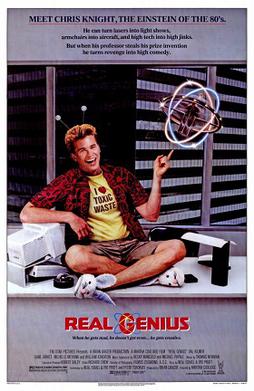
Real Genius (1985, directed by Martha Coolidge)


Mitch Taylor (Gabriel Jarrett) is a teenage genius who is recruited by Prof. Jerry Hathaway (William Atherton) to study at Pacific Tech University.  The real reason why Hathaway has recruited Mitch is because Chris Knight (Val Kilmer), another genius, has been slacking on developing the power source for an experimental laser called “crossbow.”  Hathaway hopes that Mitch can get Chris to take his work seriously and to focus on the project.  Instead, Chris teaches Mitch that he has to learn how to enjoy life or his great intelligence will become a burden and he’ll end up burned out and living in the tunnel underneath the university.  That’s what happened to Laszlo Holyfield (Jon Gries).  That’s what nearly happened to Chris.  Chris is determined not to let it happen to Mitch.

Real Genius combines college hijinks with a serious examination of the pressures of being a “real genius.”  Mitch knows everything about laser physics but he still misses his parents and cries after getting yelled at by Prof. Hathaway.  He’s just a kid, no matter how smart he is.  Chris proves himself to be a good friend, encouraging Mitch to relax and enjoy life.  Just because you’re a genius doesn’t mean that you can’t have fun.  As played by Val Kilmer, Chris Knight is the best friend that everyone wishes they could have, whether they’re a genius or not.  Even when the film gets sophomoric, Kilmer plays his role seriously and never loses sight of Chris’s humanity or why it’s so important to Chris that Mitch not become consumed by the pressure of being smarter than almost everyone else in the room.  This is one of the early Val Kilmer performances that showed just how good an actor he truly was.  With Chris’s encouragement, Mitch pursues a romance with Jordan Cochran (Michelle Meyrink) and gets revenge (more than once) on the arrogant Kent (Robert Prescott).

Eventually, Chris and Mitch realize that their research is being used to construct a weapon for the CIA and this leads to the film’s famous ending.  Ever since this movie came out, there’s been a debate over whether or not a laser could be used to make popcorn and, even more importantly, whether or not a gigantic amount of popcorn could actually destroy someone’s house.  I don’t know the answers to those questions but I’d like to think that Real Genius got it right and I have no interest in any evidence that suggests otherwise.  Sometimes, you owe it yourself to believe in the power of lasers and popcorn.  The next person who takes advantage of your hard work, destroy his house with popcorn and then sing Everybody Wants To Rule The World.  Learn the lessons of Real Genius.

Finally, when I was growing up, Real Genius was one of those films that seemed to be on HBO all the time.  Somehow, I always turned it on right when the popcorn started popping.  That popcorn-filled house, followed by Everybody Want To Rule The World, was a huge part of my childhood.  Real Genius will always bring back good memories for me.

Icarus File No. 11: The Bonfire of the Vanities (dir by Brian De Palma)


In 2021, I finally saw the infamous film, The Bonfire of the Vanities.

I saw it when it premiered on TCM.  Now, I have to say that there were quite a few TCM fans who were not happy about The Bonfire of the Vanities showing up on TCM, feeling that the film had no place on a station that was supposed to be devoted to classic films.  While it’s true that TCM has shown “bad” films before, they were usually films that, at the very least, had a cult reputation.  And it is also true that TCM has frequently shown films that originally failed with audiences or critics or both.  However, those films had almost all been subsequently rediscovered by new audiences and often reevaluated by new critics.  The Bonfire of the Vanities is not a cult film.  It’s not a film about which one can claim that it’s “so bad that it’s good.”  As for the film being reevaluated, I’ll just say that there is no one more willing than me to embrace a film that was rejected by mainstream critics.  But, as I watched The Bonfire of the Vanities, I saw that everything negative that I had previously read about the film was true.

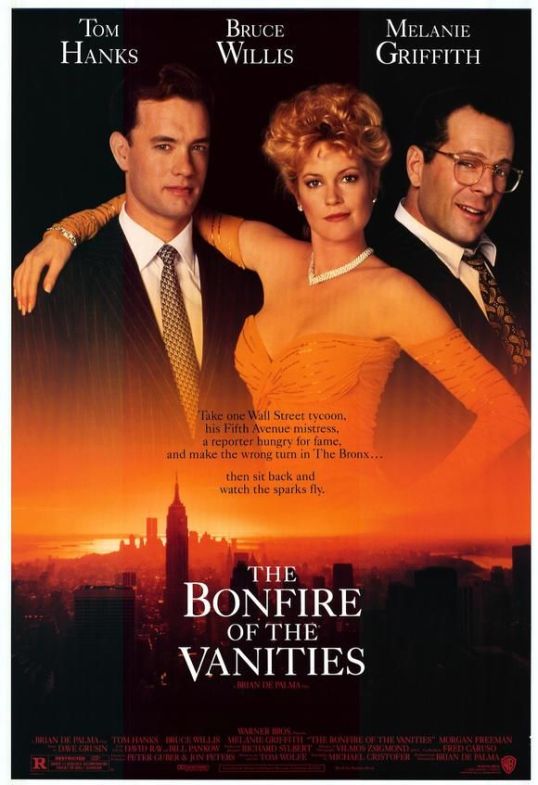
Released in 1990 and based on a novel by Tom Wolfe, Bonfire of the Vanities stars Tom Hanks as Sherman McCoy, a superficial Wall Street trader who has the perfect penthouse and a painfully thin, status-obsessed wife (Kim Cattrall).  Sherman also has a greedy mistress named Maria (Melanie Griffith).  It’s while driving with Maria that Sherman takes a wrong turn and ends up in the South Bronx.  When Sherman gets out of the car to move a tire that’s in the middle of the street, two black teenagers approach him.  Maria panics and, after Sherman jumps back in the car, she runs over one of the teens.  Maria talks Sherman into not calling the police.  The police, however, figure out that Sherman’s car was the one who ran over the teen.  Sherman is arrested and finds himself being prosecuted by a power-hungry district attorney (F. Murray Abraham).  The trial becomes the center of all of New York City’s racial and economic strife, with Sherman becoming “the great white defendant,” upon whom blame for all of New York’s problems can be placed.  Bruce Willis plays an alcoholic journalist who was British in the novel.  Morgan Freeman plays the judge, who was Jewish in the novel.  As well, in the novel, the judge was very much a New York character, profanely keeping order in the court and spitting at a criminal who spit at him first.  In the movie, the judge delivers a speech ordering everyone to “be decent to each other” like their mothers taught them to be.

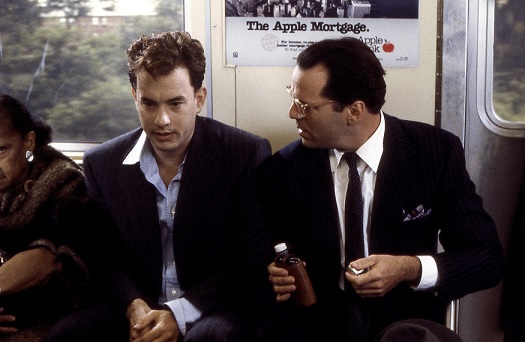
Having read Wolfe’s very novel before watching the film, I knew that there was no way that the adaptation would be able to remain a 100% faithful to Wolfe’s lacerating satire.  Because the main character of Wolfe’s book was New York City, he was free to make almost all of the human characters as unlikable as possible.  In the book, Peter Fallow is a perpetually soused opportunist who doesn’t worry about who he hurts with his inflammatory articles.  Sherman McCoy is a haughty and out-of-touch WASP who never loses his elitist attitude.   In the film, Bruce Willis smirks in his wiseguy manner and mocks the other reporters for being so eager to destroy Sherman.  Hanks, meanwhile, attempts to play Sherman as an everyman who just happens to live in a luxury penthouse and spend his days on Wall Street.  Hanks is so miscast and so clueless as how to play a character like this that Sherman actually comes across as if he’s suffering from some sort of brain damage.  He feels less like a stockbroker and more like Forrest Gump without the Southern accent.  There’s a scene, written specifically for the film, in which Fallow and Sherman ride the subway together and it literally feels like a parody of one of those sentimental buddy films where a cynic ends up having to take a road trip with someone who has been left innocent and naïve as result of spending the first half of their life locked in basement or a bomb shelter.  It’s one thing to present Sherman as being wealthy and uncomfortable among those who are poor.  It’s another thing to leave us wondering how he’s ever been able to successfully cross a street in New York City without getting run over by an angry cab driver.

Because the film can’t duplicate Wolfe’s unique prose, it instead resorts to mixing cartoonish comedy and overwrought melodrama.  It doesn’t add up too much.  At one point, Sherman ends a dinner party by firing a rifle in his apartment but, after it happens, the incident is never mentioned again.  I mean, surely someone else in the apartment would have called the cops about someone firing a rifle in the building.  Someone in the press would undoubtedly want to write a story about Sherman McCoy, the center of the city’s trial of the century, firing a rifle in his own apartment.  If the novel ended with Sherman resigned to the fact that his legal problems are never going to end, the film ends with Sherman getting revenge on everyone who has persecuted him and he does so with a smirk that does not at all feel earned.  After two hours of being an idiot, Sherman suddenly outthinks everyone else.  Why?  Because the film needed the happy ending that the book refused to offer up.

Of course, the film’s biggest sin is that it’s just boring.  It’s a dull film, full of good actors who don’t really seem to care about the dialogue that they are reciting.  Director Brian De Palma tries to give the film a certain visual flair, resorting to his usual collection of odd camera angles and split screens, none of which feel at all necessary to the story.  In the end, De Palma is not at all the right director for the material.  Perhaps Sidney Lumet could have done something with it, though he would have still had to deal with the less than impressive script.  De Palma’s over-the-top, set piece-obsessed sensibilities just add to the film’s cartoonish feel.

The film flopped at the box office.  De Palma’s career never recovered.  Tom Hanks’s career as a leading man was momentarily derailed.  Bruce Willis would have to wait a few more years to establish himself as a serious actor.  Even the normally magnanimous Morgan Freeman has openly talked about how much he hated being involved with The Bonfire of the Vanities.  That said, the film lives on because  De Palma allowed journalist Julie Salomon to hang out on the set and the book she wrote about the production, The Devil’s Candy, is a classic of Hollywood non-fiction.  (TCM adapted the book into a podcast, which is how The Bonfire of the Vanities came to be featured on the station.)  Thanks to Salomon’s book, The Bonfire of the Vanities has gone to become the epitome of a certain type of flop, the literary adaptation that is fatally compromised by executives who don’t read.

Previous Icarus Files:

  1. Cloud Atlas
  2. Maximum Overdrive
  3. Glass
  4. Captive State
  5. Mother!
  6. The Man Who Killed Don Quixote
  7. Last Days
  8. Plan 9 From Outer Space
  9. The Last Movie
  10. 88