Destiny Turns On The Radio (1995, directed by Jack Baran)


Today, it can be easy to forget what an impact Quentin Tarantino had on pop culture in the 90s.  The one-two punch of Reservoir Dogs and Pulp Fiction inspired a generation of young and aspiring filmmakers to believe that anyone could make their own film.  Suddenly, you didn’t have to be a film school graduate to call yourself a filmmaker.  You could just be someone who loved movies and who was willing to keep hustling until you had something you could slip into Sundance.  That was the feeling, anyway.  The 90s were full of films about eccentric criminals who talked a lot and who loved pop culture, only three of which were directed by Quentin Tarantino.  Some of them were good.  Most of them were not.

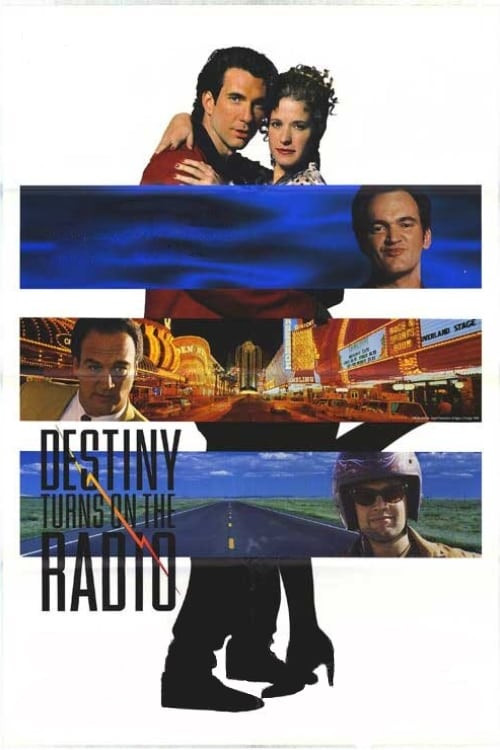
Destiny Turns On The Radio was one of the first films to rip-off Pulp Fiction and it felt more cynical than most because it was directed by Jack Baran, who wasn’t even a video store clerk.  He was a producer of films like The Big Easy and Barfly, an industry veteran ripping off two films directed by someone who was, at that time, still an outsider.  The film tells a story that had plenty of Tarantino elements, including Quentin Tarantino himself.  Tarantino signed to play Johnny Destiny right after Pulp Fiction won the Palme d’Or at Cannes.

Johnny Destiny is a gambler who is apparently also a God.  He emerges from a lightning-filled pool and his dialogue is full of pseudo-philosophy.  He is driving through the desert when he picks up Julian (Dylan McDermott) and gives Julian a lift to Las Vegas.  Johnny Destiny is taking prison escapee Julian on a ride so that Julian can face his destiny.  Julian wants to recover some money from a bank job that he pulled off with Thoreau (James Le Gros) but it turns out that, when Johnny Destiny emerged from that pool, he also stole all the money.  (There’s no specific reason for Thoreau to be named after the famous philosopher, beyond the film trying to make itself seem deep by drawing in everyone who read Walden in AP English.)  Julian wants to get back together with Lucille (Nancy Travis), a singer who performs songs more appropriate for a 20s speakeasy than a Las Vegas lounge.  Lucille is involved with a gangster (Jim Belushi).  Belushi sings Vivia Las Vegas but otherwise, this is one of his more boring performances.

Like so many of the Pulp Fiction rip-offs of the 90s, Destiny Turns On The Radio is all self-conscious attitude and cool style, full of references to pop culture that fall flat because there’s no real thought behind them.  Reservoir Dogs and Pulp Fiction were full of style but they also told compelling stories.  Destiny Turns On The Radio is all style and little else and the cast never comes together the way that the actors in Tarantino’s first two movies did.  Watching this film, I realized why Dylan McDermott and Nancy Travis both found more success on television than in feature films.  The film posits Tarantino (as Johnny Destiny) as the epitome of cool but it then burdens him with the type of dialogue that he would have cut by the time he started a second draft.

Coming hot on the heels of the success of Pulp Fiction, Destiny Turns On The Radio actually led to a few years where many critics assumed Tarantino would be a two-trick wonder.  It was thought lightning struck twice but it would never strike a third time and Tarantino would spend the rest of his career as almost a parody of his earlier success.  Luckily, Tarantino proved them wrong and Destiny Turned On The Radio turned out to be not his career’s destination but instead just a detour.

KISS Meets The Phantom Of The Park (1978, directed by Gordon Hessler)


In 1978, KISS appeared to have it all.  The band was famous for both their makeup and their anthemic stadium rock.  They had just released not only a new studio album but also four solo albums.  They had starred in their own Marvel comic and gained notoriety for supposedly allowing their blood to mixed in with the comic’s ink.  Teenagers loved KISS and parents and religious leaders feared that the band’s name stood for Knights In Satan’s Service.  KISS had everything except for motion picture stardom.

KISS Meets The Phantom Of The Park was supposed to change that.  The film starred Anthony Zerbe as Abner Devereaux, an engineer and an expert at animatronics who loses his job at Magic Mountain and seeks revenge by using robot versions of KISS to drive the audience of their concert to riot.  Fortunately, the real members of KISS are not just rock stars but also alien beings who descend from the heavens and shoot lightning bolts from their eyes.  (Gene Simmons can breathe fire.)  The real KISS isn’t going to allow their fan to be manipulated by a robot version of the band, which leads to a battle between KISS and the robots that protect Abner’s underground lair.

KISS Meets The Phantom of the Park aired on NBC on October 28th, 1978.  It was later given a theatrical release in Europe, where it was re-edited and retitled Attack of the Phantom.  Since then, it has become a very difficult film to see.  (On Amazon, old VHS copies go for several hundred dollars.)  One reason why the movie is so hard to see is because the members of the KISS hated the movie and felt that they were portrayed as being clowns instead of super heroes.  Even though the members of the band have since mellowed out about the film (with Gene Simmons suggesting it should be viewed on a double bill with Plan 9 From Outer Space), KISS Meets The Phantom Of The Park is still a film that is more talked about than actually watched.

While looking for clips of the movie on YouTube, I came across an upload of the entire film.  The only problem was that all of the dialogue was dubbed into German and that’s not a language that I speak.  Still, figuring that you have to take your opportunities when they’re available, I decided to watch.  I figured that the dialogue might not actually be that important and it wasn’t.  I was able to follow the plot just fine.  (The only weird thing about watching the move in German was listening to the members of the band speak in something other than a New York accent.)  Fortunately, there’s actually more singing than talking in Kiss Meets The Phantom Of The Park and the songs are untouched and in English.  KISS plays Magic Mountain in the film and they actually performed a real concert for filming.  Those are real fans of the band going crazy whenever Gene Simmons sticks out his tongue.

The movie itself is definitely a product of its time and not meant to be taken seriously.  The members of KISS are both aliens that descend from the heavens and rock musicians and they are never seen without their makeup.  Even when they’re hanging out at a hotel pool, they are in full costume and they’re wearing their makeup. When the members of the band enter the Phantom’s underground lab, they have to fight a series of very 70s robots, including some that know karate and two who have lightsabers.  For better or worse, it’s a very silly move that epitomizes an era.  The special effects are cheesy, the members of the band often look straight at the camera, and the rest of the cast does what they can with what they’ve been given.  Anthony Zerbe plays the Phantom with a hint of empathy while Deborah Ryan is the ingenue who searched for her missing boyfriend while Beth plays on the soundtrack.  Keep an eye out for Brion James, playing a security guard.

Overall, the band probably would have been smarter to just release a concert film but then the rest of us wouldn’t have the fun of watching Paul Stanley face off against a robot version of Bruce Lee.  KISS Meets The Phantom of The Park is worth watching at least once, even in German!

(Not Quite A) Mardi Gras Film Review: The Big Easy (dir by Jim McBride)


One of the more surprising things about the 1987 film, The Big Easy, is that there aren’t any big Mardi Gras scenes.

Don’t get me wrong.  Several characters in the film mention Mardi Gras, usually in a semi-mocking way.  And there is a scene in a warehouse where Ellen Barkin and Ned Beatty walk past some fearsome looking floats which Beatty says are being stored there until Mardi Gras.  But that’s pretty much it.

Despite not having any huge Mardi Gras scenes, The Big Easy is essentially a cinematic love letter to New Orleans.  (In fact, one could probably argue that the film is so in love with New Orleans that, by not including any big Mardi Gras scenes, the film is saying, “There’s more to this wonderful city than just beads, boobs, and people throwing up i the streets!”)  While the film does have a plot — technically, it’s both a romantic comedy and a crime drama — the plot is ultimately less important than the city where it takes place.  The Big Easy was shot on location in New Orleans and the camera loves every single street, building, and bridge to be found in the Crescent City.  The Big Easy loves the distinctive music and dialect of New Orleans.  Even more importantly, The Big Easy loves the attitude of New Orleans.  This is perhaps one of the most laid back and nonjudgmental crime films to have ever been made.

Dennis Quaid plays Remy McSwain, a Cajun police detective with a nonstop grin and a cheerfully corrupt nature.  Today, we tend to associate Dennis Quaid with playing grim-faced authority figures and serving as the commercial spokesman for Esurance so it’s interesting to see him here, playing a lovable, charismatic, and undeniably sexy rogue.  Remy may be corrupt but he doesn’t mean any harm.  For the most part, he just takes the occasional bribe and sometimes looks the other way when it comes to certain crimes.  He used at least some of the money to put his younger brother through college so really, how can you hold his lack of ethics against him?

Ellen Barkin plays Anne Osborne, a state district attorney who has been sent to New Orleans to investigate allegations of police corruption.  Anne is serious about doing her job and exposing corruption.  At the same time, she also finds herself falling for Remy, even when she has to prosecute him on charges of taking bribes.  It doesn’t take them long to become lovers.

Together, they have great sex and solve crimes!

Actually, in this case, they really do.  The film opens with the murder of a local mafia boss.  (“We call them wise guys,” Remy says, at one point.)  When more drug dealers start to turn up dead, Remy’s boss, Captain Kellom (Ned Beatty), suspects that a gang war has broken out.  (Two of the drug dealers are found with their hearts missing from their bodies, which leads to a lot of talk about how one of the city’s biggest drug kingpins is into voodoo.  It’s not a New Orleans films without a little voodoo.)  Remy, however, has reason to believe that the murderers could be cops!

As I said before, the film’s plot is less important than the city where it takes place and the people who live in that city.  Director Jim McBride and screenwriter Daniel Petrie, Jr. do a good enough job with the crime plot but it’s obvious that they’re most interested in taking Remy and Anne and surrounding them with a host of eccentric, identifiable New Orleans characters.  As a result, the film is full of memorable performances from character performers like Ned Beatty, John Goodman, Lisa Jane Persky, and Grace Zabriskie.  Even Jim Garrison, the former New Orleans district attorney whose attempt to frame an innocent man for the murder of John F. Kennedy inspired Oliver Stone’s JFK, makes an appearance as himself.

Even without any big Mardi Gras scenes, The Big Easy is an entertainingly laid back tribute to New Orleans.

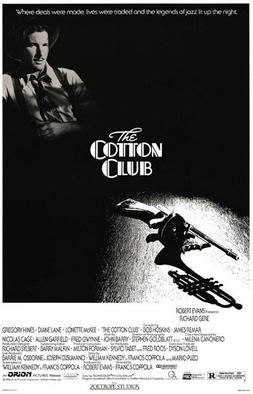
A Movie A Day #264: The Cotton Club (1984, directed by Francis Ford Coppola)


The time is the 1930s and the place is New York City.  Everyone wants to get into the Cotton Club.  Owned by British gangster Owney Madden (Bob Hoskins), the Cotton Club is a place where the stage is exclusively reserved for black performers and the audience is exclusively rich and white.  Everyone from gangsters to film stars comes to the Cotton Club.
It is at the Cotton Club that Dixie Dwyer (Richard Gere) meets everyone from Dutch Shultz (James Remar) to Gloria Swanson (Diane Venora).  Shultz hires Dixie to look after his girlfriend, Vera (Diane Lane).  Swanson arranges for Dixie to become a movie star.  Meanwhile, Dixie’s crazy brother, Vincent (Nicolas Cage), rises up through the New York underworld.  Meanwhile, dancing brothers Sandman and Clay Williams (played by real-life brothers Gregory and Maurice Hines) are stars on stage but face discrimination off, at least until Harlem gangster Bumpy Rhodes (Laurence Fishburne) comes to their aid.

The Cotton Club was a dream project of the legendary producer, Robert Evans, who was looking to make a comeback after being famously charged with cocaine trafficking in 1980.  Having commissioned a screenplay by his former Godfather collaborators, Mario Puzo and Francis Ford Coppola, Evans originally planned to direct the film himself.  At the last minute, Evans changes his mind and asked Coppola to direct the film.  After working with him on The Godfather, Coppola had sworn that he would never work with Evans again. (When he won an Oscar for The Godfather‘s screenplay, Coppola pointedly thanked everyone but Robert Evans.)  However, by 1984, a series of box office flops had damaged Coppola’s standing in Hollywood.  Needing the money, Coppola agreed to direct The Cotton Club.

Evans raised the film’s $58 million budget from a number of investors, including Roy Radin.  Roy Radin was best known for putting together Vaudeville reunions in the 70s and being accused of raping an actress in 1980.  Radin and Evans were introduced to each other by a drug dealer named Lanie Jacobs, who was hoping to remake herself as a film producer.  During the production of The Cotton Club, Radin was murdered by a contract killer who was hired by Jacobs, who apparently felt that Radin was trying to muscle her out of the film production.

While all of this was going on, Coppola fell into his familiar pattern of going overbudget and falling behind schedule.  This led to another investor filing a lawsuit against Orion Pictures and two other investors, claiming fraud and breach of contract.  When the film was finally released, it received mixed reviews, struggled at the box office, and only received two Oscar nominations.

With all of the murder and drama that was occurring offscreen, it is not surprising that the film itself was overshadowed.  The Cotton Club is a disjointed mix of gangster drama and big production numbers.  As always with post-Apocalypse Now Coppola, there are flashes of brilliance in The Cotton Club.  Some of the production numbers are impressive and visually, this movie has got style to burn.   However, among the leads, neither Richard Gere nor Diane Lane seem to be invested in their characters while the talented Hines brothers are underused.  The supporting cast is full of good character actors who are all in a search of a better script.  A few do manage to make an impression: James Remar, Bob Hoskins and Fred Gwynne as veteran gangsters, Nicolas Cage as the film’s stand-in for Mad Dog Coll, and Joe Dallesandro as Lucky Luciano.  The Cotton Club is sometimes boring and sometimes exciting but the onscreen story is never as interesting as what happened behind the scenes.


A Movie A Day #173: Great Balls of Fire! (1989, directed by Jim McBride)


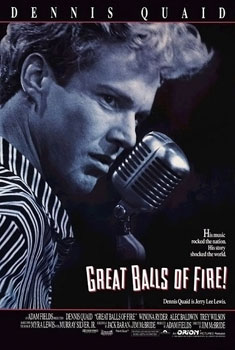
In the 1950s, Jerry Lee Lewis (Dennis Quaid) plays what his cousin, Jimmy Swaggart (Alec Baldwin), calls the devil’s music.  After signing a contract with Sam Phillips (Trey Wilson), Jerry becomes a star with his wild man persona and crazed piano playing.  When Elvis is drafted, it appears that Jerry is destined to take over as the new King of Rock and Roll.  But, then, while touring England, the press discovers that Jerry is married to his 13 year-old cousin, Myra (Winona Ryder).  When Jerry refuses to apologize for his private life, his career falls apart.
The real Jerry Lew Lewis has stated many times that he hates this musical biopic and that it has very little in common with his actual life.  Jerry has a point.  Great Balls of Fire is a highly stylized film, one that greatly sanitizes both the life of Jerry Lee Lewis and the early days of rock and roll.  In the film, there’s no struggle or even hard work on the road to becoming a star.  Jerry just drops off a recording of himself playing piano and viola! He’s a star!  Soon, teenagers are dancing around his convertible, both civil rights protestors and white Southern cops start dancing whenever they see him driving down the street, the local radio DJ waves whenever he sees them, and Jerry’s sneaking into Mississippi so that he can marry his thirteen year-old cousin.

Great Balls of Fire! takes a superficially mater of fact approach to Jerry’s marriage to Myra, neither condemning nor excusing, though it does cheat by casting the 18 year-old Winona Ryder as the 13 year-old Myra.  (If the film had cast an actress who was closer to Myra’s actual age, Great Balls of Fire! would never have been released.)  Fortunately, history helped the movie out by making Jimmy Swaggart into Jerry’s main critic.  Alec Baldwin’s performance as Jimmy Swaggart makes his interpretation of Donald Trump look subtle, nuanced, and award-worthy.

Dennis Quaid, at the height of his 80s stardom, is ideally cast as Jerry Lee Lewis, giving a good if broad performance and doing a convincing job lip-syncing to the music.  Quaid has said that he was struggling with an addiction to cocaine while filming Great Balls of Fire! and that might have made him the perfect actor to play the always conflicted and always wild Jerry Lee Lewis.  The best thing about the film is that Jerry Lee Lewis provided the music, re-recording his best known songs.  While the movie may not tell the true story of Jerry Lee Lewis, it does feature enough of his music that it is obvious why Jerry Lee Lewis nearly became the king of rock and roll.


Film Review: American Pop (1981, directed by Ralph Bakshi)


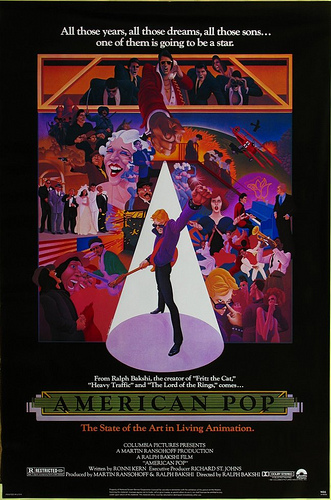
American PopLong before South Park, The Simpsons, and Pixar, there was Ralph Bakshi.  At a time when animation was considered to only be good for children, Bakshi shocked audiences and critics with animated films that dealt with mature themes and were definitely meant for adults.  His first two films, Fritz the Cat (1972) and Heavy Traffic (1973), was the also the first two animated films to receive an X-rating.  Bakshi satirized racism in the controversial Coonskin (1975) and Bakshi’s adaptation of The Lord Of Rings (1978) beat Peter Jackson’s by 23 years.  It was after the critical and commercial disappointment of the heavily flawed but interesting Lord of the Rings that Bakshi decided it was time to make a film that would be more personal to him.  The end result was American Pop.

American Pop tells the story of four generations of a family of Jewish immigrants and how music affects their lives.  In typical Bakshi fasion, this animated film deals with issues of violence, sexuality, drug abuse, and poverty.  American Pop may be animated but it is definitely a film meant for adults.

In the 1890s, Zalmie (Jeffrey Lippa) and his mother escape from Russia after Zalmie’s father, a rabbi, is killed by the Cossacks.  Zalmie grows up in New York and after his mother is killed in the Triangle Shirtwaist Factory fire, he is raised by a vaudeville comedian named Louie (Jerry Holland).  Zalmie wants to be a singer but is shot in the throat during World War I.  His voice ruined, Zalmie marries a stripper named Bella (Lisa Jane Persky) and manages her career.  His partnership with the mobster Nicky Palumbo (Ben Frommer) leads to Bella dying and Zalmie going to prison.

Zalmie’s son, Benny (Richard Singer), is a jazz pianist who, as a favor to his father, marries Nicky’s daughter.  Benny has a son named Tony and tries to pursue his career without using his father’s influence.  Then World War II breaks out.

Benny enlists in the army, seeking redemption from the crimes of his father and father-in-law.  Serving in Europe, he misses his piano and, when he finds one in a bombed-out house in Nazi Germany, he plays a few bars of As Time Goes By.  When a Nazi walks in on Benny, Benny plays Lili Marleen.  For a few seconds, Benny and the Nazi share the common bond of music.  “Danke,” the Nazi says before shooting Benny dead.

Growing up without his father, Tony (Ron Thompson) becomes a beatnik and eventually runs away from home.  He ends up in Kansas, where he has a one-night stand with a waitress and becomes a songwriter for Frankie Hart (Marya Small), a stand in for Janis Joplin.  Both Tony and Frankie start using heroin and Frankie dies of an overdose right before she is supposed to open for Jimi Hendrix.  Abandoned by Frankie’s band, Tony ends up as an addict and dealer in New York.  Accompanying him is his son, Pete, the result of his hookup with the waitress.

After being abandoned by his father, Pete (also played by Ron Thompson), follows in his footsteps and becomes a successful drug dealer.  He is dealing cocaine to all of the big rock bands but, after discovering punk rock, he realizes that he wants something more out of his life.

After announcing that he will no longer sell anyone cocaine unless he is given a chance to record a demo, Pete is given a band and a recording studio.  With the drug-craving record company execs watching, this tough and cocky punk grabs the microphone and sings…

…BOB SEGER’S NIGHT MOVES!?

The use of Night Moves, which is one of the least punk songs ever written, is one of the few false notes in American Pop.  Otherwise, this is one of Ralph Bakshi’s best films.  The majority of the film’s animation was done through rotoscoping, a technique in which animation is traced over live action footage.  (For the gang war scenes, scenes from The Public Enemy were rotoscoped, as was footage of the Nicholas Brothers used in the Sing Sing Sing With A Swing montage.)  Seen today, the technique is crude but effective at showing the contrast between the fantasy of music and the grim reality of life.  Though it has its flaws (*cough* Night Moves *cough*), American Pop is an engaging look at the history and development of American music.

American_Pop