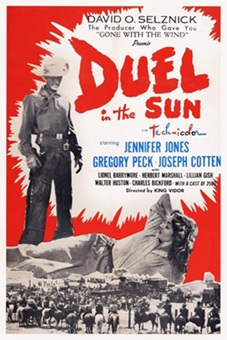
Duel In The Sun (1946, directed by King Vidor)


After her father is executed for killing her mother and her mother’s lover, “half-breed” Pearl Chavez (Jennifer Jones) is sent to live with her father’s second cousin, Laura Beth McCanles (Lillian Gish).  Laura is the wife of rancher, politician, and all-around racist Senator Jackson McCanles (Lionel Barrymore).  Worried that Pearl’s beauty and uninhibited manner will get her into trouble, Laura arranges for Pearl to meet with a minister known as The Sinkller (Walter Huston) who instructs Pearl on how to be a “good” girl.

Wanting to make Pearl bad and his, Lewton “Lewt” McCanles (Gregory Peck) becomes obsessed with Pearl and is soon forcing himself on her on a regular basis.  When the good McCanles brother, Jesse (Joseph Cotten), leaves the ranch despite being in love with Pearl, Pearl tries to find a good husband in the form of Sam Pierce (Charles Bickford).  Lewt responds by gunning Sam down and then goes on the run.  It all leads to an overwrought duel in the sun as the two doomed lovers take aim at each other.

Duel In The Sun is credited to veteran director King Vidor and there are a few shots of the western landscape that do feel typical of Vidor’s work.  However, Duel In The Sun’s true auteur was its producer, David O. Selznick.  Still looking to recapture his earlier success with Gone With The Wind and eager to make his future wife, Jennifer Jones, into an even bigger star than she was, Selznick obsessed over every detail of Duel In The Sun, pushing Vidor and a host of other directors (including Josef von Sternberg, William Dieterle, William Cameron Menzies, Otto Brower, and Sidney Franklin)  to make the film more steamy, more melodramatic, more violent, and more visually epic.  Reportedly, while Video was trying to shoot the film’s titular duel, he had to call cut several times when Selznick ran into the scene with a water bottle to spray more “sweat” onto Jones and Peck.  Today, the stiff Peck seems miscast as the black sheep of the family, the reserved Jones is even more miscast as a mestiza, and the plot is clearly too simplistic to carry the film’s epic ambitions.  A few impressive shots aside, Duel In The Sun is just boring,  In the 40s, though, the film’s relative openness about sex generated enough controversy to make Duel In The Sun into a box office hit.  It was one of the two top-grossing westerns of the 40s, beating out Red River, My Darling Clementine, Fort Apache, The Ox-Bow Incident, and several other films that were actually good.

Unlike Jones, Peck, and even usually reliable stalwart like Lionel Barrymore and Walter Huston, Joseph Cotten at least emerges from this film with his dignity intact.  Playing the good brother, Cotten gets to underplay while everyone else is overplaying and it turns out to be the right approach for him.  Surviving Duel In The Sun was no easy feat but Cotten pulled it off.
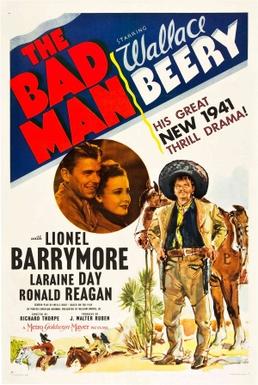
The Bad Man (1941, directed by Richard Thorpe)


Gil Jones (Ronald Reagan) lives on a ranch with his cantankerous uncle, Henry (Lionel Barrymore).  After their cattle are stolen by the notorious bandit Pancho Lopez (Wallace Beery), Gil and Henry are faced with the prospect of losing their ranch.  Banker Jasper Hardy (Henry Travers) wants to foreclose on Henry and take over the ranch but a businessman named Morgan Pell (Tom Conway) shows up and offers to pay the then-huge sum of $20,000 for the land.  Accompanying Morgan is his wife, Lucia (Laraine Day).  Lucia was Gil’s childhood love and Morgan fears that Lucia still loves Gil more than him.  Also in the mix is Gil’s comic relief best friend (Chill Wills), who has a crush on Hardy’s daughter (Nydia Westman).  Negotiations are interrupted when the flamboyant Lopez and his men return to the ranch and take everyone, but Gil, hostage.

This sepia-toned film is based on a stage play, one that had already been filmed twice.  It was Ronald Reagan’s first film for MGM and, when Reagan was running for President, he quipped that if he could survive acting opposite Wallace Beery and Lionel Barrymore than he could survive negotiating with Leonid Brezhnev.  The role of Gil is a typical Ronald Reagan role.  He’s good-natured and dependable and a little boring.  Because he once saved Lopez’s life, Lopez is willing to help him out with his problems.  Reagan is not bad in the role but he is overshadowed by Barrymore and Beery, two veteran actors who chew the scenery with gusto here.  Berry speaks in an exaggerated and not at all convincing Mexican accent while Barrymore bellows all of his lines.  Gil has so many different people yelling at him that it’s impossible not to feel sorry for him.  Morgan has ulterior motives for offering to buy the land and Tom Conway is a convincing villain.  Lopez helps out Gil and her uncle, saving not only their land but also plotting to bring Gil and Lucia back together.  It’s a stage bound mix of drama and comedy that doesn’t really work, though Beery and Barrymore are amusing and Ronald Reagan shows why he was cast in so many best friend roles.

Whether you’ll enjoy it will probably depend on how you feel about the cast because they’re really the only reason to watch.  If you’re a fan of Barrymore, Beery, or Reagan the film might work for you.  If you’re not, this stagey 70-minute western is probably not for you.

From 1939, it’s Lionel Barrymore and Orson Welles in A Christmas Carol!


This radio production of A Christmas Carol was originally broadcast on Christmas Eve, 1939.  It’s not really Christmas unless you experience at least one version of Charles Dickens’s classic holiday tale and this version features not only Orson Welles providing the narration but Lionel Barrymore playing the role of Scrooge!

Other members of the cast included such well-known Welles’s associates as  Everett Sloane (Marley’s ghost), Frank Readick (Bob Cratchit), Erskine Sanford (Fezziwig) and George Coulouris (Ghost of Christmas Present).  Two years after this broadcast, Welles, Sloane, Sanford, and Coulouris would all appear in Citizen Kane.

For your listening pleasure, we offer up this journey to the past….

10 Oscar Snubs From the 1940s


Ah, the 40s! For most of the decade, the world was at war and the Academy’s nominations reflected that fact. The best picture lineups alternated between patriotic films that encouraged the battle against evil and darker films that contemplated both the mistakes of the past and what threats might be waiting in the future.  With the Academy being even more aware than usual that films and awards could be used to send a message, the snubs continued.

1940: John Carradine Is Not Nominated For The Grapes of Wrath

John Carradine’s first credited film appearance was in 1930 but Carradine himself claimed that he had appeared as an uncredited extra in over 70 films before getting that first credit.  Carradine would continue to work until his death 58 years later.  John Carradine did so many films that he was still appearing in new releases in the 90s, years after his death.  He appeared in over 234 films and in countless television shows.  He was a favorite of not only Fred Olen Ray’s but also John Ford’s.

Unfortunately, Carradine was never nominated for an Oscar, despite the fact that he did appear in some classic films.  (He also appeared in a lot of B-movies, which is perhaps one reason why the Academy was hesitant to honor him.)  Personally, I think Carradine most deserved a nomination for playing “Pastor” Jim Casy in John Ford’s The Grapes of Wrath.  Carradine is ideally cast as the former preacher turned labor activist.  When he’s alive, he gives the Joads hope.  When he dies, both the Joads and the audience start to realize how difficult things are truly going to be.

1942: Ronald Reagan Is Not Nominated For Best Supporting Actor For Kings Row

Kings Row is an enjoyably over-the-top small town melodrama and future President Ronald Reagan is fantastic in the film, with his natural optimism providing a nice contrast to the truly terrible things that happen to him and his loved ones over the course of the film.  Reagan was not nominated for this performance, the one that both he and the most of the critics agreed was his best, but he should have been.

1943: Hangmen Also Die Is Not Nominated For Best Picture

Fritz Lang’s anti-Nazi classic was not nominated for Best Picture and only received two nominations (for Sound and Score).  That year, the Best Picture winner was another anti-Nazi classic, Casablanca.

1943: Shadow Of A Doubt Is Ignored

Today, it is recognized as one of Hitchcock’s best but, in 1943, Shadow of a Doubt couldn’t even score a nomination for Joseph Cotten’s wonderfully diabolical turn as Uncle Charlie.  One gets the feeling that the film’s satirical jibes at small town America and its theme of evil hiding behind a normal façade were not what the Academy was looking for at the height of World War II.  It’s a shame because, in many ways, Cotten’s Uncle Charlie was the perfect symbol of the enemy that the Allies were fighting.

1944: Tallulah Bankhead In Not Nominated For Best Actress For Lifeboat

Unlike Shadow of a Doubt, Hitchcock’s Lifeboat received several Oscar nominations.  However, Tallulah Bankhead was not nominated for Best Actress.  Perhaps the Academy was scared of what she might say if she won.

1944: Fred MacMurray and Edward G. Robinson Are Not Nominated For Double Indemnity

For all the nominations that this classic noir received, somehow neither Fred MacMurray nor Edward G. Robinson were nominated for their roles.  Both actors are brilliantly cast against type in this film.  MacMurray uses his trademark casual glibness to portray Walter Neff as being an arrogant man who is hardly as clever as he thinks that he is.  Meanwhile, Robinson’s more introspective performance leaves you with little doubt that, if anyone can solve this case, it’s him.  While Barbara Stanwyck was (rightfully) nominated, it’s had to believe that both MacMurray and Robinson were snubbed.

1946: Thomas Mitchell and Lionel Barrymore Are Not Nominated For Best Supporting Actor For It’s A Wonderful Life

As wonderful as James Stewart and Donna Reed are, it just wouldn’t be Bedford Falls without Uncle Billy and Mr. Potter!  Thomas Mitchell breaks your heart in the scene where he tries to remember what he did with the lost money.  And, for audiences who had just lived through the Great Depression, Lionel Barrymore represented every businessman who cared more about money than people.  It’s impossible to imagine the film without them …. or without Henry Travers, for that matter!  Seriously, very few films have received three best supporting actor nominations but It’s A Wonderful Life deserved to be one of them.

1948: Humphrey Bogart Is Not Nominated For Best Actor For The Treasure of the Sierra Madre

The Treasure of the Sierra Madre received four Oscar nominations.  Somehow, not one of those nominations was not for Humphrey Bogart.

1948 and 1949: Red River, Fort Apache, and She Wore A Yellow Ribbon Are Not Nominated For Best Picture

The public may have loved Westerns but the Academy largely shied away from them, with a few notable exceptions.  Howard Hawks’s Red River and John Ford’s Fort Apache and She Wore A Yellow Ribbon are today all recognized as being classic Hollywood films.  However, the Academy, then at the height of its bias towards “genre” films, didn’t honor any of them.

1949: James Cagney Is Not Nominated For Best Actor For White Heat

“Top of the world, ma!”  Maybe so, but not top of the Oscars.  The Academy was always more interested in honoring Cagney for being a song-and-dance man than for honoring him for his iconic gangster roles.

Agree?  Disagree?  Do you have an Oscar snub that you think is even worse than the 10 listed here?  Let us know in the comments!

Up next: Get ready to hate the commies and to love Ike because the 50s are coming!

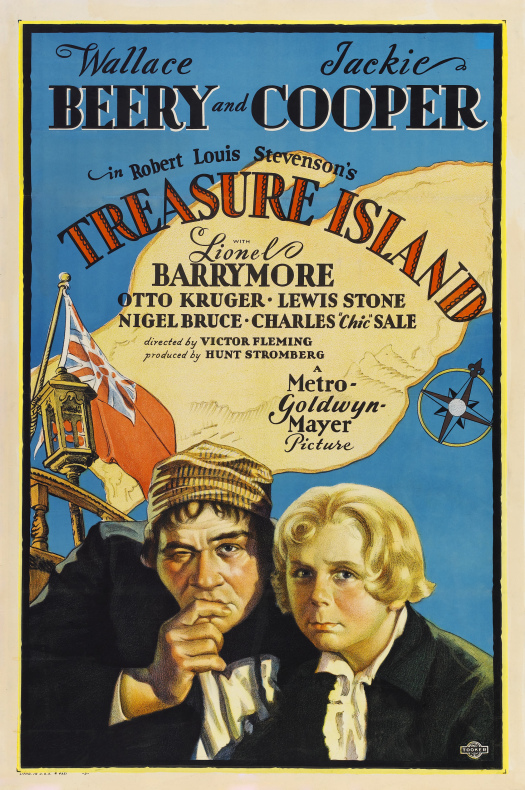
Yo-Ho-Hollywood!: TREASURE ISLAND (MGM 1934)


gary loggins's avatarcracked rear viewer

Robert Louis Stevenson’s  venerable 1883 adventure novel TREASURE ISLAND has been filmed over 50 times throughout the years, beginning with a 1918 silent version. There was a 1920 silent starring Charles Ogle (the original screen FRANKENSTEIN monster!) as that dastardly pirate Long John Silver, a 1972 adaptation with Orson Welles, a 1990 TV Movie headlined by Charlton Heston, and even a 1996 Muppet version! Most movie buffs cite Disney’s 1950 film as the definitive screen TREASURE ISLAND, with Bobby Driscoll as young Jim Hawkins and Robert Newton as Long John (and Newton would go on to star in the TV series LONG JOHN SILVER, practically making a career out of playing the infamous fictional buccaneer), but…

…a case can certainly be made for MGM’s star-studded 1934 interpretation of the story, teaming Wallace Beery and Jackie Cooper as Long John and Jim. This was the first talking TREASURE ISLAND, and the…

View original post 572 more words

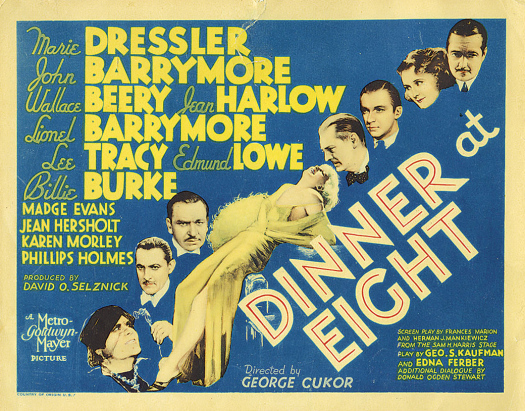
Pre Code Confidential #25: The Stars Are Out for a Delicious DINNER AT EIGHT (MGM 1933)


gary loggins's avatarcracked rear viewer

After the success of 1932’s all-star GRAND HOTEL, MGM studio boss Louis B. Mayer kept his sharp eyes peeled for a follow-up vehicle. The answer came with DINNER AT EIGHT, based on the witty Broadway smash written by George S. Kaufman and Edna Ferber. Mayer assigned his newest producer (and son-in-law) David O. Selznick, fresh from making hits at RKO, who in turn handed the director’s reigns to another MGM newcomer, George Cukor. Both would have long, prosperous careers there and elsewhere. Frances Marion and Herman Mankiewicz adapted the play to the screen for the studio with “more stars than there are in heaven”, and those stars truly shine in this film (in the interest of fairness, the stars will be presented to you alphabetically):

John Barrymoreas Larry Renault 

The Great Profile plays aging, alcoholic former silent star Larry Renault in a role that surely hit close to home. 

View original post 929 more words

Holidays Scenes That I Love: From It’s A Wonderful Life, George Bailey Wishes Bedford Falls A Merry Christmas


I love the pure joy of this scene.  Not even old Mr. Potter can bring George down.

Of course, for that matter, George can’t bring Mr. Potter down either.  It’s a Merry Christmas all around!

(Be sure to check out Case’s alternative reading about life under Mr. Potter, It’s A Wonderful, Pottersville!)

From 1939, it’s Lionel Barrymore and Orson Welles in A Christmas Carol!


This radio production of A Christmas Carol was originally broadcast on Christmas Eve, 1939.  It’s not really Christmas unless you experience at least one version of Charles Dickens’s classic holiday tale and this version features not only Orson Welles providing the narration but Lionel Barrymore playing the role of Scrooge!

Other members of the cast included such well-known Welles’s associates as  Everett Sloane (Marley’s ghost), Frank Readick (Bob Cratchit), Erskine Sanford (Fezziwig) and George Coulouris (Ghost of Christmas Present).  Two years after this broadcast, Welles, Sloane, Sanford, and Coulouris would all appear in Citizen Kane.

For your listening pleasure, we offer up this journey to the past….

Bats in the Belfry: MARK OF THE VAMPIRE (MGM 1935)


gary loggins's avatarcracked rear viewer

Tod Browning’s 1931 DRACULA is a masterpiece of terror, the film that launched the Golden Age of Horror and made Bela Lugosi a star. Four years later, Bela and Browning teamed again for MARK OF THE VAMPIRE, loaded with horrific atmosphere but staked through the heart by two fatal blows – too much comic relief and an ending that’s a trick, rather than a treat, for horror buffs.

Lugosi and his “daughter”, Carroll Borland

The shadow of vampirism is terrorizing a small European village, as Sir Karel Borotyn is found murdered, drained of his blood! Inspector Neumann investigates, not believing in such supernatural hokum and suspecting everyone. Lovely young Irena Borotyn, engaged to handsome young Fedor, stands to inherit her father’s estate, with family friend Baron Otto serving as her guardian. When a peasant is found also drained of blood, the villagers suspect the evil Count Mora and his daughter…

View original post 485 more words

Moanin’ Low: On Claire Trevor and KEY LARGO (Warner Brothers 1948)


gary loggins's avatarcracked rear viewer

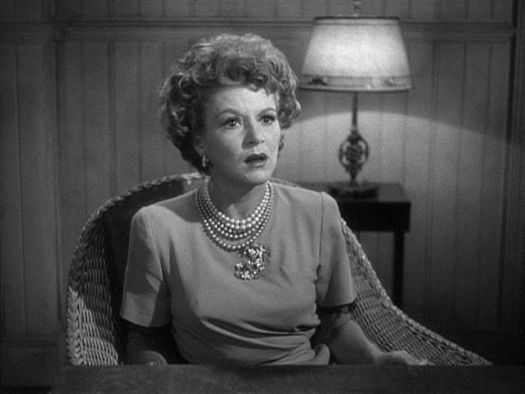
John Huston’s filmnoir KEY LARGO is a personal favorite, and a bona fide classic in its own right that works on many different levels. Much of its success can be credited to the brilliant, Oscar-winning performance of Claire Trevor as Gaye Dawn, the alcoholic ex-nightclub singer and moll of gangster Johnny Rocco (played with equal brilliance by Edward G. Robinson ). The woman dubbed by many “Queen of Noir” gives the part a heartbreaking quality that makes her stand out among the likes of scene stealers Robinson, Humphrey Bogart , Lauren Bacall , and Lionel Barrymore .

Claire Trevor (1910-2000) arrived in Hollywood in 1933, and almost immediately became a star. Her early credits include playing Shirley Temple’s mom in BABY TAKE A BOW (1934), the title role in the Pre-Code drama ELINOR NORTON (also ’34), Spencer Tracy’s wife in the bizarre DANTE’S INFERNO (1935), and the reporter out…

View original post 685 more words