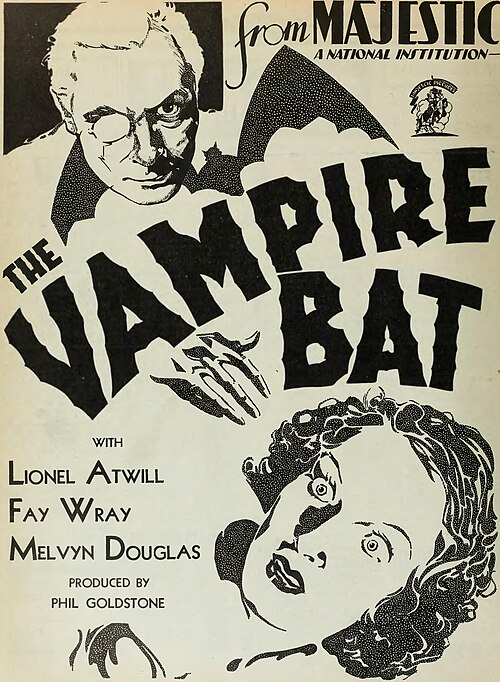
Horror Film Review: The Vampire Bat (dir by Frank R. Strayer)


In 1933’s The Vampire Bat, people are dying in a small German village, victims of blood loss.  A woman named Martha Mueller (Rita Carlisle) was recently attacked by a bat, leading to rumors of a vampire.  When the local town eccentric, a twitchy man named Hermann Glieb (Dwight Frye), argues that bats are actually harmless and admits that he likes bats because they are “soft” and “nice,” people start to suspect that he might be the vampire.  Another man named Kringen (George E. Stone) claims that he was attacked by a vampire and insinuates that it was Glieb.  Glieb may seems like a strange man who likes to collect bats but could he be something even more sinister?

Two town leaders have opposite feelings about the claim that a vampire is attacking the town.  Karl Brettschneider (Melvyn Douglas) is the local police inspector and he deals with facts.  He doesn’t believe in superstition and he initially scoffs at the idea that a vampire is attacking the village.  Meanwhile, Dr. Otto von Niemann (Lionel Atwill) is the town’s doctor.  He’s been treating the victims of the bat attacks and he’s even be letting some of his patients live at his home.  Everyone knows that Dr. von Neimann is a kindly man of science.  Karl is even dating Ruth (Fay Wray), one of Otto’s boarders.  But is the doctor as benevolent as everyone assumes?

When answering that question, consider these four facts:

  1.  Dr. von Neimann is the one who encouraged Kringen to spread stories about a vampire haunting the town, despite the fact that Kringen himself said that he didn’t want to start a panic.
  2. Dr. van Niemann is played by Lionel Atwill.
  3. Glieb is played by Dwight Frye.
  4. Karl is played by Melvyn Douglas.

Indeed, for horror fans, the casting of Lionel Atwill gives the game away.  Lionel Atwill appeared in a number of horror films and it was rare that he wasn’t cast as the villain.  (One of his non-villainous role was as the one-armed Inspector Krogh in The Son of Frankenstein.)  From the minute the viewer sees Atwill, he seem to give off sinister vibes and it’s not really a surprise when he turns out to be less than trustworthy.

As for Dwight Frye, horror fans love him for playing a number of unhinged weirdos, like Renfield in the Lugosi-version of Dracula and the torch-bearing servant in Karloff’s Frankenstein.  Frye was good at playing twitchy types but one thing that all of Frye’s characters had in common is that they were pretty much destined to be victims.  Even when Frye played an unlikeable character,  like in Frankenstein, it was obvious that he was going to end up getting killed at the hands of the Monster.

Finally, Melvyn Douglas was the epitome of propriety in every film in which he appeared.  If Douglas thinks that there is something more going on than just a vampire attacking people, there probably is.  And since we know Douglas can’t be the main bad guy, that pretty much just leaves Lionel Atwill.

The Vampire Bat is a short and enjoyable B-movie that puts an interesting spin on the typical vampire legend.  Though the budget may be low, the cast of Atwill, Douglas, Frye, and Wray can’t be beat and all of them give fully committed performances.  Dwight Frye, in particular, gives one of his best performance as the unfortunate Glieb.  As always, Lionel Atwill makes for an entertaining villain.  At its best, The Vampire Bat comments on the power of hysteria.  Convinced that there is a vampire in their midst, the town goes mad and it directs its anger towards those who are seen as being on the outside, men like Glieb.

The Vampire Bat is more than worthy of your Halloween viewing.
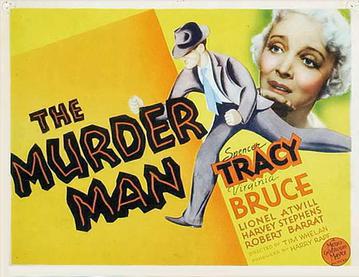
Film Review: The Murder Man (dir by Tim Whelan)


Seven minutes into the 1935 film, The Murder Man, 27 year-old James Stewart makes his film debut.

He’s playing a reporter named Shorty and, since this is a 30s newspaper film, he’s first seen sitting at a table with a bunch of other cynical reporters, the majority of whom seem to be alcoholics and gambling addicts.  Suddenly, words comes down that a corrupt businessman named Halford has been assassinated, shot by an apparent sniper.  (It is theorized that he was shot from one of those carnival shooting gallery games, which was somewhat oddly set up on a street corner.  Maybe there was shooting galleries all over place in 1935.  I supposed people had to do something to keep their spirits up during the Depression.)  While the other reporters run to the scene of the crime, Shorty is on the phone and calling his editors to let them know that a huge story is about to break.

Steve Grey (Spencer Tracy) is the reporter assigned to the story.  Crime is his beat and everyone agrees that no one’s better at covering criminals and understanding what makes them tick.  Unfortunately, it’s not always easy to track Steve down.  He’s a hard drinking reporter and lately, he’s been concerned about the collapse of his father’s business.  Still, when Steve is finally tracked down, he throws himself into covering the story and speculating, in print, about who could have killed Halford.  In fact, his girlfriend (Virginia Bruce) worries that Steve is working too hard and that he’s developing a drinking problem.  She suggests that Steve needs to take some time off but Steve is driven to keep working.

It’s largely as a result of Steve’s actions that a man named Henry Mander (Harvey Stephens) is arrested and convicted of Halford’s murder.  Steve should be happy but instead, he seems disturbed by the fact that he is responsible for Mander going to jail.  When his editor requests that Steve go to Sing Sing to interview Mander, a shocking truth is revealed.

Admittedly, the main reason that I watched The Murder Man was because it was the feature film debut of James Stewart.  (Stewart previously appeared in a comedy short that starred Shemp Howard.)  Stewart is only in a handful of scenes and he really doesn’t have much to do with the main plot.  To be honest, Shorty’s lines could have been given to anyone.  That said, Stewart still comes across as being a natural on camera.  As soon as you hear that familiar voice, you can’t help but smile.

Even if Stewart hadn’t been in the film, I would have enjoyed The Murder Man.  It’s fast-paced mystery and it has a decent (if not totally unexpected) twist ending.  It’s one of those films from the 30s where everyone speaks quickly and in clipped tones.  Casual cynicism is the theme for the day.  Spencer Tracy gives a wonderful performance as the hard-drinking and troubled Steve Grey and the scene where he meets Mander in prison is surprisingly moving.  Clocking in at only 68 minutes, The Murder Man is a good example of 30s Hollywood.

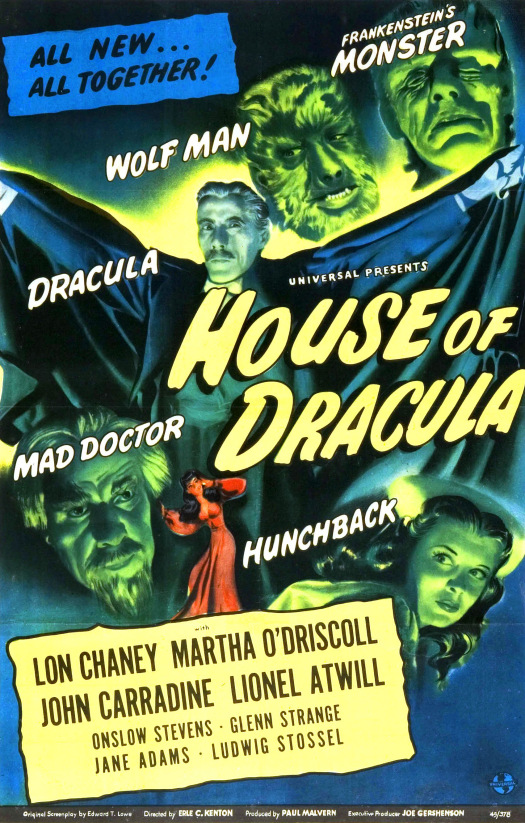
Horror Film Review: House of Dracula (dir by Erle C. Kenton)


When last we saw Dracula, the Wolf Man, and Frankenstein’s Monster, they were all coming to an untimely end in House of Frankenstein.

Dracula (John Carradine) was caught out in the sun by a group of angry villagers and ended up turning back into a skeleton while desperately trying to climb into his coffin.  The Wolf Man, also known as Larry Talbot (Lon Chaney, Jr.), was shot, presumably with a silver bullet, and finally, the world was free of having to listen to Larry whine about his unfortunate condition.  The Monster (Glenn Strange) was last seen drowning in quicksand.

Despite all of that, all three of them return in 1945’s House of Dracula.  The Monster is at least found in an underground lair, preserved in a state of suspended animation by the quicksand.  Dracula and Larry Talbot, however, just show up with neither looking the worst for wear.  I supposed that Larry could have survived being shot but Dracula’s return is bizarre because he was literally exposed to sunlight.  In the past, reviving Dracula has always required the stake to be removed from his heart.  Did someone remove the sunlight from Dracula’s skeleton?

All three of the cursed beings show up at the castle of Dr. Franz Edelmann (Onslow Stevens).  Working with two nurses, the beautiful and religious Milizia (Martha O’Driscoll) and a compassionate hunchback named Nina (Janes Adams), Edlemann is researching blood transfusions.  He believes that blood transfusions can cure just about anything.  Edelmann is so convinced that he can cure Dracula of his vampirism that he allows Dracula to move his coffin into the castle’s cellar.  Edelmann is also convinced that he use the spores of a special plant to cure Larry of his lyncanthropy.  As usual, Larry Talbot is skeptical and spends the entire movie boring everyone with the details of how much it sucks to be a werewolf.  As for Frankenstein’s Monster, he’s in the castle because Edelmann happend to come across him in an underground chamber.  Quite a coincidence, that.

Unfortunately, all of the blood transfusions in the world can’t stop Dracula from being Dracula and soon, the Lord of the Vampires is trying to turn Milizia into his queen.  Larry is also in love with Milizia, to the extent that he doesn’t realize that Nina is falling in love with him.  Meanwhile, Edelman ends up infecting himself with some of Dracula’s blood and soon, his reflection is no longer showing up in mirrors and he’s feeling the temptation to revive Frankenstein’s Monster.  A violent murder upsets the villagers, who refuse to listen to Inspect Holz (Lionel Atwill) when he begs them to let the police take care of things as opposed to laying siege on the castle with a bunch of torches.  That’s what happens when you allow your house to become the House of Dracula.

House of Dracula is a clear and marked improvement on House of Frankenstein.  While Larry Talbot is just as whiny as ever (and Lon Chaney, Jr.’s sad sack performance is a bit dull) and Frankenstein’s Monster is a bit underused, John Carradine makes for a perfect Dracula, mixing old world charm with cunning cruelty.  Director Erle C. Kenton directs the film as if it were a film noir, filling the castle with ominous shadows and giving us a cast of morally conflicted characters.  Though I think most modern viewers are a bit too jaded to be truly scared by the old horror films, the scene where Edelmann watches as his reflection disappears from the mirror is effectively creepy.  I can only imagine how audiences in 1945 reacted to it.

When first released, House of Dracula was not a hit and, as a result it was one of the final “serious” films to feature the Universal monsters.  (Chaney and Strange would reprise their signature roles in a few comedies while Carradine would play Dracula in several other non-Universal productions.)  Seen today, it seems like the perfect final chapter for the monsters that, for 20 years, defined Universal.

Previous Universal Horror Reviews:

  1. Dracula (1931)
  2. Dracula (Spanish Language Version) (1931)
  3. Frankenstein (1931)
  4. Island of Lost Souls (1932)
  5. The Mummy (1932)
  6. The Invisible Man (1933)
  7. The Bride of Frankenstein (1935)
  8. Dracula’s Daughter (1936)
  9. Son of Frankenstein (1939)
  10. The Wolf Man (1941)
  11. Ghost of Frankenstein (1942)
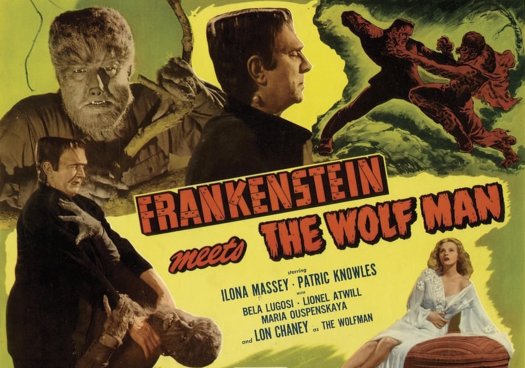
  12. Frankenstein Meets The Wolf Man (1943)
  13. Son of Dracula (1943)
  14. House of Frankenstein (1944)
  15. Creature From The Black Lagoon (1954)

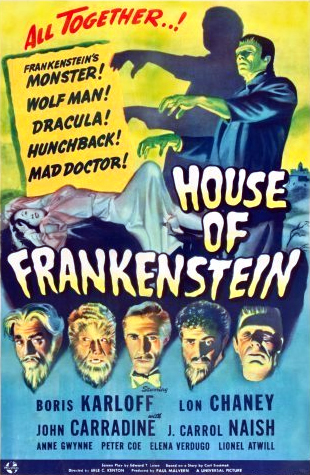
Horror Film Review: House of Frankenstein (dir by Erle C. Kenton)


House of Frankenstein opens in a prison.  Dr. Gustav Neimann (Boris Karloff), the bother of one of Baron Frankenstein’s assistants, has been convicted of robbing graves and attempting to carry on the Baron’s work.  Dr. Neimann’s faithful assistant is the hunchback, Daniel (J. Carroll Naish).  Daniel is loyal to Neimann because Neimann has promised to someday place Daniel’s brain in a stronger body.

When a sudden earthquake allows Neimann and Daniel to escape, they waste no time in getting revenge on Neimann’s enemies.  First, they murder a traveling showman named Prof. Lampini (George Zucco) and steal both his identity and his mobile horror exhibit.  Included in the exhibit is a coffin that Lampini claimed held the skeleton of Dracula.  (There’s even a stake sticking out of the skeleton’s chest.)  When Neimann returns to his original hometown, he removes the stake from the skeleton so that he might use it on the Burgomaster, Hussman (Sig Ruman).  The skeleton transforms into Dracula (John Carradine).  Because he is relieved to have been brought back to life, Dracula does not attack Neimann but instead agrees to help Neimann get revenge on Hussman in return for Neimann looking after his coffin.  Dracula soon learns that he should have thought twice before trusting either Neimann or Daniel.

Neimann moves on, stopping off at Frankenstein’s village and recovering the bodies of both Frankenstein’s Monster (Glenn Strange) and Larry Talbot (Lon Chaney, Jr.) from the frozen chamber in which they were trapped at the end of Frankenstein Meets The Wolf Man.  Revived from suspended animation, Larry immediately starts whining about how much his life sucks.  (I love The Wolf Man but subsequent films turned Larry into the whiniest of the Universal monsters.)  Neimann promises to put Larry’s brain in a new body if he helps to revive the Monster.  Larry agrees.  Meanwhile, Daniel falls in love with a gypsy girl named Ilonka (Elena Verdugo) while Ilonka falls in love with Larry.  Daniel wants Neimann to put his brain in Larry’s body, Larry won’t stop whining about the approaching full moon, and the villagers are getting suspicious!

House of Frankenstein has never been a favorite of critics or horror historians and the film does have its share of flaws.  For instance, though it would have been fun to see Bela Lugosi return to his signature role, John Carradine seems like ideal casting for Dracula.  Unfortunately, Dracula is only in the film for about ten minutes and he comes to an end that really doesn’t feel worthy of a character of his stature.  The film reduces Larry Talbot to just being a dumb lug who won’t stop feeling sorry for himself.  Finally, Glenn Strange has the right physique for the Monster but, much as with John Carradine, he is underused.

That said, I still enjoyed House of Frankenstein.  A lot of that is because of Boris Karloff, who brings a lot of sly humor to his performance as the mad scientist.  (That said, Karloff himself later said that he did the role solely for the money and was bored with the whole thing.)  J. Carroll Naish turns Daniel into a rather sympathetic henchman, one who is so desperate to be “normal” that he’s willfully blinded himself to the fact that Neiman really doesn’t care about anyone other than himself.  (In many ways, he’s the equivalent of the hapless characters that Michael Ripper later played for Hammer Films.)  Finally, Elena Verdugo brings a lot of life to the stock role of the dancing gypsy girl who falls in love with Larry Talbot despite the fact that Larry is kind of a dumb lug.

For a modern viewer, the main appeal of House of Frankenstein is that it is one of the original Universal horror films, even if it came out long after the first Dracula and Frankenstein films.  As such, it has all the things that we associate with and love about those films.  There’s a ruined castle.  There’s angry villagers.  The cast is full of Universal horror mainstays, including Lionel Atwell and Anne Gwynne.  And, yes, the film features a mob descending on the castle with torches.  Flaws and all, House of Frankenstein is an enjoyable time capsule.  It’s a horror film from a far more innocent age and it’s one that remains a fun watch.

Previous Universal Horror Reviews:

  1. Dracula (1931)
  2. Dracula (Spanish Language Version) (1931)
  3. Frankenstein (1931)
  4. Island of Lost Souls (1932)
  5. The Mummy (1932)
  6. The Invisible Man (1933)
  7. The Bride of Frankenstein (1935)
  8. Dracula’s Daughter (1936)
  9. Son of Frankenstein (1939)
  10. The Wolf Man (1941)
  11. Ghost of Frankenstein (1942)
  12. Frankenstein Meets The Wolf Man (1943)
  13. Son of Dracula (1943)
  14. Creature From The Black Lagoon (1954)

10 Horror Stars Who Never Won An Oscar


gary loggins's avatarcracked rear viewer

It’s Oscar night in Hollywood! We all may have our gripes with the Academy over things like the nominating process (see my posts on THE OTHER SIDE OF THE WIND STAN & OLLIE and THEY SHALL NOT GROW OLD ), but in the end, we’ll all still be watching – I know I will!

One of my gripes over the years has always been how the horror genre has gotten little to no attention from Oscar over the years. Sure, Fredric March won for DR. JEKYLL & MR. HYDE , but there were plenty of other horror performances who’ve been snubbed. The following ten actors should have (at least in my opinion) received consideration for their dignified work in that most neglected of genres, the horror film:

(and I’ll do this alphabetically in the interest of fairness)

LIONEL ATWILL

 Atwill’s Ivan Igor in MYSTERY OF THE WAX MUSEUM goes…

View original post 1,042 more words

30 Days of Noir #4: Lady in the Death House (dir by Steve Sekely)


The 1944 film, Lady in the Death House, tells the tragic and faintly ridiculous story of Mary Kirk Logan (Jean Parker).

The daughter of a small-time criminal, Mary has spent most of her life trying to escape from her family’s legacy of crime.  She’s even got a job, working at the same bank that her father once tried to rip off.  Of course, at work, everyone knows her as Mary Kirk and they have no idea that her father was the infamous Tom Logan.  If that information got out, Mary would lose her job and no longer be able to take care of herself or her younger sister, Suzy (Marcia Mae Jones).

One night, Mary is out on a date with a clumsy man who takes her out to a nightclub and manages to accidentally set Mary’s dress on fire.  Luckily, Dr. Brad Braford (Douglas Fowley) is there, having a drink with his friend, the famous criminologist, Charles Finch (Lionel Atwill).  Brad jumps into action, extinguishing the fire and saving Mary’s dress.  It’s love at first sight.

There’s just one problem.  Dr. Bradford is studying ways to bring the dead back to life and, in order to raise money for his research, he’s been working as the state’s executioner.  When someone goes to the electric chair, Brad is the one who pulls the lever.  Mary says that she can only marry Brad if he gives up his electrifying night job.

However, before Brad can turn in his letter of resignation, Mary is arrested for the murder of Willis Millen (Dick Curtis), a crook who once knew her father.  Mary swears that she’s innocent but there are two eye witnesses who testify that they not only heard Mary and Willis fighting but that they also saw the shadow of someone hitting Willis over the head with a lamp.  It doesn’t take long for the jury to reach a verdict:

I have to admit that, when this newspaper appeared on-screen, I was actually more curious about the “youth” who was arrested for stealing glitter off of campaign signs.  However, for whatever reason, the film declines to follow up on that story.  Instead, we watch as Mary goes to death row, with the knowledge that she is to die “at the hand of the man I love.”

However, there may still be hope!  Charles thinks that Mary is innocent.  Though there’s only 24 hours left before Brad is scheduled to execute Mary, Charles launches an investigation of his own.  But even if Charles is able to find the evidence that exonerates Mary, will he be able to contact the governor in time?  Or will Mary go to the chair?

Well, regardless of what happens, rest assured that this World War II-era film will end with an appeal for all movie goers to do the right thing and buy war bonds.

Lady in the Death House is an entertaining but fairly ludicrous little movie.  I mean, realistically, having the executioner execute his own fiancée is a huge conflict of interest.  It seems like they could have gotten a substitute executioner, if just for one night.  But, if they did that, we wouldn’t get the melodramatic highlight of Mary announcing that she’s scheduled to be killed “by the hand of the man I love.”

Lady in the Death House provides a rare chance to see Lionel Atwill in a heroic role.  The British actor played a countless number of mad scientists, killers, and Nazis before his premature death in 1946.  (Atwill’s promising career was derailed in 1943, when he accused of hosting orgies at home and was subsequently convicted of perjury.  That’s one reason why Atwill turned up in a “poverty row” feature like this one.)  Atwill is convincing as Charles Finch.  The same superior attitude that made him a good villain also makes him believable as the only person capable of figuring out who murdered Willis Millen.

Taking on its own terms, Lady in the Death House is a fun movie.  If nothing else, it provides a lesson on how to get a message to the governor, even if no one’s quite sure where he is for the evening.  That’s an important lesson to learn!

Halloween Havoc!: HOUSE OF DRACULA (Universal 1945)


gary loggins's avatarcracked rear viewer

Since I’ve already reviewed HOUSE OF FRANKENSTEIN back in 2015,  we now turn our attention to HOUSE OF DRACULA, the last “official” entry in the series (though the Universal Monsters would ‘Meet Abbott & Costello’ three years later). The film tries to put a new slant on things, using science to conquer the supernatural, but winds up being just a hodgepodge of familiar horror tropes without much cohesion. HOUSE OF DRACUA does have its fans, but I’m not one of them.

John Carradine  returns as Count Dracula, introducing himself as Baron Latos to Dr. Edlemann (Onslow Stevens ) and seeking a cure for his vampirism. Edlemann discovers a “peculiar parasite” in Dracula’s blood, and believes he can cure him through a series of transfusions. But the Count, that sneaky devil, has his fangs set for Edlemann’s pretty nurse Militza (Martha O’Driscoll),  whom he hypnotizes with those hypnotic eyes of his…

View original post 466 more words

Halloween Havoc!: FRANKENSTEIN MEETS THE WOLF MAN (Universal 1943)


gary loggins's avatarcracked rear viewer

FRANKENSTEIN MEETS THE WOLF MAN was Universal’s first Monster Mash-Up, and in my opinion the best of the lot. From here, things got a little crowded, but by spotlighting just two supernatural terrors, we get a spooky, atmospheric ‘B’ film that really works. Lon Chaney Jr. returns to his signature role of Lawrence Talbot, suffering from the curse of lycanthropy, and he’s even better than in the original (which I reviewed in 2015 ). And The Monster is played by 60-year-old Bela Lugosi , in the part he rejected twelve years earlier. Bela’s interpretation is… interesting (but more on that later).

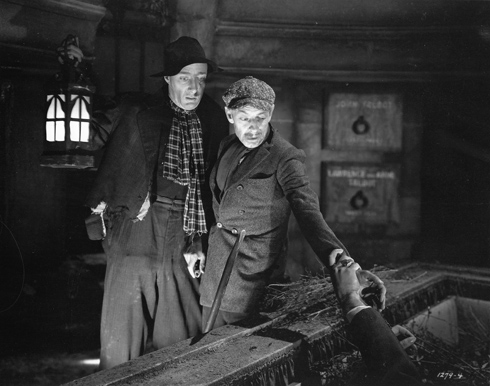
The eerie opening scene features two graverobbers under a full moon, breaking into the Talbot family crypt. Opening the lid of the late Larry Talbot’s coffin, they find the body is covered in wolfbane, and one of them recites that familiar “Even a man who’s pure in heart…” poem…

View original post 731 more words

Halloween Havoc!: GHOST OF FRANKENSTEIN (Universal 1942)


gary loggins's avatarcracked rear viewer

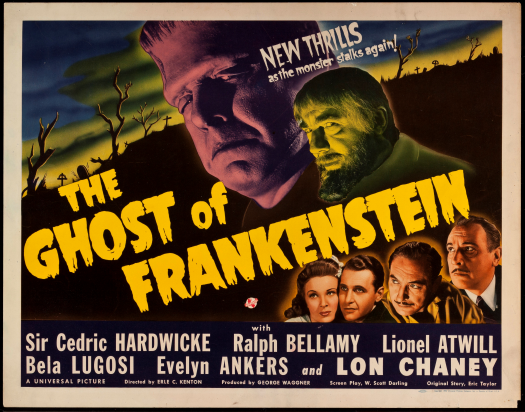
The success of Universal’s SON OF FRANKENSTEIN meant a sequel was inevitable, and the studio trotted out GHOST OF FRANKENSTEIN three years later. Horror stalwarts Bela Lugosi (as the broken-necked Ygor) and Lionel Atwill (although in a decidedly different role than the previous film) were back, but for the first time it wasn’t Boris Karloff under Jack Pierce’s monster makeup. Instead, Lon Chaney Jr., fresh off his triumph as THE WOLF MAN , stepped into those big asphalter’s boots as The Monster. But while SON OF was an ‘A’ budget production, GHOST OF FRANKENSTEIN begins The Monster’s journey into ‘B’ territory.

Old Ygor is still alive and well, “playing his weird harp” at deserted Castle Frankenstein. The villagers (including Dwight Frye! ) are in an uproar (as villagers are wont to do), complaining “the curse of Frankenstein” has left them in poverty, and storm the castle to blow it up…

View original post 694 more words

Halloween Havoc!: THE MAD DOCTOR OF MARKET STREET (Universal 1942)


gary loggins's avatarcracked rear viewer

The natives are getting restless… and you will too, while watching THE MAD DOCTOR OF MARKET STREET, which feels a lot longer than its 61 minute running time. The film does have a few saving graces, mainly the great Lionel Atwill as a mad scientist experimenting with bringing people back from the dead, and is an early endeavor for future film noir auteur Joseph H. Lewis . But the extremely lame script by Al Martin, whose inexplicably long career included the Lewis-directed Bela Lugosi vehicle INVISIBLE GHOST, manages to sink this shocker despite Atwill’s and Lewis’s best efforts.

Dr. Ralph Benson offers a man $1000 to let him put the man in a “catatonic state”, and revive him later. Benson has mad dreams about conquering death and disease with his untried (and definitely not FDA approved) methods. When the man doesn’t return home the next day, his wife calls the…

View original post 447 more words