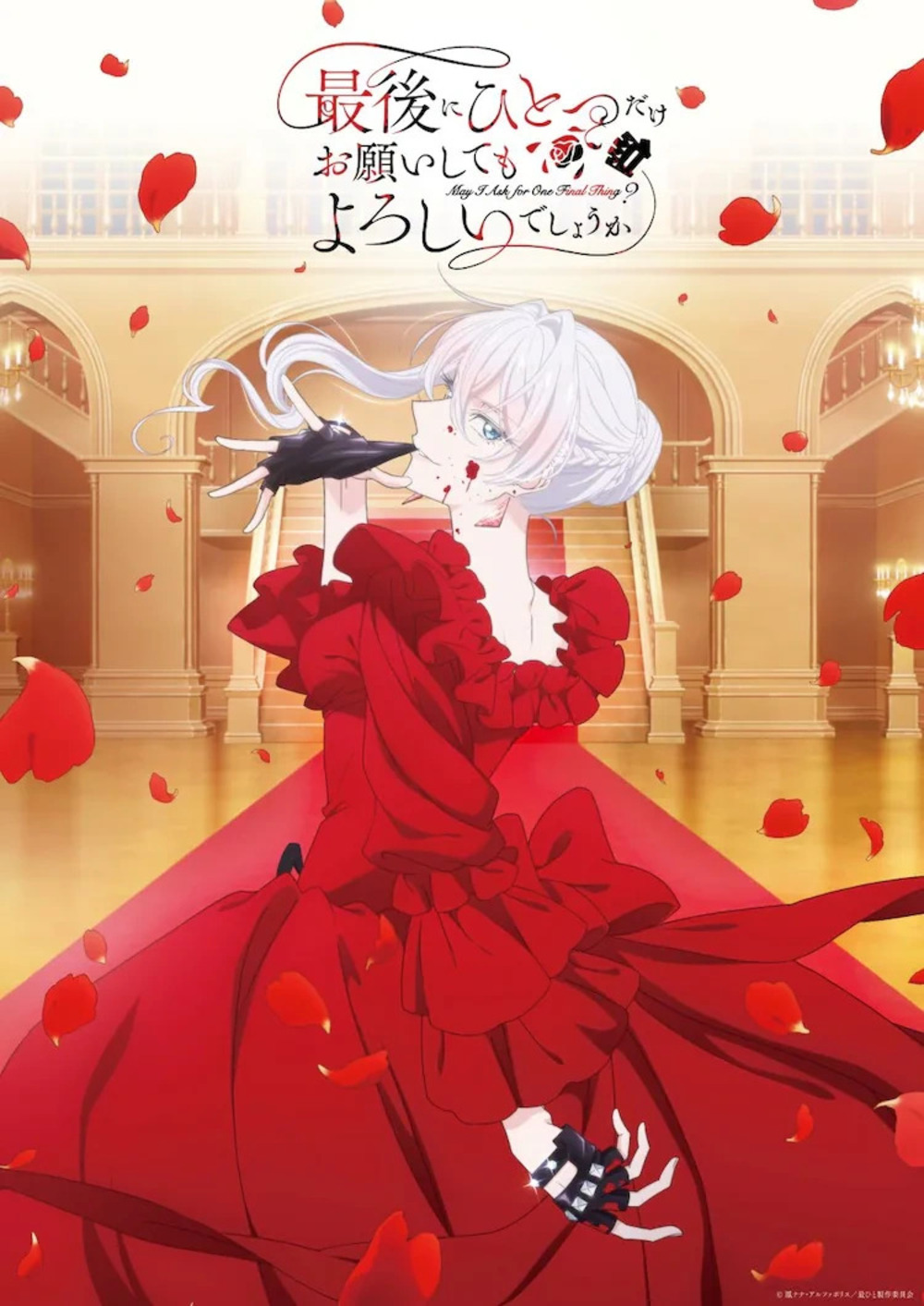
“Corrupt nobles are my meat. You will not deny me my meat.” — Scarlet El Vandimion
May I Ask for One Final Thing? delivers a sardonic skewering of otome genre conventions in its 2025 Fall season run, transforming the familiar villainess trope into a relentless satire of noble excess and romantic delusion. Adapted from Nana Ōtori’s light novels with illustrations by Satsuki, the series follows Scarlet El Vandimion, a duchess trapped in an abusive engagement to the insufferable Prince Kyle von Pallistan. The premiere episode wastes no time dismantling expectations: rather than the prince casting off his “wicked” fiancée for a doe-eyed commoner, Scarlet responds to his public betrayal with a devastating one-punch knockout, toppling Kyle, his paramour Terrenezza Hopkins, and a ballroom full of corrupt elites. This brazen inversion establishes the show’s core mode—mocking the otome formula’s predictable beats while reveling in their absurdity, all anchored by Scarlet’s unyielding presence as its emotional and thematic linchpin.
Scarlet El Vandimion stands as such a strong character that whatever flaws the narrative may have are propped up by how exceptionally well-written she is, her complexity elevating the entire production. Voiced masterfully by Asami Seto, whose excellent performance infuses every line with layers of restrained fury, wry sarcasm, and vulnerable steel, Scarlet embodies the villainess archetype with exaggerated precision—her poise and sharp tongue a deliberate caricature of haughty nobility, yet grounded in palpable humanity. Beneath the icy beauty and controlled outer persona lies a very ultra-sadistic, violent, and confrontational individual, a revelation that adds delicious menace to her every action. Years of Kyle’s physical and emotional mistreatment have conditioned her to endure for her family’s sake, forging a restraint that makes her eventual snap all the more cathartic—and terrifying. When he announces his love for the scheming Terrenezza—a parody of the “pure-hearted” heroine with her manipulative glint—Scarlet’s polite facade shatters. Her iconic line, “May I ask for one final thing?” precedes a barrage that sends foes crashing through opulent decor, satirizing the genre’s ritualized humiliations by reversing victim and victor. Seto’s delivery here is pitch-perfect, a silky venom that turns menace into melody, carrying Scarlet from icy composure to explosive triumph and making her the undeniable heart of every scene, her sadistic glee in the chaos impossible to ignore.
What makes Scarlet even more compelling is how unlike similar characters in otome games and stories she feels. Despite being a master of magic and highly proficient in archery, swordplay, and other martial arts, she still prefers to use her hands to do the talking, as if the black leather gloves with studded knuckles are the most natural extension of her personality. That choice says a lot about her: she is not interested in flashy posturing when direct action will do, and she does not waste time pretending that elegant court manners can solve what brute honesty—and a vicious thrill in inflicting pain—can. The gloves become part of her identity, a visual shorthand for a character who understands perfectly well how much power she has and chooses to express it in the bluntest, funniest, and most satisfying way possible, her confrontational nature reveling in the up-close brutality. It also makes her feel sharper than the typical otome heroine or villainess, because her combat style is not just about strength but about attitude—an ultra-violent worldview that prioritizes the raw satisfaction of a personal beatdown over distant spells or refined techniques.
What unfolds is a parade of otome clichés turned on their head: the engagement ball becomes a demolition derby, scheming rivals meet cartoonish ends, and the “evil fiancée” emerges as the sole agent of justice, her fists a blunt rebuttal to whispered intrigues and teary confessions. Scarlet’s strength shines in these moments, her well-crafted arc—from dutiful sufferer to empowered avenger—propelling the satire forward, fueled by the sadistic undercurrent that makes her victories feel wickedly personal. Seto’s voice acting elevates this further, modulating from haughty drawl to deadpan quips amid chaos, ensuring that even formulaic beatdowns feel fresh through her character’s magnetic charisma and the actress’s nuanced range, capturing the thrill Scarlet takes in her violence. The animation amplifies this satirical edge, with character designs that lampoon aristocratic vanity—elaborate wigs and gowns unraveling into chaotic combat poses, faces contorting from smug superiority to slack-jawed panic. Its art style, reminiscent of classic otome, reverse harem romance stories, and even the yaoi genre, makes light of the series’ overall theme, adopting those genres’ polished, ethereal aesthetics—flowing locks, luminous eyes, and dramatic shading—to underscore the very pretensions it skewers, all while Scarlet’s commanding design cuts through the gloss with her predatory intensity.
Action sequences mimic One Punch Man‘s deadpan efficiency, Scarlet’s blows—voiced with Seto’s exhilarating exertion—dispatching antagonists in over-the-top fashion, underscoring the genre’s inflated stakes while highlighting her confrontational preference for hands-on savagery. The score layers orchestral pomp with jarring rock bursts, mirroring the disconnect between noble pretense and brutal reality. Yet the satire sharpens in quieter moments: Scarlet’s mixed-heritage ally highlights the world’s hypocritical prejudices, a nod to otome’s often superficial “fantastic racism,” while bloodied nobles whimper like the damsels they once scorned. Scarlet’s interactions here reveal her depth, her protective instincts and moral clarity making her a beacon amid the farce, propped up flawlessly by Seto’s emotive subtlety that hints at the violent storm beneath.
Romantic subplots receive the same sardonic treatment, with First Prince Julian—Kyle’s upright counterpart, voiced by Wataru Katoh—offering alliance and affection amid slave-trading busts. Scarlet’s dynamic with him pokes at otome’s chivalric fantasies: her post-abuse caution deflates swooning tropes, turning courtship into pragmatic maneuvering, and Seto’s wary inflections add authentic texture to her guarded heart, even as her sadistic side simmers in the background. Side figures, from enslaved unfortunates to scheming lords, function as satirical props—punchable embodiments of entitlement rather than nuanced players—further mocking the genre’s tendency to flatten opposition. Yet Scarlet’s well-written navigation of these elements, her strategic alliances and unapologetic agency, overshadows their shallowness. The narrative arcs from ballroom chaos to noble reckonings and trafficking exposés, all framed as exaggerated justice porn that lampoons revenge isekai’s moral simplicity. Content like violence and abuse allusions fits the older-teen skew, but Scarlet’s robust characterization and Seto’s vocal prowess keep the satire from descending into mere exploitation.
Even its flaws have basis in its themes of deconstructing and turning the otome genre on its head—and Scarlet props them up regardless. Repetition in the “smug jerk arrives, gets obliterated” formula, waning animation enthusiasm later on, and shallow side-character development mirror the very rote predictability and superficiality the series mocks in its source material—turning potential weaknesses into meta-commentary on otome’s formulaic limitations. Thematically, Scarlet wields sarcasm like a weapon, dismantling otome’s core illusions: the redemptive power of true love, the nobility of suffering silence, the inevitability of the heroine’s triumph. Nobles’ powdered facades flying amid beatdowns evoke a farce on privilege, Kyle’s perpetual bruising a running gag on unearned arrogance, but it’s Scarlet’s growth, voiced with Seto’s masterful control, that ties it all together—her ultra-sadistic core making each triumph a dark delight. Meta-awareness rewards genre veterans—every “prince forsakes fiancée” echo inverted for laughs—while the 12-episode structure satirizes seasonal pacing, teasing light novel extensions without deeper commitment. Pacing falters mid-run, but Scarlet’s charisma, amplified by Seto, sustains the bite: Kyle’s whiny bluster and Terrenezza’s cloying falsity become foils that highlight her superiority.
World-building serves the send-up, opulent halls clashing with sordid underbellies in ways that ridicule escapist splendor. Scarlet’s evolution—from corseted symbol of repression to geared-up avenger—mirrors the genre’s own half-hearted empowerment arcs, taken to gleeful extremes, her journey rendered compelling by Seto’s expressive range and the revelation of her violent essence. Mid-season triumphs, like dismantling a trafficking network, blend action with pointed jabs at abuse narratives, while the finale’s noble clash affirms her ascent, albeit in convoluted fashion that self-mockingly apes convoluted plots—yet Scarlet’s resolve carries it through.
This satirical lens polarizes, delighting those weary of otome’s saccharine loops while frustrating purists attached to its comforts. It thrives as guilty-pleasure critique, echoing Kill la Kill‘s irreverence or Magical Girl Ore‘s gender flips, without reinventing the wheel—content to punch holes in the one it rides, thanks to Scarlet’s anchoring strength.
May I Ask for One Final Thing? stands as a 2025 highlight for its biting otome satire, channeling Scarlet El Vandimion’s rampage into a mirror held to genre absurdities. Her well-written depth—icy facade masking an ultra-sadistic, violent confrontational core—her unusual preference for settling things with her fists despite her magical and martial mastery, and Asami Seto’s excellent voice acting prop up every flaw, elevating the caustic glee and trope-torching catharsis into essential viewing for fans ready to laugh at the formula’s follies.
Anime You Should Be Watching
- Gakuen Utopia Manabi Straight
- Chōjin Densetsu Urotsukidōji
- School Days
- Higurashi no Naku Koro ni
- Toradora!
- Aria
- Azumanga Daioh
- Bible Black
- Puella Magi Madoka Magica
- Black Lagoon
- Ika Musume
- High School DxD
- Bakemonogatari
- Sailor Moon
- Princess Tutu
- Another
- Hellsing Ultimate
- Sword Art Online
- Wolf Children Ame and Yuki
- Toaru Kagaku no Railgun
- Nichijō
- Redline
- Gakkou Gurashi (School Live)
- Gate: Thus the Japanese Self-Defense Force Fought in Their Land
- Hinamatsuri
- Asobi Asobase
- Zombie Land Saga
- Monster
- Farming Life In Another World (Isekai Nonbiri Nouka)
- Perfect Blue
- Shiki
- Angel of Darkness (Injū Kyōshi)
- Blood: The Last Vampire
- Akira
- Space Battleship Yamato (Uchū Senkan Yamato)
- Macross Plus
- Ninja Scroll (Jūbē Ninpūchō)
- Tokyo Godfathers (Tōkyō Goddofāzāzu)
- Memories
- That Time I Got Reincarnated as a Slime (Tensei Shitara Suraimu Datta Ken)
- Spy x Family
- Record Of Lodoss War (Rōdosu-tō Senki)
- Berserk (Kenpū Denki Berserk)
- Jin-Roh
- Made In Abyss (Meido in Abisu)
- Legend of the Galactic Heroes (Ginga Eiyū Densetsu)
- Nausicaä of the Valley of the Wind

