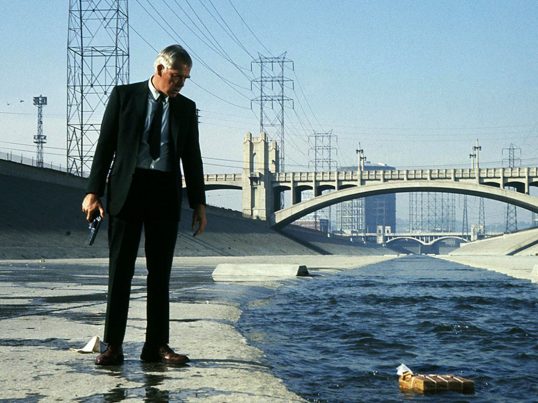
Charles Bronson in DEATH HUNT (1981) – Keep warm my friends!


If you’re in Texas or Arkansas today, I hope you’re keeping as bundled up as Charles Bronson in DEATH HUNT. It’s cold out there people! Keep safe and stay home if at all possible! We don’t know how to drive in this weather!

Enjoy DEATH HUNT’s trailer below! Charles Bronson and Lee Marvin are as tough as it gets!

Song of the Day: Wand’rin Star, sung by Lee Marvin


Continuing our tribute to Lee Marvin on what would have been his 100th birthday, our song of the day is a reminder that Lee Marvin was not just a tough guy actor.

He was also a singer who had a number one single in the UK and Ireland with this song from 1969’s Paint Your Wagon!  The same two weeks that Lee Marvin had the number one spot, The Beatles had the number two spot with Let It Be.

Scenes That I Love: Lee Marvin on Point Blank


100 years ago today, Lee Marvin was born in New York City.  One of the great screen tough guys, Lee Marvin played stoic and determined men who you didn’t want to upset.

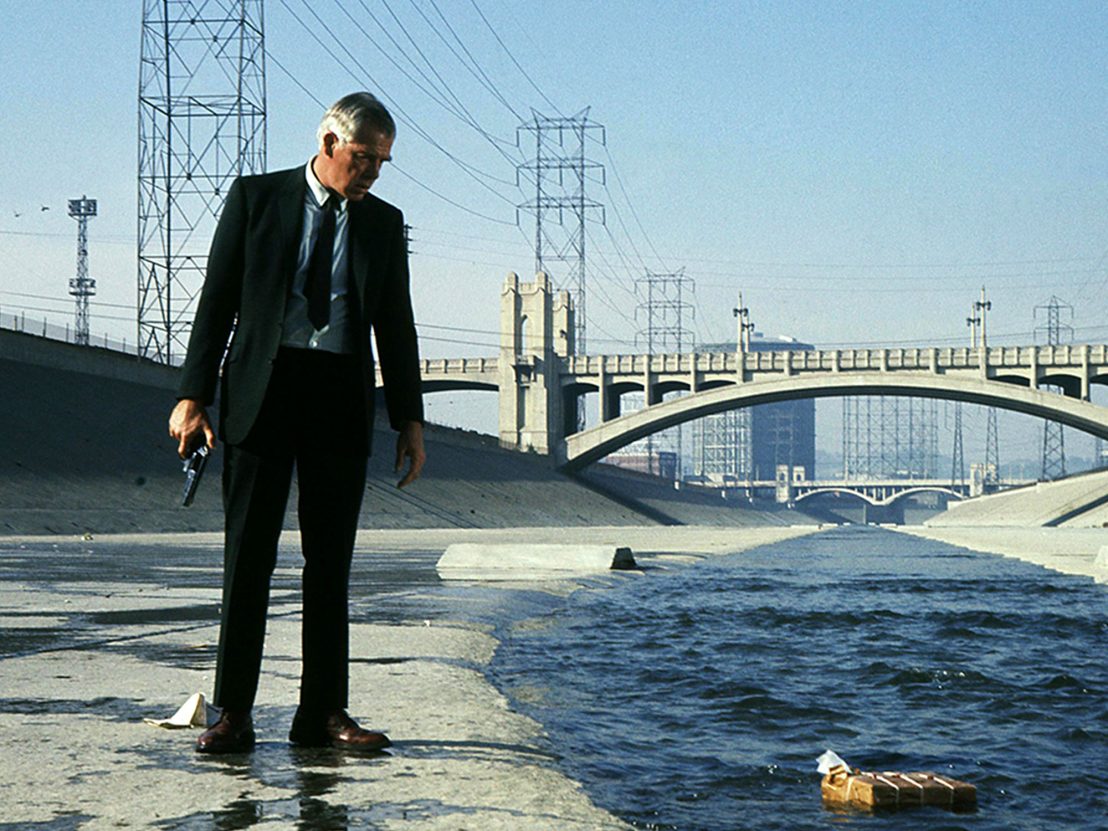
That was certainly true of his role as Walker in 1967’s Point Blank.  A thief who was double crossed by his partner and the organization to which his partner was in debt, Walker is determined to get back the money that he stole from someone else.  Relentlessly, Walker moves from one mob boss to another and repeatedly, those bosses make the mistake of thinking that they can double cross him again.

Point Blank (1967, directed by John Boorman)

In this scene, which was reportedly considered to be shockingly violent by 1967 standards, Carter (Lloyd Bochner) attempts to fool Walker, just to discover that Walker is smarter and far more ruthless than anyone realizes.

10 Oscar Snubs From The 1960s


Ah, the 60s. Both the studio system and the production code collapsed as Hollywood struggled to remain relevant during a time of great social upheaval. The Academy alternated between nominating films that took chances and nominating films that cost a lot of money. It led to some odd best picture lineups and some notable snubs!

1960: Psycho Is Not Nominated For Best Picture and Anthony Perkins Is Not Nominated For Best Actor

To be honest, considering that the Academy has never really embraced horror as a genre and spent most of the 60s nominating big budget prestige pictures, it’s a bit surprising that Psycho was actually nominated for four Oscars.  Along with being nominated for its production design and its cinematography, Psycho also won nominations for Alfred Hitchcock and Janet Leigh.  However, Anthony Perkins was not nominated for Best Actor, despite giving one of the most memorable performances of all time.  The film literally would not work without Perkins’s performance and, considering that Perkins pretty much spent the rest of his career in the shadow of Norman Bates, it’s a shame that he didn’t at least get a nomination for his trouble.  Psycho was also not nominated for Best Picture, despite being better remembered and certainly more influential than most of the films that were.

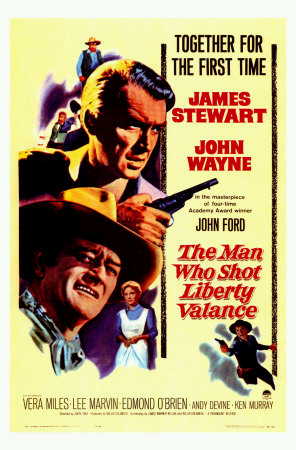
1962: The Man Who Shot Liberty Valance Is Almost Totally Snubbed

The Man Who Shot Liberty Valance was not totally snubbed by the Academy.  It received a nomination for Best Costume Design.  But still, it deserved so much more!  John Ford, James Stewart, John Wayne, Lee Marvin, Vera Miles, and the picture itself were all worthy of nominations.  Admittedly, 1962 was a year full of great American films and there was a lot of competition when it came to the Oscars.  Still, The Man Who Shot Liberty Valance definitely deserved a best picture nomination over the bloated remake of Mutiny on the Bounty.  Today, if the first Mutiny on the Bounty remake is known for anything, it’s for Marlon Brando being difficult on the set.  But The Man Who Shot Liberty Valance is still remembered for telling us to always print the legend.
1964: From Russia With Love Is Totally Snubbed

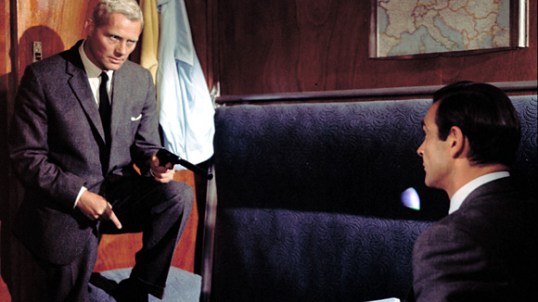
The same year that the Academy honored George Cukor’s creaky adaptation of My Fair Lady, it totally ignored my favorite James Bond film.  From Russia With Love is a Bond film that works wonderfully as both a love story and a thriller.  Sean Connery, Lotte Lenya, Robert Shaw, and Terence Young all deserved some award consideration.  From Russia With Love was released in the UK in 1963.  In a perfect world, it would have also been released concurrently in the U.S., allowing From Russia With Love to be the film that gave the the Academy the chance to recognize the British invasion.  Instead, Tom Jones was named the Best Picture of 1963 and From Russia With Love had to wait until 1964 to premiere in the U.S.  It was snubbed in favor of one of old Hollywood’s last grasps at relevance.

1964: Slim Pickens Is Not Nominated For Best Supporting Actor

Playing three separate roles, Peter Sellers dominates Dr. Strangelove: Or How I Learned To Stop Worrying And Love The Bomb.  But, as good as Sellers is, the film’s most memorable image is definitely Slim Pickens whooping it up as he rides the bomb down to Earth.  George C. Scott and Sterling Hyaden also undoubtedly deserved some award consideration but, in the end, Pickens is the one who brings the film to life even as he helps to bring society to an end.

1967: In Cold Blood Is Not Nominated For Best Picture

In Cold Blood, though not a perfect film, certainly deserved a nomination over Dr. Doolittle.  In Cold Blood is a film that still has the power to disturb and haunt viewers today.  Dr. Doolittle was a box office debacle that was nominated in an attempt to help 20th Century Fox make back some of their money.
1967: Sidney Poitier Is Not Nominated For Best Actor For In The Heat Of The Night

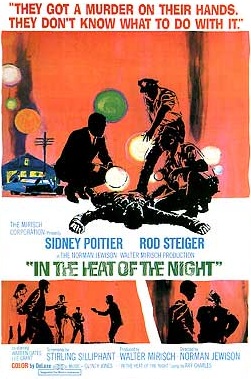
In 1967, Sidney Poitier starred in two of the films that were nominated for Best Picture but somehow, he did not pick up a nomination himself.  His restrained but fiercely intelligent performance in In The Heat Of The Night provided a powerful contrast to Rod Steiger’s more blustery turn.  That Poitier was not nominated for his performance as Virgil Tibbs truly is one of the stranger snubs in Academy history.  (If I had to guess, I’d say that the Actors Branch was split on whether to honor him for In The Heat of the Night or Guess Who’s Coming To Dinner or even for To Sir With Love and, as a result, he ended up getting nominated for none of them.)

1968: 2001: A Space Odyssey and Planet of the Apes Are Not Nominated For Best Picture

Neither one of these classic science fiction films were nominated for Best Picture, despite the fact that both of them are far superior and far more influential than Oliver!, the film that won that year.

1968: The Good, The Bad, and the Ugly Is Totally Ignored

Not even Ennio Morricone’s score received a nomination!

1968: Petulia Is Totally Snubbed

Seriously, I don’t know what was going on with the Academy in 1968 but it seems they went out of their way to ignore the best films of the year.  Richard Lester’s Petulia is usually cited as one of the definitive films of the 60s but it received not a single Oscar nomination.  Not only did the film fail to receive a nomination for Best Picture but Richard Lester, George C. Scott, Julie Christie, Shirley Knight, Richard Chamberlain, and the film’s screenwriters were snubbed as well.

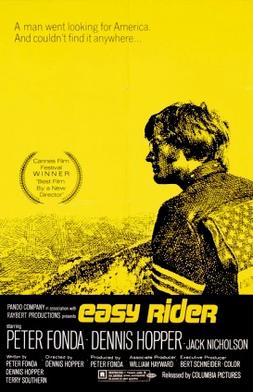
1969: Easy Rider Is Not Nominated For Best Picture

Yes, I know.  Easy Rider is a flawed film and there are certain moments that are just incredibly pretentious.  That said, Easy Rider defined an era and it also presented a portrait of everything that was and is good, bad, and timeless about America.  The film may have been produced, directed, and acted in a drug-razed haze but it’s also an important historical document and it was also a film whose success permanently changed Hollywood.  Certainly, Easy Rider’s legacy is superior to that of Hello, Dolly!

Agree? Disagree? Do you have an Oscar snub that you think is even worse than the 10 listed here? Let us know in the comments!

Up next: It’s the 70s!
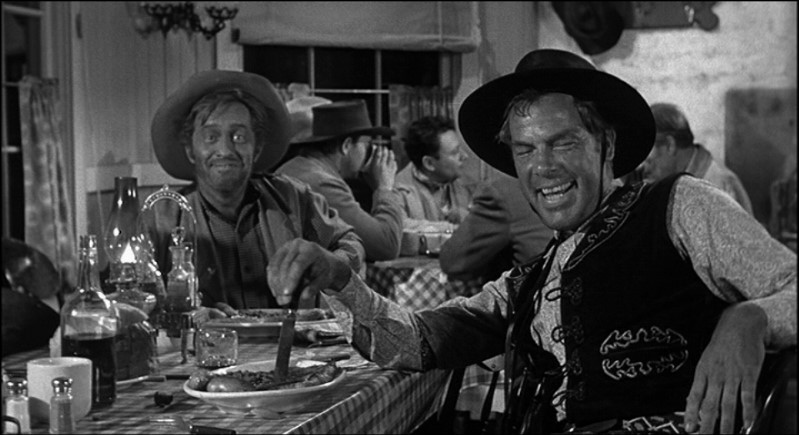
Scenes That I Love: The Steak Scene From The Man Who Shot Liberty Valance


Since today is the 113th anniversary of the birth of John Wayne, I decided to watch the 1962 classic, The Man Who Shot Liberty Valance!  And then I decided to share a scene that I love from the film.

The famous steak scene features three of the greatest screen icons of Hollywood’s golden age: James Stewart, John Wayne, and Lee Marvin.  Lee Marvin is the bully who is terrorizing the entire town.  James Stewart is the idealist who thinks that the law, and not violence, is the answer.  And John Wayne is …. well, he’s John Wayne.  He’s the only man in town who can stand up to Lee Marvin but, at the same time, he’s also aware that his time is coming to a close.  In the scene below, all three of the characters display their different approaches to life and a disagreement with steak nearly leads to violence.

This scene — and really, the entire film — features these three actors at their best.  John Wayne is an actor who is often described as having “just played himself” but that’s really not quite fair.  While Wayne’s outsized persona definitely does influence how the audience reacts to any character that he plays, he was a better actor than he’s often given credit for being.  That’s especially evident in The Man Who Shot Liberty Valance, in which Wayne plays a confident man’s man who knows that fate is closing in on him.  The coming of civilization (represented by James Stewart) will be great for the town of Shinbone but it will also leave men like Wayne’s Ton Doniphon with nowhere to go.  The coming of civilization means that the heroes of the past are destined to become obsolete.

Enjoy this scene from The Man Who Shot Liberty Valance:

4 Shots From 4 Films: Special Lee Marvin Edition


Prime Cut (1972, directed by Michael Ritchie)

4 Shots From 4 Films is just what it says it is, 4 shots from 4 of our favorite films. As opposed to the reviews and recaps that we usually post, 4 Shots From 4 Films lets the visuals do the talking!

96 years ago, Lee Marvin was born in New York City.  After getting kicked out of several prestigious prep schools for “bad behavior,” 18 year-old Lee Marvin enlisted in the Marin Corps, was briefly a corporal before getting demoted back to private (again, because of “bad behavior”), and was wounded in action during the Battle of Saipan.  (Marvin was one of the few members of his unit to survive the battle.)  After he was discharged from the Marines, he worked as a plumber’s assistant at a local community theater and, after being asked to temporarily replace an actor who had fallen ill, Marvin decided to pursue a career as an actor.

Marvin became one of Hollywood’s premier tough guys.  He played his share of gangsters, cops, and cowboys but, because of his background, he was a natural for playing military men.  Whether it was The Dirty Dozen, The Big Red One, or The Delta Force, Lee Marvin was a natural leader and brought authenticity to every military role the played.  His final film was The Delta Force, which just happens to be the greatest film ever made.

In honor of Lee Marvin’s birthday, here are:

4 Shots From 4 Films

The Man Who Shot Liberty Valance (1962, directed by John Ford)

Point Blank (1967, directed by John Boorman)’

The Big Red One (1980, directed by Sam Fuller)

The Delta Force (1986, directed by Menahem Golan)

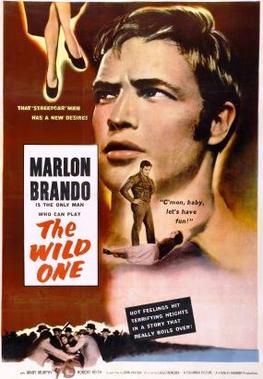
Film Review: The Wild One (dir by Laszlo Benedek)


Motorcycles have always been unbelievably sexy and, in 1953, so was Marlon Brando.

1953 was the year that Brando played Johnny Strabler in The Wild One.  Johnny’s the leader of the Black Rebels Motorcycle Club.  He wears a leather jacket and always has a cap tilted rakishly on his head.  When Johnny moves, he makes it a point to take his time.  He doesn’t run from anyone and, perhaps most importantly, he doesn’t run to anyone.  Johnny’s a rebel and he doesn’t care who knows it.  “What are you rebelling against?” Johnny is asked.  “Whaddya got?” Johnny replies and, when he says it, you not only believe him but you want to join him in his rebellion.

And yet, from the minute that we see Johnny, it’s obvious that there’s more to him than just his jacket and his attitude.  He speaks softly and when he smiles, there’s something almost shy about the expression.  You look into his brooding, soulful eyes and you know that Johnny isn’t just about making trouble.  He’s searching for something that society alone can’t deliver.  Johnny’s a bad boy, the type who you fool yourself into thinking that you — and only you — can reach and help heal.

At least, that’s the way that Kathie (Mary Murphy) feels about him, even though she’s way too smart to accept his invitation to go to a dance with him.  Kathie works at a diner in a small California town.  When Johnny and his gang ride into the town, all of the boring, responsible citizens want to force him to leave.  Kathie, alone, sees that Johnny’s not as bad as everyone assumes he is.  And if there’s any doubt about the fact that Johnny’s got a good soul despite his brooding nature, Chino (Lee Marvin) shows up to remind everyone of what a truly bad biker is like.

Chino and Johnny may both love their motorcycles but otherwise, they’re opposites.  If Johnny has the soul of a poet, Chino has no soul at all.  Johnny’s searching for freedom while Chino is merely searching for power.  Chino and Johnny were once friends, all part of the same gang.  However, Johnny eventually went off on his own and took the younger gang members with him.  Chino, in many ways, represents America’s destructive and wild path.  He’s an old west outlaw who rides a motorcycle instead of a horse.  Johnny, meanwhile, is a wanderer who represents the part of America that created Kerouac and Dylan.

(Interestingly enough, both Brando and Marvin were 29 years old when they made The Wild One.  However, Brando looked much younger and Marvin looked considerably older, which only added to the film’s theme of generational conflict.  Brando, himself, has never rode a motorcycle before making The Wild One and reportedly avoided the actual bikers who were hired to act as extras.  Lee Marvin, on the other hand, was an experienced rider and fit right in with the film’s cast.  To be honest, Lee Marvin is actually more convincing than Brando but Brando had the eyes and the wounded way of speaking whereas Marvin was every single guy who needlessly revs his motorcycle’s engine in the middle of the night.)

Anyway, needless to say, the townspeople are even less happy once Chino’s gang shows up.  Unfortunately, few of them understand the difference between Johnny and Chino.  In fact, the majority of the upright citizens prove themselves to be just as and, in some cases, more violent than the bikers that they’re trying to run out of town.  It all leads to violence, tragedy, and, ultimately, understanding.  This was a 50s film after all.  Director Laszlo Benedek may have played up the more sordid aspects of the story but the film was produced by the reliably and safely liberal Stanley Kramer and the film concludes on a very Krameresque note.

If you only know Marlon Brando from the latter half of his career, when he was best known for his weight, his eccentricities, and his personal tragedies, than watching The Wild One is quite a revelation.  It’s a well-directed film with a host of effective supporting turns but it’s Brando who makes the film unforgettable.  Watching the film, you understand why Brando became a star and you also see just how much he inspired so many of the actors who came after him.  James Dean’s performance in Rebel Without A Cause owes a huge debt to Brando’s work here.  In fact, every rebel owes a debt to The Wild One.  In the role of Johnny, Brando invites and inspires us all to ride down the road and see what we find.

The Wild One was a huge hit in 1953, leaving teenagers excited and parents concerned.  That same year, Brando also played Mark Anthony in Julius Caesar and received an Oscar nomination for the performance.  The Wild One was ignored at the Oscars but lives on whenever anyone hit the road and goes searching for America.

Queen of the Outlaws: CAT BALLOU (Columbia 1965)


gary loggins's avatarcracked rear viewer

Lee Marvin  didn’t get many chances to show his comedic side; in fact, I can only think of two off the top of my head: the John Wayne/John Ford outing DONOVAN’S REEF (1963) and the 1976 spoof THE GREAT SCOUT AND CATHOUSE THURSDAY (I’ll be charitably silent about 1969’s PAINT YOUR WAGON!).  Then there’s the comedy western CAT BALLOU, for which Marvin won an Oscar in the dual roles of drunken, broken down outlaw Kid Shelleen and hired killer Tim Strawn. Marvin’s marvelous, but if the truth be told, it wasn’t much of a stretch for Marvin to play a hard drinker and a macho tough guy… there’s a little bit of Lee in both personas!

We know we’re in for a good time right off the get-go when the fabled Columbia Torch Lady morphs into an animated, six-gun packin’ cowgirl, a sure sign not to take things too seriously…

View original post 626 more words

A Movie A Day #356: The Delta Force (1986, directed by Menahem Golan)


Last year, at this time, I set a goal for myself.

I decided that, in 2017, I would review a movie a day and I nearly succeeded. I didn’t review a movie on the day Chris Cornell died.  I missed a few days in March due to a sinus infection.  Including the review that I’m posting below, I reviewed 356 movies in 2017.  According to the year-end stats, my most popular reviews were for Heavy Metal Parking Lot, Slaughter, Body Chemistry 3, Body Chemistry 4, and Beatlemania.

Since tomorrow will be the start of a new year, this is going to be the end of my A Movie A Day experiment.  In 2018, I’ll still be watching movies and posting reviews on this site but this is my final daily review.  For my final Movie A Day, I picked the greatest movie of all time, The Delta Force!

Produced by Cannon Films, The Delta Force starts in 1980, with a helicopter exploding in the desert.  America’s elite special missions force has been sent to Iran to rescue the men and women being held hostage in the embassy.  The mission is a disaster with the members of Delta Force barely escaping with their lives.  Captain Chuck Norris tells his commanding officer, Col. Lee Marvin, that he’s finished with letting cowardly politicians control their missions.  Chuck heads to Montana while Lee spends the next few years hitting on the bartender at his local watering hole.

In 1985, terrorists led by Robert Forster hijack an airplane and divert it to Beirut.  Among those being held hostage: Martin Balsam, Shelley Winters, Lainie Kazan, Susan Strasberg, Kim Delaney, and Bo Svenson.  The great George Kennedy plays a priest named O’Malley who, when the Jewish passengers are moved to a separate location, declares himself to be Jewish and demands to be taken too.  Jerry Lazarus is a hostage who spends the movie holding a Cabbage Patch doll that his daughter gave him for luck.  Former rat packer Joey Bishop plays a passenger who says, “Beirut was beautiful then.  Beautiful.”  Fassbinder favorite Hanna Schygulla is the stewardess who refuses to help the terrorists because, “I am German!”

In America, General Robert Vaughn activates The Delta Force to rescue the hostages and take out the terrorists.  As Lee Marvin prepares everyone (including Cannon favorite, Steve James and, in a nonspeaking role, Liam Neeson) to leave, the big question is whether Chuck Norris will come out of retirement for the mission.  Of course, he does.  Even better, he brings his motorcycle with him.

Anyone who has ever seen The Delta Force remembers Chuck’s motorcycle.  Not only did it look incredibly cool but it was also mounted with machine guns and it could fire missiles at cowardly terrorists.  It didn’t matter whether you agreed with the film’s politics were or whether you even liked the movie, everyone who watched The Delta Force wanted Chuck’s motorcycle.  As the old saying goes, “You may be cool but you’ll never be Chuck Norris firing a missile from a motorcycle cool.”

The Delta Force is really three different films.  One film, shot in the style of a disaster film, is about the hostages on the plane and their evil captors.  The second film is Lee Marvin (in his final movie role) preparing his men to storm the airplane.  The third movie is Chuck Norris chasing Robert Forster on his motorcycle.  Put those three movies together and you have the ultimate Cannon movie.  The Delta Force was even directed by Cannon’s head honcho, Menahem Golan.  (Years earlier, Golan also directed Operation Thunderbolt, an Israeli film about the raid on Entebbe, which features more than a few similarities to The Delta Force.  Golan received his first and only Oscar nomination when Operation Thunderbolt was nominated for Best Foreign Language Film.)

The Delta Force is also the ultimate 80s movie.  It opens with the Carter administration fucking everything up and it ends with the Reagan administration giving Lee Marvin and Chuck Norris the greenlight to blow up some terrorists.  There is not much nuance to be found in The Delta Force but it still feels good to watch Chuck beat the bad guys.  Top that off with a shameless score from Alan Silvestri and you have one of the greatest action movies of all time.

At the end of The Delta Force, as cans of Budweiser are being passed out to rescued hostages, an extra is clearly heard to shout, “Beer!  America!”  Then everyone sings America The Beautiful.

That says it all.

A Movie A Day #185: Emperor of the North Pole (1973, directed by Robert Aldrich)


Emperor of the North Pole is the story of depression-era hobos and one man who is determined to kill them.

The year is 1933 and Shack (Ernest Borgnine) is one of the toughest conductors around.  At a time when destitute and desperate men are riding the rails in search of work and food, Shack has declared that no one will ride his train for free.  When Shack is first introduced, the sadistic conductor is seen shoving a hobo off of his train and onto the tracks.  Shack smiles with satisfaction when the man is chopped in half under the train’s wheels.

A-No.1 (Lee Marvin) is a legend, the unofficial king of the hobos.  A grizzled veteran, A-No. 1 has been riding the rails for most of his life.  (The title comes from the hobo saying that great hobos, like A-No. 1, are like the Emperor of the North Pole, the ruler of a vast wasteland).  A-No. 1 is determined to do what no hobo has ever done, successfully hitch a ride on Shack’s train.  He even tags a water tower, announcing to everyone that he intends to take Shack’s train all the way to Portland.

If A-No. 1 did not have enough to worry about with Shack determined to get him, he is also being tailed by Cigaret (Keith Carradine), a young and cocky hobo who is determined to become as big a legend as A-No. 1.  Cigaret and A. No. 1 may work together but they never trust each other.

Like many of Robert Aldrich’s later films, Emperor of the North Pole is too long and the rambling narrative often promises more than it can deliver.  Like almost all movies that were released at the time, Emperor of North Pole attempts to turn its story into a contemporary allegory, with Shack standing in for the establishment, A-No. 1 representing the liberal anti-establishment, and, most problematically, Cigaret serving as a symbol for the callow counter culture, eager to take credit for A-No. 1’s accomplishments but not willing to put in any hard work himself.

As an allegory, Emperor of the North Pole is too heavy-handed but, as a gritty adventure film, it works wonderfully.  Lee Marvin is perfectly cast as the wise, no-nonsense A-No. 1.  This was the sixth film in which Marvin and Borgnine co-starred and the two old pros both go at each other with gusto.  Carradine does the best he can with an underwritten part but this is Borgnine and Marvin’s film all the way.  Marvin’s trademark underacting meshes perfectly with Borgnine’s trademark overacting, with the movie making perfect use of both men’s distinctive screen personas.  As staged by Aldrich, the final fight between Shack and A-No. 1 is a classic.

Even at a time when almost every anti-establishment film of the early 70s is being rediscovered, Emperor of the North Pole remains unjustly obscure.  When it was first released, it struggled at the box office.  Unsure of how to sell a movie about hobos and worrying that audiences were staying away because they thought it might be a Christmas film, 20th Century Fox pulled the movie from circulation and then rereleased it under a slightly altered name: Emperor of the North.  As far as titles go, Emperor of the North makes even less sense than Emperor of the North Pole.  Even with the title change, Emperor of the North Pole flopped at the box office but, fortunately for him, Aldrich was already working on what would become his biggest hit: The Longest Yard.

Keep an eye out for Lance Henriksen, in one of his earliest roles.  Supposedly, he plays a railroad worker.  If you spot him, let me know because I have watched Emperor of the North Pole three times and I still can’t find him.