Horror Film Review: Dracula (dir by John Badham)


I have to admit that, when I first sat down to watch the 1979 version of Dracula, I wasn’t expecting much.  I hadn’t even heard of the film until I came across it on Encore and, when I considered that it was made in 1979, I immediately assumed it would be a disco Dracula film.

And, let’s be honest — a disco Dracula film sounds kinda fun.  But still, it’s Halloween.  Dracula is an icon of horror.  And somehow, the idea of watching disco Dracula just was not appealing.  It would be appealing in November or September.  BUT THIS IS OCTOBER!

Well, despite my misgivings, I watched the film and I quickly discovered that it wasn’t a disco Dracula at all.  This Dracula takes place in 1913 and there’s actually very little about it that would lead you to suspect that it had been made in the 1970s.  Instead, it feels more like a tribute to the colorful and lushly erotic Dracula films that Hammer produced in the 60s.  Except, oddly, the Hammer films were far more bloody than the 1979 version.  Oh, don’t get me wrong.  There’s a few gory scenes in 1979’s Dracula.  Towards the end of the film, there’s a rather bloody impaling.  Dracula graphically breaks another character’s neck as we watch.  But, even with those scenes in mind, the 1979 Dracula feels oddly restrained at times.

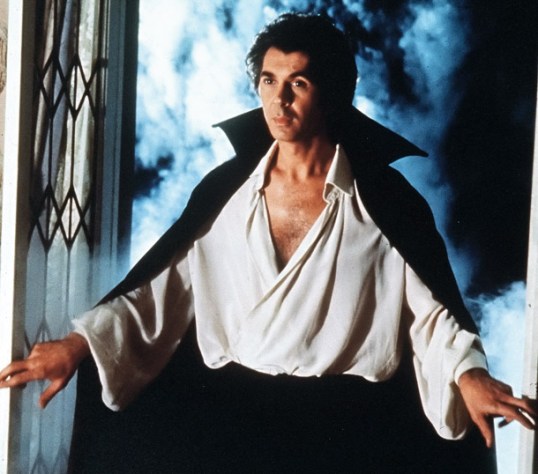
In this version of Dracula, the title character is played by a youngish Frank Langella.  I have to admit that it was a bit odd to see Langella playing someone other than a corrupt authority figure.  Dare I say it, Langella is almost sexy in this film and his somewhat feral features are perfect for a character who considers wolves to be “the children of the night.”  Langella’s performance falls between the haughty charm of Bela Lugosi and the animalistic fury of Christopher Lee.  And while Langella’s performance never quite reaches the heights of those two actors, he’s still effectively cast.

As for the film itself, it starts with a shipwreck near a local asylum.  One of the passengers on that ship is the charming but mysterious Count Dracula.  Dracula introduces himself to the head of the asylum, Dr. Jack Seward (Donald Pleasence, stealing almost every scene in which he appears).  There’s an immediate attraction between Dracula and Seward’s daughter, Lucy (Kate Nelligan).  That does not amuse Lucy’s fiancee, Jonathan Harker (Trevor Eve, who is perhaps the whiniest Harker in film history).

Meanwhile, Lucy’s best friend, Mina (Jan Francis), has been taken ill and it might have something to do with the two puncture marks on her neck.  After Mina dies, her father (played by Laurence Olivier) comes to investigate.  Her father’s name?  Abraham Van Helsing.

As I said, I was not expecting much from this version of Dracula so I was actually pleasantly surprised during the first hour of the film.  This version gets off to a nice start, with director John Badham giving us a mix of lush romanticism and gothic moodiness.  I’ve already talked about Langella’s performance but  Donald Pleasence and Laurence Olivier also distinguish themselves.  It’s obvious that these veteran performers enjoyed playing opposite each other and there’s a lot of pleasure to be found from watching Pleasence and Olivier compete to see who can steal the most scenes.

Unfortunately, after that strong first hour, Dracula slows down.  Once Seward and Van Helsing know that Dracula is a vampire, the whole movie becomes about finding excuses for them to not do anything about it.  The final 40 minutes feel almost like filler and, at one point, you’re required to believe that an elderly man, who has been seriously wounded, could still find the strength to swing a hook into a much stronger person’s back.

In the end, the 1979 Dracula is more of an intriguing oddity than a definitive version.
Embracing the Melodrama Part II #13: Rebecca (dir by Alfred Hitchcock)


Rebecca_1940_film_poster

Well, here we are, less than a week into Embracing the Melodrama, Part II, and I’m already running behind!  The plan, as I mentioned back on Monday, is to review 128 melodramatic films over the next three weeks.  And, even though I know that sounds a like a lot, I had it all planned out so that I’d be able to get all that done in just 21 days.  All I had to do was make sure that I reviewed 6 films a day.

And …

Well, life happened.

But no matter!  It may now take me 3 and a half weeks to review 128 films but that’s no great tragedy.  And besides, regardless of how long it takes, I’ve got some pretty good films scheduled.

Take, for instance, the 1940 best picture winner Rebecca.

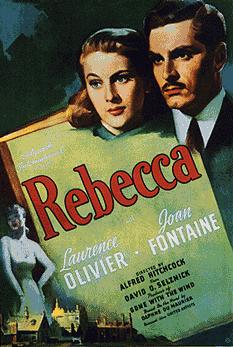
Rebecca is a film that all women can relate to.  The heroine is played by Joan Fontaine.  I say “heroine” because we never actually learn the character’s name, nor do we learn much about her background.  When we first see her, she’s defined by her job, which is to basically be a paid companion to a wealthy woman.  Later, she’s defined by her whirlwind romance with the brooding and aristocratic widower Maxim de Winter (Laurence Olivier).  When, after two weeks, they get married, she becomes known  as the second Mrs. de Winter.  She becomes defined by both who she married and who she is not.

She’s not Rebecca, the first Mrs. de Winter.

As soon as Maxim takes his new wife to his estate, the second Mrs. de Winter discovers that she’ll always live in the shadow of the deceased Rebecca.  Everyone she meets describes Rebecca as being a vibrant, lively figure — in other words, the complete opposite of the meek second Mrs. de Winter.  The coldly imperious housekeeper, Mrs. Danvers (Judith Anderson), has perfectly preserved Rebecca’s room and makes little attempt to hide the scorn that she feels for the second Mrs. de Winter.  Even worse, once they return to the estate, Maxim reveals himself to be moody and tempermental.  With the help of the manipulative Mrs. Danvers, the second Mrs. de Winter becomes convinced that Maxim will never love her as much as he loved Rebecca.

Making things even more complicated, a man claiming to be Rebecca’s cousin comes by the house when Maxim is away.  Jack Flavell (played by George Sanders, at his most serpent-like) suggests that there may have been more to Rebecca’s death than the second Mrs. de Winter was originally told…

Rebecca is a classic film, for many reasons.  It’s well-acted, with Fontaine, Olivier, Anderson, and Sanders all bringing their characters to vibrant life.  It’s a gothic romance.  It’s a thriller.  It’s a mystery.  It is the epitome of old Hollywood style.  But, for me, the main reason that Rebecca is a classic is because it tells a story to which almost everyone can relate.  Every relationship that I’ve ever had, I’ve always been curious and occasionally even jealous of who came before me.  There’s nothing more intimidating than living in the shadow of someone who you will never get a chance to meet personally.  The second Mrs. de Winter’s insecurities are everyone’s insecurities and, in some fashion or another, we’ve all had a Mrs. Danvers in our life.  The second Mrs. de Winter’s struggles are our struggles and, as she grows stronger, the viewer grows stronger with her.

Alfred Hitchcock is one of the most influential and acclaimed filmmakers of all time but he never won a directing Oscar.  Rebecca was the only one of his films to win Best Picture.  Producer David O. Selznick brought Hitchcock over from England to direct Rebecca and it’s been reported that Hitchcock resented Selznick’s interference.  (And, while Rebecca is undoubtedly a good film that was directed by Alfred Hitchcock, it’s not exactly a Hitchcock film in the way that Shadow of a Doubt, Rear Window, or Vertigo are Hitchcock films.)  As a result, Hitchcock subsequently made it a point to edit future pictures in camera so that the studios would not be able to re-edit his films.

But, whether you consider it to be a Hitchcock picture or a Selznick production, Rebecca remains a wonderfully watchable melodrama.

Lisa Reviews The Oscar Nominees: Nicholas and Alexandra (dir by Franklin J. Schaffner)


Nicholas_and_Alexandra-831476012-large

(Depending on how much you know about world history, the review below may contain spoilers.)

It was nearly four years ago that I decided that my goal in life was to watch and review every single film — no matter how obscure or potentially disappointing — that had ever been nominated for best picture.  Of course, that’s not my only goal.  If anything, I may have too many, often contradictory goals in my life.  But seeing all of the best picture nominees was definitely one of them and, all these years later, it’s a goal that I’m still trying to achieve.  With the help of TCM and their nonstop schedule of movies made long before I was born, it’s also a goal on which I am slowly but surely making progress.

Last night, as I scrolled through the guide, I noticed that TCM would be showing Nicholas and Alexandra, a three and a half hour film from 1971.  Now normally, I would be hesitant about watching a film that long, if just because I have ADHD and I doubt I’d be able to concentrate on it.  In a theater, watching the action unfold on a big screen, it wouldn’t be a big deal.  However, it’s totally different when you’re talking watching a movie on TV in a house that is full of potential distractions.  Add to that, Wednesday night is when I usually watch shows like Survivor, Hell’s Kitchen, and South Park.

But, here’s the thing.  The title Nicholas and Alexandra sounded familiar to me and not just because I’m an obsessive history nerd.  I did some checking and I discovered that, regardless of how obscure the film may be today, Nicholas and Alexandra was nominated for best picture.  It lost to The French Connection but it was nominated.

So, of course, I had to watch it.

And you know what?

NA

It’s not a terrible movie.  It’s certainly not great.  It has multiple flaws and it’s hard to imagine this film being nominated alongside films like The French Connection, Last Picture Show, and A Clockwork Orange.  Watching the movie, I got the feeling it was probably nominated because it was a big, expensive epic and not because it was one of the best of the year.  But, if you stick with the film (which, if we’re going to be honest here, is much easier said than done), it’s not quite as disappointing as you might expect it to be.

Nicholas and Alexandra tells the story of the last monarch of Russia, Tsar Nicholas II (Michael Jayston).  Struggling to escape the shadow of his father and incapable of understanding what life is like for those not born into royalty, Nicholas is portrayed as being well-meaning but autocratic and blind to the fact that the days of royalty are rapidly coming to an end.  His wife, Alexandra (Janet Susman) is also unpopular with both the Russian citizenry and the royal court on account of being German.

Alexandra spends most her time doting on her youngest son, Alexei, who suffers from hemophilia.  When a flamboyant Serbian monk named Rasputin (Tom Baker) claims that he has the power to heal Alexei, Alexandra immediately brings him into the court.  Soon, rumors are flying across Russia about Rasputin’s relationship with Alexandra.

Meanwhile, men with names like Lenin (Michael Bryant), Trotsky (Brian Cox), and Stalin (James Hazeldine) are plotting to lead a “worker’s revolution…”

If you know anything about history, it’s not really a spoiler to reveal what happens in the second half of Nicholas and Alexandra.  (And if you’re not into history, you probably would not have any interest in watching the movie in the first place.)   Archduke Franz Ferdinand is assassinated, plunging the entire world into war.  Russia declares war on Germany and the German-born Alexandra becomes even more unpopular than before.  The rest of the royal court, jealous over the mad monk’s influence, plots against Rasputin.  The Tsar is forced from the throne and Nicholas and his family spend their last days as captives of the people they once ruled.  Now a powerless prisoner, Nicholas finally starts to understand the world beyond his palace walls.  However, in the end, Nicholas, Alexandra, their children, and their loyal servants are taken into a small room and violently executed.  End of movie.

NA2

So, there are a lot of things wrong with Nicholas and Alexandra.  Not the least of the film’s problem is an unwieldy length and generally slow pace.  (The film was directed by Franklin J. Schaffner, who also directed the still-fun original Planet of the Apes.  Little of the flair he brought to Planet of the Apes is present here.)  This is one of those films that is full of incident with various characters popping up and discussing the intricacies of international politics with little concern as to whether or not any of this is the least bit cinematic or even compelling on a narrative level.  The film has a huge cast but very few memorable characters.

Even worse is that neither Nicholas nor Alexandra never come across as being all that interesting.  The film makes the case that Nicholas’s downfall was largely a result of him being unlucky enough to rule at a time when people across Europe and Asia were rejecting the old ways for the new ways of revolution and industrialization.  Nicholas is continually portrayed as being well-meaning but isolated and that has the potential to be interesting but, at times, the film feels almost as emotionally detached as its characters.

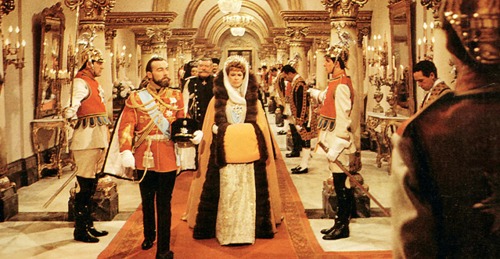
That said, Nicholas and Alexandra does work as a spectacle, as a showcase for beautiful clothing and ornate scenery.  As a character study, Nicholas and Alexandra largely fails but, as a fashion show, it’s actually a lot of fun.    Early on in the film, there’s a lengthy sequence in which Nicholas and Alexandra walk down the red-carpeted hallways of their palace.  It’s shot through Nicholas’s eyes and we see a collection of guards and noblemen and women standing to the side and bowing their heads as the Tsar and his wife walk past.  It’s a good scene and one that perfectly shows not only the life that Nicholas is used to but also why Nicholas doesn’t want to change that life.

baktna03

Perhaps not surprisingly, the first two hours of Nicholas and Alexandra work best when they focus on the flamboyant character of Rasputin.  Baker does a really go job as Rasputin, delivering all of his lines with a ferocious intensity while staring with obviously unhinged eyes.  When he’s with Alexandra, Rasputin is calculating and coldly conniving, providing just enough comfort to keep her under his control.  When he’s with Nicholas or any of the other male members of the court, he reveals himself to be an arrogant libertine, making profane jokes and bragging about his conquests.  It’s a really good performance but, as with so many other good performances in this film, it occasionally gets lost in the film’s dense production.

The best moments of Nicholas and Alexandra come towards the end, with the humbled Nicholas finally revealing his humanity and the Tsar’s family struggling to maintain their dignity even as their inevitable fate approaches.  At this point, the performers came to life.  The film suddenly had an emotional resonance.  It finally became about something!  For those final 20 or so minutes, Nicholas and Alexandra suddenly seemed worthy of being awarded.

In fact, based on those final 20 minutes, I would even be willing to see a sequel called Nicholas and Alexandra and Rasputin Makes Three.  

(Though I’m not sure how that sequel could ever be made.  As @Kev1Media pointed out when I suggested it on twitter, Adam Sandler would have to be somehow involved.)

As for Nicholas and Alexandra, it’s not a great film but if you’re into history or you’re an Oscar completist like me, the film has its occasional charms.  You just have to be willing to look for them.

Nicholas and Alexandra

Review: A Bridge Too Far (dir. by Sir Richard Attenborough)


1977 a bridge too far

“Well, as you know, I always felt we tried to go a bridge too far” — Lt. Gen. Frederick Browning

With the recent passing of Sir Richard Attenborough I decided to bring up one of the films which first brought his name to my attention. I was quite the young lad when I first saw Attenborough’s epic war film A Bridge Too Far. I would say that it was one of my earlier memories of watching a film with my father who was a major fan of war films. One could say that I got my appreciation and love for the genre from him.

A Bridge Too Far was adapted from the Cornelius Ryan book of the same name which depicted from start to finish the disastrous World War II battle known as Operation Market Garden. The film states that the Allied landings at Normandy, France in the summer of 1944 had the German forces reeling and on the verge of collapse. With Eisenhower having to choose between competing plans to chase Hitler’s forces right into Berlin from his two best generals in George S. Patton and Bernard Montgomery, the film already lays down something that’s become synonymous with military disasters throughout history. Political expediency and pressure on Eisenhower led to an operation that was never attempted in military history and one which required every aspect of the operation to go according to plan for it to work. As the film would show this was not meant to be.

The film begins with the operation’s early days as Allied commanders rush to put Montgomery’s plan to drop 35,000 paratroopers behind German lines in occupied-Netherlands in order to capture and hold key bridges until Allied armored forces arrived to reinforce them. It’s a daring plan that the Attenborough films with a obvious confidence and enthusiasm, but also one that already showed some nagging doubts from field commanders who would be in the thick of the fighting if intelligence reports were inaccurate. One could almost say that Attenborough was making the film a sort of anti-war message which was a rarity when it came to Hollywood and and film industry depicting the events of World War II at the time.

While the film does explore that very anti-war theme throughout it’s really a by-product of how the battle itself unfolds and shown to the viewers that might give one such an idea. Yet, in the end A Bridge Too Far was a much more complicated film to just be labeled as an anti-war film. Yes, the battle itself was a disaster for the Allied forces of American, British and Polish soldiers involved, but despite the political bumbling and military arrogance of those who command from behind a desk, the film actually does a great job of showing that bond soldiers earn when confronted with the horrors of battle.

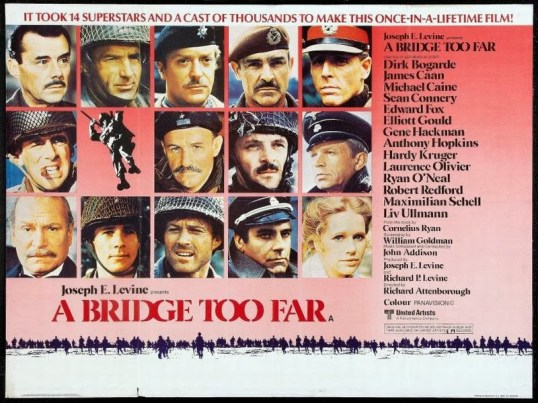
Attenborough and producer Joseph E. Levine pulls together an all-star cast for the film with names such as Sean Connery, Edward Fox, Robert Redford, Michael Caine and Laurence Olivier just to name a few. Films such as A Bridge Too Far rarely get made anymore in this day and age. The cast itself is part of the reason why the film still holds up to scrutiny decades after it’s release. While all-star casts such as this seemed to have been common place before the 1980’s it still looked like a daunting task for Attenborough to manage so many Hollywood stars and veteran British actors. Every character from Hopkin’s Col. Frost, Connery’s Gen. Urquhart and Redford’s Maj. Cook get to shine in their sections of the film as their individual stories about the battle all tie-in together to show just how complicated the events that they were filming truly turned out to be.

At times, one almost could feel overwhelmed by the amount of recognizable names and faces that come across the screen, yet Attenborough and producer Levine were able to juggle not just the logistics of the film’s screenplay, but the egos and reputation of the very stars who would become the backbone of the film.I think in a lesser filmmaker A Bridge Too Far could easily have turned into the very Operation Market Garden it was trying to depict.

It’s a film that never celebrates the concept of war itself, but actually shows that war remains a bloody and chaotic affair that relies not just on planning and execution but on the whims of lady luck. While Attenborough’s film never reached the sort of iconic status that another Cornelius Ryan adapted film has attained in The Longest Day, it does remain the more powerful of the two as it doesn’t just explore the historical event as a sort of academic exercise, but as an exploration of that old military adage of “No plan survives contact with the enemy”.

So, in the end I recommend that those looking to watch and experience the earlier directorial works of Sir Richard Attenborough should check out A Bridge Too Far. It remains to this day one of his more underappreciated films especially when compared to his later more acclaimed films like Gandhi, Chaplin and Shadowlands.

A Quickie With Lisa Marie: My Week With Marilyn (dir. by Simon Curtis)


My Week With Marilyn is apparently based on a true story. 

We know this because the film not only uses the opening title card to tell us that the story is true but the movie itself is narrated by Colin Clark (played by Eddie Redmayne) and Colin tells us pretty much the same thing, over and over again. (Seriously, this film reminded me of why I usually don’t care much for first person narration.)  Anyway, the film takes place in the late 1957.  Colin is the 3rd Assistant Director, working with Laurence Olivier (a haughty and pompous yet oddly touching performance from Kenneth Branagh) on a film called The Prince and the Showgirl.  The film stars Marilyn Monroe (Michelle Williams) who quickly starts to annoy Olivier when it becomes obvious that she’s painfully insecure, self-destructive, and dominated by her agent, acting coach, and cold husband.  Colin, however, is smitten with Marilyn and, despite the ominous warnings delivered by everyone else in the film, he soon finds himself falling in love with her and giving this film a title by spending a week with Marilyn.

My Week With Marilyn has been getting a lot of attention lately because many Oscar watchers are expecting to see Michelle Williams receive a Best Actress nomination for her performance as Marilyn Monroe.  Lately, Kenneth Branagh has become something of a dark horse for a best supporting actor nomination and personally, I would say that Julia Ormond (as a paranoid Vivien Leigh) and Judi Dench (as a supportive actress) both deserve some consideration as well. 

The film is ultimately dominated by Michelle Williams and it works whenever she’s on-screen. (And, unfortunately, it pretty much falls apart whenever she’s not.)  Williams has the daunting job of playing an icon here and she manages to be both believable as an icon and as a very fragile and poignant human being.  The script, to be honest, doesn’t give her much help.  As written, Marilyn is alternatively presented as being a helpless damsel in need of a white knight, a calculating seductress who threatens to lead Colin off of the straight and narrow path (represented here by Emma Watson as the girl that Colin treats quite badly)  and a convenient symbol of a lost age.  The brilliance of Michelle Williams is in how she manages to use these three conflicting characterizations to create one very believable Marilyn Monroe.

The main problem with this film is that it’s not called Marilyn.  Instead, it’s My Week With Marilyn and, as a result, the film is actually about the male gaze of the “My” of the title.  As good a performance as Williams gives, it’s hard to avoid the fact that, as far as this film is concerned, Marilyn ultimately exists just to teach Colin a few life lessons.  Unfortunately, as a character, Colin Clark is so thinly written that he’s never all that compelling and, as the film progresses, it’s hard not to feel that he’s ultimately using Marilyn just as surely as everyone else is. 

(In all honestly, however, I have to admit that one of my issues with Colin is that he’s played by Eddie Redmayne.  Don’t get me wrong, Redmayne is a good actor and he manages to make Colin almost likable but I simply cannot look at him without flashing back to Redmayne’s performance in Savage Grace.  That’s the movie where he plays a schizophrenic who has an incestuous relationship with his mother (Julianne Moore) before murdering her.  Redmayne was so effectively creepy in that film that, as unprofessional as it may be for a film critic, I had a hard time accepting him in the role of white knight.)  

I’ve read a lot of reviews that have complained that this film is basically just a big budget Lifetime Movie and, in many ways, it is.  Director Simon Curtis is a veteran of television and the film has the crisp but flat look of a tv show.  But even more than just the cinematography, My Week With Marilyn feels like a TV movie because its script hesitates to raise any issues that can’t be resolved in two hours.  That said, it’s really not sordid or silly enough to be a great Lifetime movie and it’s far too well acted to be a waste-of-time.  Ultimately, this is a flawed film that deserves to be seen for its performances.  If only the entire film was as compelling and interesting as the performances of Kenneth Branagh, Julia Ormond, and especially Michelle Williams.

What could have been: The Godfather


I don’t know about you but I love to play the game of “What if.”  You know how it works.  What if so-and-so had directed such-and-such movie?  Would we still love that movie as much?  Would so-and-so be a star today?  Or would the movie have failed because the director was right to reject so-and-so during preproduction?

I guess that’s why I love the picture below.  Taken from one of Francis Ford Coppola’s notebooks, it’s a page where he jotted down a few possibilities to play the roles of Don Vito, Michael, Sonny, and Tom Hagen in The Godfather.  It’s a fascinating collection of names, some of which are very familiar and some of which most definitely are not.  As I look at this list, it’s hard not wonder what if someone like Scott Marlowe had played Michael Corleone?  Would he had then become known as one of the great actors of his generation and would Al Pacino then be fated to just be an unknown name sitting on a famous list?

(This page, just in case you happen to be in the neighborhood , is displayed at the Coppola Winery in California.)

The production of the Godfather — from the casting to the final edit — is something of an obsession of mine.  It’s amazing the amount of names — obscure, famous, and infamous — that were mentioned in connection with this film.  Below is a list of everyone that I’ve seen mentioned as either a potential director or a potential cast member of The Godfather.  Consider this my contribution to the game of What If….?

Director: Aram Avankian, Peter Bogdonavich, Richard Brooks, Costa-Gravas, Sidney J. Furie, Norman Jewison, Elia Kazan, Steve Kestin, Sergio Leone, Arthur Penn, Otto Preminger, Franklin J. Schaffner, Peter Yates, Fred Zinnemann

Don Vito Corleone (played by Marlon Brando): Melvin Belli, Ernest Borgnine, Joseph Callelia, Lee. J. Cobb, Richard Conte, Frank De Kova, Burt Lancaster, John Marley, Laurence Olivier, Carlo Ponti, Anthony Quinn, Edward G. Robinson, George C. Scott, Frank Sinatra, Rod Steiger, Danny Thomas, Raf Vallone,  Orson Welles

Michael Corleone (played by Al Pacino): John Aprea, Warren Beatty, Robert Blake, Charles Bronson*, James Caan, David Carradine, Robert De Niro, Alain Delon, Peter Fonda, Art Genovese, Dustin Hoffman, Christopher Jones, Tommy Lee Jones, Tony Lo Bianco, Michael Margotta, Scott Marlowe, Sal Mineo, Jack Nicholson, Ryan O’Neal, Michael Parks, Robert Redford, Burt Reynolds, Richard Romanus, Gianni Russo, Martin Sheen, Rod Steiger**, Dean Stockwell

Sonny Corleone (played by James Caan): Lou Antonio, Paul Banteo, Robert Blake, John Brascia, Carmine Caridi, Robert De Niro, Peter Falk, Harry Guardino, Ben Gazzara, Don Gordon, Al Letteiri, Tony LoBianco, Scott Marlowe, Tony Musante, Anthony Perkins, Burt Reynolds***, Adam Roarke, Gianni Russo, John Saxon, Johnny Sette, Rudy Solari, Robert Viharo, Anthony Zerbe

Tom Hagen (played by Robert Duvall): James Caan, John Cassavettes, Bruce Dern, Peter Donat, Keir Dullea, Peter Falk, Steve McQueen, Richard Mulligan, Paul Newman, Jack Nicholson, Ben Piazza, Barry Primus, Martin Sheen, Dean Stockwell, Roy Thinnes, Rudy Vallee****, Robert Vaughn, Jerry Van Dyke, Anthony Zerbe

Kay Adams (played by Diane Keaton): Anne Archer, Karen Black, Susan Blakeley, Genevieve Bujold, Jill Clayburgh, Blythe Danner, Mia Farrow, Veronica Hamel, Ali MacGraw, Jennifer O’Neill, Michelle Phillips, Jennifer Salt, Cybill Shepherd, Trish Van Devere

Fredo Corleone (played by John Cazale): Robert Blake, Richard Dreyfuss, Sal Mineo, Austin Pendleton

Connie Corleone (played by Talia Shire): Julie Gregg, Penny Marshall, Maria Tucci, Brenda Vaccaro, Kathleen Widdoes

Johnny Fontane (played by Al Martino): Frankie Avalon, Vic Damone*****, Eddie Fisher, Buddy Greco, Bobby Vinton, Frank Sinatra, Jr.

Carlo Rizzi (played by Gianni Russo): Robert De Niro, Alex Karras, John Ryan******, Sylvester Stallone

Virgil “The Turk” Sollozzo (played by Al Letteiri): Franco Nero

Lucas Brasi (played by Lenny Montana): Timothy Carey, Richard Castellano

Moe Greene (played by Alex Rocco): William Devane

Mama Corleone (played by Morgana King): Anne Bancroft, Alida Valli

Appollonia (played by Simonetta Steffanelli): Olivia Hussey

Paulie Gatto (played by John Martino): Robert De Niro*******, Sylvester Stallone

—-

* Charles Bronson, who was in his mid-40s, was suggested for the role of Michael by the then-chairman of Paramount Pictures, Charlie Bluhdorn.

** By all accounts, Rod Steiger – who was then close to 50 – lobbied very hard to be given the role of Michael Corleone.

*** Some sources claim that Burt Reynolds was cast as Sonny but Brando refused to work with him.  However, for a lot of reasons, I think this is just an cinematic urban legend.

**** Despite being in his 60s at the time, singer Rudy Vallee lobbied for the role of the 35 year-old Tom Hagen.  Supposedly, another singer — Elvis Presley — lobbied for the role as well but that just seems so out there that I couldn’t bring myself to include it with the “official” list.

***** Vic Damone was originally cast as Johnny Fontane but dropped out once shooting began and announced that the project was bad for Italian Americans.  He was replaced by Al Martino.

****** John P. Ryan was originally cast as Carlo Rizzi but was fired and replaced with Gianni Russo.  Ryan went on to play the distraught father in Larry Cohen’s It’s Alive.  Russo went on to co-star in Laserblast.

******* Robert De Niro was originally cast in this role but dropped out to replace Al Pacino in The Gang That Couldn’t Shoot Straight.  Pacino, incidentally, had to drop out of that film because he was given the role of Michael in The Godfather.