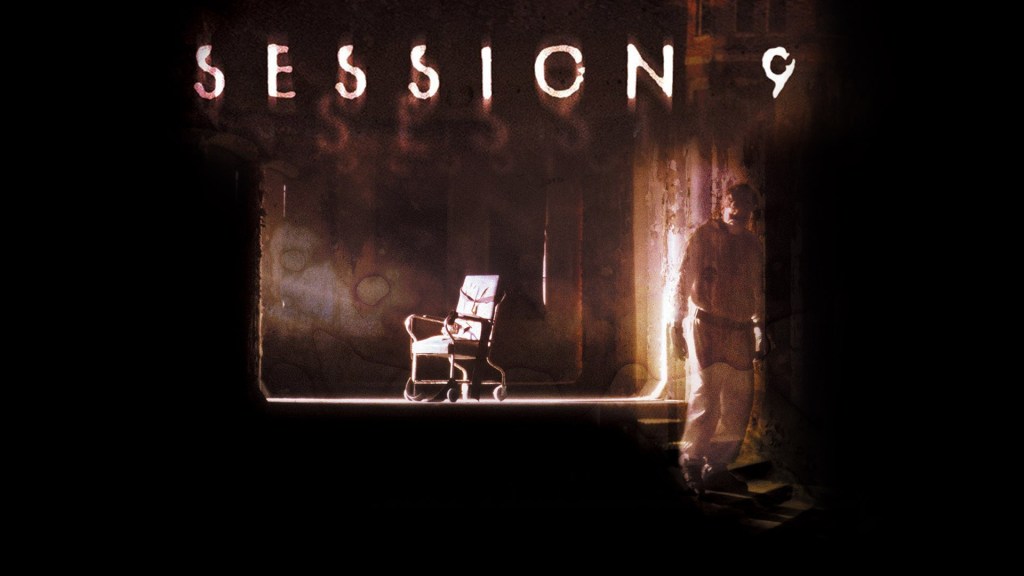
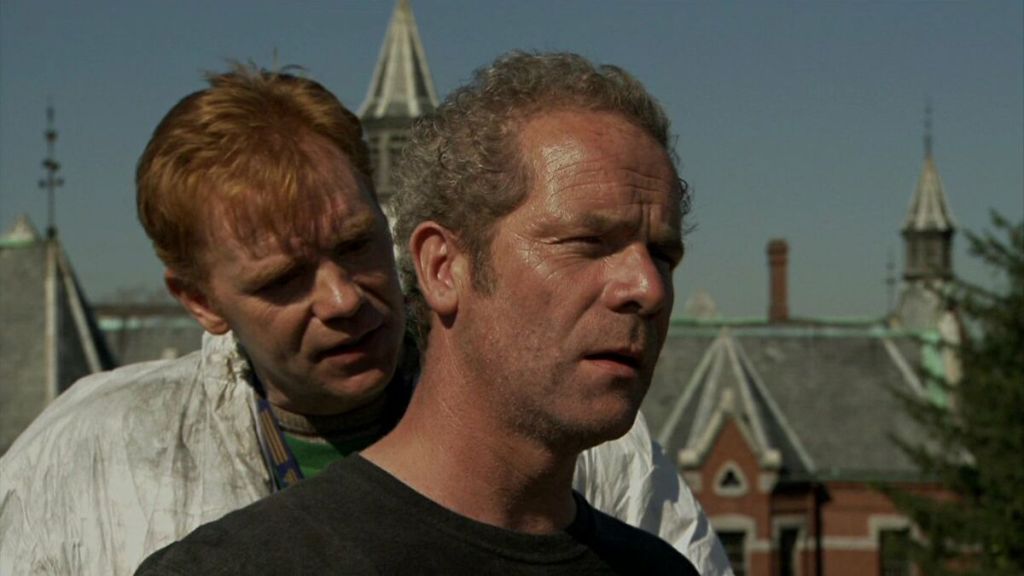
Brad reviews SESSION 9 (2001), starring David Caruso and Peter Mullan!


Gordon Fleming (Peter Mullan) the owner of a company that removes asbestos from old buildings, makes a bid for the work at the Danvers State Hospital in Massachusetts. In a desperate need for cash in his personal life, Gordon promises that his crew can complete the job in only one week, even though a job like this should normally take at least three weeks. His crew… Phil (David Caruso) is Gordon’s right hand man who tries to keep everyone else in line. This isn’t very easy these days considering that another member of the team is Hank (Josh Lucas), who’s currently “dating” (not the word Hank uses) Phil’s ex-girlfriend. The crew is rounded out by Mike (co-writer Stephen Gevedon), a law school dropout who seems to be way too smart to be doing this kind of work, and Jeff (Brendan Sexton III), Gordon’s nephew. As you might expect, once they begin the job, strange things start happening as the crew members find various items in the gigantic mental institution that once housed up to 2,400 people. Mike finds a box of tapes of nine therapy sessions detailing the case of Mary Hobbes, a patient with many personalities who may have murdered someone decades before. Meanwhile, Hank finds a stash of coins and other valuable items in one of the walls. A gambling addict, Hank goes back late that night when no one is around to collect his discovery. Things don’t go well and Hank doesn’t show up for work the next day. We’re led to believe that Hank has headed off to Florida for “casino school,” and this is where things start really getting weird as the pressure of the job and the strange events seem to be getting to the entire crew. When Jeff spots a very oddly acting Hank in the building a couple of days later, the sinister events at the Danvers State Hospital begin to completely unravel! 

Director Brad Anderson’s SESSION 9 is a creepy, slow burn that’s best described as a psychological horror film. It’s one of those movies where you can’t trust what you’re seeing on screen because the story is about the disturbed and damaged human mind. In my opinion, this is the most haunting kind of horror film because there are so many examples in the real world of mentally disturbed people committing horrific acts of violence. My wife has spent the last decade of her nursing career in the area of forensic psychology where she takes care of mentally ill individuals who have committed these types of horrible atrocities, often against the very people in their lives who take care of them. This is real world stuff. And the film’s setting, the actual Danvers State Hospital, also known as the Danvers Lunatic Asylum, in Danvers, Massachusetts, which operated from 1878 to 1992, adds a lot to the atmospheric feel of dread in the film. The Neo Gothic architecture of the facility, and the labyrinth of tunnels connecting the various buildings are a perfect setting for the creepy elements of Anderson’s story, and he takes full advantage of the location. The story and the setting set the stage for what feels like true terror, and I have to admit that SESSION 9 has stayed with me after my initial viewing. 

The cast of SESSION 9 is very effective. Though David Caruso receives top billing, the story really revolves around Gordon Fleming, portrayed by Peter Mullan. I primarily recognized Mullan from his interesting role as Jacob Snell in the excellent Netflix series OZARK, but he’s had quite a career as both an actor (TRAINSPOTTING, THE VANISHING) and director (THE MAGDALENE SISTERS). His quiet, internal performance is a solid anchor for the strange things going on around his crew. Caruso’s character is experiencing his own share of problems in his personal life, and the actor’s edgy intensity is a nice counterbalance to Mullan’s stillness. His life seems to be getting a little out of control and that dynamic works well for the moody paranoia of the film. Of the remaining performances, Josh Lucas seems to fair the best. His character isn’t really all that likable, but he does bring some humor to the role, and it’s ultimately the revelation of his character’s fate that begins to bring the story’s horrifying events to light. 

As I mentioned earlier, SESSION 9 is a slow burn of a film. Brad Anderson takes his sweet time setting the story up by introducing us to the dynamic of the main characters and placing them in the spectacular environment of the institution’s decaying buildings. It takes a bit for the doom and gloom to really start kicking in, so it’s possible that impatient or distracted viewers could lose interest as not much seems to be happening. I also wasn’t very surprised when the revelations of the story finally came to light. If you’re paying attention, the end moments of the movie aren’t as big of a “gotcha” as they could have been. But that’s all okay, because the brilliance of SESSION 9 is ultimately the mood it creates and the impending sense of dread we feel for the final discovery of what some of our characters may be capable of. In those aspects, SESSION 9 is a resounding success. 
October Hacks: The Ranger (dir by Jenn Wexler)


In 2018’s The Ranger, Chloe Levine gives a strong performance as Chelsea, a young woman who grew up visiting a remote cabin that was owned by her uncle, a reclusive writer.  Chelsea has never recovered from the mysterious death of her uncle.  (She says he was attacked by a wolf.)  Now, she’s a 20-something with pink hair.  She’s dating a wannabe punk rocker named Garth (Grant Lahu) and hanging out with Garth’s friends and bandmates, Abe (Bubba Weiler), Jerk (Jeremy Pope), and Amber (Amanda Grace Benitez).

Garth makes most of his money by dealing a drug called echo.  When the cops attempt to bust the group at a punk club, Garth reacts by stabbing a policeman.  Garth, Chelsea, Abe, Jerk, and Amber pile into their van and go on the run.  Their plan is to lay low until the heat dies down.  I don’t know how they’re planning on doing that in a van that is covered with graffiti and which has the word “ECHO” written on the side of it.

The group decides to hide out at Chelsea’s old cabin, which happens to be in the middle of a national park.  At the park, they run into a stern-faced park ranger (Jeremy Holm).  The Ranger tells them that, if they break any of the state park rules, he’ll have to come after them.  Everyone except for Chelsea laughs at the Ranger and they basically dare him to come arrest them.  The Rangers warns them that it’s hunting season and they need to wear bright clothing so they don’t get accidentally get mistaken for wildlife and shot.  Amber points at her blue hair and says that’s bright enough.  Jerk gives the Ranger the finger.  Garth smirks.  Uhmm …. aren’t these people supposed to be trying to hide from the law?  If you’re trying to lay low and not draw attention to yourself, why would you needlessly antagonize the first authority figure that you meet?  For that matter, why doesn’t anyone in this film change they’re very identifiable clothes?  Why doesn’t anyone cut their hair or do anything else that people do when they’re on the run?  Chelsea is fairly likable and I sympathized with her frustration over the way everyone in the movie treated her family’s cabin.  But Chelsea’s friends?  They’re not only obnoxious but they’re stupid as well.

Upon reaching Chelsea’s cabin, Garth immediately lights a cigarette in the living room.  Chelsea asks him not to smoke in the cabin.  Garth replies that nobody’s around who is going to care.  (Uhmm…. Chelsea cares, you idiot.)  Later, Garth and Amber decide to start a bonfire in the middle of the woods.  Again, these people are just amazingly stupid.  Fortunately, just when you feel that you can’t take much more of them, the Ranger starts killing them off.

The Ranger starts out strong.  Both Chloe Levine and Jeremy Holm give strong performances and many of the kills scenes are genuinely creative.  That said, I ended up getting a little bored once the focus shifted from the Ranger stalking Chelsea’s friends to the Ranger holding Chelsea prisoner.  Once the Ranger starts talking (and talking and talking) about his motives, he becomes a far less interesting and menacing character.  The Ranger is at its best when it focuses on being a wilderness slasher.

In the end, this film reminded me of why I don’t go camping.  You never know what might be in the woods.

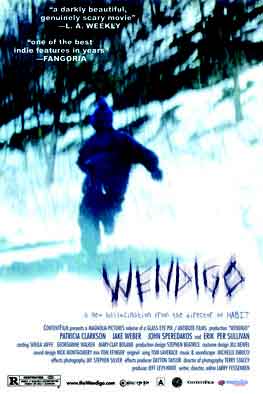
Horror Film Review: Wendigo (dir by Larry Fessenden)


The 2001 film, Wendigo, tells the story of a family in the Catskills.  Some families go to upstate New York and they hang out with the dance people and learn a lesson about tolerance, class conflict, and dirty dancing.  Others leave New York City and head up north because they’re trying to get away from the stress that comes from being a New Yorker.  The film is about the latter and, to be honest, I don’t blame them for leaving the city.  While it’s true that I don’t live in New York, I’ve seen enough clips of Bill de Blasio speaking to know that I also would want to get away from that 8 foot monster.

Of course, there are monsters in upstate New York as well.  Just as South Texas has to deal with chupacabras, it would appear that Upstate New York has a Wendigo problem.  According to the film, the Wendigo is a man who turned into a monster after committing cannibalism.  The Wendigo can assume any shape and …. well, it’s basically just a real bitch to be around, I guess.

At least, that’s how it inititally appears when George (Jake Weber) and his wife Kim (Patricia Clarkson) and their son Miles (Erik Per Sullivan) are just starting out their trip upstate.  George accidentally crashed into a deer and gets into with a local hunter named Otis (John Speredakos).  Otis is really upset that George took out that deer before he got a chance to.  George apologizes but it doesn’t seem to do much good.  Later, when the family reach their cabin …. well, things just continue to get out of hand.  Are they being harassed by the hunters or is it the Wendigo?

Or could it be both!?

As you may have guessed, I had a bit of a mixed reaction to Wendigo when I saw it.  On the one hand, I appreciated the way the film captured the feeling of isolation and there’s a few nicely surreal dream sequences.  If you’ve been reading this site for a while, you know how much I appreciate an effective and surreal dream sequence.  However, Wendigo is also a rather slowly-paced film.  It’s only 91 minutes long but it felt much longer and Otis is such a total caricature that it made it difficult for me to take his character seriously as either a hunter or, for that matter, a legitimate threat to anyone’s safety.  As a viewer, I took one look at Otis and I thought to myself, “There better be an actual monster in the film because if this guy is the villain, it’s going to be a long 90 minutes.”

As for the cast, Patricia Clarkson and Jake Weber were believable if not terribly interesting as the parents.  It was especially interesting to see Clarkson in a horror film, as this isn’t a genre with which one really associates her.  (Jake Weber at least has Medium on his resume.)  Erik Per Sullivan also did an okay job as Miles.  I was glad that he wasn’t as annoyingly precocious as a lot of a child actors tend to be.  The supporting cast is a mixed collection of performers who try too hard and those who don’t seem to be trying at all.

Wendigo has got some effective, Shining-influenced visuals and it ends on an appropriately ambiguous note.  The film has its moments but, ultimately, it was a bit too slow-paced and uneven for me.

Film Review: Hamlet (dir by Michael Almereyda)


What if Hamlet was a hipster douchebag?

That appears to be the question at the heart of the 2000 film adaptation of William Shakespeare’s most famous play.  In this adaptation, a young Ethan Hawke plays a Hamlet who is no longer a melancholy prince but who is instead a film student with a petulant attitude.

As you probably already guessed, this is one of those modern day adaptations of Shakespeare.  Denmark is now a Manhattan-based corporation.  Elsinore is a hotel.  Hamlet ponders life while wandering around a Blockbuster and, at one point, the ghost of his father stands in front of a Pepsi machine.  While Shakespeare’s dialogue remains unchanged, everyone delivers their lives while wearing modern clothing.  It’s one of those things that would seem rather brave and experimental if not for the fact that modern day versions of Shakespeare have gone from being daring to being a cliché.

At the film’s start, the former CEO of the Denmark Corporation has mysteriously died and his brother, Claudius (Kyle MacLachlan), has not only taken over the company but he’s also married the widow, Gertrude (Diane Venora).  Hamlet comes home from film school, convinced that there has been a murder and his suspicions are eventually confirmed by the ghost of his father (Sam Shepard).  Meanwhile, poor Ophelia (Julia Stiles) takes pictures of flowers while her brother, Laertes (Liev Schreiber), glowers in the background.  Polonius (Bill Murray) offers up pointless advice while Fortinbras (Casey Affleck) is reimagined as a corporate investor and Rosencrantz (Steve Zahn) wears a hockey jersey.  Hamlet spends a lot of time filming himself talking and the Mousetrap is no longer a player but instead an incredibly over-the-top short film that will probably remind you of the killer video from The Ring.

I guess a huge part of this film’s appeal was meant to be that it featured a lot of people who you wouldn’t necessarily think of as being Shakespearean actors. Some of them did a surprisingly good job.  For instance, Kyle MacLachlan was wonderully villainous as Claudius and Steve Zahn was the perfect Rosencrantz.  Others, like Diane Venora and Liev Schreiber, were adequate without being particularly interesting.  But then you get to Bill Murray as Polonius and you start to realize that quirkiness can only take things so far.  Murray does a pretty good job handling Shakespeare’s dialogue but that doesn’t change the fact that he’s totally miscast as the misguided and foolish Polonius.  One could easily imagine Murray in the role of Osiric.  Though it may initially seem a stretch, one could even imagine him playing Claudius.  But he’s simply not right for the role of Polonius.  Murray’s screen presence is just too naturally snarky for him to be convincing as a character who alternates between being a “tedious, old fool” and an obsequious ass kisser.

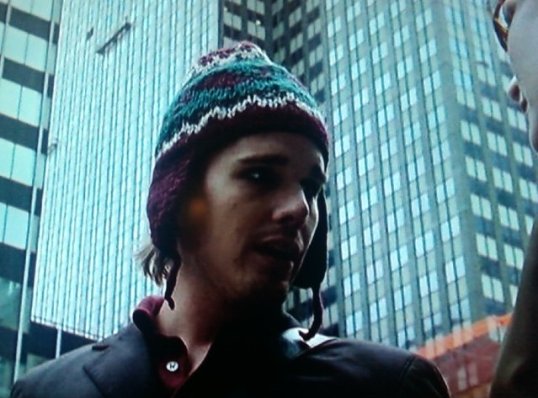
Considering that he spends a large deal of the movie wearing a snow cap while wandering around downtown Manhattan, Ethan Hawke does a surprisingly good job as Hamlet.  Or, I should say, he does a good job as this film’s version of Hamlet.  Here, Hamlet is neither the indecisive avenger nor the Oedipal madman of previous adaptations.  Instead, he’s portrayed as being rather petulant and self-absorbed, which doesn’t necessarily go against anything that one might find within Shakespeare’s original text.  Hawke’s not necessarily a likable Hamlet but his interpretation is still a credible one.

At one point, while Hamlet thinks about revenge, we see that he’s watching Laurence Olivier’s version of Hamlet on television.  There’s Olivier talking to Yorick’s skull while Hawke watches.  It’s a scene that is somehow both annoying and amusing at the same time.  On the one hand, it feels rather cutesy and more than a little pretentious.  At the same time, it’s so over-the-top in its pretension that you can’t help but kind of smile at the sight of it.  To me, that scene epitomizes the film as a whole.  It’s incredibly silly but it’s so unapologetic that it’s easy to forgive.

Playing Catch-Up: The Accountant, Carnage Park, The Choice, The Legend of Tarzan


Continuing my look back at the films of 2016, here are four mini-reviews of some films that really didn’t make enough of an impression to demand a full review.

http://www.youtube.com/watch?v=wmKtb-Pvpf4

The Accountant (dir by Gavin O’Connor)

2016 was a mixed year for Ben Affleck.  Batman v. Superman may have been a box office success but it was also such a critical disaster that it may have done more harm to Affleck’s legacy than good.  If nothing else, Affleck will spend the rest of his life being subjected to jokes about Martha.  While Ben’s younger brother has become an Oscar front runner as a result of his performance in Manchester By The Sea, Ben’s latest Oscar effort, Live By Night, has been released to critical scorn and audience indifference.

At the same time, Ben Affleck also gave perhaps his best performance ever in The Accountant.  Affleck plays an autistic accountant who exclusively works for criminals and who has been raised to be an expert in all forms of self-defense.  The film’s plot is overly complicated and director Gavin O’Connor struggles to maintain a consistent tone but Affleck gives a really great performance and Anna Kendrick reminds audiences that she’s capable of more than just starring in the Pitch Perfect franchise.

http://www.youtube.com/watch?v=6iVQLAGKPPE

Carnage Park (dir by Mickey Keating)

I really wanted to like Carnage Park, because it was specifically advertised as being an homage to the grindhouse films of the 1970s and y’all know how much I love those!  Ashley Bell plays a woman who gets kidnapped twice, once by two bank robbers and then by a psycho named Wyatt (Pat Healy).  Healy chases Bell through the desert, hunting her Most Dangerous Game-style.  There are some intense scenes and both Bell and Healy are well-cast but, ultimately, it’s just kind of blah.

http://www.youtube.com/watch?v=EmdHVSKhxhM

The Choice (dir by Ross Katz)

The Choice was last year’s Nicholas Sparks adaptation.  It came out, as all Nichols Sparks adaptations do, just in time for Valentine’s Day and it got reviews that were so negative that a lot of people will never admit that they actually saw it.  Benjamin Walker and Teresa Palmer play two people who meet, fall in love, and marry in North Carolina.  But then Palmer is in a car accident, ends up in a coma, and Walker has to decide whether or not to turn off the life support.

As I said, The Choice got terrible reviews and it’s certainly not subtle movie but it’s actually better than a lot of films adapted from the work of Nicholas Sparks.  Walker and Palmer are a likable couple and, at the very least, The Choice deserves some credit for having the courage not to embrace the currently trendy cause of euthanasia.  That alone makes The Choice better than Me Before You.

The Legend of Tarzan (dir by David Yates)

Alexander Skarsgard looks good without his shirt on and Samuel L. Jackson is always a fun to watch and that’s really all that matters as far as The Legend of Tarzan is concerned.  It’s an enjoyable enough adventure film but you won’t remember much about it afterward.  Christoph Waltz is a good actor but he’s played so many villains that it’s hard to get excited over it anymore.

Cleaning Out The DVR, Again #5: We Are Still Here (dir by Ted Geoghegan)


1-we-are-still-here

The fifth film on my DVR was the 2015 haunted house film, We Are Still Here.  I recorded We Are Still Here off of the SyFy channel on March 20th.  Sad to say, I really can’t remember what I was doing or watching on March 20th while my DVR recorded one of the best horror movies of the previous year.  I was probably watching something pn Lifetime.  That usually seems to be the case.

But anyway, let’s talk about We Are Still Here.

As a self-professed lover of both horror and old grindhouse exploitation films, there is really no excuse for it to have taken me this long to see We Are Still Here.  We Are Still Here is one of those wonderfully low-budget indie films that mixes a traditional genre — in this case, the haunted house film — with a far less traditional view of humanity.  With its mix of bump-in-the-dark horror and cynicism about human nature, We Are Still Here feels like a mix of the Coen Brothers and H.P. Lovecraft.

Anne (Barbra Crampton, a veteran of horror films like Castle Freak and You’re Next) and Paul (Andrew Sensenig, who played the mysterious antagonist of Upstream Color) are a married couple who are struggling to deal with tragedy.  Their son, Bobby, was recently killed in a car wreck.  Anne is trapped in a prison of depression, while Paul just wants to move on with their lives.  Hoping that it will help them to forget their sadness, Paul and Anne buy a house in New England.

(New England, not coincidentally, was also the home of H.P. Lovecraft, as well as being the setting for some of his best-remembered stories.)

But, of course, the house proves to be anything but therapeutic.  From the minute they move in, Anne is convinced that they are not alone.  With every mysterious sound and strange happening within the house, Ann becomes more and more convinced that the spirit of Bobby is with them.

If you’re a horror fan, you will not be surprised to learn that they are not alone.  There is a presence in the house but is it Bobby or is it something far more sinister?  Shortly after moving in, Anne and Paul meet their new neighbors.  As friendly as they may be, there is definitely something off about Dave (Monte Markham) and his wife, Cat (Connie Neer).  Dave tells them that the house was originally a funeral home an about how it was owned by the mysterious Dagmar family.  The Dagmars were reportedly forced to leave town after it was learned that they were selling the bodies brought to them for burial and burying empty coffins.  Could this have anything to do with the strange vibe that Anne and Paul both get from the house?

Despite Paul’s skepticism, Anne invites her friends, May (Lisa Marie) and Jacob (Larry Fessenden), to come for a visit.  May and Jacob are both spiritualists and Anne hopes that they can contact Bobby’s spirit.  Again, it’s not a spoiler to reveal that they do contact something.  The surprise comes from what they contact and what happens as a result.

We Are Still Here is a chilly and dream-like film, one that wisely devotes as much time to creating and maintaining a properly creepy atmosphere as it does to all the expected scare scenes.  When the presence in the house is finally revealed, it’s a scary moment but for me, the most haunting scenes in the film are the shots of the snow-covered landscape surrounding the house.  The icy roads are as cold and unforgiving and as potentially dangerous as anything that might be living in the old Dagmar house.  And, just as the weather cannot be controlled, neither can the paranormal.

We Are Still Here is a deliberately paced film.  In fact, it’s probably a bit too deliberate to really be effective when viewed with commercial interruptions.  We Are Still Here works because it creates an atmosphere of foreboding and certain doom and it’s hard to maintain an atmosphere when, every 20 minutes or so, the action has to stop for a commercial about Tide pods.  To best appreciate this film and what it has to say about loss, faith, and delusion, it’s necessary to watch the story unfold without any pause to the narrative.

Fortunately, this intelligent and well-acted horror film is currently available on Netflix, where it can be viewed without commercial interruption!  If you’re a horror fan, you owe it to yourself to watch.

We-Are-Still-Here

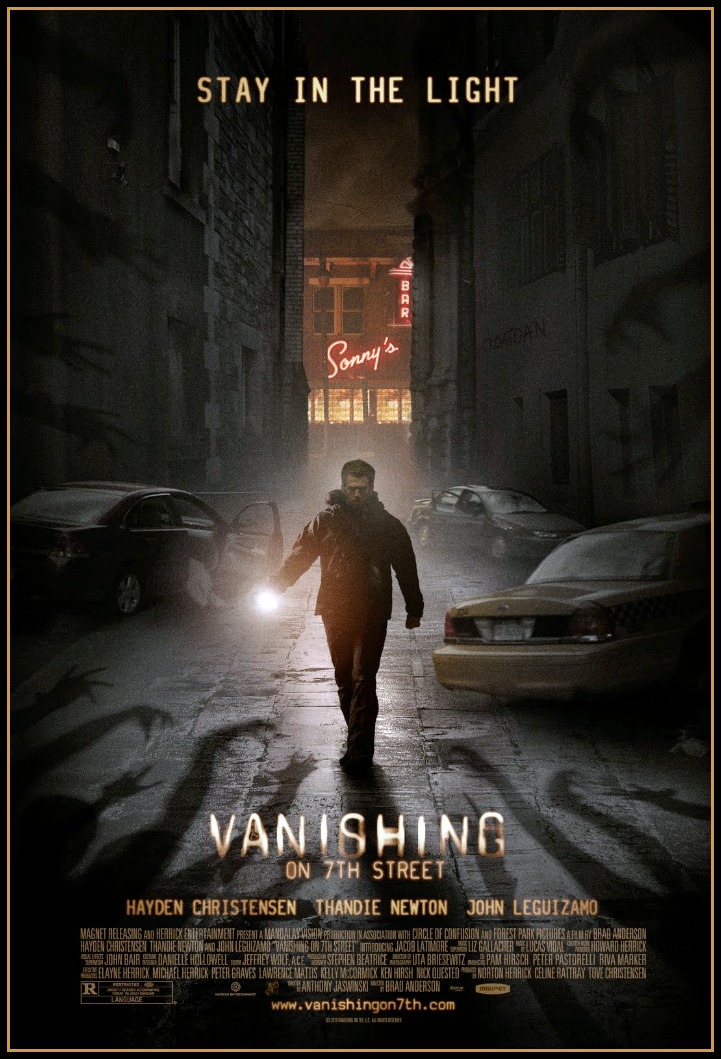
Review: Vanishing On 7th Street (dir. by Brad Anderson)


In the genre world of horror and thrillers there’s been one name who always seem to be on the verge of breaking out. He has done some exceptionally well-crafted horror and thrillers which never could get a mainstream audience to commit to but always gathering a cult-following upon their release. He has done some wonderful work as a TV director for such acclaimed shows as Fringe, Treme, Boardwalk Empire and The Wire. His best known work was a thriller collaboration with Christian Bale in The Machinist. While it’s a film more well-known for the extremes an actor was willing to go for to make their performance as authentic as possible it was also a film which showed style and talent in it’s filmmaker. The person I speak of is Canadian filmmaker Brad Anderson whose latest film was another low-budget horror-thriller which looks to be gaining a cult-following once again despite not being well-received by the mainstream critics. Vanishing On 7th Street was a film using the screenplay of Anthony Jaswinski which puts an interesting, claustrophobic and, at times, entertaining twist on the oft-used and well-ridden post-apocalyptic genre.

The film begins with film projectionist Paul in his projection booth reading up on the lost colony of Roanoke and the mysterious word left behind: CROATOAN. It’s through his point of view that we first see the beginning of what could be the end of the world as lights begin to flicker then go out throughout the theater and the mall it’s located in. Paul investigates this event only to discover sets of clothing and accessories where theater patrons and employees used to be in. With each passing moment the darkness — punctuated by just the flashlights of Paul and a lone mall security guard — becomes to take on an ominous tone before the film sudden moves ahead three days into what would become the major setting for the film: a lit bar on a deserted and darkened stretch of 7th Street in Detroit, Michigan.

We meet the rest of the main cast in this bar. There’s Luke who used to be a TV anchorman who discovers to his horror just what might have been the cause of the disappearance of most everyone in the world as he tries to find his girlfriend at the TV station they both worked at. It’s in these flashbacks to Luke’s early experience with the dark apocalypse that we see some of the most perfectly shot scenes of a major city devoid of life. An urban setting where the sudden disappearance of people during the power outage the night before has caused an eerie detritus of crashed vehicles, empty clothing and, in a sudden and violent sequence, a lone airline crashing in the background. It’s through Luke and the lone survivor in the bar, a 12-year old boy named James (Jacob Latimore), that we begin to try and piece together just what might have caused the event which continues to plague those left behind for the last three days.

The film posits the basic concept that darkness itself was the culprit for the disappearance of everyone and what continues to stalk those still left behind, alive and desperate for answers. While the film never really give definite answers as to the cause the two other characters in the back outside of Luke and James bring their own theories. There’s Rosemary (Thandie Newton), the distraught mother searching for her infant son, who thinks what’s going on around them is the the prophecized Rapture and those left behind were those who have sinned and were now being tormented for whatever sins they might have committed. On the other side is Paul from the beginning of the film who Luke rescues from an illuminated bus stop shelter who believes the very thing which caused the disappearance of the Roanoke colony during the 16th-century has now returned on a global-scale. His reasonings run the gamut of scientific causes from wormholes, black holes, gamma ray burst, nanotech gone amok and even an accident from a particle collider.

The audience are left to decide amongst themselves which explanation holds merit since neither one has enough backing to be the true answer. Vanishing On 7th Street leaves much of the questions raised by the dark apocalypse around these surviving characters to be left ambiguous and unanswered which at times becomes a detriment to the narrative as a whole. It’s a testament to Brad Anderson’s direction that the film was able to move past the apparent weaknesses in Anthony Jaswinski’s script and deliver a taut thriller (the film never truly gets to the level of horror) that just builds and builds with tension from beginning to an end that seemed almost too rushed.

With a low-budget and minimal cast the film tries to create some of the tension in the film be a construction of the differences between the four main characters. The actors were pretty game to try and make their characters more complex than what the script have provided, but in the end they still seem too basic for anyone of them to become sympathetic for the audience to truly care for their well-being. The film has to finally rely on just them as the last people on the planet as the main crux for the audience to latch onto. All the actors involved never become too cartoonish or stereotypical in their performance, but some of their decision-making in the middle and latter section of the film were too horror-typical, but they do add to the film’s many scenes of mounting terror as characters drop flashlights, lose light sources and other such problems with the living shadows in the darkness creeping up to try and take those still left. These scenes do look to be too stereotypical of other horror films but under Anderson’s direction there’s a palpable sense of claustrophobia and menace in these shadows.

What truly sells the film despite these flaws outside of Anderson’s direction would be the minimalist score by first-time film composer Lucas Vidal. His composition for the film were at once ominous and haunting. At times his score shows off hints of influences from the more doom-laden scores of Philip Glass. The other component of the film which definitely added to the atmosphere of inevitable doom to the film was Uta Briesewitz cinematography which made great use of darkness and solitary light sources to create islands of safety in a sea of encroaching terror we never truly comprehend. It’s the trifecta of Anderson’s directing, Vidal’s minimalist doom orchestration of a score and Briesewitz’s cinematography which gives Vanishing On 7th Street enough reasons to be a film which stands out as a fine piece of genre filmmaking despite weaknesses in the script.

Brad Anderson truly seem to be a filmmaker destined to remain in the fringes of mainstream cinema. His Vanishing On 7th Street continues to be another example of his great work in the horror-thriller genre. Despite same flaws which could turn off some of those who see this film it doesn’t diminish the fact that even at it’s worst this film was still an entertaining piece of post-apocalyptic work which brings some new ideas into the genre. Maybe a stronger treatment of the script would’ve made for a near-perfect thriller and one which could’ve had more horror to it, but Anderson was able to make a good enough film with an average script that I think deserves for this film to be seen by more people. For every horror remakes we get from Michael Bay’s Platinum Dunes to the latest in the Saw-like torture porn horror it’s good to see that such films as Vanishing On 7th Street exist to be the solitary beacon of light in a sea of cookie-cutter, by-the-numbers horror films that seem to dominate each film year after the other.