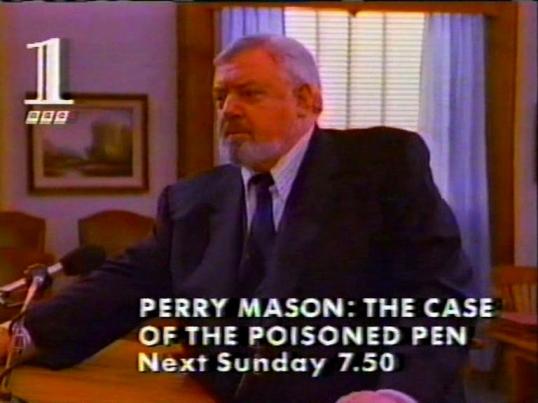
When an arrogant true crime writer named Bradley Thompson (David Warner) is poisoned while attending a writers conference, his ex-wife (Barbara Babcock) is arrested and charged with his murder. Perry Mason (Raymond Burr) and Ken Malansky (William R. Moses), who had their own run-in with Thompson, defend her in court and try to track down the real murderer.
This was a good whodunit. The mystery was pretty easy to solve but all of the suspects were memorable and the supporting cast, which included Cindy Williams, Tony Lo Bianco, and Earl Boen, were entertaining to watch. My favorite character was Max Mulgrew, a tough-guy crime writer who was played by Kiel Martin. When Mulgrew was asked if he hated Thompson enough to murder him, Mulgrew says yes but he would have shot him instead of poisoning him!
Amy Hastings, who Alexandra Paul played in the previous three movies, is not in this movie and nobody says anything about her so, hopefully, her character has moved on. Without Amy around, that means that Della (Barbara Hale) gets to help out with the investigation for once. It was nice to see Della showing why she was the best assistant that Perry could have ever hoped for.
I remember enjoying this movie when I watched it with my aunt a few years ago. I enjoyed it again when I watched it last night.
When I was a kid our family loved Kenny Rogers. I remember listening to songs like “Lucille,” “The Gambler,” “Daytime Friends,” “She Believes in Me,” and “Lady” on my dad’s vinyl records. I would have been no older than second or third grade, and me and my siblings would really belt out “You picked a fine time to leave me, Lucille.” But the one Kenny Rogers song that affected me more than any of the others was the “Coward of the County.” If you know the lyrics of the song, then you know what I’m talking about. As a kid of around 8 years old, the story about Tommy, Becky and the Gatlin Boys was a little more mature than what I was used to. I remember not even being sure what exactly happened to Becky, but I knew it was bad. I also remember a TV movie based on the song starring Kenny Rogers, so you know our family watched it.
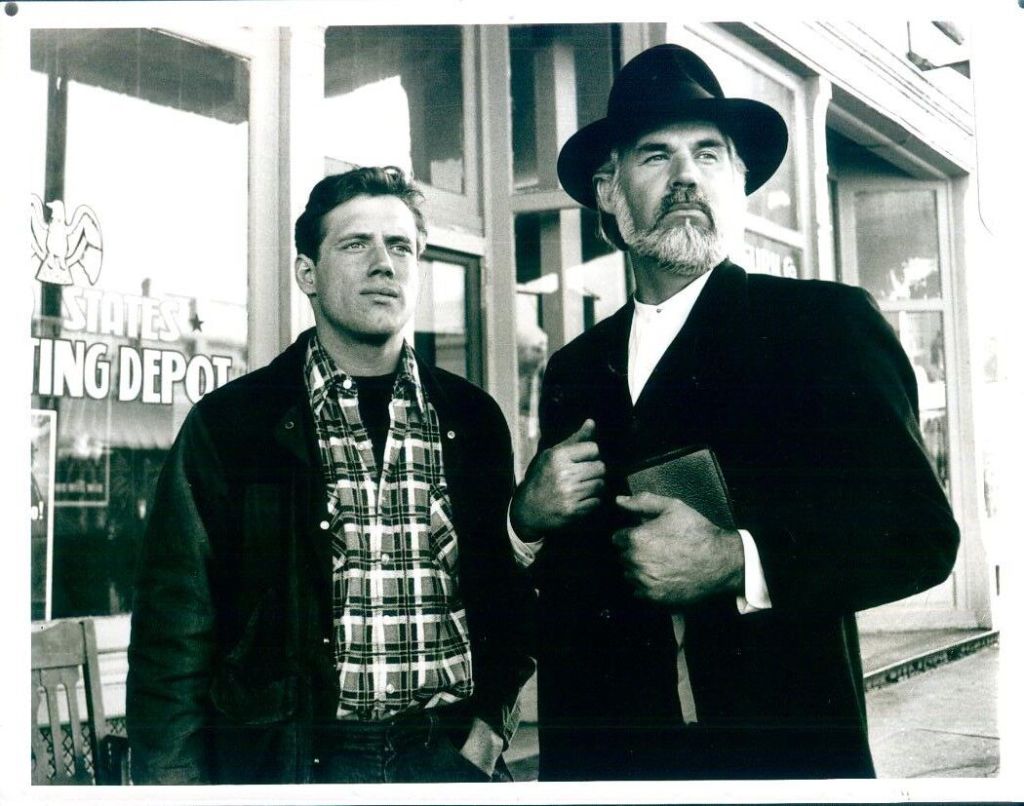
The TV movie premiered in 1981 and stars Kenny Rogers as Matt, a preacher who likes to drink, gamble, and cavort with the ladies. His nephew Tommy (Fredric Lehne) is a nice young man who already seems to have a bit of a reputation as someone you can push around. We learn this about Tommy at the town Christmas carnival when Jimmy Joe Gatlin wins a cake at a cake-walk (do y’all remember those things?) and proceeds to shove it in Tommy’s face. Tommy grabs Jimmy Joe by the arm to make him stop, but then he walks away without fighting back. It’s right after this confrontation between Tommy and Jimmy Joe that Matt makes an announcement to the crowd that the Japanese have just bombed Pearl Harbor, placing our story in 1941. Immediately the young men of the town, including Jimmy Joe Gatlin, start making their plans to join the military and head out for boot camp. And I tell you, this Jimmy Joe is a real jerk. Before he leaves, he tells the local beauty Becky that she’s “his” girl whether she likes it or not even though she’s telling him she’s not his girl. Jimmy Joe also stops to call Tommy a coward and ask him why he’s standing there with the men when he hasn’t even joined the military. We soon learn that Tommy has a very specific reason for not fighting. You see, his dad died in prison. He had to go to prison for killing another man in a fight, and before he passed he away, he asked his son to promise him that he would never fight. With the bully Jimmy Joe out of town, Tommy and Becky begin seeing each other and fall in love. That part of his life is happy, but everywhere Tommy goes he’s reminded that young men are fighting and dying for their country while he’s still at home. He really wants to keep his promise to his dad not to fight, but he feels he should fight for his country. After eight weeks, Jimmy Joe returns and tries to reclaim Becky as his girl. Becky tells him that she loves Tommy and they are getting married. Jimmy Joe doesn’t take the news well so he heads out and starts drinking. Full of drunken courage, he and his brothers head back to Becky’s house and he forces himself on her. When Tommy finds out what happened to Becky, he’s finally had enough and he confronts Jimmy Joe Gatlin and his brothers. He breaks his promise to his dad and beats the crap out of the Gatlin brothers. As the words of the song would say, “sometimes you have to fight to be a man.” Soon after, Tommy enlists in the service because with Becky he truly has something at home worth fighting for.
I’ll just start out by addressing the elephant in the room that Becky was raped by Jimmy Joe, and that’s what it took for Tommy to finally fight. I sure wish the cake to the face or the many times the Gatlin boys called him yellow would have been enough, but unfortunately it took something that horrible. I didn’t really understand all of this in 1981, and it’s pretty crazy that a mainstream country song told this story to be honest. Also, you might be surprised that Kenny Rogers is more of a peripheral character as the wandering preacher of the story. The main character, Tommy, is played by Fredric Lehne. He’s a likable actor who’s still very busy to this day on TV. I enjoyed seeing Lehne because he was very good in a movie that was filmed here in Arkansas called GREATER back in 2016. The movie tells the tragic, but inspirational story of Brandon Burlsworth, a former walk-on who became an All-American offensive lineman for the Razorbacks. Sadly, he died in a car accident in 1999 after being drafted to play professional football for the Indianapolis Colts. Lehne played an important role as a coach who helped get the very best out of Burlsworth. As a frequent attendee of Razorbacks home football games, I watched Burlsworth play many times in person and the whole state loved him. The news was devastating to our state, and the movie about his short, but very meaningful life is very special to me.
There were a couple of other things that I found interesting about COWARD OF THE COUNTY. First, I wondered if it was just a coincidence that the bad guys were the Gatlin Boys, especially considering that Larry Gatlin and his brothers were contemporary country music stars along with Kenny Rogers. According to the songwriters, they thought the Gatlin boys had a great ring to it and worked great for the song, better than anything else they could come up with. According to Larry Gatlin, he thinks they should have chosen a different name, but he was also a good friend with Kenny Rogers. Finally, the movie was partially filmed in Covington, GA, which has a very unique Courthouse with a large clock tower. Covington, which is about 35 miles east of Atlanta, is affectionately known as the “Hollywood of the South” due to the large number of movies and TV shows filmed there. To name just a few, THE CANNONBALL RUN, MY COUSIN VINNY, and the TV show THE VAMPIRE DIARIES were all filmed in Covington. My wife and I stayed the night in Covington on our way to Myrtle Beach in 2020 and visited the downtown area before we headed on. As soon as I saw that clock tower in COWARD OF THE COUNTY, I knew that it was filmed in Covington.
In 1980’s Stoned, Scott Baio plays Jack Melon, a teenager with a problem.
Jack is shy, awkward, and can’t escape the shadow of his older brother, Mike (Vincent Bufano). Mike is champion swimmer. Jack is someone who can barely walk down a hallway without walking into a wall. But then Teddy (Jack Finch) gets Teddy hooked on marijuana, the so-called weed with roots in Hell! Soon, Jack is acting weird, making strange jokes, and getting all of the attention in the world. Unfortunately, Jack is also alienating those closest to him and his newfound habit leads to a near-tragedy.
Stoned was aired as an ABC Afterschool Special and, while it’s not quite Reefer Madness, it does adhere to the general anti-drug formula. In record time, Jack goes from being shy and dorky to being goofy and potentially dangerous. We get all the expected scenes of Jack devouring ice cream, Jack wandering around in a daze, Jack realizing that the girl he likes what’s nothing to do with the new Jack, Jack’s well-meaning teacher (played by the show’s writer and director, John Herzfeld) confronting his students about their drug use, and Jack accidentally hitting his brother with an oar. Jack thinks that marijuana is opening his brain because, while stoned, he suddenly realizes that a tree looks like “Old Man Eber.” Stoned goes on to show Jack ruining his life but I have to admit that I spent most of the running time wondering who Old Man Eber was. (Seriously, Old Man Eber sounds like some sort of Lovecraftian ghoul, waiting in the shadows to drag one to an Arkham cemetery.) Of course, someone nearly dies as a result of Jack’s marijuana use. What’s interesting is Jack is able to save the person’s life, even though he’s stoned. Would non-stoned Jack have been able to do it?
From the fashion choices to the cast to the message that marijuana is the most dangerous thing on the planet, Stoned is one of those TV specials that epitomizes its time. This was a film that was made at a time when it was inconceivable that there would some day be commercials for edible gummies and it shows. Watching Stoned is like stepping into a time machine.
Today, of course, Scott Baio is better known for his politics than his acting. Whenever I see a headline that reads, “This veteran Hollywood star is calling out his industry for not understanding America,” I know the story is inevitably going to be about Scott Baio complaining about his taxes. That said, Scott Baio is convincing when he’s playing Jack as being awkward and insecure but he definitely goes a bit overboard once Jack starts smoking. While that probably dilutes the effectiveness of the film’s message (because, let’s be honest, real stoners are going to watch this and easily recognize the fact that Jack is trying way too hard to convince everyone that he’s stoned), it does give this film a certain entertainment value.
Here is Stoned, complete with the commercials that aired when the show was original broadcast on November 12th, 1980:
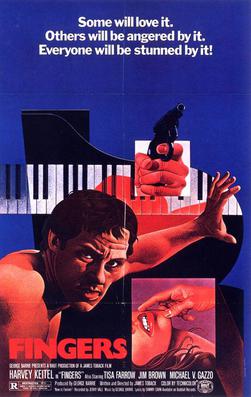
The 1978 film, Fingers, tell the story of Jimmy “Fingers” Angelilli (Harvey Keitel). Jimmy is a creep who works as a debt collector for his father, a small-time loan shark named Ben (Michael V. Gazzo). Jimmy is violent and brutal and often wanders around with a disturbingly blank-look on his face but we’re supposed to like him because he’s a talented pianist and he’s got a recital interview coming up at Carnegie Hall. Jimmy carries a radio with him wherever he goes and he’s obsessed with the song Summertime. He’s the type who will sit in a crowded restaurant and play the song and then get upset when someone tells him to turn off his radio. By the end of the movie, I was really hoping that someone would take Jimmy’s radio and smash into a hundred pieces.
Jimmy is in love with Carol (Tisa Farrow, who was a far better actress than her sister Mia and who would later appear in Lucio Fulci’s classic, Zombi 2), who doesn’t really seem to all that into him. Despite being in love with Carol, Jimmy still hits on every woman that he meets and, because this is a 70s films, he’s constantly getting laid despite being kind of a charmless putz.
Jimmy meets a former boxer named Dreems (Jim Brown). Carol is apparently one of Dreems’s mistresses. Jimmy silently watched while Dreems knocks two women’s heads together. Jimmy stands there with his little radio and a blank expression on his face. Is anything going on inside of Jimmy’s head? It’s hard to say.
Eventually, Jimmy finds out that a gangster (Tony Sirico) owes his father money but is refusing to pay. It all leads to violence.
As a film, Fingers is pretty much full of shit but that shouldn’t come as a surprise because it was the directorial debut of James Toback and there’s no American filmmaker who has been as consistently full of shit as James Toback. Fingers has all of Toback’s trademarks — gambling, crime, guilt, classical music, and a juvenile view of sexuality that suggests that James Toback’s personal development came to a halt when he was 16 years old. It’s a pretentious film that really doesn’t add up too much. Again, you know what you’re getting into when James Toback directs a film. Don’t forget, this is the same director who made a documentary where he was apparently shocked to discover that no one wanted to finance a politically-charged remake of Last Tango in Paris starring Alec Baldwin and Neve Campbell.
Fingers is a bit of an annoying film and yet it’s not a total loss. For one thing, if you’re a history nerd like I am, there’s no way that you can’t appreciate the fact that the film was shot on location in some of New York’s grimiest neighborhoods in the 70s. While I imagine it was more of a happy accident than anything intentional on Toback’s part (because, trust me, I’ve seen Harvard Man), Fingers does do a good job of creating an off-center, dream-like atmosphere where the world constantly seems to be closing in on its lead character. Jimmy is trying to balance his life as violent mobster with being a sensitive artist and the world around him is saying, “No, don’t count on it, you schmuck.”
As well, Harvey Keitel gives a …. well, I don’t know if I would necessarily say that it’s a good performance. In fact, it’s a fairly annoying performance and that’s a problem when a film is trying to make you feel sympathy for a character who is pretty unsympathetic. That said, there’s never a moment in the film where Keitel is boring. In Fingers, Keitel takes the method to its logical end point and, as a result, you actually get anxious just watching him simply look out of a window or sit in a corner. Even though Jimmy eyes rarely shows a hint of emotion, his fingers are always moving and, just watching the way that he’s constantly twitching and fidgeting, you get the feeling that Jimmy’s always on the verge of giving out a howl of pain and fury. It doesn’t really make Jimmy someone who you would want to hang out with. In fact, I spent the entire movie hoping someone would just totally kick his ass and put him in the hospital for a few weeks. But it’s still a performance that you simply cannot look away from. Watching Keitel’s performance, you come to realize that Fingers is essentially a personal invitation to visit a Hell that is exclusively populated by method actors who have gone too far.
Anyway, my feelings about Fingers were mixed. Can you tell? It’s an interesting movie. I’ll probably never watch it again.
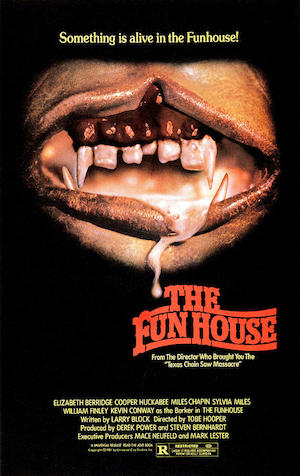
1980’s The Funhouse opens with an almost shot-for-shot recreation of the famous shower scene from Psycho, with Amy (Elizabeth Berridge) getting attacked in the shower by a masked, knife-wielding maniac.
The only difference is that there’s no shrieking violins, there’s no blood, and the knife is quickly revealed to be a fake. It turns out that the “killer” is actually Amy’s younger brother, Joey (Shawn Carson). Joey loves horror movies. In fact, he’s pretty much the perfect stand-in for The Funhouse‘s intended audience. Joey was just playing a rather mean-spirited prank but now, as a result, Amy snaps that she’s not going to take him to the carnival.
Of course, Amy isn’t supposed to be going to the carnival either. Her parents have strictly forbidden it. Everyone knows that traveling carnivals are dangerous and, at the last town the carnival visited, two teenagers disappeared! There’s no proof that the carnival has anything to do with those disappearances, of course. But still…
Amy does exactly what I would have done in her situation. She tells her parents that she’s going over to a friend’s house and then she goes to the carnival anyway! Accompanying her is her boyfriend Buzz (Cooper Huckabee), who is so cool that he has a name like Buzz. Also along for the ride: Amy’s best friend, Liz (Largo Woodruff), and her boyfriend, Richie (Miles Chapin). Richie’s kind of a loser but that’s to be expected. Every group needs at least one idiot who can do something stupid that gets everyone else killed. We all know how that works.
The carnival turns out to be just as sleazy as Amy’s parents thought it would be. There’s a fake psychic (Sylvia Miles). There’s a magician who dresses like Dracula. There’s a barker (Kevin Conway), whose deep voice is constantly heard in the background. And, of course, there’s a funhouse! Still, everyone’s having a good time. Either that or they’re all just stoned.
For his part, Joey sneaks out of the house and goes to the carnival himself. He doesn’t have quite as much fun as Amy. In fact, his experience is pretty scary. Weird carnival people keep yelling at him. He keeps getting lost. Still, things could be worse. By the time his parents arrive to pick Joey up, Amy and her friends are all trapped in the funhouse. They’re being pursued by the barker and his deformed son (Wayne Doba). Needless to say, it’s all pretty much Richie’s fault.
Richie. What a dumbass.
With its teenage victims and its lengthy chase scenes, The Funhouse is often dismissed as just being another early 80s slasher film. However, The Funhouse is actually a fairly clever, entertaining, and occasionally even witty horror film. Much like director Tobe Hooper’s best-known film, The Texas Chainsaw Massacre, The Funhouse gets its scares by convincing audiences that they’re actually seeing more than they are. Hooper emphasizes atmosphere and performances over gore. While The Funhouse has its share of jump scares, it mostly succeeds by convincing us that anyone could die at any moment. It’s an intense film, with excellent performances from both Elizabeth Berridge and Kevin Conway.
After kickstaring the slasher genre with The Texas Chainsaw Massacre, Hooper used The Funhouse to poke a little fun at it. From the opening shower scene to the electrifying finale, Hooper plays with the genre-savvy expectations of the audiences. Our four victims even do the smart thing for once — they try to all stay together. Needless to say, that doesn’t work out too well.
The Funhouse is an entertaining thrill ride and, seen today, it’s more evidence that Tobe Hooper deserved better than he got from the film industry.
 Through the Shattered Lens