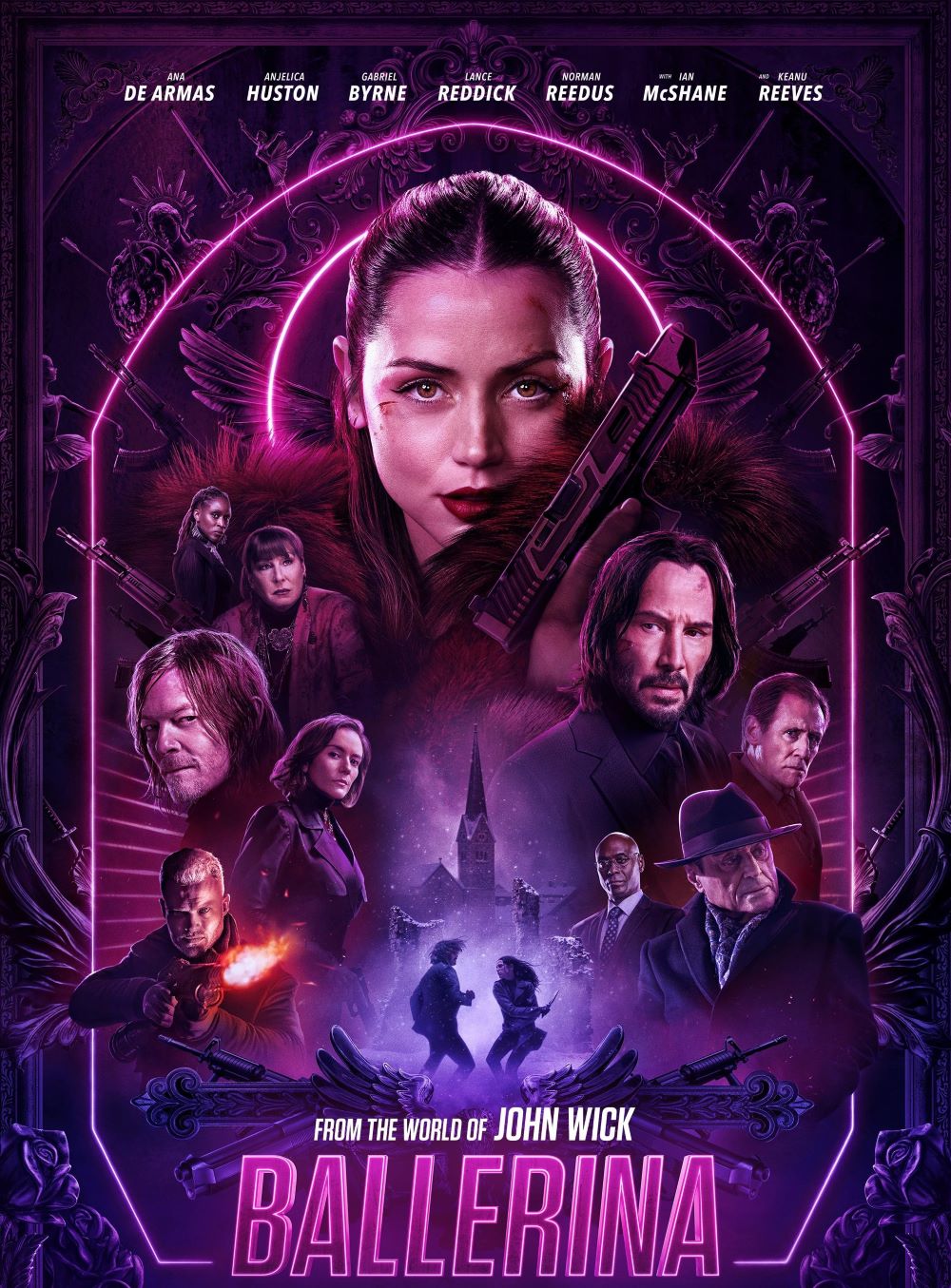
Film Review: From the World of John Wick: Ballerina (dir. by Len Wiseman)


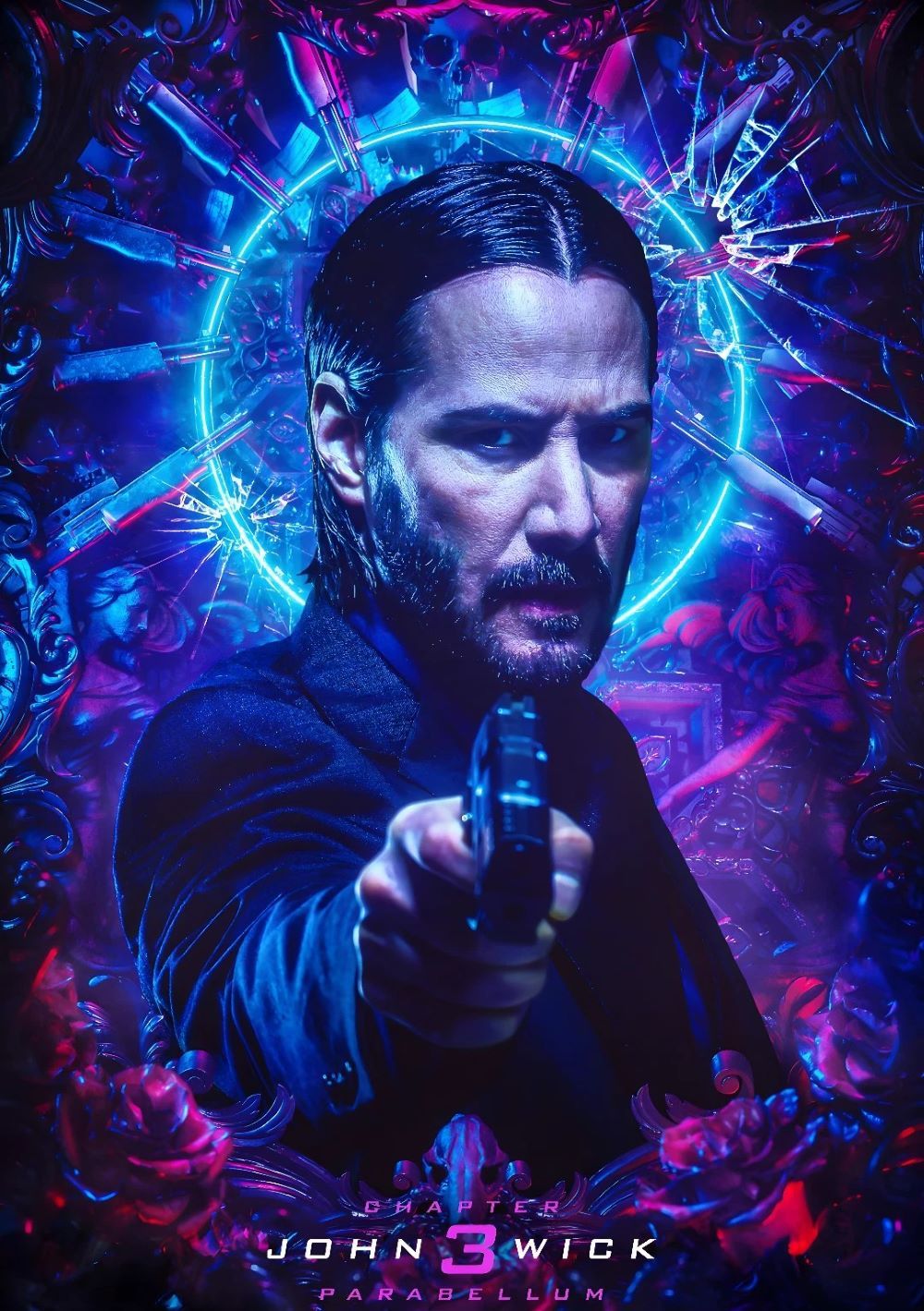
It seems almost inevitable that Ana de Armas would make it into the John Wick franchise. Having worked with Keanu Reeves in multiple films since 2015’s Knock Knock, she has great chemistry with him on camera. De Armas has also proven she can handle action both with 2021’s No Time to Die and 2023’s Ghosted, with the latter also boasting a bit of comedy. From the World of John Wick: Ballerina (or just Ballerina for the sake of this writing) puts Ana in the mix of all the madness as Eve Maccaro. While it doesn’t have the tightest story in the world when compared to the rest of the John Wick saga, Ballerina does hold its own at least as a showcase for the stunt work. If you enjoyed Atomic Blonde or any of the Underworld films, you really won’t have any problems here.

The story for Ballerina takes place during the events of John Wick 3 – Parabellum. As a child, when Eve loses her father to a crew of armed men sporting a brand on their wrists, she is taken in by The Continental’s Winston (Ian McShane). Winston introduces her to the tribe of killers known as the Ruska Roma, lead by The Director (Anjelica Houston), who train her to become like them. Those familiar with the John Wick franchise will recall that the Ruska Roma was John’s tribe before some action caused a split between him and them.

In addition to her pointe practices (which look painful), she’s trained with knives, guns and other tactics. Unlike the assassins that normally frequent The Continental, the Ruska Roma aren’t fully ruthless and can be a force of good. After handling various tests, she discovers a clue leading to the people who killed her father and the man who leads them (ironically played by Point of No Return’s’ Gabriel Byrne, given the film moves in similar circles). Can Eve get her vengeance in the shadow of the legendary Baba Yaga?

While Eve’s story is a still a tale of vengeance as much as Wick’s, there are two distinct differences. As taught by her trainer Nogi (Sharon Duncan Brewster, Dune: Part One), being a girl has some merits and flaws. She might not have the strength to go toe to toe with some of her male opponents (and try telling Ana this, she throws herself deep into the stuntwork), she can move for weakpoints and cheat her way though to victory. “Fight like a girl” becomes the motto. The other difference is that Eve has to work within both the rules of the Ballerinas as well as those the High Table puts on their Hotels. I thought that was an interesting touch to things.

With those stunts, I really would like to know if Ana or any of the stunt team were hurt in any way making this film. Eve goes through a lot and doesn’t have that protective Armani suit of Wick’s. Into walls, over dressers, through glass and even fire, but she keeps getting up and giving that damage right back to her targets. I hope this becomes a contender for the Academy’s new award for stunts. It’s an easy lock for a Nomination.

Casting-wise, you’ll see some familiar faces. Winston and Charon (the late Lance Reddick) are both on hand, as well as stuntman/actor Daniel Bernhardt (The Matrix Reloaded, Nobody, that awesome “ronny/lily’ episode of HBO’s Barry). Some new faces include Norman Reedus (The Walking Dead) and Anne Parillaud (Innocent Blood, La Femme Nikita).

Len Wiseman hasn’t directed a feature film since 2012’s Total Recall, but watching Ballerina you really couldn’t tell. Some of the locales do look like they were borrowed from Wiseman’s Underworld films, but that actually works in Ballerina‘s favor. The film flows well from scene to scene and the action is visible enough that there’s little to miss. There are very few lulls in the action. Though the film was written by both Derek Kolstad and Shay Hatten, who both previously worked on pretty much the entire Wick Franchise along with Nobody, it’s a different flavor to things. You won’t any any major info on the High Table and how all that works, though. This more of a contained story that flutters through the rest of the universe.

I only had one major problem with Ballerina, which was the way in which they chose to cameo Keanu Reeves as John Wick. Unless I’m wrong, I think the story makes a mistake in the John Wick timeline at some point by bringing Wick and Eve face to face (and the trailers already alluded to this). Their meeting appears to occur after Wick’s branding and ex-communication from the Ruska Roma (“You can never come back.”, she told him in John Wick 3), so the events leading up to the meeting didn’t entirely make sense to me (though it was wonderful to watch). It doesn’t mar the film, it’s still enjoyable. It’s just that tiny question that digs in the back of your skull like “If Old Biff gave young Biff the Almanac, and Young Biff changed the future, how did Old Biff exist long enough to return the DeLorean back to a 2015 timeline that shouldn’t exist anymore?” – a question I still ask every now and then.

Overall, Ballerina is a pretty good addition to the John Wick franchise. Ana de Armas gives it her all and deserves all the kudos for that work she puts in. Here’s hoping that we get a bit more of her action (and of that universe) down the road.

Ana de Armas visits the Continental in the Ballerina Trailer!


It seems rather fitting to see Ana de Armas taking the lead in a story within John Wick’s universe. After all, she’s has a knack for action with films like No Time to Die and Ghosted, and she’s worked with Keanu Reeves in both Knock Knock and Exposed. The real question with Ballerina is whether audiences will want to see a John Wick-like film with a female lead. I can already imagine the incel crowd chirping about how John Wick is now tainted with the touch of – (Ick!! Dare I say it….) – Women. That same crowd may also have forgotten about Adrianne Palicki’s assassin in the first film, and Halle Berry’s character with her dogs in the third. Female Assassins are as old at the Kunoichi. Perhaps even far older than that. There are so many tales to be told, especially in this universe.

I’m excited to see how this turns out. With a look that mirrors Le Femme Nikita and Point of No Return, de Armas’ Eve looks to be just as dangerous as her predecessor, possibly as one of the Ballerina assassins referenced in John Wick 3. The trailer has the feel of the other movies, but we’ll have to wait and find out when it releases. Len Wiseman has the directing duties on this one. It’s been a while since he made a movie, but I did enjoy the style of 2012’s Total Recall. Hopefully, he’ll do good here.

The only thing that I find odd is the name – audiences all know it has to do with John Wick. Does it have to have that whole “From the World of John Wick” in the title? I’m pretty sure your average movie viewer will put things together once they see the Continental, Winston (Ian McShane) or Charon (Lance Reddick, in one of his final roles). Also on hand are Norman Reedus (The Bikeriders) and of course, Keanu Reeves, which could just be a cameo.

From the World of John Wick: Ballerina will be in cinemas in 2025.

The Films of 2024: Shirley (dir by John Ridley)


In 1972, a New York Congressperson named Shirley Chisholm made history when, in January of that year, she announced that she would be a candidate for the Democrat presidential nomination.  Chisholm, who had already made history when she became the first Black woman to be elected to Congress, was also the first Black woman to run for a major party’s presidential nomination.

(For the record, U.S. Senator Margaret Chase Smith of Maine and the Rev. Channing Phillips were, respectively, the first woman and the first Black to run for a major party’s presidential nomination.  Smith lost the Republican nomination to Barry Goldwater in 1964.  In 1968, Phillips was the first Black to have his name officially put into nomination at a major party political convention.)

Of course, Chisholm did not win in 1972.  She was one of many liberal candidates who declared that they were running as an alternative to the presumed front runner, U.S. Sen. Edmund Muskie.  When Muskie’s campaign stalled in New Hampshire, it was George McGovern (and not Shirley Chisolm, John Lindsay, Eugene McCarthy, or Fred Harris) who benefitted.  For the most part, the media viewed Chisholm as being a protest candidate, one who had a small but loyal activist base but which couldn’t compete with candidates like McGovern and Hubert Humphrey.  Still, Chisholm went into the convention with a handful of delegates and, with McGovern not having enough pledged delegates to win outright, it was expected that Shirley Chisholm would at least be able to get some concessions from him in return for her support.

Political conventions being what they are, things didn’t work out that way.  Due to several backroom deals, George McGovern was able to secure the nomination during the first round of voting.  McGovern went on to suffer a landslide defeat and for years, his general election campaign would be held up as an example of how not to run for President.  Chisholm returned to the U.S. Congress, where she served for another ten years.

Featuring Regina King in the title role, Shirley is a dramatization of that primary campaign.  In many ways, it’s a typical Netflix docudrama.  It’s well-made and it’s tasteful and occasionally, it’s a little bit boring.  Political junkies will enjoy it, particularly if they’ve studied the 1972 presidential election.  My inner history nerd was thrilled as largely forgotten historical figures were casually mentioned in the dialogue.  Who would have guessed that a film released in 2024 would have featured characters talking about the presidential campaigns of Sam Yorty, John Lindsay, and Walter Fauntroy?  Sadly, no mention is made of Patsy Mink.  While Shirley Chisholm was making history as the first Black woman to run for president, U.S. Rep. Patsy T. Mink of Hawaii was doing the same as the first Asian-American woman to run.

It’s an uneven film, one that takes it time getting started.  Filmmaker John Ridley is a better writer than director.  Some of the scenes, like the ones of Chisholm mentoring a young Barbara Lee (Christina Jackson), felt a bit too much on the nose.  (That said, Barbara Lee did start her career as a volunteer with the Chisholm campaign and, while in Congress, she regularly cited Chisholm as an inspiration.)  But then there were other scenes that worked wonderfully, like Chisholm visiting segregationist George Wallace (W. Earl Brown) after Wallace had been shot.  The film is at its best when it reaches the Democrat Convention and Chisholm goes from being elated to disappointed as one of her strongest allies goes from supporting her to announcing that it’s time for all the black delegates to line up behind McGovern.  Regina King’s performance, especially towards the end of the film, captures both Shirley Chisholm’s strength and her vulnerability.  It’s not always easy being a trailblazer.

Finally, if you want to learn more about Shirley Chisholm’s 1972 presidential campaign, I suggest the 2005 documentary, Shirley Chisholm ’72: Unbought and Unbossed.

Film Review: The Caine Mutiny Court-Martial (dir by William Friedkin)


The Caine Mutiny Court-Martial is a film that I wanted to like more than I actually did.

The movie, which is based on a play by Herman Wouk (which was itself based on a novel by Wouk that was adapted into an Oscar-nominated film in 1954), takes place in a Naval courtroom.  Lt. Steven Maryk (Jake Lacey) is on trial, accused of mutiny against his commanding officer.  Maryk claims that, when the ship sailed into a storm, his commanding officer, Philip Francis Queeg (Kiefer Sutherland), was giving orderss that put the entire ship at risk.  With the support of the officers, Maryk relieved Queeg of command.  Maryk claims that he did so with the knowledge that it would lead to him being court-martialed.

Maryk is assigned Lt. Greenwald (Jason Clarke) as his defense counsel.  Greenwald is not happy with his assignment because he think that Maryk is guilty and he believes in the chain of command.  When Maryk and his fellow officers claim that Queeg was showing signs of mental instability, Greenwald wonders how they came to that conclusion.  Whereas Maryk and his fellow officers, including Keith (Tom Riley) and Keefer (Lewis Pullman), claim that Queeg was dangerously unstable, Greenwald sees an insecure commander who was abandoned by his men.  Greenwald comes to realize that keeping Maryk out of the brig will mean destroying Queeg on the stand.

As I said, I wanted to like this film more than I actually did.  The Caine Mutiny Court-Martial was the final film to be directed by William Friedkin.  Friedkin started his career by directing adaptations of plays like The Birthday Party and The Boys In The Band, so another theatrical adaptation does feel like an appropriate bookend for a legendary career.  Friedkin’s best films featured troubled and somewhat obsessive individuals, people who are almost addicted to taking risks.  That’s certainly an accurate description of several of the characters in The Caine Mutiny Court-Martial, from Queeg to Keefer to even Greenwald himself.  After Friedkin passed away in August, I found myself really hoping that The Caine Mutiny Court-Martial would be one final brilliant Friedkin film.

There’s a lot of good things to be said about The Caine Mutiny Court-Martial, including the fact that Jason Clarke is well-cast as Lt. Greenwald.  But, in the end, The Caine Mutiny Court-Martial is essentially a filmed play and, despite a camera that moves frequently, it all feels rather stagey and, at a time, a bit too theatrical.  As good as Clarke is, some other members of the cast can’t break free of the film’s staginess and their performances often feel disappointingly superficial.  This is especially true of Monica Raymund as the prosecutor and, surprisingly, Kiefer Sutherland as Queeg.  Sutherland, who, when he was younger, would have been the ideal pick for the role of Lt. Keefer, gives an overly mannered performance as Queeg, one that is all tics and nerves but with little of the vulnerability that Humphrey Bogart brought to the role in the 1954 film.

Friedkin’s The Caine Mutiny Court-Martial takes place in 2022, as opposed to the World War II setting of Wouk’s original novel.  This does lead to an interesting subtext, as Friedkin’s version of the story is set during a time when many people are no longer confident in America’s military leadership.  (Wouk’s novel and play came out while America was still feeling confident after the victory of the Allies in World War II.)  Friedkin takes a direct approach to the material, allowing the audience to decide for themselves whether Maryk did the right thing.

It’s a solid enough film but one that never quite escapes its stage origins.  Friedkin’s respect for the material comes through, even if the film isn’t totally successful.

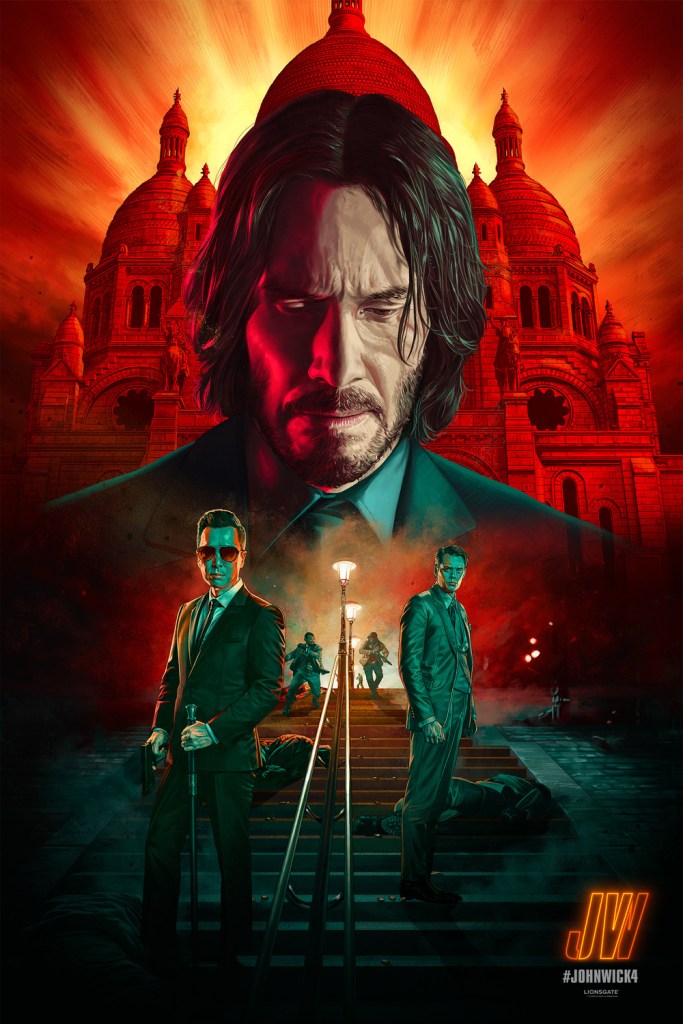
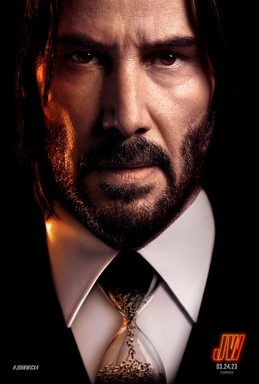
Film Review: John Wick: Chapter Four (dir by Chad Stahelski)


Yesterday, I finally watched the hit film of March 2023, John Wick: Chapter Four.  It left me overwhelmed and I mean that in the best possible way.

The film picks up where the last film left off.  John Wick (Keanu Reeves), the dog-loving, formerly retired professional hit man, is still traveling the world and killing the leaders of the High Table.  As becomes apparent from the start of the film, it’s a bit of a fool’s errand as killing one leader only leads to another leader being installed.  When John travels to Morocco to kill the leader known as “The Elder,” he discovers that the Elder he knew is gone and has been replaced with a new Elder.  He still kills the new Elder because that’s what John Wick does.  He kills people.  He’s a literal killing machine, one who audiences like because he loves dogs, is still mourning for his dead wife, and he’s played by Keanu Reeves.  On paper, the relentless and ruthless character of John Wick is horrifying.  But, when he’s played by Keanu Reeves, he becomes the killing machine that audiences can’t help but love.

The arrogant and brilliantly named Marquis Vincent Bisset de Gramont (Bill Skarsgard, giving a wonderfully hissable performance) is currently in charge of the efforts to track down and kill John.  The Marquis establishes himself as being evil by not only killing Charon (Lance Reddick) but also blowing up the Continental.  Upset by the murder of Charon and the destruction of his business, Winston (Ian McShane, playing his role with the perfect amount of wounded dignity) tells John that he can end his entire war with the High Table by challenging the Marquis to a duel.  Unfortunately, to do that, John has to convince another criminal organization to sponsor him and just about criminal organization on the planet wants John did.  To make things even more difficult, the Marquis has brought the blind assassin, Caine (the incredible Donnie Yen), out of retirement to track down John.  Caine and John are old friends but Caine knows that his daughter will be killed unless he kills John.

Clocking in at 169 minutes, John Wick: Chapter Four is a big, flamboyant, and at times overwhelming production.  John Wick travels across the world and every country in which he finds himself is home to someone who wants him dead.  And since everyone that John Wick knows seems to have a unlimited supply of guards and henchmen, the fights are nonstop and the violence is over the top but the film is so energetic and cheerfully excessive that it’s never boring.  Each fight scene feels like it could be a separate film on its own, with each member of the cast getting a chance to show off what they can do.  The water-filled fight in a Berlin night club is the film’s best moment but it’s closely followed by an extended combat sequence that’s set in a hotel in Japan.  With its vivid cinematography and ornate production design and its spectacular stunts, John Wick Chapter 4 is a work of pure cinema, an thrill ride of glorious excess.  Along with providing an ending to John Wick’s story, it also pays tribute to everything that audiences love about action cinema.  It’s a film for people who love action and, even more importantly, it’s film that has as much love for its audience as it does for itself.

The film ends on a note of apparent finality, one that becomes more ambiguous the more that one examines it.  This may be the last chapter of John Wick’s story or it may not.  (Considering the film’s box office and critical success, I suspect that it will not be the last.)  John Wick Chapter Four serves as a fitting (if perhaps temporary) end to the saga and also a tribute to both the action aesthetic and Keanu Reeves’s innate likability. 

Film Review: White Men Can’t Jump (dir by Calmatic)


Hulu’s White Men Can’t Jump is the story of two aging basketball players who have never lived up to their potential but who have yet to totally give up on their dreams.

Even when he was in high school, Kamal Allen (Sinqua Walls) was considered to be one of the best basketball players in the country.  A lot of that was due to how he was raised by his father, Benji (Lance Reddick, giving a strong performance in one of his final roles).  Benji was a basketball star himself and, as we see in several flashbacks, he trained Kamal to be the best.  Benji was so obsessed with turning Kamal into a great player that he even drove away Kamal’s mother.  Benji taught Kamal all that he needed to know about playing basketball but not enough about how to survive once his playing days were over.  Unfortunately, after Benji was diagnosed with MS, Kamal lost his concentration.  When he responded to being taunted during a game by going into the stands and punching a guy out, Kamal ended up getting arrested and he also ended up losing his chance of entering the NBA.

Jeremy (Jack Harlow) was a college basketball star who blew out his knee and lost his chance to go pro.  He makes his living hustling other basketball players, knowing that they’ll assume that he can’t shoot because he’s white.  He also sells highly suspicious health tonics and he spends a lot of time meditating.  Though he can barely walk without taking his pain pills first, Jeremy still wants to make the NBA.  When he hears that stem cell treatment might help his knee, Jeremy starts to scheme to win the money to cover the cost.

Together, Jeremy and Kamal hustle other players, make some money, and become unlikely friends.

It took me three days to get through White Men Can’t Jump, largely because the film itself was so boring that I struggled to actually pay attention to it for more than a few minutes at a time.  This film is a remake of a 1992 film that starred Wesley Snipes and Woody Harrelson.  I have not seen the original White Men Can’t Jump but I have seen enough films featuring both Snipes and Harrelson to know that they are both talented and charismatic actors who both have strong comedic timing.  In short, they don’t have much in common with the two leads of the new version of White Men Can’t Jump.  In the role of Kamal, Sinqua Walls is solid but dull.  Walls is convincing but he’s never particularly interesting.  Making his film debut in the role of Jeremy, rapper Jack Harlow is so incredibly obnoxious that I found myself wanting to throw something at the screen whenever he popped up.  The film repeatedly emphasizes that no one wants to play with Jeremy because he’s white but I think it’s equally probable that they’re just reacting to the fact that he is an incredibly annoying human being.  Director Calmatic does all the usual choppy editing and slow-motion dunking that most viewers have come to expect from movies about basketball but with little chemistry between the leads and a script that tends to repeat the same jokes over and over again, this film never takes flight.

Keanu Reeves returns in the John Wick 4 Trailer!


The High Table would like a word with John Wick.

I’m surprised there’s anyone left to fight, but on hand, we have Natalia Tena (Game of Thrones), Bill Skarsgard (Barbarian), Hiroyuki Sanada (The Wolverine), Scott Adkins (Accident Man), Clancy Brown (Thor: Ragnarok) and the legendary Donnie Yen (Ip-Man, Rogue One). They join the original cast that includes Keanu Reeves, Laurence Fishburne, Lance Reddick, & Ian McShane.

John Wick: Chapter 4 is set to release in theatres on March 24, 2023.

A rivalry begins in the Godzilla vs. Kong trailer


Back in 1986, Optimus Prime muttered 6 six words to Megatron that would sear itself into the minds of kids for a generation.

“One shall stand, One shall fall.”

And here we are, 30 years later, still using that phrase, or something like it. as Godzilla vs. Kong  offers the tagline “One Will Fall”.

After 3 mega movies (Godzilla, Kong: Skull Island & Godzilla: King of the Monsters), we’re finally ready for a kaiju matchup of truly epic proportions. Godzilla vs Kong pairs the two legendary monsters against each other, though for what reasons, we’re not entirely sure. Neither side wishes to concede, and the battle looks like it’s going to be both in the water and on land. From the newly released trailer, it looks like Kong’s the current hero. The returning characters of Mark and Madison Russell (Kyle Chandler and Millie Bobby Brown) from Godzilla: King of the Monsters seem to feel that something’s wrong with our atomic breath spewing hero. Dr. Chen (Zhang Ziyi, Crouching Tiger, Hidden Dragon) is also on hand to help. After saving the world twice, why would he suddenly turn on mankind? I’m not sure I like the idea of Godzilla being a villain in all this, but they have to have a reason to fight, I suppose.

While it doesn’t look like anyone returns from Kong: Skull Island, we still have Kong and some supporting characters in Alexander Skarsgard (The Legend of Tarzan), Julian Dennison (Deadpool 2), Jessica Henwick (Underwater), Eiza Gonzalez (Bloodshot), Danai Gurira (Black Panther), and Lance Reddick (John Wick 3 – Parabellum).

Godzilla vs. Kong is due in IMAX and on HBO Max on March 26th, 2021.

Here’s The First Trailer for Destiny 2!


And finally, here’s the first trailer for Destiny 2.  I’m going to be honest and admit that I don’t know much about any of this but I do know that there was more than a little excitement here at the TSL Bunker when this was released.

Is it just me or can Lance Reddick make almost anything sound noble?

Destiny 2 will be released, for PC, PlayStation 4, and Xbox One, on September 8th.

Film Review: Faults (dir by Riley Stearns)


Faults_(film)_POSTER

Faults is many things.

It’s a character study.  It’s a thriller.  It’s a deeply unsettling horror film.  It’s a darker-than-dark comedy that will make you laugh even while you’re glancing over your shoulder to make sure there are no strangers hiding in the shadows.  It’s a look at religion, faith, free will, and guilt.  It’s a declaration that a major talent — writer/director Riley Stearns — has arrived.  It’s an acting showcase for both Mary Elizabeth Winstead and Leland Orser.  It’s a film that found success on the festival circuit and then had an all-too brief theatrical release in March.  It’s also a film that’s currently available on Netflix.  Finally, it’s one of the best films of the year so far.

When we first meet professional cult deprogrammer Ansel Roth (Leland Orser), he is eating dinner in a hotel restaurant and desperately trying to convince his waiter that he has an agreement with management, guaranteeing him free meals while staying at the hotel.  After Ansel is kicked out of the restaurant, he then tries to convince the hotel manager that his room is supposed to be free as well.  The manager gives Ansel an hour to check out.

As quickly becomes apparent, Ansel is nearly broke and he’s living out of his car.  What little money he has, he makes from giving sparsely attended lecture where he literally begs people to pay fifteen dollars to get a copy of his latest book.  After his lectures, Ansel is willing to sign his new book at a cost of five dollars per signature.

(At one point, when someone asks Ansel to sign his previous book, Ansel abruptly explains that he no longer signs that book.  If you want his five dollar autograph, you have to first pay fifteen dollars to get his new book.)

At one point, Ansel was a minor celebrity with his own talk show but, after a girl he deprogrammed subsequently committed suicide, Ansel’s life fell apart.  His latest book is self-published and his former manager, the oddly polite Terry (Jon Gries), claims that Ansel owes him money.  Terry’s enforcer, Mick (the always intimidating Lance Reddick), is stalking Ansel from cheap motel to cheap motel.

However, things start to look up for Ansel when he’s approached by Paul (Chris Ellis) and Evelyn (Beth Grant).  They explain that their daughter, Claire (Mary Elizabeth Winstead), has joined a cult known as Faults and is a follower of a mysterious figure named Ira.  They ask Ansel to deprogram her.  Ansel agrees to do so and charges them $20,000.

After Ansel and two “assistants” literally grab Claire off the street, they take her to a cheap motel where, behind locked doors, Ansel starts to try to deprogram Claire.  However, from the start, Ansel discovers that it’s going to be more difficult than he realized.

For one thing, Claire remains calm throughout the whole kidnapping and, even when locked in the shabby motel room, is confident that she is about to “move on” and achieve a higher level of existence.  When Paul and Evelyn show up and try to talk to Claire, it turns out that they’re not quite the loving parents that they initially presented themselves as being.  Paul, in particular, reveals himself to have a fierce temper and he demands that Claire change into clothes that would be more appropriate for a teenager than for an adult.  When Ansel suggests that the overbearing Paul should back off, Paul replies that he “knows” what Ansel truly wants to do with Claire.

Secondly, even as Ansel tries to deprogram Claire, he still has to deal with Terry and Mick.  Neither one of them is particularly concerned about whether or not Ansel can pull Claire away from Faults.  Instead, Terry just wants his money.

And finally, even as Ansel tries to keep control of the situation, he is personally falling apart.  He finds himself having sudden nosebleeds.  At one point, his suit spontaneously combusts into flame.  (Believe it or not, there is a relatively plausible reason for why this happens but that doesn’t make it even less shocking.)  When Ansel falls asleep in the motel room, he subsequently wakes up in his car and has no memory of how he got there.

And through it all, Claire remains a seductive and manipulative enigma.  Sometimes she’s cold and in control.  Other times, she’s surprisingly vulnerable.  Ansel finds himself both attracted to and frightened of Claire.  Throughout the film, Ansel insists that he has “free will” but Claire forces him to reconsider that assumption.

Faults is a low-key and disturbing film that is distinguished by a very dark and cynical sense of humor.  Mary Elizabeth Winstead is amazing as the mysterious Claire while Leland Orser is wonderfully desperate and surprisingly sympathetic as Ansel.  When Faults first started, I was concerned that, since it largely takes place in one cramped motel room, the film would be too stagey to be effective.  But director Riley Stearns does amazing work with that one location and, as a result, Faults is one of those rare films that actually gets more intriguing the deeper you get into it.

Faults is currently available on Netflix and you should watch it.