Scenes That I Love: “Help me!” from The Fly


The Fly (1958, D: Kurt Neumann)

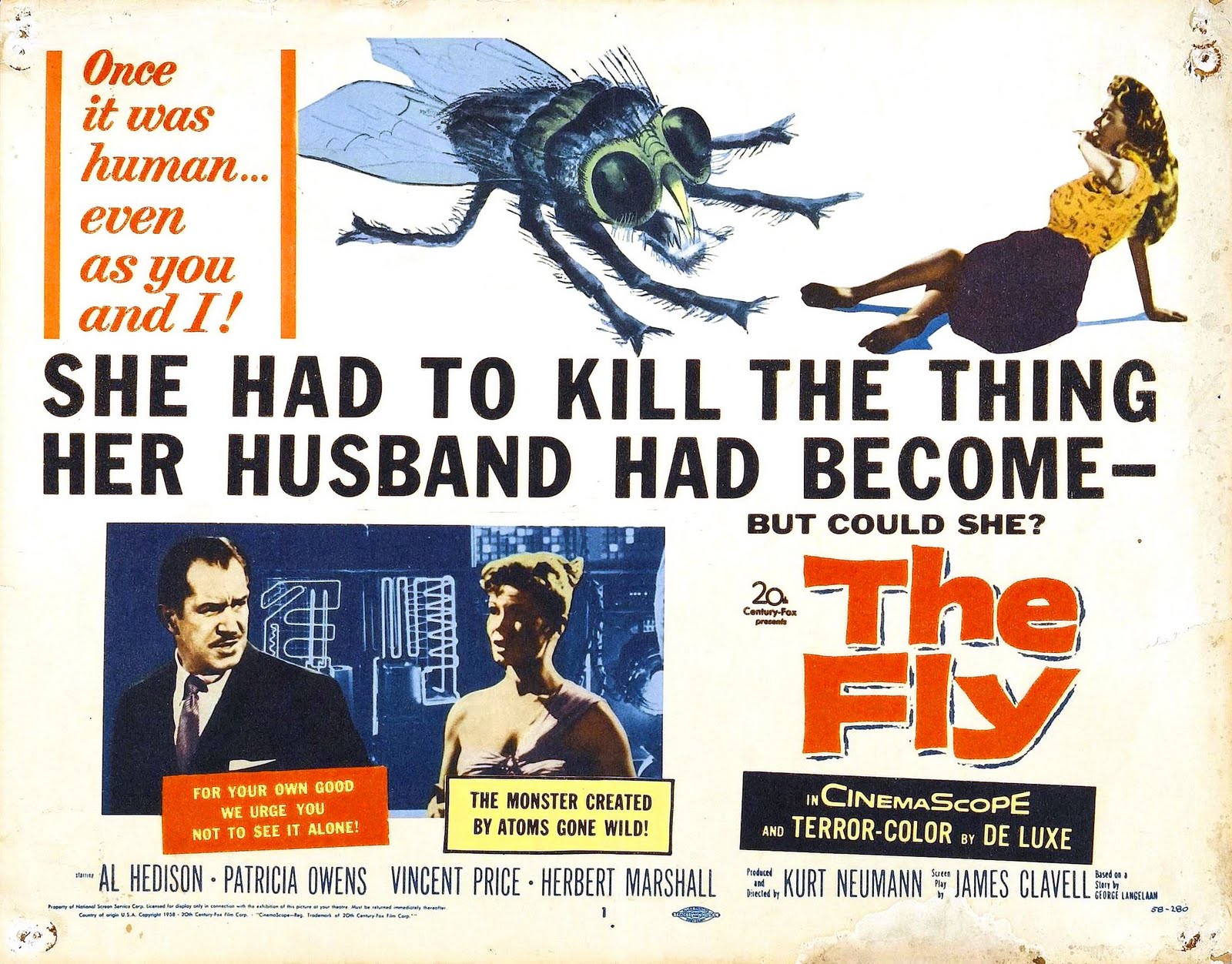
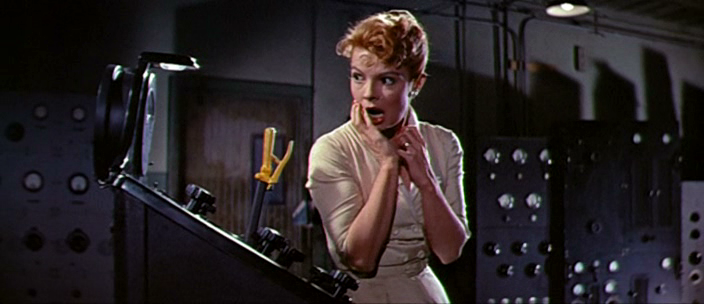
One of the great things about the original, 1958 version of The Fly is that, even though it starred Vincent Price, Price didn’t play the Fly.  Instead, for once, Price was allowed to be the voice of reason, the guy who said, “Maybe don’t mess around with the laws of time and space.”

Today’s scene that I love is from the ending of the original Fly.  Supposedly, Price had a hard time filming this scene because whenever he heard the recording of David Hedison crying out, “Help me!,” he would start laughing.  Still, if you know what spiders actually do to the flies that they capture, you can’t help but sympathize with our misdirected scientist in the web.  Destroying him with a rock was probably the most merciful thing that anyone could do.

Scenes That I Love: Vincent Price In The Fly


The Fly (1958, D: Kurt Neumann)

One of the great things about the original, 1958 version of The Fly is that, even though it starred Vincent Price, Price didn’t play the Fly.  Instead, for once, Price was allowed to be the voice of reason, the guy who said, “Maybe don’t mess around with the laws of time and space.”

Today’s scene that I love is from the ending of the original Fly.  Supposedly, Price had a hard time filming this scene because whenever he heard the recording of David Hedison crying out, “Help me!,” he would start laughing.  Still, if you know what spiders actually do to the flies that they capture, you can’t help but sympathize with our misdirected scientist in the web.  Destroying him with a rock was probably the most merciful thing that anyone could do.

In honor of Vincent Price, on what would have been his birthday, here is a scene that I love.

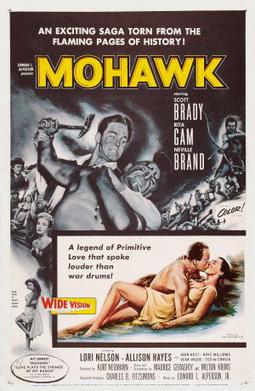
Mohawk (1956, directed by Kurt Neumann)


In the late 18th century, Boston socialite Cynthia Stanhope (Lori Nelson) travels to Fort Alden in upstate New York to visit her fiancé, a painter named Jonathan Adams (Scott Brady), who has been commissioned to paint the local scenery.  As soon as Cynthia and her mother arrive, they are shocked to discover that not only Jonathan has been painting pictures of the members of the Native local tribes but that he is also now flirting with a barmaid named Greta.  Greta is played by Allison Hayes so who can blame him?  Cynthia wants to return to their normal upper class life in Boston but Adams has fallen for the untamed wilderness of the frontier.

When Onida (Rita Gam), the daughter of Iroquois chief Kowanen (Ted de Corsia) is captured during a raid on the fort, Adams is assigned to escort her back to her tribe.  Leaving behind Cynthia and Greta, Adams falls in love with Onida over the course of the journey.  When he meets the Iroquois, he earns the respect of her father and the entire tribe when he agrees to paint the chief’s portrait.

Meanwhile, a haughty settler named Butler (John Hoyt) is trying to play the army and the Iroquois against each other, feeding both of them false information in an attempt to spark a war.  Butler is hoping that a war will lead to both sides wiping each other out so that he can once again have the valley to himself.  When it turns out that his words might not be enough to spark a war, Butler resorts to murder.  When Kowanen’s son is killed, the Iroquois prepare for war while Adams is framed for the crime and finds himself tied to a stake.

Mohawk is a standard B-western, with a plot that is largely lifted from John Ford’s Drums Along The Mohawk.  Unfortunately, Adams is about as sympathetic hero as you would expect someone manipulating three different women to be and, when it comes to depicting the Iroquois, Mohawk resorts to too many clichés.  This is one of those westerns where the Native characters speak broken English, even when they are just talking to each other.

Mohawk does have three things to recommend it.  Number one, John Hoyt was a master at playing haughty villains and Butler is easy to root against.  You will look forward to seeing him get his comeuppance.  Number two, Allison Hayes was a force of nature and that’s true even in this film, where she’s not given nearly enough to do.  Number three, one of Iroquois braves is played by Neville Brand.  A highly decorated World War II veteran, Brand built a long career playing tough guys.  In Mohawk, it only takes one look at Neville Brand to know that this isn’t someone you want to mess with.  Anyone watching would want to stay on Neville Brand’s good side.

Otherwise, Mohawk is forgettable.  Two years after it was released, Mohawk’s director Kurt Neumann, would be responsible for the much more memorable The Fly.

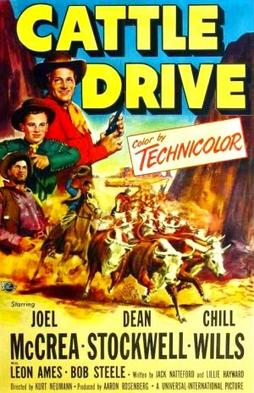
Cattle Drive (1951, directed by Kurt Neumann)


In this coming-of-age Western, Dean Stockwell plays Chester Graham, Jr., the spoiled and unruly son of a railroad owner (Leon Ames).  While riding on his father’s train and making trouble for the conductor, Chester overhears his father talking about sending him to a military school.  When the train makes as top, Chester impulsively runs away.  The train leaves without him and Chester finds himself stranded in the middle of the wilderness.  That’s when he sees cowboy Dan Matthews (Joel McCrea) trying to catch a wild stallion.

Dan is a part of a cattle drive.  Knowing that he can’t leave Chester to die in the wilderness, Dan brings him back to his camp.  The other members of the company aren’t too keen on having to look after a spoiled brat along with the cattle and Chester isn’t too happy to hear that he’ll be expected to work if he expects to get fed.  But with no choice but to work together, Chester, Dan, and the rest of the company make the journey to Santa Fe.  Chester finally drops his attitude enough to work with the company’s cook (Chill Wills) while Dan deals with a rival cowboy named Currie (Henry Brandon). Chester learns about responsibility and Dan finally finds the courage to consider settling down.

Of the many westerns that Joel McCrea made over the course of his career, he considered Cattle Drive to be his favorite and it’s easy to see why.  Cattle Drive features McCrea doing what he did best, playing a tough but good-hearted and down-to-earth cowboy who looked after an outsider.  If you were ever lost in the old west, Joel McCrea is precisely the type of cowboy that you would hope would come to your rescue.  The plot features almost every single cattle drive cliché that you could imagine but McCrea plays his role with a winning combination of grit and compassion and he and Dean Stockwell, who is also very good, make a good team.  Shot in Death Valley and Utah, Cattle Drive feels and look authentic and should be enjoyed by anyone looking for good, heartfelt western.

Scenes That I Love: “Help me!” from The Fly


The Fly (1958, D: Kurt Neumann)

One of the great things about the original, 1958 version of The Fly is that, even though it starred Vincent Price, Price didn’t play the Fly.  Instead, for once, Price was allowed to be the voice of reason, the guy who said, “Maybe don’t mess around with the laws of time and space.”

Today’s scene that I love is from the ending of the original Fly.  Supposedly, Price had a hard time filming this scene because whenever he heard the recording of David Hedison crying out, “Help me!,” he would start laughing.  Still, if you know what spiders actually do to the flies that they capture, you can’t help but sympathize with our misdirected scientist in the web.  Destroying him with a rock was probably the most merciful thing that anyone could do.

Cleaning Out the DVR Pt. 22: Winter Under the Stars


gary loggins's avatarcracked rear viewer

I haven’t done one of these posts in a while, and since my DVR is heading towards max capacity, I’m way overdue! Everyone out there in classic film fan land knows about TCM’s annual “Summer Under the Stars”, right? Well, consider this my Winter version, containing a half-dozen capsule reviews of some Hollywood star-filled films of the past!

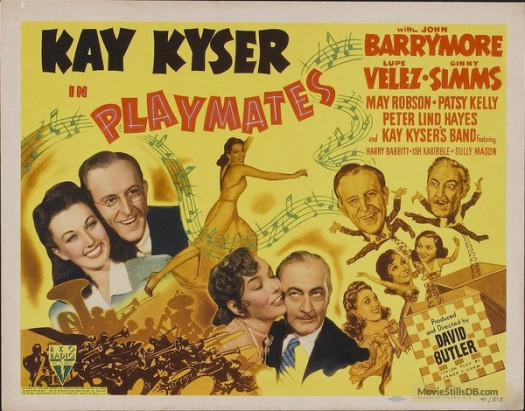
PLAYMATES (RKO 1941; D: David Butler ) – That great thespian John Barrymore’s press agent (Patsy Kelly) schemes with swing band leader Kay Kyser’s press agent (Peter Lind Hayes) to team the two in a Shakespearean  festival! Most critics bemoan the fact that this was Barrymore’s final film, satirizing himself and hamming it up mercilessly, but The Great Profile, though bloated from years of alcohol abuse and hard living, seems to be enjoying himself in this fairly funny but minor screwball comedy with music. Lupe Velez livens things up as Barrymore’s spitfire…

View original post 1,088 more words

Halloween Havoc!: SECRET OF THE BLUE ROOM (Universal 1933)


gary loggins's avatarcracked rear viewer

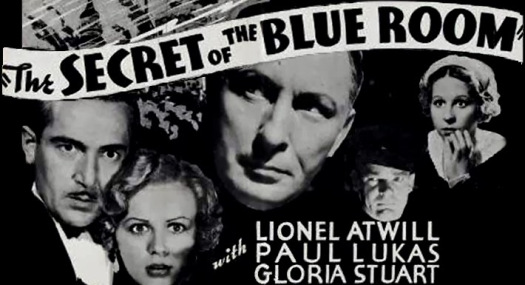
The horror cycle of the early 1930’s cast its dark shadow on other film genres. SECRET OF THE BLUE ROOM is one of those “old dark house/locked room” mysteries showing that influence; it’s a creepy, atmospheric little movie about mysterious murders, with horror vet Lionel Atwill front and center among the suspects. There aren’t any “monsters” here, but some good chills courtesy of director Kurt Neumann, who later directed the 1950’s sci-fi horrors KRONUS, SHE DEVIL, and THE FLY .

It’s a dark and stormy night (naturally!) at Castle von Hellsdorf, and Irene, daughter of Master of the House Robert, is celebrating her birthday with three suitors: Captain Walter Brink, Frank Faber, and Tommy Brandt, while outside, a mysterious stranger lurks. The conversation turns to ‘The Blue Room’, kept under lock and key after three strange (some say supernatural) murders occurred many years ago, always at One AM. Tommy, eager…

View original post 320 more words

Halloween Havoc!: THE FLY (20th Century Fox 1958)


gary loggins's avatarcracked rear viewer

fly1

THE FLY is one of those films you’re probably familiar with if you’re a horror/sci-fi fan. I’ve seen it many times, but was under the impression it was a black & white movie (probably due to early viewings as a young’un, deprived of color TV). So when I rewatched it again in glorious Technicolor, I was pleasantly surprised. This tale of science gone wrong has held up well, and its iconic scene of The Fly’s unmasking still manages to jolt the viewer (even if you know it’s coming!).

fly2

The film’s framing device finds us witnessing Helene Delombre murdering her husband Andre by squishing his head and arm under a huge hydraulic press (and it’s a pretty gruesome demise), then calling her brother-in-law Francois to tell him. Francois is stunned, to say the least, and gets ahold of his friend Inspector Charas. They drive over to the Delombre Freres (the movie’s set in Montreal)…

View original post 827 more words