Shattered Politics #77: Thank You For Smoking (dir by Jason Reitman)


Thank_you_for_smoking_PosterI have always hated those Truth.com commercials.  Truth.com is an organization that claims to be dedicated to eradicating smoking.  Their smug commercials are essentially the height of hipster douchebaggery, a bunch of self-consciously cool people wandering around and harassing random people about whether or not they smoke.  And then, of course, there was the commercial where they all gathered outside a tobacco company and pretended to be dead.  Of course, the truth about Truth.com is that they are essentially the same people who, in high school, would get offended whenever anyone wore a short skirt.  I really can not stand people like that.  (And don’t even get me started on those assholes who appear in the Above The Influence commercials.)  Myself, I don’t smoke because I have asthma.  But, seriously, whenever I see a Truth.com commercial, I’m tempted to run down to 711 and start.

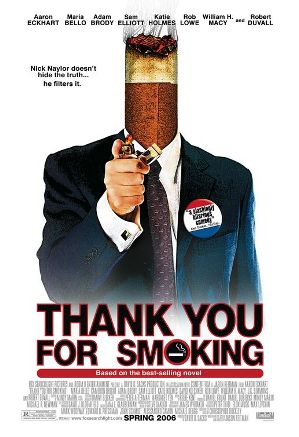
And so maybe that’s why I like the 2005 comedy Thank You For Smoking.

The hero of Thank You For Smoking is Nick Naylor (Aaron Eckhart), a lobbyist for the tobacco industry, who is first seen appearing on a talk show and winning over a hostile audience by announcing that the tobacco industry is going to be investing millions in researching way to keep young people from smoking and shaking the hand of a teenage honor student who is dying from lung cancer.  Over the course of the film, Nick shows us how he does business, everything from defending tobacco companies on talk shows to convincing a former Marlboro Man-turned-cancer-patient to drop his law suit.  When Nick isn’t working, he’s hanging out with his best friends (who are lobbyists for both the liquor and the gun industries), trying to bond with his son (Cameron Bright), or having sex with a reporter (Katie Holmes).

Now, in most movies, Nick Naylor would be the villain.  However, in Thank You For Smoking, Nick becomes a hero by default, if just because everyone who disagrees with him is even worse than he is.  Add to that, Nick has the benefit of being played by Aaron Eckhart while all of his opponents are played by balding actors with ugly beards.

Another reason that I liked Thank You For Smoking was because the main villain was a senator from Vermont and it’s about time somebody stood up to the tyranny of Vermont.  Ortolan Finistirre (William H. Macy) has built a career out of campaigning against the tobacco industries and why shouldn’t he?  Who, other than Nick Naylor, is willing to defend them?  Finistirre’s latest plan is to change the law so that every pack of cigarettes has to be branded with a skull and crossbones warning.

When Nick and Finistirre finally face off, it’s a battle between those who believe in allowing people the freedom to make their own choices and those who hide their totalitarian impulse behind claims that they’re working for the greater good.

Thank You For Smoking was Jason Reitman’s first film.  And while it may be a bit too episodic and it frequently struggles to maintain a consistent tone, it’s still a lot better than both Labor Day and Men, Women, & Children.
Quick Review: Gone Girl (dir. by David Fincher)


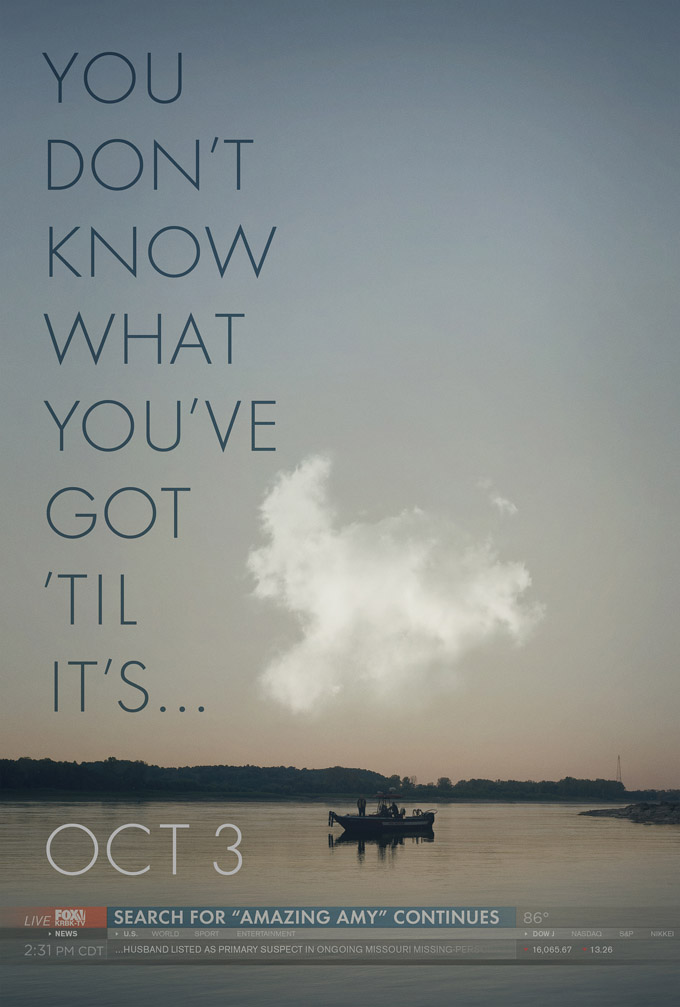
gone-girl-posterI stumbled onto the novel for Gillian Flynn’s Gone Girl in a mall. It sat near the front of the store with the rest of her books, emblazoned with one of those “soon to be a major motion picture” stickers and a “#1 New York Times Bestseller” label on top. I figured I try it, unaware that David Fincher was involved on the project. During that read, I ran to the Barnes & Noble in Union Square to pick up Flynn’s other books, Sharp Objects and Dark Places. After a co-worker and I finished these (I haven’t read Sharp Objects yet), we agreed that we enjoyed them, overall.

Of Gone Girl the Motion Picture, Flynn herself handles the screenwriting duties and she presents an adaptation so close to her novel that I wouldn’t be shocked if the film receives the same response as the first Harry Potter film. I only spotted 2 distinct changes, and these don’t damage the film in any way. They just may make you say..”Oh, crap, she didn’t keep that.”, If anything.

“But Lenny..” You might say, after hearing me tell you this over pizza and soda. “You’re losing me again, you’re talking too much. I never read Gone Girl. I could care less about the book, I just want to know about the movie because tickets are expensive, dammit! Wrap it up. Is it worth seeing or not?”

In a word, yes. Flynn’s story and Fincher’s direction are like Wine and Cheese here. Flynn’s machine gun writing and Fincher’s pacing method could make them as hot a duo as True Detective’s Nic Pizzolatto and Cary Joji Fukunaga. If actress / producer Reese Witherspoon was involved in getting these two together, she may have another gem under her belt to put next to her film Penelope.

Gone Girl is the story of Nick and Amy Dunne, a happily married Missouri couple on the verge of their 5th Anniversary. When Nick suddenly discovers his wife is missing, the investigation into her disappearance seems to lead back to him, presenting the question of whether our hero may or may not be involved. Just as with the novel, the audience is given glimpses into Amy’s story through flashbacks of their life together. The movie dances from chapter to chapter (or scene to scene, I should say) in this fashion and does so pretty well. You’ve a love story wrapped in a mystery.

The casting is spot on. There’s not a single person in this film that seemed like they didn’t fit their part. Both Ben Affleck (Argo) and Rosamund Pike (Jack Reacher, The World’s End) are magnetic when theyre not dealing with each other and if the movie manages to stumble into Awards season, their names could get thrown into the hat.

The supporting cast in Gone Girl is somewhat strong. Carrie Coon does a fine job as Nick’s sister Margo, which was definitely a good choice. It’s Kim Dickens (Hollow Man, Treme), Neil Patrick Harris and Tyler Perry who have the best screen time of any one outside of the leads. Every one of them help to pick up the story when you think it might waver a bit.

“Great!” you may say, getting up to leave. “I’ll check it out. Thanks for letting me know.”, To which I’d ask..”Don’t you want to know about the direction? Cinematography?” You might sit back down, sigh and roll your eyes, as if to say…”Sure, not like you’d let me leave without telling me anyway, right?”

At this point, everything is technical.

Fincher’s direction is straightforward. Working with Jeff Chernoweth, his cinematographer from Fight Club & The Girl With the Dragon Tattoo, the lighting is what you come to expect from the two. Colors in the present are muted, muddied and almost clinical. By contrast, Amy’s flashbacks appear bright and colorful, but the audience may notice this changing as the story progresses. You could almost say it’s the Zodiac color scheme layered on a different story. Gone Girl doesn’t feel like a “Fincher” movie in the way The Shining was Kubrick’s. It’s more of a Flynn story that would look really good if Fincher put it on screen. I’m not sure if there’s a better way to describe it, actually.

Gone Girl falters in the dialog at times. I had a few moments where scenes that felt fine in the novel fell flat in the film, particularly in some of the flashbacks. Have you ever had a moment where you watch a film, see two people talk to one another and say to yourself (or the person next to you), “Who says that, really?” The relationship of Nick and Amy was a hard, abbreviated sell for me, probably because of the time constraints. You know they’re together, and love is implied (and sexually displayed, I might add), but I can’t say that I recognized a big chemistry between Pike and Affleck. When acting around everyone else they’re great, but between each other, they lost me a little in the beginning. If it were a Blu Ray, I’d be tempted to tap that Chapter Forward button. Mind you, this is coming from a book to movie comparison, so a viewer that hasn’t read the book may respond differently to what’s on screen.

I will say that separately, Rosamund Pike and Ben Affleck are wonderful in this as Nick & Amy. I hope that this gets Pike some more lead dramatic roles, as she was more than memorable here.

Both Trent Reznor and Atticus Ross handled the scoring duties for Gone Girl. In their 3rd go around with Fincher, the sounds are similar to The Social Network, though a bit more subdued. They have a few standout tracks, and their music blends well in Gone Girl, though.

Overall, Gone Girl makes for a interesting night at the cinema, but it’s best viewed if you can manage to avoid the hype and catch it just to sate a curious mind.

Embracing the Melodrama #59: At Any Price (dir by Ramin Bahrani)


at-any-price-poster-big

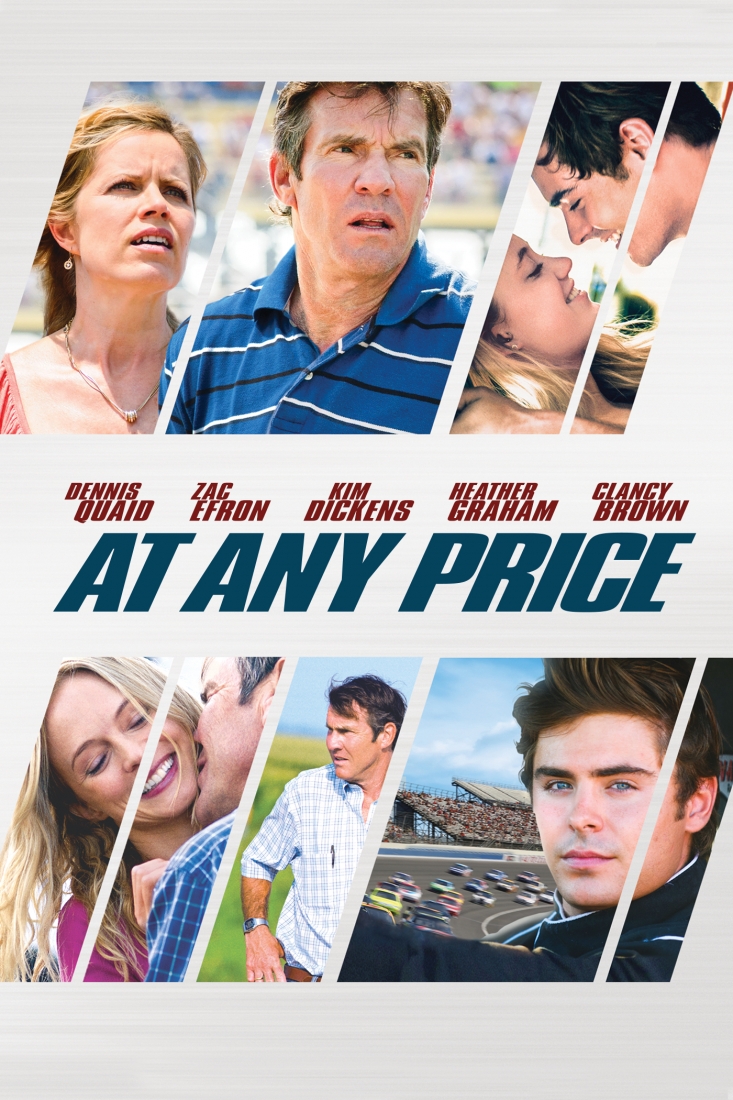
With Embracing the Melodrama coming to a close (only two more reviews to go, including this one!), I want to take this opportunity to tell you about a good film from last year that didn’t get quite as much attention as it may have deserved.  The Iowa-set At Any Price is a look at greed, family secrets, and even murder in rural America.  It’s not a perfect film but it features a perfect lead performance from Dennis Quaid and it’s worth taking a chance on.

Dennis Quaid plays Henry Whipple, an Iowa farmer who also works as a sales representative for the Liberty Seed Company.  Henry sells genetically modified seeds and one thing that this film gets absolutely right is just how cut-throat the seed business truly is in the heartland.  Henry is very proud to be the top seed salesman in the county, with only Jim Johnson (Clancy Brown) coming close to matching him.  The film’s best scenes are the ones that follow Henry as he travels along his route, selling seeds, giving away candy bars, and always flashing his wide grin.  It’s only as the film progresses that we start to notice how desperate that grin really is.  Henry, we soon realize, is motivated mainly by greed and fear.  He’s the type of farmer who will go to a stranger’s funeral just to try to buy the deceased’s land.  Henry is also the type of guy who is willing to cut ethical corners to sell seeds as well.  As far as Henry is concerned, he’s only doing what he has to do to make sure that he has a successful business to pass on to his family.

Henry is all about his family and, while that may be his redemption, it’s also his family’s curse because Henry is something of a control freak.  Henry’s loyal wife (Kim Dickens) turns a blind eye to Henry’s mistress (Heather Graham).  Meanwhile, his oldest son has fled Iowa and moved down to South America.  Henry’s remaining son, Dean (Zac Efron), is more interested in pursuing a career in NASCAR than on the family farm.  Eventually, as the result of a shocking and almost random act of violence, Dean is forced to pick his future.

With both Neighbors and That Awkward Moment, Zac Efron has been reinventing himself as a skilled comedic actor.  Before that, however, he appeared in a series of movies that were meant to show his dramatic range, films like The Paperboy, Parkland, and this one.  These films ranged in quality from terrible to good but, in all of them, Zac Efron felt miscast.  Efron is the weak link in At Any Price.  Dean is supposed to be a character driven by both anger and a need to win (at any price — we have a title!) but when we look at Efron’s pretty blue eyes, we’re left with the impression that there’s not much going on behind them.

Far more effective is Dennis Quaid.  Quaid is so likable in the role that it takes a while to realize that Henry is essentially a monster.  And yet, you never totally lose your sympathy for him.  He has his own demons, demons that he’s passing down to his son.  The power of Quaid’s performance is that you can tell he knows he’s wrong but he just can’t stop himself.

At Any Price is a good farmland melodrama, full of beautiful landscapes and carefully observed details.  It’s not a perfect film but it is one worth watching for anyone who is wondering whatever happened to the American dream.

at-any-price-father-son