Late Night Retro Television Reviews: Friday the 13th: The Series 1.16 “Tattoo”


Welcome to Late Night Retro Television Reviews, a new feature where we review some of our favorite and least favorite shows of the past! On Fridays, I will be reviewing Friday the 13th, a show which ran in syndication from 1987 to 1990. The show can be found on YouTube!

This week, a pair of tattoo needles cause trouble!

Episode 1.16 “Tattoo”

(Dir by Lyndon Chubbuck, originally aired on March 7th, 1988)

Tommy Chen (Leonard Chow) is a first generation Chinese-American who has a gambling problem.  He owes several thousand dollars to the local gangsters and his grandfather, Lum Chen (Keye Luke), is no longer willing to help cover his costs.

However, Tommy thinks that he’s found the perfect solution for his problems.  He has two cursed tattoo needles.  All he has to do is tattoo something on someone’s body.  That tattoo will come to life and, as long as the tattooed person dies, Tommy will win whatever game that he’s playing.  With a gangster demanding that he pay his debts by the end of the night, Tommy is going from gambling den to gambling den, drawing tattoos and making money.  Unfortunately, he owes so much that almost every dollar that he makes is taken away from him as soon as he receives it.

And, of course, he also has Ryan, Micki, and Jack trying to track him down as well.

I had mixed feelings about this episode.  On the one hand, the tattoo needles are a totally impractical weapon because Tommy, who is a little bit on the small side, has to find a way to get his victims to lie still and not resist while he tattoos him.  His first victim is a half-conscious woman at an Opium den and that’s at least believable.  But, by the time Tommy is tattooing a gangster, you have to wonder if there isn’t a more practical way for him to make money.

On the other hand, the sight of the tattoos coming to life and crawling (or slithering) up their victims is definitely a frightening one.  One tattoo turns into a giant spider.  Another turns into a coral snake.  One tattoo turns into a fist that bursts out of someone’s chest.  (That made me jump.)  The needles may be impractical but if you have a thing about spiders and snakes (as I do), it really won’t matter.  They’re too frightening for the viewer to spend too much time worrying about the logic of how they actually work.

Fortunately, Ryan and Jack are able to recover the needles and use them to kill the latest tattoo before it can claim a victim.  Unfortunately for Tommy, he’s playing Russian roulette at the time.  Even more unfortunately for Micki, she’s standing close enough to get splattered by blood when Tommy’s gun turns out to have a bullet in the chamber.  I have to admit that I’ve never gotten the appeal of Russian roulette.  I’ve always assumed it must be a guy thing.  Myself, I see the gun being traded back and forth and I say, “Yikes!”

Next week, a cursed electric chair falls into the hands of a dentist …. AGCK!

Retro Television Reviews: Miami Vice 1.15 “Golden Triangle: Part Two”


Welcome to Retro Television Reviews, a feature where we review some of our favorite and least favorite shows of the past!  On Mondays, I will be reviewing Miami Vice, which ran on NBC from 1984 to 1989.  The entire show is currently streaming on Tubi!

This week’s episode is all about Castillo!

Episode 1.15 “Golden Triangle: Part Two”

(Dir by David Anspaugh, originally aired on January 18th, 1985)

Last week’s episode revealed a little bit about Castillo’s past and what actually goes on underneath his stoic facade.  This week’s episode exposed even more of Castillo …. literally!

Part two of Golden Triangle opens with Castillo very much out of uniform as he strips down to a black speedo and swims in the ocean.  To be honest, it was a bit strange to see because …. well, he’s Castillo.  Castillo shows no emotion.  Castillo never smiles.  Castillo, up until last week, had no life outside of his work.  Now, suddenly, the viewer learns that Castillo has kept himself in pretty good shape.  It’s weird to see someone with that good of a body and that strange of a mustache.

After his swim, Castillo meets with Crockett and Tubbs.  They tell him that they are searching Miami for both Lao Li and May Ying.  Castillo tells them not to, saying that “This department is not my private detective agency,” but Crockett and Tubbs insist on being allowed to help.  As they explain it, Lao Li is a heroin dealer so they’re actually doing their job by searching for him.

It turns out to be much easier to track down Dale Menton (John Santucci), a former CIA agent who knew Castillo in Thailand and who was Lao Li’s handler.  Menton reveals that Lao Li and his entire family is in Miami and they’re all hiding in plain sight.  He even gives Lao Li’s phone number to Castillo.  Menton also mentions that he was the one who, years ago, informed Lao Li that Castillo was planning on raiding one of his drug shipments.  As a result, most of Castillo’s men were killed and, after his house was blown up, Castillo wrongly believed that May Ying had been killed.

Castillo meets with Lao Li (Keye Luke), who explains that he is only in Miami because he is retired and that he’s no longer in the drug business.  (Needless to say, Castillo sees right through him.)  Castillo also meets May Ying (Joan Chen) and discovers that she is now remarried and has a son.  Somewhat touchingly, Castillo is happy for her.  However, Castillio also knows that May Ying and her husband have been brought to Miami to serve as hostages.  If he goes after Lao Li (or Menton), May Ying will be killed.

Lao Li is very clever but his dumbass grandsons (played by Peter Kwong and Kevin Gray) are not.  They ignore Lao Li’s order to lay low and instead, they start dressing like Sonny Crockett and driving around town in a White Lamborghini.  When they’re arrested while in the middle of a drug deal, Castillo realizes that he finally has the leverage to take Lao Li down.

This episode was pretty much a showcase for Edward James Olmos, who played Castillo has being the one man in Miami who was not willing to compromise his values.  At the end of the show, Lao Li suggested that there might be a mutual respect between him and Castillo just for Castillo to inform him that no, Castillo had absolutely no respect for Lao Li.  The episode ended with Castillo watching as May Ying and her husband returned to Thailand, happy to know that she was alive and doing well but also resigned to the fact that she could no longer be with him.  It was an emotionally powerful moment.

Next week, Crockett and Tubbs head to Colombia!

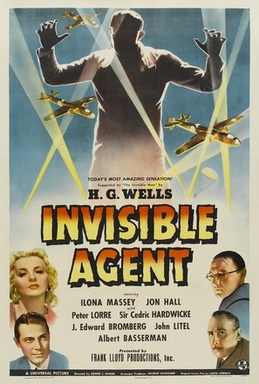
Horror Film Review: Invisible Agent (dir by Edwin L. Marin)


In 1942, the world was at war and everyone, whether a soldier or a civilian, was expected to do their part for the war effort.  That included the best and the brightest of Hollywood.  Stars like Jimmy Stewart, Clark Gable, and Henry Fonda enlisted in army.  Others sold war bonds and narrated patriotic news reels.  Even the Universal monsters did their part for the war effort, with the Invisible Man becoming the Invisible Agent in the 1942 film of the same name.

Invisible Agent opens in 1940, with Frank Griffin, Jr. (Jon Hall), the grandson of the original Invisible Man, being confronted by a Nazi (Sir Cedric Hardwicke) and a Japanese spymaster (Peter Lorre) at his print shop in Manhattan.  They want his grandfather’s invisibility formula.  At first, they offer to pay him for it.  Then, when Frank refuses, they threaten to chop off his fingers.  Frank manages to escape with both his fingers and the formula.  As Frank later tells the Americans, he’s not willing to give the formula to anyone because he knows how dangerous it can be if not used properly.  As far as Frank is concerned, the formula must never be used again.  Frank does say that he might change his mind under extraordinary circumstances.

The film cuts to a series of headlines announcing that the Japanese have bombed Pearl Harbor.  The circumstances are now extraordinary and Frank agrees that it is time to use the formula for the war effort.  But he agrees to do so on the condition that only he be allowed to take the formula.  Frank becomes the Invisible Agent, taking the formula and then parachuting into Nazi Germany.  Unseen, Frank searches for information about Nazi spies in the U.S. and the details of Germany’s plan to bomb New York.  Along the way, he meets Maria Sorenson (Ilona Massey), a wealthy German woman who is lusted after by the members of the German high command but who is actually working for the Resistance.  Frank also finds himself, once again, coming across the two men who previously threatened him in New York.

Here are the positive things about this film.  Invisible Agent has an intriguing premise.  The Nazis are such monsters that even the once fearsome Universal monsters are joining the effort to take them down.  The film also features two intelligent performances from Cedric Hardwicke and Peter Lorre, both of whom bring some unexpected shadings to their villainous roles.  The opening scene in Manhattan plays out like an intense film noir and, once the action moves to Germany, director Edwin L. Marin keeps things moving at a steady pace.

Unfortunately, Invisible Agent has one huge problem that it cannot overcome.  Jon Hall gives a remarkably charmless performance in the title role, flatly delivering his lines and showing very little in the way of personality.  When you’re not seen for the majority of the film, it’s important to have a voice that’s full of personality.  That’s one reason why the previous Invisible Man films benefitted from the casting of actors like Claude Rains and Vincent Prince.  Jon Hall, on the other hand, just comes across as being dull.  He gives a boring performance, whether visible or not and, as a result, Invisible Agent falls flat in a way that the previous Invisible films did not.  There’s no real stakes in his turning invisible because there really wasn’t much to him to begin with.

Still, I thank the Invisible Agent for his service.

Previous Universal Horror Reviews:

  1. Dracula (1931)
  2. Dracula (Spanish Language Version) (1931)
  3. Frankenstein (1931)
  4. Island of Lost Souls (1932)
  5. The Mummy (1932)
  6. The Invisible Man (1933)
  7. The Bride of Frankenstein (1935)
  8. Dracula’s Daughter (1936)
  9. Son of Frankenstein (1939)
  10. The Invisible Man Returns (1940)
  11. The Wolf Man (1941)
  12. Ghost of Frankenstein (1942)
  13. Frankenstein Meets The Wolf Man (1943)
  14. Son of Dracula (1943)
  15. House of Frankenstein (1944)
  16. House of Dracula (1945) 
  17. Creature From The Black Lagoon (1954)

Film Review: Cocaine and Blue Eyes (1983, directed by E.W. Swackhamer)


When San Francisco-based private investigator Michael Brennen (O.J. Simpson) gives a ride to Joey Crawford (John Spencer) on Christmas Eve, he doesn’t know that it’s going to lead to the biggest case of his career.  When Joey asks Michael to help him track down his ex-girlfriend, Michael assumes that Joey would never be able to pay for his investigative services.  But one week later, Michael gets something in the mail from Joey.  Inside the envelope, there’s a picture of both Joey’s ex and a thousand dollar bill.  Ever after he discovers that Joey was mysteriously killed the night before, Michael decides to take on the case.  His investigation will take him not only to Joey’s ex but it will also lead to him uncovering a drug ring that involves one of San Francisco’s most prominent families.
Simpson not only starred in this made-for-TV movie but he also served as executive producer.  Watching the movie, it’s obvious that it was meant to serve as a pilot for a Michael Brennen TV series and it’s also just as obvious why that series never happened.  O.J. Simpson was not a terrible actor but, ironically for someone who set records as an NFL player, there was nothing tough about him.  Simpson may be playing a two-fisted, cash-strapped P.I. but, in every scene, he comes across like he can’t wait to hit the golf course.  Simpson’s pleasant demeanor may have served him well in other areas of his life but it didn’t help him with this role.  Whenever Simpson has to share a scene with John Spencer, Candy Clark, Cliff Gorman, or any of the other members of this film’s surprisingly talented supporting cast, Simpson’s bland screen presence and lack of gravitas becomes all the more apparent.

Of course, when seen today, the main problem with Cocaine and Blue Eyes is that it’s impossible to watch without thinking, “Hey, didn’t the star of this movie get away with killing his wife and an innocent bystander?”  Even the most innocuous  of lines take on a double meaning when they’re uttered by O.J. Simpson.  It doesn’t help that the movie opens with Michael visiting his estranged wife and their children on Christmas Eve and getting chased around the neighborhood by a guard dog.  When the movie was made, this scene was probably included so that O.J. could show off some of the moves that made him a star at UCLA and with the Bills.  Seen today, the scene takes on a whole different meaning.

Without O.J. Simpson, Cocaine and Blue Eyes could easily pass for being an extended episode of Magnum P.I., Simon and Simon, or any other detective show from the 80s.  With Simpson, it becomes a pop cultural relic.  I don’t think it’s ever been released on DVD but it is available on YouTube, where it can be viewed by O.J. Simpson completists everywhere.

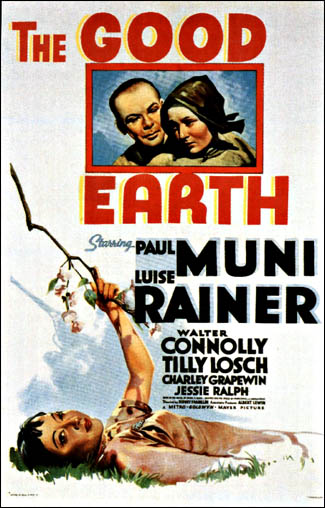
Cleaning Out The DVR #22: The Good Earth (dir by Sidney Franklin)


(For those following at home, Lisa is attempting to clean out her DVR by watching and reviewing 38 films by this Friday.  Will she make it?  Keep following the site to find out!)

Good_earth_(1937)

The 1937 film The Good Earth is a strange one.

It’s a big, epic film about life in China in the years before World War I.  It opens with a poor farmer named Wang (Paul Muni) marrying a servant girl named O-Lan (Luise Rainer).  O-Lan is quiet but strong and, with her support, Wang eventually starts to prosper.  He buys land and they have children.  Together, Wang and O-Lan manage to survive both famine and a political upheaval.  In fact, it’s China’s volatile politics that occasionally allow the family to survive.  When a revolutionary mob loots a mansion, O-Lan joins in just long enough to come across a bag of diamonds that the Wang uses to eventually buy the biggest house in town.  Once he’s become wealthy and complacent, Wang ends up taking on a younger, second wife (Tilly Losch) and O-Lan finds herself competing for his attention.  Ultimately, it’s only when Wang is again forced to tend to the Earth that he understands what is really important.

So, here’s the weird thing about The Good Earth.  It’s a film about China.  It covers several years of Chinese history and the story itself is rooted in Chinese culture.  All of the characters are meant to be Chinese.  When the movie was filmed, China was at war with Japan so it’s not surprising that the film was shot in California.  But what is interesting (though not really surprising when you consider the history of Hollywood) is that there are very few Chinese people in the cast and none of them play any of the major roles.

Instead, Wang was played by Austria-born, Chicago-raised Paul Muni.  O-Lan was played by German Luise Rainer.  Wang’s comic relief uncle was played by American character actor Walter Connolly while his father was played by a former vaudeville star from Ohio named Charley Grapewin.  All of the actors are heavily made up so that they’ll look Chinese but none of them act or sound Chinese.  It makes for a very strange viewing experience.

And it’s a bit unfortunate because there are some very good scenes in The Good Earth.  Technically, it’s a very strong film.  Towards the end, there’s a locust invasion that is still thrilling to watch.  The sets look great.  The costumes look great.  If you’re a history nerd like me, the story has the potential to be interesting.  But, whenever you start to get sucked into the film’s story, Wang starts to speak and sounds totally like a guy from Chicago and it takes you out of the movie.  The uneven mix of quality and miscast actors makes for a rather disjointed viewing experience.

As a big epic, it’s probably not surprising that The Good Earth was nominated for best picture.  However, it lost to another Paul Muni film, The Life of Emile Zola.

http://www.youtube.com/watch?v=3iEREqQjjzU

Cleaning Out The DVR #5: Around The World In 80 Days (dir by Michael Anderson)


Last night, as a part of my effort to clean out my DVR by watching and reviewing 38 movies in 10 days, I watched the 1956 Best Picture winner, Around The World In 80 Days.

Based on a novel by Jules Verne, Around The World In 80 Days announces, from the start, that it’s going to be a spectacle.  Before it even begins telling its story, it gives us a lengthy prologue in which Edward R. Murrow discusses the importance of the movies and Jules Verne.  He also shows and narrates footage from Georges Méliès’s A Trip To The Moon.  Seen today, the most interesting thing about the prologue (outside of A Trip To The Moon) is the fact that Edward R. Murrow comes across as being such a pompous windbag.  Take that, Goodnight and Good Luck.

Once we finally get done with Murrow assuring us that we’re about to see something incredibly important, we get down to the actual film.  In 1872, an English gentleman named Phileas Fogg (played by David Niven) goes to London’s Reform Club and announces that he can circumnavigate the globe in 80 days.  Four other members of the club bet him 20,000 pounds that he cannot.  Fogg takes them up on their wager and soon, he and his valet, Passepartout (Cantinflas) are racing across the world.

Around The World in 80 Days is basically a travelogue, following Fogg and Passepartout as they stop in various countries and have various Technicolor adventures.  If you’re looking for a serious examination of different cultures, this is not the film to watch.  Despite the pompousness of Murrow’s introduction, this is a pure adventure film and not meant to be taken as much more than pure entertainment.  When Fogg and Passepartout land in Spain, it means flamenco dancing and bullfighting.  When they travel to the U.S., it means cowboys and Indians.  When they stop off in India, it means that they have to rescue Princess Aouda (Shirley MacClaine!!!) from being sacrificed.  Aouda ends up joining them for the rest of their journey.

Also following them is Insepctor Fix (Robert Newton), who is convinced that Fogg is a bank robber.  Fix follows them across the world, just waiting for his chance to arrest Fogg and disrupt his race across the globe.

But it’s not just Inspector Fix who is on the look out for the world travelers.  Around The World In 80 Days is full of cameos, with every valet, sailor, policeman, and innocent bystander played by a celebrity.  (If the movie were made today, Kim Kardashian and Chelsea Handler would show up at the bullfight.)  I watch a lot of old movies so I recognized some of the star cameos.  For instance, it was impossible not to notice Marlene Dietrich hanging out in the old west saloon, Frank Sinatra playing piano or Peter Lorre wandering around the cruise ship.  But I have to admit that I missed quite a few of the cameos, much as how a viewer 60 years in the future probably wouldn’t recognize Kim K or Chelsea Handler in our hypothetical 2016 remake.  However, I could tell whenever someone famous showed up on screen because the camera would often linger on them and the celeb would often look straight at the audience with a “It’s me!” look on their face.

Around The World in 80 Days is usually dismissed as one of the lesser best picture winners and it’s true that it is an extremely long movie, one which doesn’t necessarily add up to much beyond David Niven, Cantinflas, and the celeb cameos.  But, while it may not be Oscar worthy, it is a likable movie.  David Niven is always fun to watch and he and Cantinflas have a nice rapport.  Shirley MacClaine is not exactly believable as an Indian princess but it’s still interesting to see her when she was young and just starting her film career.

Add to that, Around The World In 80 Days features Jose Greco in this scene:

Around The World In 80 Days may not rank with the greatest films ever made but it’s still an entertaining artifact of its time.  Whenever you sit through one of today’s multi-billion dollar cinematic spectacles, remember that you’re watching one of the descendants of Around The World In 80 Days.