Tonight’s excursion in televised horror comes the second season of HBO’s Tale From The Crypt. Originally broadcast on April 21st, 1990, The Switch tells the story of an elderly millionaire (William Hickey) who is desperately in love with a younger woman (Kelly Preston). When she tells him that she’s looking for a younger man, he goes to extreme lengths to become that younger man.
The episode was directed by Arnold Schwarzenegger and features good work from both William Hickey and Kelly Preston. And, of course, the whole story ends with a sardonic twist that, once again, reminds the viewers that the universe is just as random and meaningless as Werner Herzog says it is.
After I finished watching Girls Just Want To Have Fun, it was time for the 1986 film, Secret Admirer!
Secret Admirer is a fairly good example of a film that is dependent upon the idiot plot. Every plot complication could have been avoided by the characters not being idiots. The entire storyline could have been resolved within five minutes if some of the characters had been willing to ask questions before jumping to assumptions. Idiot plots tend to fun when they deal with teenagers, largely because, when you’re that age, you can get away with being an idiot. That’s part of the charm of being a teenager and why nobody ever wants to grow up. When you’re a teenager, you’re not expected to have any common sense or knowledge of the real world so you can get away with a lot more. At the same time, idiot plots involving adults tend to be annoying because adults really should know better. The idiot plot of Secret Admirer involves both teenagers and adults and, as a result, the film is half-charming and half-annoying.
Smart but shy Toni (Lori Loughlin) has a crush on her lifelong friend, the sweet but kinda stupid Michael (C. Thomas Howell). So, Toni writes Michael an incredibly eloquent love note and slips it into his locker. When Michael finds the note, he assumes that it was written by Debbie (Kelly Preston), who is pretty and popular but only dates college students. When Michael attempts to write a response to Debbie, he is sabotaged by his limited vocabulary, lack of eloquence, and general dimness. Luckily, Toni finds the note and, wanting to spare Michael any embarrassment, rewrites it for him. Debbie is so touched by Toni’s note that she goes out on a date with Michael. Toni is forced to stand in the background and watch while the boy she loves falls for a girl who is obsessed with shopping. (Secret Admirer suggests that this obsession indicates that Debbie is shallow but seriously, who doesn’t love to shop?) Will Toni tells Michael that she loves him or will she leave him so that she can spend a year studying abroad? (Personally, I would leave and have fun exploring Europe but then again, I also love to shop so obviously, Toni and I have conflicting worldviews.)
But that’s not all! Michael’s dad, George (Cliff DeYoung), also finds the note and assumes that it was written to him by Debbie’s mom, Elizabeth (Leigh Taylor-Young). Of course, Debbie’s father, a police detective named Lou (the always gruff Fred Ward), also comes across the note and becomes convinced that George and Elizabeth are having an affair. He somewhat forcibly recruits George’s wife, Connie (Dee Wallace Stone), to help him expose George and Elizabeth for being the cheaters that he believes them to be….
I got annoyed with the parents fairly quickly. It’s always fun to watch Fred Ward grimace and glare at people but otherwise, all of the adults were way too stupid and their behavior reminded me of that terrible episode of Saved By The Bell where the exact same thing happens to Mr. Belding. Secret Admirer works best when the adults are pushed to the background and the film concentrates on the relationship between Toni and Michael. They’re a sweet couple and you really want to see them end up together. Michael may be stupid but he’s still really cute and the film is perfectly charming whenever it concentrates on him and Toni.
Incidentally, Michael has several friends. They all ride around in a van and look through old issues of Playboy together. Most of the friends are interchangeable but I did like Ricardo (Geoffrey Blake), just because he was wearing a suit and a fedora for no particular reason. Ricardo didn’t really get to do much but his fashion sense made a definite impression.
By the admittedly high standards of 80s teen films, Secret Admirer is a minor film. It’ll never be mistaken for Sixteen Candles or Pretty In Pink. That said, it’s still an entertaining and occasionally sweet film. You’ll want to skip over the scenes involving the adults but the scenes involving C. Thomas Howell and Lori Loughlin are perfectly charming.
What’s an Insomnia File? You know how some times you just can’t get any sleep and, at about three in the morning, you’ll find yourself watching whatever you can find on cable? This feature is all about those insomnia-inspired discoveries!
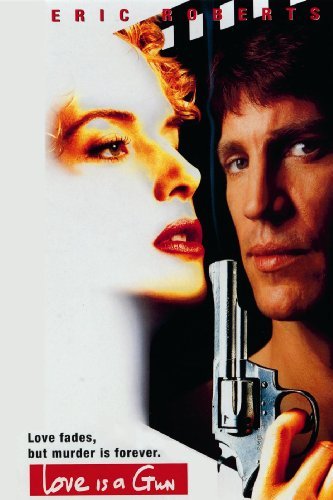
If you were suffering from insomnia last night, at around 2 in the morning, you could have turned on Showtime and watched Love is a Gun, an odd little thriller from 1994.
How odd is Love Is a Gun? It’s so odd that it stars Eric Roberts. Roberts plays Jack, a photographer with problems. His longtime girlfriend, Isabelle (Eliza Roberts), refuses to forgive him for cheating on her in the past and demands that he put a ring on her finger. (Jack, for his part, has bought a ring but he keeps losing it.) Jack is haunted by a reoccurring dream, in which he sees himself with a gun pointed at his head. Isabelle says that the dream means that Jack needs to give her a ring. Jack says it’s all about deja vu.
Jack gets a job working as a crime scene investigator. He meets a detective who is so crazy that he’s played by R. Lee Ermey. Jack takes pictures of dead bodies. His colleagues make macabre jokes. A local reporter offers to pay Jack for insider information. Ermey asks Jacks to help cover up a crime. Jack has visions of a line of well-dressed detectives shooting at him, firing squad style. Eventually, Jack ends up sitting in a living room, an anonymous body at his feet, and watching a soap opera. The actors on TV repeat dialogue that we’ve heard Jack and Isabelle say earlier in the film. Jack starts to giggle and is soon laughing like a maniac. A detective steps into the living room and asks Jack if he remembered to take a picture of the body in the bathroom. “Oh yeah,” Jack says, “I forgot about that…”
Jack meets a model named Jean (Kelly Preston). He takes pictures of her wearing a bridal gown and occasionally playing dead. He realizes that he’s already seen the exact same pictures that he’s just taken. Somebody left them in his locker at work but the images of Jean faded to black as soon as he looked at them. He asks Jean if this is all an elaborate joke. “Take the shot, Jack,” Jean replies.
Soon, Jean and Jack are having an affair. Jean tells Jack that she has a strange rash. Jack imagines that there’s a hole in Jean’s forehead. A man claiming to be Jean’s husband shows up and wishes Jack luck because his wife is crazy.
Jack goes back to Isabelle. Isabelle demands the ring. Jack freaks out and returns to Jean. Jean says she’s pregnant but then says she isn’t. Jack giggles and then cries. He goes back and forth between the two women, constantly begging for forgiveness as beads of sweat collect on his forehead.
Jack’s watch stops. He tries to get it repaired. An old man yells at him that his watch is cursed and cannot be repaired because it might infect all of the other watches in the man’s shop.
And, after all of that, the movie starts to get really weird…
Love Is A Gun does eventually offer up an explanation as to what’s going on. It doesn’t make a bit of sense but somehow, the total incoherence of it all adds to this low-budget film’s charm. Full of surreal images and intentionally odd dialogue, Love Is A Gun is compulsively watchable.
It also features a genuinely strange performance from Eric Roberts. Roberts goes through the film with this goofy smile on his face, except for the scenes when Jack gets upset. When Jack is upset, Roberts stomps his feet, jumps up and down, yells out every other line of dialogue, and contorts his body in some truly weird ways. When he gets really angry, he grabs can after can of beer and furiously shakes them before opening, causing the beer to drench his face. Eric Roberts’s lead performance is literally one of the oddest things that I have ever seen and it’s worth watching Love Is A Gun just to experience it.
My first reaction was to think, “Wow, Kevin Spacey really can act!” I mean, don’t get me wrong. I knew that, especially when working with a director who is strong enough to curb his natural tendency to go overboard, Kevin Spacey was capable of giving a great performance. However, Spacey is one of those actors who has such a unique look and style about him that I think sometimes we forget that he’s capable of doing more than just playing variations on Kevin Spacey.*
And it is true that, in the role of real-life Washington D.C. lobbyist Jack Abramoff, Kevin Spacey gave a performance that was full of the usual Spacey tricks. By that, I mean we got the Spacey voice going from a purr to a roar in just a manner of seconds. We got the Spacey glare, where he narrows his eyes and stares at whoever has offended him with an intensity that lets you know that something bad is about to happen. We got that somewhat strained Kevin Spacey smile, the way facial expression that lets us know that we don’t want to know what’s going on behind that friendly facade.
But, even though Spacey was up to his usual tricks, all of those tricks still came together to create a unique character. As I watched the film, I forgot that I was watching Kevin Spacey. Instead, I really felt that I was watching and listening to one of the most powerful lobbyists in American history.
And, when Abramoff was eventually arrested and prosecuted for defrauding his clients, I couldn’t help but feel a little bit of sympathy for him. Spacey plays the character with such a combination of hyperactive charm and righteous fury that you can’t help but be a little bit enthralled by him. That’s not to say that Kevin Spacey turns Jack Abramoff into a sympathetic character. (Indeed, as good as Spacey is, there are a few moments when his contempt for Abramoff comes through and his performance suddenly turns into a one-dimensional caricature.) But what Spacey does do is show that Jack Abramoff was less an inhuman monster and more the logical product of Washington culture. The only difference between Abramoff and everyone else in Washington is that Abramoff got caught.
But, at the same time, the move itself is never quite as interesting as Spacey’s lead performance. The movie’s main theme appears to be that Washington is corrupt and we’d do better if we curtailed the power of lobbyists but … well, do you really need a movie to tell you this? I mean I’m pretty much apolitical and I knew that long before I saw Casino Jack!
Casino Jack: Good performance. Boring message. Bleh movie.
—
* This is better known as the Christopher Walken syndrome.
Have you ever noticed how, occasionally, a totally obscure film that was made several decades ago will suddenly show up on either Starz or Encore and, the next thing you know, it’s only like every other day? That was the case a few months ago when, at times, it seemed as if the only thing playing on cable was a teen comedy from 1985 called Mischief.
After I saw it listed in the guide a few dozen times, I thought to myself, “Somebody at that station must really like that movie.” So, one night, I actually took the time to watch it and discovered why that mysterious person loved this movie. Mischief may not be as well-known as some of the other films in this series of Back to School reviews but it’s still a pretty good movie.
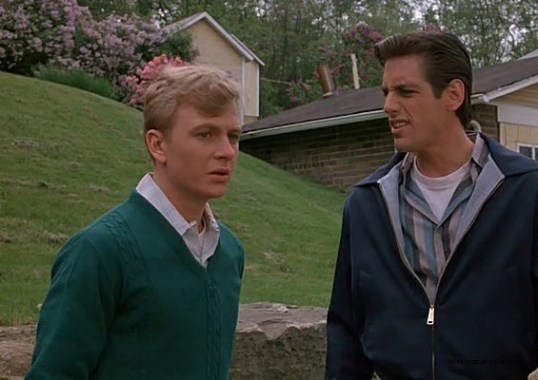
Like so many of the teen films that were released in the 70s and 80s, Mischief takes place in the 1950s. (I assume that’s because most films about teenagers are made by adults who want to both relive and perhaps change the past. I suppose that’s one reason why so many films released today are set in the 1990s. In another ten years or so, all of the new high school films will be set in 2003.) The very shy and clumsy Jonathan (Doug McKeon) has a crush on the beautiful but unattainable Marilyn (Kelly Preston). Fortunately, Jonathan is befriended by Gene (Chris Nash) who is the prototypical rebel without a cause. Gene wears a leather jacket. Gene rides a motorcycle. Gene doesn’t get along with his alcoholic, violin-playing father (Terry O’Quinn, in full asshole mode here). Gene even stands up to the school bully (D.W. Brown) and starts dating the bully’s ex-girlfriend, Bunny (Catherine Mary Stewart). Most importantly, Gene helps Jonathan finally develop the confidence necessary to ask Marilyn out.
And, for a while, Gene & Bunny and Jonathan & Marilyn make for the perfect foursome. But, as we all know, perfection can never last in a coming-of-age story. Jonathan starts to discover that he and Marilyn are not quite as compatible as he originally assumed that they were. As for Gene, he has to deal with his increasingly violent and drunken father…
That last paragraph probably makes Mischief sound a lot more dramatic than it actually is. Make no mistake about it — while Mischief does deal with some serious issues — it is primarily a comedy and a pretty good one at that. McKeon is endearingly clumsy in his initial attempts to get Marilyn to notice him and Nash — even though he’s playing a very familiar character — is likable as well. Perhaps the smartest thing that Mischief did is that it made Gene cool but it didn’t make him too cool. The film’s best scenes are the ones where Gene momentarily surrenders his rebel facade and reveals that he’s just as confused as everyone else. Catherine Mary Stewart and Kelly Preston are well-cast as well, with Preston especially doing a good job at making a potentially unsympathetic character likable.
In many ways, Mischief is a pretty predictable film. I think it features probably every single cinematic cliché that one would expect to see in a film about the 50s. But the film itself is so likable and good-natured that it doesn’t matter if it’s predictable. It’s just a good, enjoyable movie and what’s wrong with that?
(Incidentally, the screenplay for Mischief was written by Noel Black, who also directed the previously reviewed Private School.)
During the late 1970s and early 1980s, one could hardly step into a theater during the fall or winter movie season without seeing a trailer for the newest Stephen King adaptation. His name had become synonymous with cinematic horror, and nearly every year brought a new film promising supernatural terror or psychological unease.
Among this wave of adaptations came a 1983 film that united two masters of the genre—Stephen King, the reigning literary giant of horror, and John Carpenter, the filmmaker who had already cemented his reputation with Halloween and The Thing. Their collaboration resulted in the sleek, deadly story of a boy and his car: Christine.
The film opens on the assembly line of a Plymouth factory in 1957, immediately signaling that something is off about this particular 1958 Plymouth Fury. From the first note of the retro rock soundtrack to the gleam of that deep crimson paint, Carpenter frames the car with both nostalgia and menace. The lighting in this opening feels almost clinical—bright, sterile, mechanical—yet Christine’s red sheen cuts violently through it, a visual omen that this machine is infused with something beyond metal and chrome. Carpenter wastes no time making it clear that this car is not an inanimate prop; it’s a living entity from the moment it’s born.
We’re soon introduced to the film’s human core—Arnie Cunningham (Keith Gordon), a shy, bookish teenager tormented by bullies and smothered by his controlling parents, and his best friend Dennis Guilder (John Stockwell), the confident star athlete who often looks out for him. One afternoon, during their drive home from school, Arnie spots a rusting, decrepit Plymouth Fury in the front yard of an old man named Roland D. LeBay. Where Dennis sees a heap of junk, Arnie sees perfection. Ignoring his friend’s concerns—and later, his parents’ outrage—Arnie buys the car and names it Christine.
As Arnie begins restoring Christine to her former glory, a transformation occurs—not just in the car, but in Arnie himself. The once timid, acne-scarred teenager grows into a confident, even arrogant young man, donning slicker clothes, sharper speech, and a darker aura. Christine becomes his obsession, his refuge, and ultimately, his identity.
Carpenter crafts this metamorphosis with eerie precision, pairing the car’s physical renewal with Arnie’s psychological decay. The cinematography shifts accordingly—the lighting grows darker, drenched in neon reds and shadowy blues, mirroring Christine’s two faces: seductive allure and demonic possession. Carpenter’s score, a pulsing blend of electronic rhythm and minimalistic dread, underscores these shifts. It functions almost like Christine’s heartbeat—steady, mechanical, and ominously sensual.
Between the vintage rock tracks that accompany Arnie’s moments of infatuation and the electronic motifs that follow Christine’s predatory stalks, Carpenter manipulates sound to blur the lines between teenage romance and supernatural horror. Every rev of the engine feels rhythmic, almost musical, as if the car itself communicates through vibration and tone rather than words.
Arnie’s newfound confidence even earns him Leigh Cabot (Alexandra Paul), the most desired girl in school—a relationship that initially feels like a symbol of his triumph. But Christine is no fairy tale. When Arnie’s bullies vandalize his beloved car, the story turns from eerie to vengeful.
In a now-iconic sequence, Christine repairs herself before Arnie’s stunned eyes—the crumpled metal expands, glass re-forms, headlights ignite like eyes opening from a nightmare. Carpenter lights the scene with a soft, golden underglow that turns mechanical resurrection into a hauntingly beautiful transformation. It’s both horrifying and hypnotic—a perfectly scored ballet of vengeance set to the hum of machinery and the director’s unmistakable electronic pulse.
What follows is a furious killing spree. Christine prowls the night streets for retribution, a creature of fire and gasoline more alive than metal should ever be.
While Carpenter’s adaptation diverges from King’s novel, it remains faithful to its emotional and thematic essence. King’s book delves deeply into the idea of objects absorbing the evil of their owners, suggesting that malevolence can linger in things as much as in people. Carpenter, however, turns the focus inward.
His version becomes a tragic character study—a battle for Arnie’s soul between the cold, seductive power of obsession and the fragile warmth of human connection. In one corner stands Christine, the car that offers Arnie unconditional love but demands total possession. In the other are Dennis and Leigh, desperate to save the friend they’re rapidly losing to something they can’t fully understand.
Carpenter’s signature touches—his electronic score, minimalist framing, and cynical tone—imbue the film with a dark romanticism. Christine is less a haunted object than a femme fatale: a mechanized embodiment of jealousy and desire. The film’s atmosphere bridges two eras, combining the nostalgic vibe of 1950s Americana with the grim realism of Reagan-era suburbia.
By the end, Christine becomes both a story of supernatural obsession and a commentary on teenage identity—the hunger to shed weakness, to command respect, and to control one’s fate, even at the cost of one’s soul.
Upon its release in December 1983, Christine performed modestly at the box office but was far from a failure. Over time, it has developed a strong cult following, cherished by both Carpenter devotees and Stephen King fans. Though often overshadowed by Carpenter’s heavier-hitting works like The Thing or Escape from New York, Christine remains one of his most technically polished films. It also stands as a fascinating bridge between studio horror and Carpenter’s independent sensibilities—where the shine of a Hollywood production mingles with the grit of a B-movie heart.
If Christine teaches any lesson, it’s that love and possession are two sides of the same coin. Arnie’s tragedy lies not in falling for the wrong woman, but in falling for one that burns with literal hellfire. In Carpenter’s vision, the road to damnation isn’t paved with good intentions—it’s lined with chrome, lit by headlights, and always hungry for one more ride.




 Through the Shattered Lens