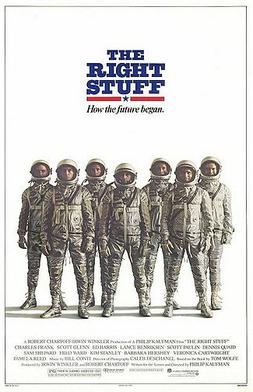
Lisa Marie Reviews An Oscar Nominee: The Right Stuff (dir by Philip Kaufman)


There’s a brilliant scene that occurs towards the end of 1983’s The Right Stuff.

It takes place in 1963.  The original Mercury astronauts, who have become a symbol of American ingenuity and optimism, are being cheered at a rally in Houston.  Vice President Lyndon Johnson (Donald Moffat) stands on a stage and brags about having brought the astronauts to his supporters.  One-by-one, the astronauts and their wives wave to the cheering crowd.  They’re all there: John Glenn (Ed Harris), Gus Grissom (Fred Ward), Alan Shephard (Scott Glenn), Wally Schirra (Lance Henrisken), Deke Slayton (Scott Paulin), Scott Carpenter (Charles Frank), and the always-smiling Gordon Cooper (Dennis Quaid).  The astronauts all look good and they know how to play to the crowd.  They were chosen to be and sold as heroes and all of them have delivered.

While the astronauts are celebrated, Chuck Yeager (Sam Shepard) is at Edwards Air Force Base.  Yeager is the pilot who broke the sound barrier and proved that the mythical “demon in the sky,” which was whispered about by pilots as a warning about taking unnecessary risks, was not waiting to destroy every pilot who tried to go too fast or too high.  Yeager is considered by many, including Gordon Cooper, to be the best pilot in America.  But, because Yeager didn’t have the right image and he had an independent streak, he was not ever considered to become a part of America’s young space program.  Yeager, who usually holds his emotions in check, gets in a jet and flies it straight up into the sky, taking the jet to the edge of space.  For a few briefs seconds, the blue sky becomes transparent and we can see the stars and the darkness behind the Earth’s atmosphere.  At that very moment, Yeager is at the barrier between reality and imagination, the past and the future, the planet and the universe.  And watching the film, the viewer is tempted to think that Yeager might actually make it into space finally.  It doesn’t happen, of course.  Yeager pushes the jet too far.  He manages to eject before his plane crashes.  He walks away from the cash with the stubborn strut of a western hero.  His expression remains stoic but we know he’s proven something to himself.  At that moment, the Mercury Astronauts might be the face of America but Yeager is the soul.  Both the astronauts and Yeager play an important role in taking America into space.  While the astronauts have learned how to take care of each other, even the face of government bureaucracy and a media that, initially, was eager to mock them and the idea of a man ever escaping the Earth’s atmosphere,  Chuck Yeager reminds us that America’s greatest strength has always been its independence.

Philip Kaufman’s film about the early days of the space program is full of moments like that.  The Right Stuff is a big film.  It’s a long film.  It’s a chaotic film, one that frequently switches tone from being a modern western to a media satire to reverent recreation of history.  Moments of high drama are mixed with often broad humor.  Much like Tom Wolfe’s book, on which Kaufman’s film is based, the sprawling story is often critical of the government and the press but it celebrates the people who set speed records and who first went into space.  The film opens with Yeager, proving that a man can break the sound barrier.  It goes on to the early days of NASA, ending with the final member of the Mercury Seven going into space.  In between, the film offers a portrait of America on the verge of the space age.  We watch as John Glenn goes from being a clean-cut and eager to please to standing up to both the press and LBJ.  Even later, Glenn sees fireflies in space while an aborigines in Australia performs a ceremony for his safety.  We watch as Gus Grissom barely survives a serious accident and is only rescued from drowning after this capsule has been secured.  The astronauts go from being ridiculed to celebrated and eventually respected, even by Chuck Yeager.

It’s a big film with a huge cast.  Along with Sam Shepherd and the actors who play the Mercury Seven, Barbara Hershey, Pamela Reed, Jeff Goldblum, Harry Shearer, Royal Dano, Kim Stanley, Scott Wilson, and William Russ show up in roles both small and large.  It can sometimes be a bit of an overwhelming film but it’s one that leaves you feeling proud of the pioneering pilots and the brave astronauts and it leaves you thinking about the wonder of the universe that surrounds our Earth.  It’s a strong tribute to the American spirit, the so-called right stuff of the title.

The Right Stuff was nominated for Best Picture but, in the end, it lost to a far more lowkey film, 1983’s Terms of Endearment.  Sam Shepard was nominated for Best Supporting Actor but lost to Jack Nicholson.  Nicolson played an astronaut.

Late Night Retro Television Reviews: Gun 1.1 “The Shot”


Welcome to Late Night Retro Television Reviews, a feature where we review some of our favorite and least favorite shows of the past!  On Tuesdays, I will be reviewing Gun, an anthology series that ran on ABC for six week in 1997.  The entire show is currently streaming on Tubi!

Produced by filmmaker Robert Altman, Gun was an anthology series that followed one gun from person-to-person.  Each week would feature a new cast and a new story.  The show itself didn’t catch on but, because of Altman’s prestige, is still managed to attract some prominent and interesting guest stars during it’s 6-episode run.

The first episode, for instance, brings the gun together with Daniel Stern, Ed Begley, Jr., and model Kathy Ireland.

Episode 1.1 “The Shot”

(Dir by James Foley, originally aired on April 12th, 1997)

The first episode of Gun opens with an unnamed dumbass purchasing a pearl-handed, .45 semi-automatic pistol.  When he takes it home, his kids are impressed but his wife threatens to kick him out if he ever fires the gun in the house.  Next thing you know, the dumbass is pretending to be Robert De Niro in Taxi Driver and pointing the gun at the television.  The final shoot-out from The Good, The Bad, and The Ugly leads to the TV getting shot.  The dumbass returns the gun.  Later, that night, someone breaks into the gun store and steals the gun.

Who stole it?  It turns out that it was just a guy who spends his time holding up convenience stores.  Unfortunately, his next attempt at a convenience store robbery does not go well, largely due to one aggravated customer.  Harvey Hochfelder (Daniel Stern) is already in an agitated state before the robbery even begins.  He just wants to leave Los Angeles for Virginia but, before he can leave, he had to stop off at the slowest convenience store in L.A.  Harvey loses it as soon as he realizes that the robbery is going to mean his escape to Virginia is going to be even further delayed.  When Harvey’s wife (Kathy Baker) enters the store, the robber is startled into first shooting at Harvey and then dropping the gun.  The robber runs outside and tries to steal Harvey’s car, with Harvey’s son and dog in the back seat.  Harvey grabs the gun and chases the robber down.  The robber crashes the car and Harvey holds him at gun point until the police arrive.

Harvey becomes a celebrity.  He even appears on the cover Newsweek, with the simple headline, “American Hero.”  Hollywood wants to make a made-for-TV movie about what happened in the convenience store, with Harvey playing himself and Kathy Ireland playing his wife.

Unfortunately, the friends of the robber are not happy that Harvey “fingered our homie” (yes, that’s actual dialogue) and they decide that they want to get revenge on Harvey.  When they force his car off the road and then pull guns of their own on him, Harvey diffuses the situation by offering them roles the movie.  Everyone wants to be a star!

Finally, the day of filming has arrived.  Under the guidance of the film’s director (Ed Begley, Jr.), Harvey prepares to climb into bed with a lingerie-clad Kathy Ireland….

Suddenly, Harvey is back in the convenience store, getting shot multiple times by the robber and expiring as a security camera records his final moments.  His entire time as a Hollywood star was just a dying fantasy which, honestly, was kind of obvious just by how cartoonish all of the Hollywood scenes were.

Well, as far as first episodes are concerned this was really, really …. bad.  Anthology shows are always a bit hit-and-miss and this episode was definitely almost all miss and no hit.  As good a character actor as he may be, Daniel Stern overacts to such an extent in this episode that it’s difficult to really have much sympathy for Harvey and the episode’s final twist largely fell flat.

The first episode of Gun is an almost entire …. dare I say it? …. misfire.

Film Review: All The King’s Men (dir by Steven Zaillian)


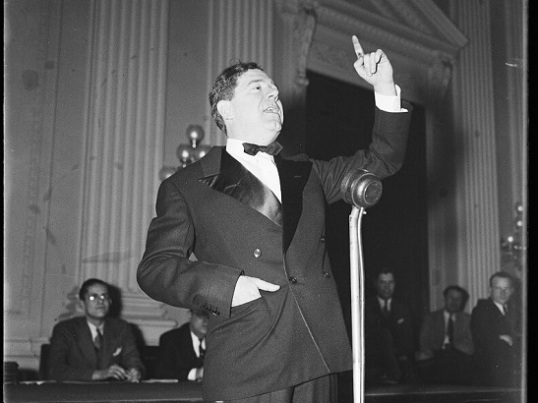
On September 10th, 1935, a Senator named Huey Long was shot and killed at the Louisiana State Capitol in Baton Rogue.

While it’s generally agreed that Carl Weiss, the son-in-law of a political opponent, approached Long, there’s still some debate as to whether or not Weiss was the one who shot Long. Did Weiss fire one shot at Long or was Long himself accidentally shot by his many bodyguards, all of whom opened fire on Weiss? (Weiss died at the scene, having been wounded at least 60 times.) There’s even some who argue that Weiss didn’t even have a gun on him when he approached Long and that Long’s bodyguards misinterpreted Weiss’s intentions. Or, as some more conspiracy-minded historians have suggested, perhaps Long’s bodyguards were themselves paid off by one of Long’s many enemies. With Huey Long, anything was possible.

Huey Long has been described as being an American dictator, a man who ran for office as a populist and who, as governor and then senator, ruled Louisiana with an iron fist. His slogan was “Every man a king,” and he promoted a platform that mixed Socialism with redneck resentment. (In modern terms, he mixed the vapid but crowd-pleasing rhetroic of AOC with the bombastic but calculated personal style of Donald Trump.) He often played the flamboyant buffoon but he also knew how to reward his friends and punish his enemies. At the time of his death, he was planning to run for President against FDR. It’s said that, in typical Long fashion, he planned to run as a third party candidate and draw away enough votes from Roosevelt to allow Republican Alf Landon to win. Then, in 1940, Long would run for the Democratic nomination and send President Landon back to Kansas.
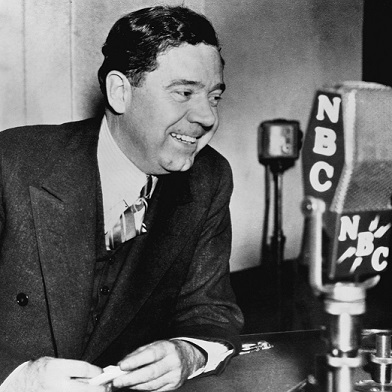
Huey-Long-radio-3000-3x2gty-5c2934d246e0fb00012da4a1

Whether his plan was feasible or not, they came to an end with his death. However, his legacy continued as members of the Long family dominated Louisiana politics for decades to come. Huey’s brother, Earl, served as governor of Louisiana for several contentious terms. Huey’s son, Russell, spent nearly 40 years in the Senate and, as chairman of the Finance Committee, was one of the most powerful men in the country. As late at 2020, Huey’s third cousin was serving in the Louisiana Senate. In the past few years, both Donald Trump and Bernie Sanders have been compared to Huey Long. Of course, if Huey were alive today, he’d probably be very popular online. Political Twitter has never met an authoritarian that it couldn’t make excuses for.

Among those who were fascinated by the life and death of Huey Long was a Southern poet and novelist named Robert Penn Warren. Warren used Long as the basis for Willie Stark, the man at the center of the novel All The King’s Men. In the novel, Stark is a classic and tragic American archetype, the man of the people who loses his way after coming to power. Stark starts the book as an idealist who wants to make life better for the poor but who, as he works his way up the political ladder, loses sight of why he first entered politics in the first place. He goes from fighting for the people to fighting only for himself. The book was controversial but popular and won the 1947 Pulitzer Prize. In later interviews, Warren often said that All The King’s Men was never meant to be a book about politics but instead a book about two men, Willie Stark and reporter Jack Burden, losing their way during the tumult of the Great Depression.  Regardless of Warren’s intentions, most readers and critics have focused on the book as a cynical look at American politics and the authoritarian impulse.

All-the-Kings-Men-1949

Considering the book’s popularity, it’s not surprising that All The King’s Men was turned into a movie just three years after it was published.  Directed by Robert Rossen and starring a perfectly cast Broderick Crawford as Willie Stark, the film won the Oscar for Best Picture of 1949.  Just as with the book, the film was considered to be controversial.  Many claimed that the film’s cynical portrayal of American politics was the equivalent of supporting communism, despite the fact that both the novel and the original film present Stark as being the epitome of the hypocritical Marxist dictator.  Indeed, if any character would have inspired audiences in 1949 to distrust socialism, it would have been a faux populist like Willie Stark.  Still, John Wayne was so offended by the book and the script that he very publicly turned down the role of Willie Stark.  That was all the better for Broderick Crawford, who won an Oscar playing the role.  When seen today, the original All The King’s Men holds up surprisingly well, as does Crawford’s lead performance.  Filmed in harsh black-and-white and featuring a cast of cynical, tough-talking characters, it’s a political noir.

Those who found the 1949 version of All The King’s Men to be dangerously subversive obviously had no idea what was in store for them and the country over the next couple of decades.  There’s a reason why the best-known book about the downfall of Richard Nixon was called All The President’s Men.  By the start of the current century, with all of the political corruption that was happening in the real world, the flaws and crimes of Willie Stark seemed almost quaint by comparison.  In 2006, with George W. Bush serving his second term, America embroiled in two unpopular wars, and the economy looking shaky, it was decided that it was time for a new version of the story of Willie Stark.

This version was directed by Steven Zaillian, the screenwriter whose credits included Schindler’s List, Gangs of New York, Hannibal, and American Gangster.  The role of Willie Stark was played by Sean Penn, who was both an Academy Award winner and an outspoken critic of George Bush.  (And, make no mistake about it, the new version of Willie Stark would be as much based on Bush as he was on Huey Long.)  Jude Law played Jack Burden, the reporter who narrated the story of Stark’s rise and fall.  Kate Winslet, Anthony Hopkins, James Gandolfini, Patricia Clarkson, Mark Ruffalo, Jackie Earle Haley, and Kathy Baker all had supporting roles.  This was a cast full of Oscar nominees and, indeed, the film’s trailer had that portentous, “the movie is very important and award-worthy” feeling to it that studios go with whenever they’re trying to convince audiences that they have an obligation to see a film, regardless of how boring or annoying it may look.  Entertainment Weekly predicted that All The King’s Men would be an Academy Award contender. For nearly two months, one could not see a movie at the Dallas Angelika without also seeing thee trailer for All The King’s Men.  It was a movie that was due to arrive at any minute and it was coming with an awful lot of hype.

And then, the strangest thing happened.  The film itself kind of disappeared.  It arrived and then it promptly got lost.  The reviews were overwhelmingly negative.  Audiences did not turn out to see the film.  It was a box office bomb, one that pretty much ended Steven Zaillian’s career as a director.  The film played for a week in Dallas and then left the city’s movie screens.  Even if I had been planning on seeing the film when it was originally released, I wouldn’t have had the opportunity.  The Gods of cinema, politics, and Southern accents were conspiring to protect me from suffering through a bad movie and I guess I should be thankful.  There’s nothing that makes me cringe more than hearing a bad Southern accent in a movie and the trailer for All The King’s Men was full of them.

Way back in November of last year, I noticed that the 2006 version of All The King’s Men was available on Encore On Demand.  At the time, I had politics on my mind.  The Virginia and New Jersey gubernatorial elections had bee held earlier that week.  Biden’s huge infrastructure bill had passed the House on the very same night that I came across the film.  Hell, I figured, could watching Sean Penn as Willie Stark be any worse than watching Joe Biden try to give a speech from the Oval Office?  So, I decided to give the movie a chance and I quickly discovered that watching Sean Penn’s Willie Stark was a lot worse.

In All The King’s Men, Sean Penn gives the type of bad performance that can only be given by a good actor.  Penn yells and grimaces and barks out order like the villain in a badly dubbed Bollywood movie.  When he watches a dancer, he doesn’t just look at her.  Instead, he stares with all the intensity of a cartoon wolf who has just spotted Little Red Riding Hood.  There’s nothing subtle about Penn’s performance, least of all his overbaked accent.  The only thing wilder than Penn’s accent is his hair, which often seems to be standing up straight as if he’s just removed his fingers from an electrical socket.  It’s a performance that is heavy on technique but empty on substance.  In both the book and the original film, Willie Stark is flamboyant in public but cool and calculating in private.  In the remake, Penn yells and sweats and jumps around and comes across as being so desperate that it’s hard to buy into the idea that anyone would believe a word that he said.  Broderick Crawford’s Willie Stark was believable because Crawford, with his bulky build and his plain-spoken manner, came across as being a real human being.  One could imagine voters looking at Crawford and believing that he was just like them.  Sean Penn, on the other hand, comes across like a rich man’s version of a poor man.  Penn is too obviously condescending to be an effective populist.  Voters will forgive a lot but they’ll never forgive a politician who openly talks down to them.

As for the rest of the cast, they’re a very talented group but not one of them is convincingly cast.  In fact, many of them give career-worst performances.  Anthony Hopkins does his usual eccentric routine but it doesn’t add up too much because the audience never sees him as being anything other than Anthony Hopkins using a rather spotty Southern accent.  When Hopkins’s character dies, it’s not a tragedy because the character himself never feels real.  Instead, you’re juts happy that Hopkins collected a paycheck.  Kate Winslet seems to be bored with the role of Stark’s mistress.  Mark Ruffalo is dazed in the role of Winslet’s brother.  As Jack Burden, Jude Law seems as lost as anyone, which wouldn’t be problem if not for the fact that Jack is the one narrating the film.  When your narrator is lost, you’re in trouble.

There’s really only two members of the cast who escape the film unscathed.  Jackie Earle Haley is properly intimidating as Stark’s devoted bodyguard.  Haley doesn’t get many lines but one look at his disturbed eyes tells you all you need to know about how far he’ll go to protect his boss.  On the other hand, James Gandolfini gets several lines and he does such a good job of delivering them and he plays the role of a corrupt political boss with such a perfect combination of good humor and cold pragmatism that you have to wonder just how much All The King’s Men would have been improved if Gandolfini had played Willie Stark instead of Sean Penn.

Steve Zaillian’s direction involves a lot of soft-focused flashbacks and several visual references to the Nuremberg rallies.  Just as with Penn’s performance, there’s nothing subtle about Zaillian’s direction, despite the fact that the story itself is so melodramatic that it calls for the opposite of a heavy-handed approach.  One wonders what exactly Zaillian was trying to say with his version of All The King’s Men, which presents Willie Stark as being a monster but still as the audacity to end with a clip of him giving a rousing campaign speech.  Again, the problem is that we never buy into the idea that Willie Stark was ever sincere in his desire to help the common man.  Everything about both Penn’s performance and Zaillian’s direction serves to suggest that, from the start, Stark viewed them as just being a means to an end.  Ending the film with a flashback of Willie giving a campaign speech is about as moving as a friend from high school contacting you on Facebook and then trying to get you to take part in a pyramid scheme.  There’s no sincerity to be found in any of it.

In the end, it’s a film of overheated performances and meticulously shot scenes that all add up to very little.  There are a few moments where Sean Penn’s body language and his vocal inflections suggest that he’s trying to channel George W. Bush but there’s nothing particularly shocking or subversive about that.  In 2006, every movie and TV show had to find a way to take a swipe at Bush and Penn’s never been particularly reticent when it comes to broadcasting his politics.  Though All The King’s Men was executive produced by political consultant James Carville, there’s very few moment in the film that feel authentic.  It’s like a high school senior’s view of politics.

All The King’s Men came and went quickly.  Fortunately, everyone was able to move on.  Steven Zaillian has not directed another film but remains an in-demand scriptwriter.  Sean Penn, Anthony Hopkins, and Kate Winslet all won Oscars after appearing in this film (though, it should be noted, none of them won for this film).  Mark Ruffalo and Jude Law went on to join the Marvel Universe.  Jackie Earle Haley continues to be a much-respected character actor.  Tragically, James Gandolfini is no longer with us but his performance as Tony Soprano will never be forgotten.  The second version of All The King’s Men wasted a lot of talent but, fortunately, talent always finds a way to survive.

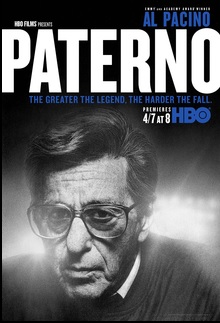
Film Review: Paterno (dir by Barry Levinson)


There’s a great scene that occurs about an hour into HBO’s latest original film, Paterno.

Joe Paterno (Al Pacino), the legendary and aging Penn State football coach, has been accused of knowing and failing to report that one of his former assistant coaches, Jerry Sandusky (Jim Johnson), was a pedophile.  With Paterno and his family plotting out strategy behind closed doors, a group of Penn State students gather outside of the Paterno home.  Instead of being angry that children were molested at their college, they’ve come to show their support for Paterno.

“JOE PATERNO!” they chant.

Scott Paterno (Greg Grunberg) hears the chants.  Scott is a lawyer and appears to be the only member of the Paterno family to truly understand the seriousness of the accusations.  Scott steps outside.

“JOE PATERNO!” the crowd continues to chant.

Scott thanks them for their support but then says that they also need to show the same support to all of Sandusky’s victims…

“JOE PATERNO!” the chant continues.

Struggling to be heard, Scott again asks them to remember that the children molested by Sandusky are the ones who need the most support…

Suddenly, the chant changes.  “SCOTT PATERNO!” the crowd starts to chant.  It’s not because they’ve heard anything that Scott’s said.  Instead, it’s because Scott’s a Paterno and, in the eyes of the crowd, that makes him royalty.  As the crowd continues to chant his name, Scott gives up and reenters the house.

Paterno could have used more scenes like that, scenes that explicitly showed the danger of blind hero worship as opposed to just telling us about it.  For the most part, Paterno feels like a well-written Wikipedia article.  You can’t deny the skill with which the film was made but, at the same time, it’s difficult not to get frustrated by Paterno‘s refusal to really dig too far underneath the surface of the story.

Some of the problem is with the film’s structure.  The film primarily takes place over the final six days of Paterno’s career.  Paterno spends the majority of the film locked away in his house, passive aggressively avoiding the question of what he knew and when he knew it.  His wife (Kathy Baker) and his other son, buffoonish Jay (Larry Mitchell), make excuses for him while Scott tries to get everyone to understand that the accusations aren’t just going to go away.  This is the part of the Paterno story that, in most films, would be summed up by an end credits title card.

As a result, Paterno never really deals with why Joe Paterno not only didn’t report Sandusky but also apparently protected him and that, to be honest, is the most important and troubling part of the story.  Since Sandusky is only briefly seen, we never get any insight into his relationship with Paterno and we never understand why Paterno would go to bat for an assistant who he, at one point, refers to as being “a pain in the ass.”  Was Paterno truly clueless about what was happening or did he just think he could sweep it under the rug and nobody would say anything because he was Joe Paterno?  Were Paterno’s actions the result of willful blindness or hubris?  It’s not so much a problem that the film leaves certain questions unanswered as much as it’s a problem that the film itself doesn’t seem to be all that concerned with the answers.

When the film isn’t concentrating on the Paternos, it’s concentrating on the reporter, Sara Ganim (Riley Keough), who originally broke the story.  However, these scenes are never quite as compelling as the film seems to think they are.  Riley Keough, who was so great in American Honey, seems miscast here.  For the most part. Sara seems to be there so that she can witness the Penn State students rioting and chanting, “Fuck the Media” after Paterno loses his job.

The best thing that Paterno has going for it is the lead performance of Al Pacino.  Pacino plays Paterno as a man who is very comfortable with the routine that he’s built up for himself.  His life revolves around Penn State, his team, and finally his own legend.  When the Sandusky story first breaks, Paterno can’t understand why he even has to be concerned about it.  He’s got a game against Nebraska coming up!  Awkward even around his adoring family, Paterno only seems to be truly comfortable when he’s coaching.  Pacino plays Paterno as a fragile and sickly man, a once ferocious lion brought down by a combination of cancer and scandal.  When we first see him, Paterno is coaching his team to a record-setting victory and he seems like a larger-than-life figure.  By the end of the movie, Paterno seems much smaller, a confused man who still can’t seem to bring himself to deal with why everyone is getting so upset.  It’s a great performance in an uneven film.


Cleaning Out The DVR Yet Again #32: Sister Cities (dir by Sean Hanish)


(Lisa recently discovered that she only has about 8 hours of space left on her DVR!  It turns out that she’s been recording movies from July and she just hasn’t gotten around to watching and reviewing them yet.  So, once again, Lisa is cleaning out her DVR!  She is going to try to watch and review 52 movies by the end of Wednesday, December 7th!  Will she make it?  Keep checking the site to find out!)

Sister Cities originally aired on Lifetime on September 17th.  When it first aired, I was really expecting to like it just because it’s a movie about four sisters and I’m the youngest of four sisters.  Add to that, one of the sisters was named Dallas and Dallas is my city.  Seriously, I seemed destined to like Sister Cities.

But then I actually saw the film.  And I have to admit that, for the first hour or so, I felt a little bit guilty about not liking the film.  It may have been a painfully slow film but I figured that it deserved some credit for at least trying to take the time for the viewers to get to know the four sisters.  As well, I couldn’t deny that casting did a good job when it came to selecting the four lead actresses.  You looked at them and they all had enough features and mannerisms in common that you could actually believe that they were related.

In the film, the four sisters gather together after the suicide of their mother (played, in flashbacks, by both Amy Smart and Jacki Weaver).  The sisters all have their own distinct personalities and, for some reason, three of them are named after cities.

For instance, the youngest sister is named Baltimore (Troian Bellisario).  She’s a free-spirit who does what she wants.  Now, my boyfriend is from Baltimore.  I have friends who live in Baltimore.  I’ve visited Baltimore and I loved it.  But I would not name my daughter Baltimore because Baltimore is a great name for a city but it’s a terribly clunky one for a human being.  If I was going to pick a city to name my daughter after, I’d probably go with Savannah or maybe Charlotte.  Or, for that matter, maybe Ardglass.   But not Baltimore.

Then there’s Dallas (Michelle Trachtenberg), who is the super organized and neat sister.  She’s the one who gets taunted for always wearing matching underwear but seriously, what’s wrong with that?  At least Dallas gets a pretty name.

Austin (Jess Wexler) has a pretty name too.  We’re told that she’s a successful writer.  We never believe it for a second.  Austin lived with her mother and she’s the one who called the other sisters back home.  Austin is as close as the film comes to having a central character.

And then there’s Carolina (Stana Katic), who is the oldest.  She’s a lawyer and she’s angry because her mother named her after one of the Carolinas but never clarified which one.

To be honest, it’s a bit too much.  The sisters are all exaggerated types.  The mother is an exaggerated type.  They all have cutesy names.  The nonstop theatrical quirkiness of it all is very off-putting and it doesn’t help that the film’s first hour is painfully slow.  There’s a few attempts at dark humor but it’s never as insightful or affecting as it seems to think it is.

Then we get to the second hour and the film remains painfully slow but it also turns into a rather strident screed about assisted suicide.  Eventually, the whole film comes down to an extended flashback of a beatific-looking Jacki Weaver smiling as she calmly explains that Austin will have to help her commit suicide because she’s the only sister who is emotionally strong enough to handle it.  It was all so manipulative and heavy-handed that I ended up getting so annoyed that I took off my shoes and nearly threw them at the TV.

Sorry, Baltimore.

Sorry, Dallas.

Sorry, Austin.

Sorry, Carolina.

Back to School Part II #39: The Glass House (dir by Daniel Sackheim)


the_glass_house_2001_film

Originally, I was planning on using the 2001 thriller The Glass House as one of my guilty pleasure reviews.  Because, seriously, this film truly is one of the guiltiest of all guilty pleasures.  I mean, there’s so much that you can criticize about the movie but it’s so much fun that I always feel rather bad for doing so.  However, after giving it some thought, I decided to use The Glass House as one of my Back to School reviews.  Seeing as how I just totally trashed a Leelee Sobieski film called Here On Earth, it only seems fair to now recommend one of her films.

In The Glass House, Leelee plays Ruby Baker, a 16 year-old whose parents are killed in a car accident.  Though their uncle (Chris Noth) wants to adopt them, the will states that Ruby and her nine year-old brother (Trevor Morgan) will instead be looked after by their parents’ best friends, Erin (Diane Lane) and Terry (Stellan Skarsgard).

Now, here’s the thing.  This is going to blow your mind.  Guess where Erin and Terry live?  They live in a big mansion in Malibu and the entire house is made out of … GLASS!  We have a title, right!?  But wait, there’s more!  Guess what Terry and Erin’s last name is?  That’s right — GLASS!  So, the house is not only literally a glass house but it’s also the Glass house as well!  And beyond that, there’s that old saying that people who live in glass houses shouldn’t throw stones and … well, that really doesn’t apply to this film.

Anyway, I’m making such a big deal about the title because it pretty much tells you everything that you need to know about The Glass House.  There is not a single subtle moment to be found in this entire film. And really, this is not a film that requires or rewards subtlety.  We know that Terry Glass is up to no good from the minute we meet him, largely because he’s played by Stellan Skarsgard and when was the last time Stellan Skarsgard played a trustworthy character?  Skarsgard pretty much gives the same performance here that he’s given in almost every thriller that he’s ever appeared in (including David Fincher’s rehash of The Girl With The Dragon Tattoo — which I’m still ticked off about, by the way) but it works wonderfully because there’s not a hint of pretension to The Glass House.  It just wants to entertain and it does just that.  There’s little that can match the entertainment value of watching Stellan Skarsgard go totally over the top.

Sure, the film has all sorts of flaws.  Ruby’s intelligence changes from scene to scene, depending on what the film’s story needs her to do.  (For that matter, the same thing can be said about every character in the film.)  But the film’s a lot of fun and Leelee Sobieski gives one of the best and most sympathetic performances of her career.  Ruby may be an inconsistent character but she’s so well-played that you like her anyway.  In a film that often threatens to go just a little bit too crazy, Leelee gives a performance of both believable grief and believable inner strength.  She keeps the film grounded just enough that you’ll continue to watch even when the narrative hits a rough patch.  As well, Bruce Dern is hilariously sleazy as a possibly duplicitous attorney.  The only thing more entertaining than watching Stellan Skarsgard go over the top is watching Bruce Dern do the same thing in the same film.

The Glass House is one of those films that seems to show up on cable constantly.  And, 9 times out of 10, I’ll at least watch at least a little bit of it.  It’s just a fun movie.

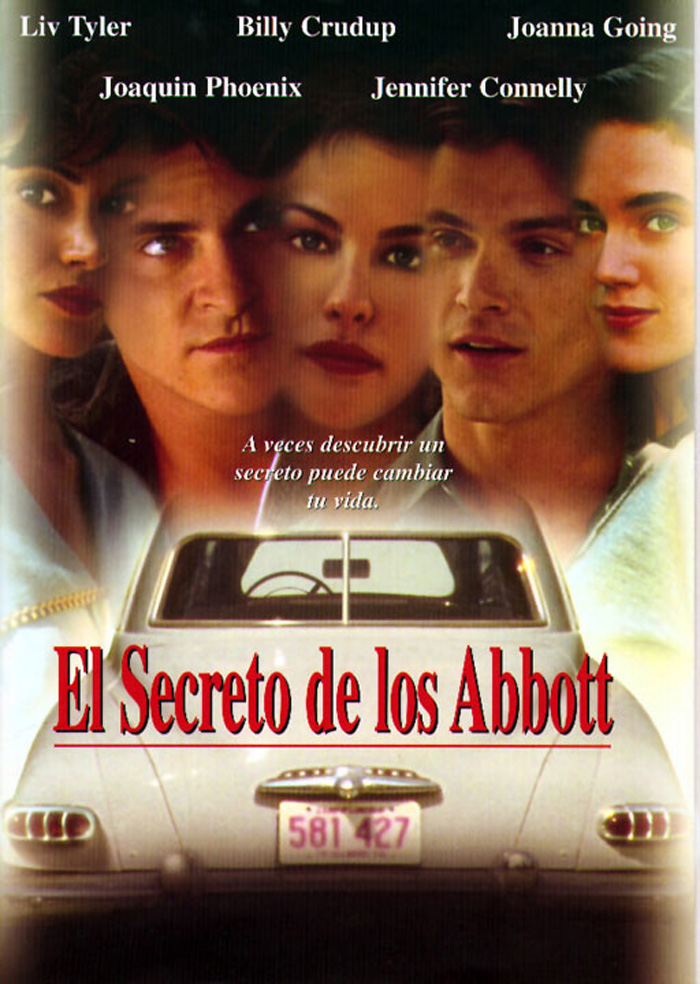
Embracing the Melodrama #45: Inventing the Abbotts (dir by Pat O’Connor)


First released in 1997, Inventing the Abbotts is a small town, romantic melodrama about two families in the 1950s.  One family is poor.  One family is rich.  As you can probably guess, each is fated to determine the destiny of the other.

Decades ago, Lloyd Abbott (Will Patton) and Holt were business partners.  However, after Lloyd had an affair with Holt’s wife (Kathy Baker), their friendship ended.  Lloyd eventually becomes the richest man in town and has three beautiful daughters: dutiful Alice (Joanna Going), wild Eleanor (Jennifer Connelly), and virginal Pam (Liv Tyler).  Holt is long since dead and his two sons, Jacey (Billy Crudup) and Doug (Joaquin Phoenix) live next door to the Abbotts.  While the bitter Jacey is obsessed with the Abbott family and ends up pursuing both Eleanor and the married Alice, Doug claims not to care about the Abbotts.  However, despite his claimed indifference, Doug soon finds himself falling in love with Pam.  Will Doug and Pam be together or will Lloyd succeed in keeping them apart?

To be honest, Inventing the Abbotts is not a particularly good film.  It moves way too slowly, Doug and Jacey frequently swtich personalities whenever the plot demands it, the story is way too predictable, the voice over narration is way too obvious, and Jennifer Connelly’s character leaves the film way too early.  This is one of those films that is determined to make sue that you never forget that it’s taking place in the 50s and you can be sure that every cliché that you associate with that decade will pop up at least once.  There are a few scenes that could have been easily been replaced with a picture of Joaquin Phoenix holding a sign reading, “It’s the 50s,” without causing us to miss out on any important information.

And yet, I still liked Inventing the Abbotts.  I think it really comes down to the fact that I’m the youngest of four sisters and therefore, I have a weakness for movies about sisters.  And the sisters in Inventing the Abbotts are all perfectly cast and believable as siblings so, for me, the movie was redeemed because of the number of scenes to which anyone who is a sister or who has a sister will be able to relate.

As such, despite its flaws, Inventing the Abbotts is definitely a guilty pleasure for me.

Your results may vary.

Inventing the Abbotts

Film Reviews: The Skin I Live In (dir. by Pedro Almodovar) and Take Shelter (dir. by Jeff Nichols)


In terms of film, the horror genre has never gotten the respect that it undeniably deserves.  Afterall, some of the most effective trends in cinema (German expressionism, for instance) first had their start in the horror genre.  However, most critics seem to be more comfortable just dismissing most horror films as being a bunch of predictable tropes and easy shocks as opposes to admitting that the horror genre is one that is rich with history, subtext, and importance.  Right now, there are two horror films playing the art houses of America and they are both more than worth your time.  Those films: Pedro Almodovar’s The Skin I Live In and Jeff Nichols’s Take Shelter.

In The Skin I Live In, a weary-looking Antonio Banderas plays a world-renowned plastic surgeon who, unknown to all of his colleagues, has trapped a young woman in his sprawling estate.  With the help of his devoted servant Marilla (Marisa Paredes), he keeps the woman (played by Elena Anaya) a total prisoner while continually experimenting on her in his efforts to create a new type of skin that is immune to bug bites and being burned.  However, Anaya — who has been held prisoner for six years — is desperate to escape and is even willing to engage in self-mutilation in her effort to make things difficult for Banderas.  Finally, while Banderas is out, Marilla’s psychotic son (a terrifying Robert Alamo) shows up at the estate and, convinced that he knows the young woman, tries to kidnap her for his own.

In between the scenes involving the strange experiments going on at the estate, another story plays out as Antonio Banderas exacts a disturbing revenge on the young man (Jan Cornet) that Banderas holds responsible for the death of his daughter.  The film’s two stories eventually intersect in a surprising yet disturbingly logical way.

As a director, Almodovar often pays homage to other, similarly iconic filmmakers and The Skin I Live In feels like a combination of the over-the-top melodrama of Douglas Sirk (right down to the film’s “hero” being a doctor) and the unapologetic sordidness of Jesus Franco.  This is especially evident in the film’s big, surprise twist; a twist that manages to be both ludicrous and compelling at the same time.  (I should also note that, at the showing I went to, the twist inspired about a fourth of the people in the theater to leave.)  The end result is a creepily effective, thought-provoking horror film that is both deliberately absurd and touched with a strain of undeniable melancholy.

As opposed to the baroque The Skin I Live In, Take Shelter takes place in the deceptively mundane American midwest.  Michael Shannon plays Curtis, a soft-spoken construction worker who suddenly finds himself haunted with terrifying nightmares of an incoming apocalypse.  The nightmares always start with rain and, as the film unfolds, they grew progressively more and more disturbing.  Soon, he’s seeing shadowy figures wearing hospital gowns standing out in the rain, waiting to attack him and even worse, he starts to see visions of his friends and family waiting to attack him.  Is Curtis seeing the future or has he simply inherited his mother’s schizophrenia?

The genius of the film is that, up until the final scene, you’re not quite sure.  I’ve seen a lot of nightmares in a lot of horror films and I can usually spot them long before the inevitable scene of the film’s hero waking up in bed with a shout.  Take Shelter is full of nightmares and they all follow the same basic theme but they are so effortlessly woven into the film that they still take you by surprise long after they shouldn’t.  As a viewer, you find yourself relating to Curtis because, like him, you’re never quite sure what’s real and what’s just in his mind.  The film forces us to try to figure out whether Curtis is scared because he’s crazy or is he going crazy because he’s scared. 

The film’s apocalyptic visions reminded me a lot of Peter Weir’s somewhat similar film, The Last Wave.  However, both director Jeff Nichols and star Michael Shannon manage to make this story their own.  Shannon is in nearly every scene of the film and he gives a performance that’s both dramatic and subtle.  In the past, whenever Shannon’s played a mentally ill character (Revolutionary Road, The Runaways), I’ve always felt he’s come really close to caricature.  However, in this case, he gets it right and brings a real sense of reality and urgency to the film.  Also giving good performances: Kathy Baker (as Curtis’s mother) and Jessica Chastain (who plays Shannon’s wife).

The horror genre may never get the respect it deserves.  However, films like The Skin I Live In and Take Shelter are here to let us know that horror remains a vibrant genre that will not be ignored.