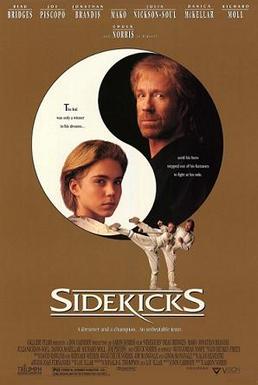
Sidekicks (1992, directed by Aaron Norris)


Barry Gabrewski (Jonathan Brandis) is a teenager living in Houston with his father (Beau Bridges).  Barry has asthma and has a hard time at school, being picked on by everyone from the school bully (John Buchanan) to the athletics coach (Richard Moll) to the clueless principal (Gerrit Graham).  Barry has only one ally and his name is Chuck Norris!  Whenever Barry is having a hard time, he imagines taking part in an exciting mission with Chuck Norris.  In his imagination, he and Chuck recreate scenes from all of Chuck’s movies even though Barry is really too young to be watching anything that violent.

Barry wants to learn karate but is turned down by an arrogant dojo owner (Joe Piscopo, channeling Martin Kove).  Barry finally finds a teacher (Mako) who uses Barry’s love of all things Chuck Norris to train him.  Barry enters the local karate tournament and wouldn’t you know it, there’s Chuck!  He’s attending as a guest and he’s hoping to see Joe Piscopo taught a lesson in humility.  When Barry and his sensei are told that they don’t have enough members for their team, Chuck volunteers to fight with them.  No one objects to the world’s most famous martial artist deciding to take part in a local, largely amateur karate tournament.  Can Barry win the tournament with the help of his hero?

Chuck Norris famously turned down a role in The Karate Kid.  Some sources say that he was offered the John Kreese role while others say that Norris was offered the sensei role that eventually become Mr. Miyagi.  Chuck has always said that his agent turned down the script and he didn’t even know it had been offered to him until years later but Sidekicks sticks so close to the Karate Kid plot that it does sometimes feel like it was made so that we could see what Karate Kid would have been like if Chuck Norris had accepted a role.  The movie follows the Karate Kid formula while lacking the edge that made Karate Kid stand out.  Karate Kid was a coming-of-age movie with a lot of karate.  Sidekicks is a blatant celebration of Chuck Norris.

Fortunately, Chuck Norris has always had the moves to back up his high self-regard and, in this film, he actually seems to be relaxed and having fun playing a version of himself.  Sidekicks is predictable and ego-driven but it has a likable energy and Chuck shows a willingness to poke fun at his earlier movies.  Whatever else you might say about Sidekicks, there were a lot of bullied kids would have loved to have had a friend like Chuck Norris.  Sidekicks is also the only place where you can see Chuck Norris fight Joe Piscopo and there’s something to be said for that.
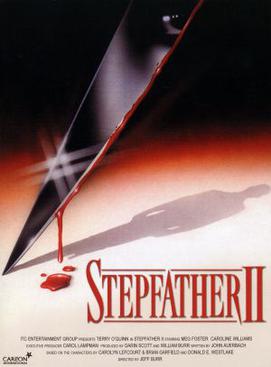
The Stepfather II: Make Room For Daddy (1989, directed by Jeff Burr)


Remember how, at the end of the first Stepfather film, Jerry Blake (played, in a classic horror performance, by Terry O’Quinn), was killed by the family that he was planning on murdering for not living up to his expectations?

It turns out that he wasn’t dead after all.  He was shot.  He was stabbed in the back.  Somehow, he wasn’t killed.  Also, despite being a mass murderer, he was sent to a mental institution where the security is so lackadaisical that he manages to murder a psychologist and a guard and then escape once again.

Taking on the name of Gene Clifford and passing himself off as a family therapist, the Stepfather continues his search for the perfect family.  He meets and becomes engaged to Carol (Meg Foster), who doesn’t find it weird that Gene is always whistling Camden Races.  Before he can marry Carol, Gene is going to need to dispose of her ex-husband and her best friend.  And, of course, Carol and her son Todd (Jonathan Brandis) are going to have to live up to Gene’s ideal of the perfect American family.

This is a disposable sequel, which eliminates all of the humor of the first film and just turns Jerry/Gene into another generic slasher.  The strength of the first film was that Jerry seemed likable up until the moment that his idealized vision of the perfect family was threatened.  Then he snapped and ended up in the basement, ranting and raving.  In Stepfather II, Gene is obviously dangerous from the start and a lot less interesting.  The movie is unfortunate and unnecessary and even Terry O’Quinn seems to be bored.  Give the film some credit, though, for giving Meg Foster a sympathetic role.  Gene may be crazy but no one could blame him for falling for Carol.  How could anyone resist those eyes?

Horror Film Review: It (dir by Tommy Lee Wallace)


Last month, before I saw the latest film version of Stephen King’s It, I watched the 1990 miniseries version.

This was my first time to watch the It miniseries, though I had certainly heard about it.  Most of the reviews that I had read seemed to be mixed.  Everyone seemed to agree that Tim Curry was the perfect choice for the role of Pennywise the Dancing Clown.  However, many other reviewers complained that the program’s television origins kept It from being as effective as it could be.  “Not as scary as the book,” everyone seemed to agree.  The actors who played the members of the Loser Clubs as children all seemed to receive general acclaim but not everyone seemed to be as enamored with the adult cast.  And everyone, even those who liked the miniseries as a whole, complained about the show’s finale, in which Pennywise took the form of a giant spider.

Well, I have to agree about the giant spider.  That spider looked painfully fake, even by the standards of 1990s television.  Not only does the spider look too fake to truly be scary but, once that spider showed up, that meant that Tim Curry disappeared from the film.  Curry deserved every bit of acclaim that he received for playing the role of Pennywise.

All that said, the miniseries was still a lot better than I had been led to believe.

Certainly, it’s not as frightening as the book or the movie.  Considering that the It miniseries was produced for network television, that’s not surprising.  As opposed to the movie, the miniseries attempts to cover King’s entire novel.  That’s a lot of material, even when you have a five hour running time.  Obviously, a good deal of the story had to be cut and there are a few scenes in the miniseries that feel a bit rushed.  Characters like Audrey Denbrough and Stanley Uris, who were compelling in the novel, are reduced to being mere bystanders.  Some of the novel’s most horrific scenes — like Henry Bowers cutting Ben — are either excised or heavily toned down.  If the novel was as much about the hypocrisy of the adults of Derry as the paranormal horror of Pennywise, that theme is largely left out of the miniseries.

That said, It still had its share of memorable moments.  The image of a clown standing on the side of the road, holding balloons, and waving is going to be creepy, regardless of whether it’s found in a R-rated film or on ABC.  The death of little George Denbrough is horrific, regardless of whether you actually the bone sticking out of his wound or not.  Even the library scene, in which a grown-up Richie Tozier deals with a balloon filled with blood, was effectively surreal.

As for the actors who played the members of the Losers Club, the results were occasionally uneven.  The actors who played them as children were all believable and had a credible group chemistry.  You could imagine all of them actually being friends.  As for the adults, some of them I liked more than others.  Harry Anderson, Dennis Christopher, and Tim Reid gave the best performances out of the group.  John Ritter and Annette O’Toole were somewhere in the middle.  Richard Thomas was absolutely awful and I found myself snickering whenever he was filmed from behind and I saw his pony tail.  Richard Masur, unfortunately, wasn’t around long enough to make much of an impression one way or the other.

Ultimately, though, the miniseries (much like the book) suffers because the adults are never as interesting as Pennywise.  Tim Curry dominates the entire movie and, when he’s not onscreen, his absence is definitely felt.  Watching the miniseries made me appreciate why the film version kept Pennywise’s screen time to a minimum.  Pennywise is such a flamboyant and dominant character that, if not used sparingly, he can throw the entire production out of balance.

Despite its flaws, I liked the miniseries.  Yes, it’s uneven.  Yes, it’s toned down.  Yes, it works better in pieces than as a whole.  But, taken on its own terms, It was effective.  Director Tommy Lee Wallace creates a suitably ominous atmosphere and the child actors are all properly compelling.  And, finally, that damn clown is always going to freak me out.

Just for fun, here’s a trailer for It, recut as a family film: