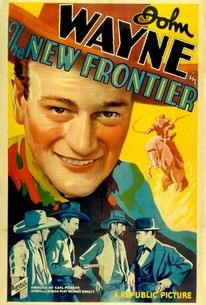
Riders of Destiny (1933, directed by Robert N. Bradbury)


John Wayne sings!

Well, not really.  Wayne does play a cowboy named Singin’ Sandy Saunders in this early, pre-code Western but his voice was dubbed by someone who didn’t sound anything like Wayne.  Wayne was only 25 when he starred in Riders of Destiny and this was six years before Stagecoach made him a star but he already had his famous way of speaking.

Riders of Destiny starts off with Singin’ Sandy riding through the west.  When he comes across a wounded sheriff and then witnesses a stagecoach being robbed by Ms. Fay Denton (Cecilia Parker), he knows that he’s reached the town of Destiny.  The town is under the control of a land developer named Kincaid (Forrest Taylor).  Kincaid and his henchmen have been extorting the local citizens and stealing money from Fay and her father (George “Gabby” Hayes).  After Singin’ Sandy reveals his skills with a gun, Kincaid offers him a position in his gang and if Sandy accepts, Kincaid will be unstoppable.  Before Sandy’s mysterious appearance, the townspeople wrote to Washington to help and Washington has agreed to send down one of their best agents.  Could that agent be traveling in disguise as a singing cowboy?

It’s always difficult for me to take a Singing Cowboy film seriously.  (That’s especially true after watching Tim Blake Nelson in The Ballad of Buster Scruggs.)  John Wayne is not an actor who was ever meant to be seen playing a guitar and singing a song, even if his voice was dubbed.  But Riders of Destiny is not that bad of a programmer.  If you can overlook the singing, the story is surprisingly mature and violent and Forrest Taylor is a good villain as the oily Kincaid.  (With Kincaid demanding protection money and gunning down anyone who refuses to play it, he has more in common with the type of gangsters who were appearing in Warner Bros. crime films than with the typical western bad guy.)  Cecilia Parker, who would eventually be best known for appearing in the wholesome Andy Hardy films, is sexy as Fay and, because this is a pre-code film, she gets away with robbing a stagecoach.  With a running time of barely an hour, the action has to move quickly and there’s no need for any padding.  Finally, even this early in his career, John Wayne was a perfect western hero, whether he was on his horse chasing the bad guys or walking down a dusty street, singing a song about how the “streets will run with blood” before drawing his guns.

Wayne would go on to play one more Singing Cowboy, in 1935’s The Lawless Range.  Again, his voice was dubbed.  He later said that he abandoned the Singing Cowboy genre because the children who saw the films would often approach him and ask him to sing one of the songs and they were always disappointed to learn that he couldn’t actually a sing a note.  Of course, in 1939, John Ford would select Wayne to play The Ringo Kid in Stagecoach and Wayne would never have to sing again.

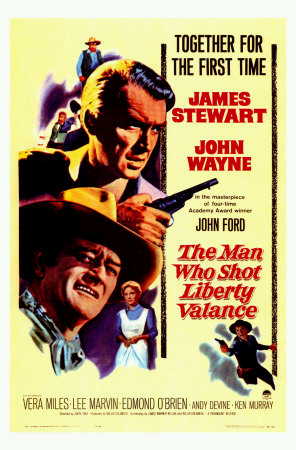
Scenes That I Love: The Steak Scene From The Man Who Shot Liberty Valance


Since today is the 113th anniversary of the birth of John Wayne, I decided to watch the 1962 classic, The Man Who Shot Liberty Valance!  And then I decided to share a scene that I love from the film.

The famous steak scene features three of the greatest screen icons of Hollywood’s golden age: James Stewart, John Wayne, and Lee Marvin.  Lee Marvin is the bully who is terrorizing the entire town.  James Stewart is the idealist who thinks that the law, and not violence, is the answer.  And John Wayne is …. well, he’s John Wayne.  He’s the only man in town who can stand up to Lee Marvin but, at the same time, he’s also aware that his time is coming to a close.  In the scene below, all three of the characters display their different approaches to life and a disagreement with steak nearly leads to violence.

This scene — and really, the entire film — features these three actors at their best.  John Wayne is an actor who is often described as having “just played himself” but that’s really not quite fair.  While Wayne’s outsized persona definitely does influence how the audience reacts to any character that he plays, he was a better actor than he’s often given credit for being.  That’s especially evident in The Man Who Shot Liberty Valance, in which Wayne plays a confident man’s man who knows that fate is closing in on him.  The coming of civilization (represented by James Stewart) will be great for the town of Shinbone but it will also leave men like Wayne’s Ton Doniphon with nowhere to go.  The coming of civilization means that the heroes of the past are destined to become obsolete.

Enjoy this scene from The Man Who Shot Liberty Valance:

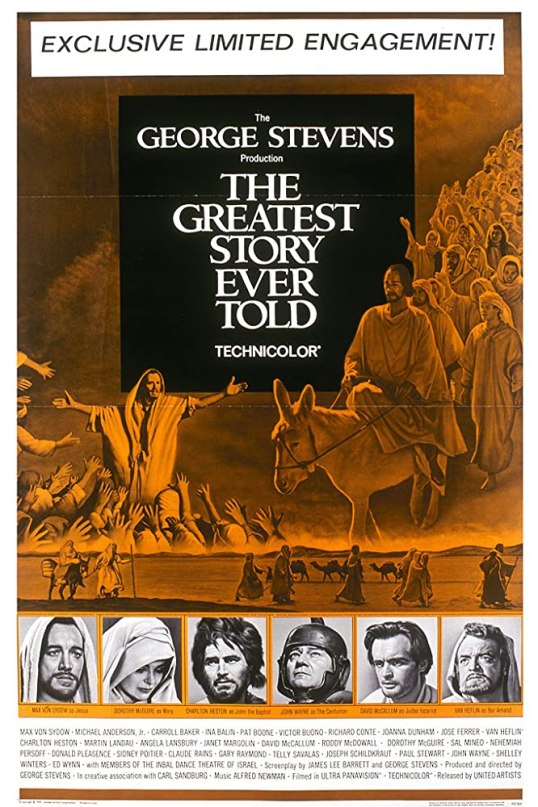
Film Review: The Greatest Story Ever Told (dir by George Stevens)


The 1965 biblical epic, The Greatest Story Ever Told, tells the story of the life of Jesus, from the Nativity to the Ascension.  It’s probably the most complete telling of the story that you’ll ever find.  It’s hard to think of a single details that’s left out and, as a result, the film has a four hour running time.  Whether you’re a believer or not, that’s a really long time to watch a reverent film that doesn’t even feature the campy excesses of something like The Ten Commandments.

(There’s actually several different version of The Greatest Story Ever Told floating around.  There’s a version that’s a little over two hours.  There’s a version that’s close to four hours.  Reportedly, the uncut version of the film ran for four hour and 20 minutes.)

Max von Sydow plays Jesus.  On the one hand, that seems like that should work because Max von Sydow was a great actor who gave off an otherworldly air.  On the other hand, it totally doesn’t work because von Sydow gives an oddly detached performance.  The Greatest Story Ever Told was von Sydow’s first American film and, at no point, does he seem particularly happy about being involved with it.  von Sydow is a very cerebral and rather reserved Jesus, one who makes his points without a hint of passion or charisma.  When he’s being friendly, he offers up a half-smile.  When he has to rebuke his disciples for their doubt, he sounds more annoyed than anything else.  He’s Jesus if Jesus was a community college philosophy professor.

The rest of the huge cast is populated with familiar faces.  The Greatest Story Ever Told takes the all-star approach to heart and, as a result, even the minor roles are played by actors who will be familiar to anyone who has spent more than a few hours watching TCM.  Many of them are on screen for only a few seconds, which makes their presence all the more distracting.  Sidney Poitier shows up as Simon of Cyrene.  Pat Boone is an angel.  Roddy McDowall is Matthew and Sal Mineo is Uriah and John Wayne shows up as a centurion and delivers his one line in his trademark drawl.

A few of the actors do manage to stand out and make a good impression.  Telly Savalas is a credible Pilate, playing him as being neither smug nor overly sympathetic but instead as a bureaucrat who can’t understand why he’s being forced to deal with all of this.  Charlton Heston has just the right intensity for the role of John the Baptist while Jose Ferrer is properly sleazy as Herod.  In the role Judas, David McCallum looks at the world through suspicious eyes and does little to disguise his irritation with the rest of the world.  The Greatest Story Ever Told does not sentimentalize Judas or his role in Jesus’s arrest.  For the most part, he’s just a jerk.  Finally, it’s not exactly surprising when Donald Pleasence shows up as Satan but Pleasence still gives a properly evil performance, giving all of his lines a mocking and often sarcastic bite.

The Greatest Story Ever Told was directed by George Stevens, a legitimately great director who struggles to maintain any sort of narrative momentum in this film.  Watching The Greatest Story Ever Told, it occurred to me that the best biblical films are the ones like Ben-Hur and The Robe, which both largely keep Jesus off-screen and instead focus on how his life and teachings and the reports of his resurrection effected other people.  Stevens approaches the film’s subject with such reverence that the film becomes boring and that’s something that should never happen when you’re making a film set in Judea during the Roman era.

I do have to admit that, despite all of my criticism of the film, I do actually kind of like The Greatest Story Ever Told.  It’s just such a big production that it’s hard not to be a little awed by it all.  That huge cast may be distracting but it’s still a little bit fun to sit there and go, “There’s Shelley Winters!  There’s John Wayne!  There’s Robert Blake and Martin Landau!”  That said, as far as biblical films are concerned, you’re still better off sticking with Jesus Christ Superstar.

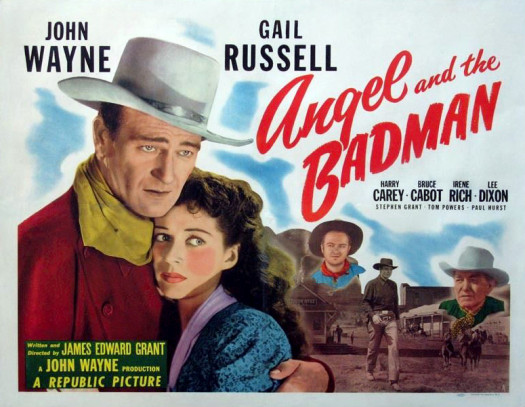
Redemption Song: John Wayne in ANGEL AND THE BADMAN (Republic 1947)


gary loggins's avatarcracked rear viewer

John Wayne  starred in some of the screen’s most iconic Westerns, but I’ve always had a soft spot in my heart for ANGEL AND THE BADMAN. Perhaps it’s because the film fell into Public Domain in the mid-70’s, and I’ve had the opportunity to view it so many times. Yet I wouldn’t keep coming back to it if it weren’t a really good movie. It’s Wayne’s first film as producer, and though it has plenty of that trademark John Wayne action and humor, it’s a bit different from your typical ‘Big Duke’ film.

Wayne plays Quirt Evans, an outlaw on the run. The wounded Quirt encounters a Quaker family, the Worths, who take him to file a land claim before the big guy finally passes out. They bring him back to their family farm to nurse him back to health, and pretty daughter Penny, unschooled in the ways of the…

View original post 762 more words

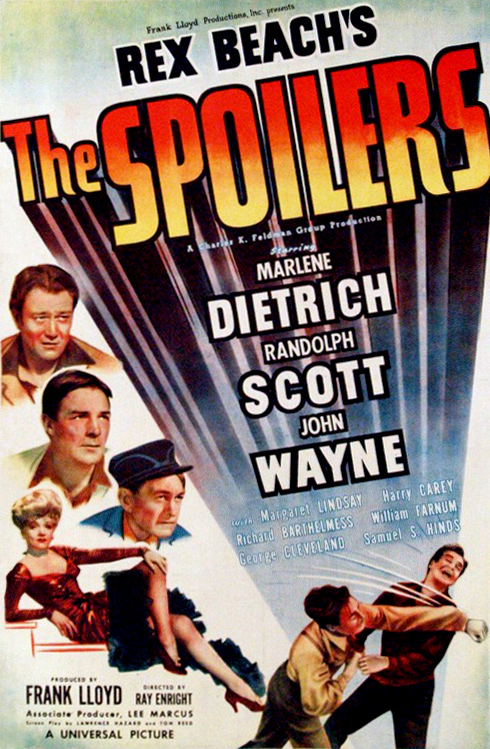
Yukon Gold: THE SPOILERS (Universal 1942)


gary loggins's avatarcracked rear viewer

What’s this?? A “Northern” Western set in 1900 Alaska Gold Rush territory starring my two favorite cowboys, John Wayne and Randolph Scott ? With the ever-enticing Marlene Dietrich thrown in as a sexy saloon owner? Count me in! THE SPOILERS is a big, brawling, boisterous film loaded with romance, action, and, most importantly,  a sense of humor. It’s the kind of Hollywood entertainment epic that, as they say, “just don’t make ’em like that anymore”. I’ve never been quite sure who “they” are, but in regards to THE SPOILERS, they’re right – and more’s the pity!

Rex Beach’s popular 1906 novel had been filmed three times before (1914, 1923, 1930), and would be one more time after (in 1955), but with The Duke, Rugged Randy, and La Dietrich on board, this has got to be the best of the bunch. Even though audiences were more than familiar with the story…

View original post 697 more words

Special Veterans Day Edition: John Wayne in SANDS OF IWO JIMA (Republic 1949)


gary loggins's avatarcracked rear viewer

Critics of John Wayne gave him a lot of flak for not serving his country during World War II, especially in the turbulent 1960’s, labeling him a phony patriot and celluloid warrior. The truth is Wayne DID try to get into the war, but was stymied in his attempts on two fronts: Republic Studios boss Herbert Yates, who filed for deferments so he wouldn’t lose his cash cow, and Wayne’s first wife Josie, who failed to forward letters from OSS Chief Wild Bill Donovan’s office. Be that as it may, The Duke was no phony, and did what he could on the home front for the war effort.

SANDS OF IWO JIMA was made four years after the war as a tribute to the brave souls of the United States Marine Corps who fought against the Japanese in the South Pacific. Wayne plays the tough top kick Sgt. John Stryker…

View original post 748 more words

Familiar Faces #7: Gordon Jones, Working Class Hero


gary loggins's avatarcracked rear viewer

Brawny actor Gordon Jones (1911-1963) was never a big star, but an actor the big  stars could depend on to give a good performance. Stars like John Wayne, Roy Rogers, and Abbott & Costello knew Gordon could deliver the goods in support, and he spent over thirty years as a working class actor. Not bad for a small town kid from Alden, Iowa!

Gordon as The Green Hornet with Keye Luke as Kato

Jones originally came to California on a football scholarship, playing guard for UCLA. Like his fellow Iowan John Wayne , Gordon began his film career in uncredited parts, and soon moved up in casts lists with films like RED SALUTE (1935), STRIKE ME PINK (1936), and THERE GOES MY GIRL (1937). Gordon’s big lug persona made him ideal for second leads as the hero’s pal, though he did get some leading roles in Poverty Row vehicles like…

View original post 669 more words