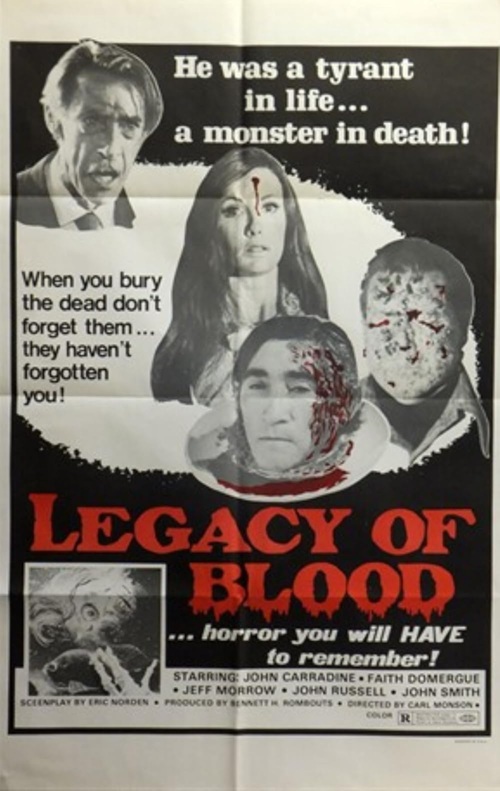
October Hacks: Blood Legacy (dir by Carl Monson)


a.k.a. Blood Legacy

In this 1971 film, John Carradine briefly plays Christopher Dean, a wealthy man who hated his family and his servants.  He dies before the film actually begins but we do get to see him in flashbacks and we also hear his voice at the reading of his will.  Dean leaves a fortune to his children and his servants, but he does so only on the condition that they spend a week at Dean’s estate.  If anyone dies or leaves the estate, they will lose their inheritance and the money will be split amongst those who stayed and/or survived.  You can see where this is leading, right?

This is actually a promising premise and it’s easy to imagine how it could have inspired an American version of Mario Bava’s Bay of Blood, where one person is killed by another just for that killer to then be killed by someone else until eventually, there’s no one left.  Unfortunately, while the characters are all unpleasant and greedy, none of them are as memorable as anyone in Bava’s classic shocker.  They’re all generic jerks and, as such, it’s hard to have much of a reaction when they start dying.  The film does feature several familiar B-movie stars.  Jeff Morrow and Faith Domergue (both of whom were in This Island Earth) appear as brother and sister.  Richard Davalos (who played James Dean’s brother in East of Eden) has an eccentric role.  Western character actor Rodolfo Acosta plays the sheriff who eventually takes an axe to the forehead.  B-movie veteran Buck Kartalian plays Igor, the butler.  (His name is actually Igor!)  Some of the members of the cast were good actors but few of them are particularly good in this film.  I did appreciate the weird energy of Buck Kartalian.  John Carradine doesn’t do much but he does deliver his lines with the proper amount of contempt.

The film does have a few vaguely interesting kills.  Bees are used as a weapon at one point.  A head is found in a refrigerator and Richard Davlos says, “This is just like a horror movie.”  Wow, Richard, thanks for sharing!  There’s a big twist ending but it really not that impressive of a twist.

Probably the most interesting thing about Blood Legacy is that it’s essentially a remake of Andy Milligan’s The Ghastly Ones. (Director Carl Monson had a habit of ripping off other films.  In 1973, he remade Roger Corman’s Little Shop of Horrors.  Monson called his remake Please Don’t Eat My Mother.  The film starred Buck Kartalian.)  Blood Legacy was originally released under the title Legacy of Blood but Milligan was so annoyed at being ripped-off that he later made his own remake of The Ghastly Ones and decided to give it the same title as Carl Monson’s rip-off.  Monson changed his film’s title and distributed it under the names Will To Die and Blood Legacy so that it wouldn’t be confused with Andy Milligan’s Legacy of Blood.  It makes sense.  Why would anyone want their Andy Milligan rip-off to be confused with an actual Andy Milligan film?
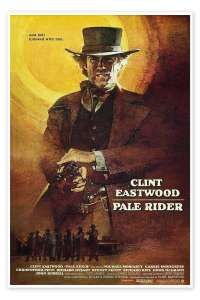
Pale Rider (dir. by Clint Eastwood)


We continue the Shattered Lens’ celebration of Clint Eastwood with 1985’s Pale Rider, one of my favorites. This was a film my long time friend Jay shared with me many years ago, as he owns most of Eastwood’s library of films. I like to think of it as a softer version of Eastwood’s own High Plains Drifter, which my father loved, but I couldn’t really get. It’s a tale of vengeance, but wrapped more in miracles. 

You should first know that Westerns aren’t really my genre when it comes to film types I often watch. I don’t have a lot of historical background when it comes to Westerns overall. If you asked for a short list of my favorites, I’d give up Rustler’s Rhapsody (it’s a fun comedy), The Good, The Bad & The Ugly (my Dad watched it often), Blazing Saddles, and in terms of books, the first few books of Stephen King’s The Dark Tower. I only recently watched Shaneafter Logan was first released, and I love the Red Dead Redemption games.

Pale Rider takes place in California around the time of the gold rush. Outside the town of LaHood, named after the wicked Coy LaHood (Richard Dysart, The Thing), we have a group of miners settled in that are hoping to strike it rich. It’s somewhat difficult with LaHood’s henchmen trying to drive them out at every turn, to steal the land. Hull Barrett (Michael Moriarty, Q The Winged Serpent) hopes to be successful, living with his fiancé Sarah (Carrie Snodgress, The Fury) and her daughter, Meghan (Sydney Penny, The Wife He Met Online). The most recent attack from LaHood’s men has shattered the miners’ morale and few are spared. Even Meghan’s dog is killed, causing her to wish for a miracle.

When LaHood’s son, Josh (Chris Penn, True Romance) and some other baddies (including The Thing‘s Charles Callahan, reuniting with Dysart) confront Hull, a stranger steps in. He handles them all easily with an axe handle, and as thanks, Hull welcomes him to the Miners area for room and board. Of course, having a stranger brings up all sorts of questions from the townsfolk, who don’t appear to be too trusting. Is he an outlaw, possibly? Even Meghan’s a little apprehensive at first, with her quote from Revelations 6:8 forshadowing the Pale Rider’s presence. Everyone is put at ease when they find our stranger is actually a Preacher, though Hull is still a bit curious about the six bullet sized scars on the man’s back. Can the Preacher help the Miners keep their land and stop LaHood? 

From a casting standpoint, Pale Rider is damn near perfect. Although Eastwood is the main star in his own film, he comes across more as an accessory for everyone else in scenes. Moriarty does most of the heavy lifting, as does Snodgress and Penny. Their characters are all easily likable and the supporting cast (particularly Doug McGrath’s Spider) shine in their parts. Dysart’s LaHood is a dark character and there’s a wonderful verbal conflict between him and Eastwood in one scene that’s just sweet to watch to see who loses their cool first. 

Pale Rider is both pretty simple and well executed from a story standpoint. It bears some similarities to Eastwood’s other film, High Plains Drifter. Though the town isn’t painted in red, there are allusions to the idea that the Preacher may be something of.a specter or ghost of vengeance. We’re not given any kind of full story as to why the Preacher’s here. We are shown that both The Preacher and LaHood’s Marshall, Stockburn (John Russell, The Outlaw Josey Wales) share a history, but that’s it. The story, like the Preacher and the events around him, moves in mysterious ways. 

What I love the most about Pale Rider is the way the Preacher changes the minds (and hearts) of those around him. The miners learn to fend for themselves. His enemies are often in shock over what he does (and at least one flips from bad to good). It kind of reminds me of Wild West version of John Wick or Nobody, with a character whose reputation precedes him. 

Bruce Surtees was the Cinematographer for Pale Rider, who also worked on a number of Eastwood’s earlier films, including The Outlaw Josey Wales and Play Misty for Me. Pale Rider has some beautiful landscape shots of the West (as the film was filmed in Idaho). Despite all the well lit shots, there are still moments where faces are obscured by the brim of a hat or the contrasts in a candlelit room. 

The story isn’t without some dark areas or some odd moments. A dog is killed, and there’s a scene where Meghan is nearly raped, but there’s some intervention before things can get out of hand. Both instances help to show how dark the villains are in the overall tale. Both Sarah and Meghan seem to take their own shine to The Preacher, one already in a relationship and the other too young for what she’s asking for, but I took it to just be that their both a bit mesmerized by the Preacher’s presence in different ways. 

Overall, Pale Rider is a wonderful offering by Eastwood, with fine performances by everyone involved. The Preacher does what he can to make things better around him with a peaceful approach. When push comes to shove, however, the guns come out blazing. 

Film Review: The Outlaw Josey Wales (dir by Clint Eastwood)


Towards the end of 1976’s The Outlaw Josey Wales, Josey (played by Clint Eastwood) says, “I guess we all died a little in that damned war.”

He’s referring to the American Civil War and the film leaves you with no doubt that Wales knew what he was talking about.  A farmer living in Missouri, Josey Wales wasn’t involved in the Civil War until a group of guerillas, the Redlegs, raided his home and killed his family.  Seeking vengeance, Wales joined the Bushwackers, a group of Confederate guerillas that were led by the infamous “Bloody Bill” Anderson.  After Anderson’s death and the South’s surrender, Senator James H. Lane (Frank Schofield) offers amnesty to any of the Bushwackers willing to surrender and declare their loyalty to the United States.  Fletcher (John Vernon), the leader of the surviving Bushwackers, thinks it’s a good idea and his men eventually agree to surrender.

Everyone except for Josey Wales.

Fletcher tells Josey that he’ll be an outlaw and that Lane will send his men to capture and execute him.  “I reckon so,” Josey Wales replies.  It’s not that Josey was particularly a fan of the Confederate cause.  Instead, having lost his family and his home and having seen hundreds of men killed, Josey no longer cares.  He’s got a death wish, something that becomes apparent when he later sneaks over to Lane’s camp and discovers that the leader of the Redlegs, Terrill (Bill McKinney), has been made a captain in the Union Army.  The surrendering Bushwackers, with the exception of Fletcher and a young man named Jamie (Sam Bottoms), are gunned down as they swear allegiance to the United States.  Joey springs into action, hijacking a Gatling gun and mowing down soldiers.  It’s a suicidal move and Josey appears to be willing to die, until he sees that Jamie has been wounded.  Josey and Jamie go on the run, pursued by soldiers and bounty hunters.

It sounds like the start of typical Clint Eastwood film and, make no mistake about it, The Outlaw Josey Wales features everything that most people have come to expect from Eastwood.  Josey Wales is an expert shot, often firing two guns while charging forward on his horse.  Josey has a way of words, explaining the purpose of getting “plain man dog mean” and telling a bounty hunter that there are better ways to make a living.  The main difference, though, is that Josey is no longer seeking revenge.  He’s lost his family and his home and he knows nothing is going to bring them back.  He sought revenge during the Civil War and saw so many people killed that, much like Jimmy Stewart in Broken Arrow, he just wants to disappear from civilization.

The problem is that men like Lane and Terrill have no intention of letting Josey Wales disappear.  The sociopathic Terrill sees it as almost being his God-given duty to kill Josey Wales and anyone else that he dislikes.  The bounty hunters are also after Josey Wales.  As Fletcher explains it, bounty hunting is the only way that many former soldiers can make money and feed their families.  As Josey moves through the southwest, his legend grows.  Every town that Josey stops in, he hears stories about the growing number of men that he has supposedly killed.

Josey also discovers that he can’t do it all alone.  He soon finds himself as a part of a new family, a collection of misfits that don’t have a home in Senator Lane’s America.  Lone Waite (Chief Dan George) is an elderly Cherokee man who suggests that Josey head for Mexico.  Little Moonlight (Geraldine Keams) is a Navajo woman who Josey rescues from two bounty hunters.  Sarah Turner (Paula Trueman) and her granddaughter, Laura Lee (Sondra Locke), are rescued from Comancheros.  Josey negotiates the release of two of Sarah’s ranch hands and befriends Chief Ten Bears (Will Sampson) while doing so.  Slowly, Josey comes out of his shell and starts to embrace life once again.  Josey goes from searching for death to searching for peace.

It’s one of Eastwood’s best films, ending on a note of not violence but instead sad regret.  It’s not only a portrait of a man learning to embrace life but it’s also a portrait of a country trying to figure out how to come back together after the bloody savagery of the Civil War.  Some, like Fletcher and Josey, want to move on.  Others, like Terrill, don’t have an identity beyond fighting and killing.  Eastwood gives a good performance but, as a director, he gives every member of the cast a chance to shine.  If you only know John Vernon as Dean Wormer from Animal House, his sad-eyed performance here will be a revelation.

Originally, The Outlaw Josey Wales was meant to be directed by Phillip L. Kaufman but Eastwood felt that Kaufman was taking too long to set up his shots and worrying about details that really didn’t matter.  Reportedly, while Kaufman was away from the set, spending hours searching for a historically-correct beer bottle to be used in a bar scene, Eastwood directed the scene himself and then convinced producer Robert Daley to fire Kaufman and allow Eastwood to direct the film.  (Kaufman also objected to the script’s anti-government subtext but seriously, that’s pretty much the subtext of every film that Eastwood has ever been involved with.)  The DGA later instituted a rule that, on productions in which the director was fired,  the replacement could not be a member of his crew or an actor in the cast but that was too late to help out Kaufman.

(Rumor has it that another reason Kaufman was fired was because he and Eastwood both “liked” Sondra Locke.  This was the first of six films that Eastwood and Locke would do together.)

To be honest, I think it worked out in the film’s favor.  It’s a little surprising that someone other than Eastwood was ever considered as director to be begin with, so perfectly does the story and the lead character fit with Eastwood’s persona.  Eastwood captures both the beauty of the untouched land and also the bloody violence of combat.  In many ways, this film almost feels like a prequel to UnforgivenThe Outlaw Josey Wales is Eastwood at his best.

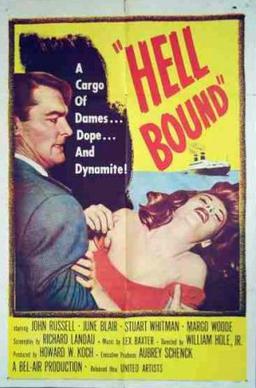
30 More Days of Noir #7: Hell Bound (dir by William J. Hole, Jr.)


Like so many film noirs, 1957’s Hell Bound opens with a narrator.  As we watch scenes of a group of thieves robbing a Naval ship of World War II narcotics, the narrator explains to us what each criminal is doing and how their plot will hopefully lead to them getting rich.  Again, this is something we’ve seen in a countless number of film noirs.  What makes Hell Bound unique is that the narration keeps going long after one would expect it to stop.  And the expected cops and federal agents are never introduced….

That’s because we’re watching a film within a film!  Jordan (John Russell) has made and produced the film himself, all to convince a gangster named Harry Quantro (Frank Fenton) to support his plan to …. well, to rob a Naval ship of narcotics.  Jordan promises that the real-life theft will go just as smoothly as the theft in the movie!  And, it must be said, Jordan’s movie was really well-made.  He hired actors and everything.  Harry agrees to give Jordan his backing on the condition that Jordan use Harry’s girlfriend, Paula (June Blair), in the operation.  That, of course, means that Jordan won’t be able to use his own girlfriend, Jan (Margo Woode).  That’s going to be awkward.

Anyway, Jordan starts to assemble his crew and they’re the typical film noir collection of misfits.  One of the more fun things about Hell Bound is that it’s full of odd and eccentric characters, the types who would you actually expect to find trying to rob the U.S. Navy of narcotics in the 1950s.  My favorite character was the blind drug dealer named Daddy (Dehl Berti).  He has the perfect attitude for someone who had the luxury of not having to see the damage caused by his professions.

Of course, there’s no such thing as a perfect plan.  Whenever you get a bunch of criminals together to pull off the perfect heist, there’s bound to be some betrayals and some paranoia.  We’ve all seen the ending of Goodfellas and we all know what the piano coda from Layla means.  Complicating matters is that a big part of the scheme requires Paula to fake being an ambulance nurse and that means that she’s going to have to work with an honest ambulance driver named Eddie Mason (Stuart Whitman).  Eddie is a good, working class guy who just wants to help people and make the world a better place.  How can Paula go through with her part of the plan when she’s got Eddie looking at his hands and saying that he wants to use them to be a healer!?

I really liked Hell Bound.  I wasn’t expecting much from it but it turned out to be a really effective and clever 50s film noir.  Clocking in at 70 minutes, it doesn’t have any time for excess padding or anything else.  As soon as the film-within-a-film comes to an end, it jumps right into the action and it doesn’t let up.  Add to that, you’ve got John Russell giving a tough and gritty performance as the wannabe criminal mastermind and then you’ve got Stuart Whitman managing to make his self-righteous character likable and June Blair doing a great job as the femme fatal.  Hell Bound is bit of an unsung classic, a tough and gritty film noir that packs a punch.


30 Days of Noir #13: Undertow (dir by William Castle)


In the 1949 film, Undertow, Scott Brady plays Tony Reagan.  Tony used to be a member of the Chicago mob but that’s all in the past now.  He served his country in World War II and now, as he tells his old racket friend, Danny (John Russell), all Tony wants to do is settle down and run a hunting lodge in Reno.

However, before Tony can forever abandon Chicago for Nevada, he has to make peace with his future in-laws.  He’s engaged to marry Sally Lee (Dorothy Hart).  In fact, he’s so in love with her that not even meeting a single teacher named Ann McKnight (Peggy Dow) can distract Tony from his plans.  The only problem is that Sally is the niece of a Chicago gangster named Big Jim Lee and, in the past, Big Jim and Tony haven’t always been the best of friends.  In fact, the Chicago police are constantly harassing Tony because they’re convinced that he wants to start a gang war with Big Jim.  Instead, Tony just wants to make peace with Big Jim before the wedding.

Tony goes to visit Big Jim and …. well, you can guess what’s going to happen, can’t you?  If you’ve seen enough film noirs, you know that no one is every totally out of the rackets.  No one believes an ex-mobster when they say that they’re no longer interested in making trouble.  Even worse, any murder committed with automatically be blamed on anyone who says that they’re no longer a member of the rackets.  That’s what happens to Tony.  Not only does he discover that Big Jim has been shot dead but everyone thinks that he’s the one who did it.  Fleeing through the shadowy streets of Chicago, Tony finds himself not only being pursued by the police but also by the murderers.  Everyone wants to either capture or kill Tony.

In fact, the only person who seems to be on Tony’s side is Ann McKnight.  Ann lets Tony hide out at her apartment while he tries to figure out what’s going on.  Of course, Ann does have a nosy landlady who has no hesitation about letting herself into the apartment whenever she feels like it….

The plot of Undertow isn’t going to win any points for originality.  It’s not going to take you long to figure out who is setting Tony up, if just because there really aren’t enough characters in the film for there to be much suspense about who is betraying who.  But no matter!  The film is still an atmospherically shot and briskly-paced thriller.  Undertow was directed by William Castle, who is probably best known for directing campy B-movies like The Tingler and Strait-Jacket.  There’s nothing campy about Castle’s direction of Undertow.  The majority of the film was shot on location and Castle makes great use of Chicago.  When Tony tries to lose the cops that are tailing him, it helps that he’s not running across a soundstage but instead down real city streets, ones that feels alive with tension and danger.  There’s also a great chase that takes place in a long and dark corridor in an underground garage.

Scott Brady (who was the brother of tough-guy actor Lawrence Tierney) gives a sympathetic performance as Tony and he and Peggy Dow have a really likable chemistry in their scenes together.  Dorothy Hart is also well-cast as the film’s femme fatale, while Bruce Bennett has a few good scenes as a detective who is an old friend of Tony’s.  Fans of “classic” matinée idols will want to keep an eye out for Rock Hudson, making a brief appearance in his second film and credited as “Roc” Hudson.

Shattered Politics #4: Mr. Smith Goes To Washington (dir by Frank Capra)


mr-smith-goes-to-washington

So, when you read that I was going to be reviewing 94 political films here at the Shattered Lens, you probably knew that one of them would have to be the 1939 best picture nominee, Mr. Smith Goes To Washington.

So, we all know that story right?  The senator from an unnamed state dies.  The weak-willed Governor (Guy Kibbee) has to appoint a new senator.  Political boss Jim Taylor (Edward Arnold) demands that the governor appoint one of his cronies.  The state’s reformers demand that the Governor appoint a never-seen crusader named Henry Hill (who, whenever I hear his name, makes me think of Ray Liotta snorting cocaine in Goodfellas).  The Governor’s children demand that he appoint Jefferson Smith (James Stewart, of course!), who is the head of something called the Boy Rangers.  The Governor flips a coin.  The coin lands on its edge but it also lands next to a newspaper story about Jeff Smith.

So, of course, Mr. Smith goes to Washington.

Now, as the movie quickly makes clear, Jeff Smith is immediately out-of-place in Washington.  For one thing, he’s actually excited to be there.  He’s convinced that he’s there to make America a better place.  When a bunch of drunken reporters (led by the great Thomas Mitchell) make Smith look foolish, Smith responds by running around Washington and punching them out.  (That whole sequence probably serves as wish fulfilment for a lot of politicians.)  When his cynical legislative aide Saunders (Jean Arthur) tells him that he’s too naive to survive in Washington, he wins her over with the purity of his idealism.  When his mentor, Senator Paine (Claude Rains), is revealed to be a part of Washington’s corrupt culture, Smith is stunned.  When Taylor tries to destroy his political career, Smith responds by giving the filibuster to end all filibusters.  He’s one man standing up against a culture of corruption and…

And there’s a reason why, 76 years later, aspiring political candidates still attempt to portray themselves as being a real-life, modern Jefferson Smith.

This is one of those films that everyone seems to agree is great and, of course, there’s many reasons to love Mr. Smith Goes To Washington.  There’s the lead performance of Jimmy Stewart, of course.  While this may not be his best performance (I prefer the more layered characterization that he brought to It’s A Wonderful Life and Anatomy of a Murder), it is Stewart at his most likable and, most importantly, he makes you feel Jeff Smith’s pain as he discovers that Washington is not the great place that he originally assumed it to be.  Claude Rains was always great when it came to playing good men gone wrong and he’s perfect as Sen. Paine.  Thomas Mitchell and Jean Arthur are perfectly cast and I always enjoy seeing the bemused smile on the face of Vice President Harry Carey as Smith conducts his filibuster.

But I think the best thing about Mr. Smith Goes To Washington is that it actually makes you believe that there are Jeff Smiths out there who actually could make a difference.  And, until Judd Apatow gets around to remaking the film with Adam Sandler, audiences will continue to believe.

http://www.youtube.com/watch?v=sm9qaEJ3MBc