May Noir: The Big Sleep (dir by Michael Winner)


Raymond Chandler’s detective classic, The Big Sleep, has twice been adapted for film.

The first version came out in 1946, just seven years after the book’s publication.  That version starred Humphrey Bogart as detective Philip Marlowe and Lauren Bacall as Vivian, the daughter of a man who has hired Marlowe to discover who is trying to blackmail him.  Directed by Howard Hawks and co-written by William Faulkner, this version of The Big Sleep is considered to be a classic noir, one that was cited as being a major influence on director Akira Kurosawa.

The 1978 version was directed by Michael Winner, takes place in London in the 1970s, and features Robert Mitchum as Marlowe.  Despite a strong ensemble cast and an excellent lead performance from Mitchum, this version of The Big Sleep still features one of the worst performances ever put on film.

Sarah Miles plays the role of Charlotte Sternwood Regan, the eldest daughter of General Sternwood (James Stewart).  Miles is playing the role that Lauren Bacall played in the first film and, despite the fact that they both earlier co-starred to a certain amount of acclaim in Ryan’s Daughter, Miles and Mitchum do not have a hint of chemistry in this film.  Actually, Miles doesn’t have chemistry with anyone in this film.  She seems detached from the action and her frequent half-smiles come across as being not mysterious but instead somewhat flakey, as if she doesn’t quite understand that she’s in a noir.  Sarah Miles is not a bad actress (as anyone who has seen Hope and Glory can tell you) but her performance here is incredibly dull.  That said, she is not the one who gives the worst performance in the film.

Instead, that honor goes to Candy Clark, playing General Sternwood’s youngest daughter, Camilla.  Camilla is meant to be mentally unstable and potentially dangerous.  Clark plays the role like a giggly teenager, constantly fidgeting and literally hissing in more than a few scenes, as if she’s been possessed by a cat.  Clark overacts to such an extent that you’ll be more likely to laugh at than be disturbed by her antics.  It doesn’t help that she shares nearly all of her scenes with Robert Mitchum, a man who was a master when it came to underacting.  If you’re going to give a bad performance, you don’t want to do it opposite someone who will make you look even worse by comparison.

The mystery of who is blackmailing General Sternwood is twisty and full of disreputable people.  At times, the film feels like a a parade of character actors.  Edward Fox, Joan Collins, Richard Boone, Oliver Reed, Harry Andrews, Richard Todd, and John Mills all show up throughout the film and, as a viewer, I was happy to see most of them.  They all brought their own sense of style to the film, especially the menacing Oliver Reed.  That said, director Michael Winner was never known for being a particularly subtle director and the film gets so mired in its own sordidness that it becomes be a bit of a slog to sit through.  As a filmmaker, Winner was a shameless.  That sometimes worked to a film’s advantage, as with the original Death Wish.  That film needed a director who would dive into its Hellish portrayal of New York City without a moment’s hesitation and that’s what it got with Michael Winner.  With Winner’s adaptation of The Big Sleep, however, the film gets so caught up in trying to shock and titillate that it’s hard not to miss the wit that made the first adaptation so special.

That said, The Big Sleep does feature the truly special opportunity to see Robert Mitchum and James Stewart acting opposite each other.  Both give good and heartfelt performances, with Mitchum plays Marlowe as a cynic with a heart and Stewart capturing the pain of knowing that your children don’t deserve all that you do for them.  Stewart and Mitchum bring a lot of emotion and sincerity to their scenes and, for at least a few minutes, The Big Sleep becomes about something more than just bloody murders and revealing photographs.  It becomes about two aging men trying to find their place in a changing world.  The Big Sleep was one of Stewart’s final feature films and he shows that, even late into his career, he was always one of the best.

 

Retro Television Reviews: The Love Boat 2.21 “A Good and Faithful Servant/The Secret Life of Burl Smith/Tug of War/Designated Lover”


Welcome to Retro Television Reviews, a feature where we review some of our favorite and least favorite shows of the past!  On Wednesdays, I will be reviewing the original Love Boat, which aired on ABC from 1977 to 1986!  The series can be streamed on Paramount Plus!

This week, we have a special 90-minute episode of The Love Boat!

Episode 2.21 “A Good and Faithful Servant/The Secret Life of Burl Smith/Tug of War/Designated Lover”

(Dir by Roger Duchowny, originally aired on February 17th, 1979)

It’s a Mills family reunion as John, Juliet, and Haley all board The Love Boat.  Despite being related, the three of them appears in three separate and unconnected stories.  (There is one moment where Juliet walks past John and he gives her a slightly quizzical  “Do I know you?” look.)

John Mills plays Bertram MacDonald, the long-time butler and chauffeur to Estelle Castlewood (Celeste Holm).  Estelle has booked herself a vacation cruise on the Pacific Princess and she’s surprised to discover that Bertram has also booked a cruise.  As Bertram explains it, the only time that he can take a vacation is when Celeste takes a vacation.  At first, Bertram promises to stay away from Celeste during the cruise so that they can both enjoy their vacations without feeling like employer and employee.  However, fate keeps bringing them together and soon, Bertram tells Celeste that he has to resign from his position because he’s now in love with her.  Fortunately, Celeste is also in love with him so it all works out.  Upon returning to America, Bertram again drives Celeste home but, this time, Celeste sits up front with him instead of in the back of her limo.  This was a rather sweet story, largely because John Mills and Celeste Holm had a lot of chemistry and, being two veteran actors, they both knew exactly how to deliver their sentimental dialogue without making it sound overly calculated.

Juliet Mills plays Millicent, who is separated from Sherman (David Hedison).  Millicent boards the cruise with her 8 year-old son, Lucas (Keith Coogan) and she is shocked to discover that Sherman has decided to take the cruise as well.  Lucas blames himself for the separation but, fortunately, he gets a pep talk from a real-life baseball star, Reggie Jackson.  (Yes, I did ask my sister who he was.)  Even better, Sherman and Millicent realize that they still love each other and agree to call off the divorce.  Yay!  Again, this was another story that worked because of the chemistry between the two leads.  Juliet Mills and David Hedison were convincing as a couple who, for all of their ups and downs, were still willing to give their marriage another chance.

Now, you may be wondering what Reggie Jackson was doing on the cruise.  It turns out that Reggie is an old friend of Isaac Washington’s.  Apparently, Isaac was known as “Freight Train Washington” in high school.  Reggie went on to become a multi-millionaire athlete while Isaac went on to become a bartender on a cruise line.  When Reggie boards the boat, he tells Isaac that he doesn’t want anyone to know that he’s famous.  However, in an amusing twist, Reggie soon becomes frustrated when he gets what he asked for. He’s soon reduced to telling people that he’s Reggie Jackson, just to have them reply that he looks nothing like Reggie Jackson.  Not even Captain Stubing believes that he’s Reggie Jackson!  Fortunately, Reggie is finally able to convince Cleo (Telma Houston) that he is who he says he is and the two of them leave the boat together.  As an actor, Reggie Jackson was a bit stiff but he still had decent comedic timing and it was hard not to be amused at his growing frustration over being anonymous.

Finally, Haley Mills plays model Cheryl Tyson.  Gopher is excited that Cheryl is going to be on the cruise.  She’s his favorite model!  He even has a big poster on the wall next to his bed in his cabin.  Unfortunately, every time that Gopher is near Cheryl, he loses the ability to speak in complete sentences.  As such, Gopher spends the majority of the episode fantasizing outlandish, film-inspired scenarios that all lead to him sweeping Cheryl off her feet.  Gopher imagines himself as an explorer, an admiral, a knight, a spy, and as Humphrey Bogart in Casablanca.  He imagines himself as Elton John, performing Pinball Wizard as the Love Boat crew dances around.  He even imagines being in a love triangle with Julie and Cheryl.  Eventually, Cheryl gives him a pity date and it’s …. well, this whole storyline was pretty stupid.  Fred Grandy was likable in the role and Gopher could be an amusingly goofy character but his fantasies were just so silly and poorly written that I couldn’t wait for them to be over.  It’s nice that the show finally gave Grandy a showcase but neither he nor Haley Mills were particularly well-served by this episode.

This was an uneven episode.  Even though the stories featuring John and Juliet Mills and Reggie Jackson were nicely done, the Hayley Mills/Fred Grandy stuff took up the majority of the episode and it dragged the whole thing down.

Next week …. Freight Train Washington falls in love!

Film Review: When The Wind Blows (dir by Jimmy Murakami)


https://www.youtube.com/watch?v=sb4R8I03C9Y

Over the past few years, I’ve seen some extremely depressing animated films.

I cried during the first fifteen minutes of Up.  I cried during the final ten minutes of Toy Stories 3 and 4.  Actually, now that I think about it, I think I’ve sobbed through every single PIXAR film, with the exception of the movies about the talking cars and the one about the good dinosaur.  My point is that I’m not one of those people who automatically assumes that, just because a film is animated, it’s necessarily going to make me laugh.  I fully understand that not all animated films are for children and that a cartoon can be just as serious and dark as a live action movie.

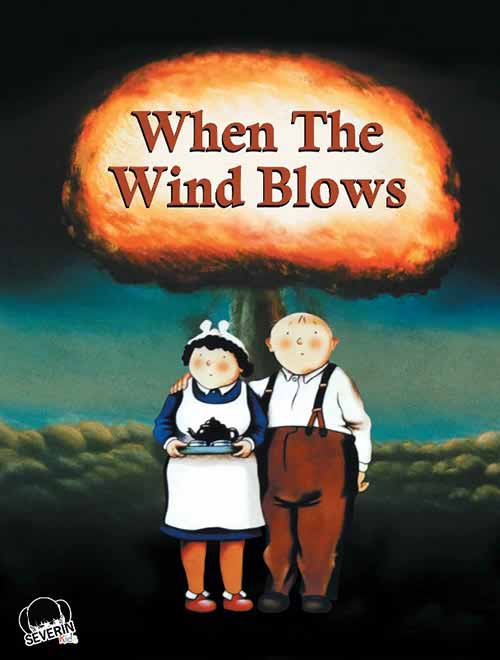
That said, I don’t think anything could have prepared for the 1986 film, When The Wind Blows.  To say that When The Wind Blows is bleak would be an understatement.  Is When The Wind Blows a depressing film?  Yes, you could say that.  It’s a film about an elderly couple facing the end of the world with optimism and a never-ending faith that things will turn out okay.  This is the most trusting couple in the world and, in the end, they end up crawling into their own separate potato sacks, where they struggle to recite the Lord’s Prayer as they both die a slow and painful death.  It’s not just that When The Wind Blows is depressing.  It’s also that it’s a film that takes place in a world bereft of hope.  It’s a film that has a message but, at the same time, it also seems to be convinced that it’s a message to which no one will bother to listen.

Jim and Hilda Bloggs (voiced by John Mills and Dame Peggy Ashcroft) are a loving couple who own a rather nice cottage in rural England.  They’re very content in their life and more than a bit complacent.  They have faith that both the milk and the paper will be delivered every morning.  Hilda has a nice garden going.  Jim regularly takes the bus down to the library, where he reads the newspapers and picks up pamphlets about what to do in case of a nuclear attack.  When the news comes over the radio that Britain will probably be attacked in 3 days, Jim industrially sets out to make a shelter for himself and Hilda.

It’s not much of a shelter.  In fact, it’s really just two doors leaning against a wall.  However, Jim and Hilda are simply following the instructions that they found in a government-printed pamphlet and both of them have a good deal of faith in the “power that be.”  As they wait for the war to break out, they remember just how much they enjoyed World War II.  Everyone was in it together during World War II!  And Jim has faith that everyone will continue to be in it together during this latest war.

The bomb eventually drops.  The animation, which previously had the feel of an old school Christmas special, becomes dark and ominous as the world around Jim and Hilda’s house erupts into flames.  Jim and Hilda hide in their little shelter.  Though the pamphlets say that they shouldn’t leave the shelter for at least two weeks, Jim and Hilda leave within a few hours.  They walk around outside and look at the charred remains of the garden.  Hilda wonders what fallout looks like.  Jim isn’t sure.

And, at this point, we know they’re both as good as dead.  (Interestingly enough, it does appear that they survived longer than their neighbors, who perhaps did not hide behind a door.)  The rest of the film is essentially watching Jim and Hilda waste away while remaining convinced that someone from the government is going to come and save them.  You find yourself wondering if the two of them are really as naive as they seem or if they’re both in a shared denial about what’s happened.  It’s probably a combination of the two.

It’s an undeniably effective film.  It not only works as an anti-war film but also as an anti-government film.  Both the Left and the Right will find things to appreciate in the film’s story.  But my God is it ever a depressing movie.  It’s a well-made film that I’ll probably never voluntarily watch again.

19

Lisa Reviews An Oscar Nominee: Great Expectations (dir by David Lean)


“My Christian name was Philip Pirrip, which I pronounced Pip….”

SHUT UP, PIP!

Seriously, there’s a lot of good things that can be said about Charles Dickens’s Great Expectations but most readers simply can’t get past the fact that the narrator insists on being called Pip.  I don’t necessarily blame them, as Pip might be a good nickname for a child but, by the time you’re 16, you should be demanding that everyone call you Phil.  That said, I’ve always liked Great Expectations.  Despite the fact that Charles Dickens could be a terribly pedantic writer, the plot of Great Expectations is genuinely interesting and the book is full of interesting characters, the majority of whom don’t demand to be known by their childhood nicknames.  Plus, I’ve always related to Estella.

The 1946 film adaptation of Great Expectations was at least the third movie to be made from the novel and it would be followed by many more.  (In 1998, there was a modernized version where Pip was wisely renamed Finn.)  Still, the 1946 adaptation is the best.  As directed by David Lean (and based on a stage version that was put together by none other than Alec Guinness), Great Expectations remains true to the source material while, at the same time, cutting away a lot of extraneous material.  As a result, Lean’s film version of the story maintains a clear narrative momentum, which is something that eluded Dickens in his sprawling original.

John Mills plays Pip, an orphan who is being raised by his wicked aunt and her husband, the simple but kind-hearted blacksmith, Joe Gargery (Bernard Miles).  One night, Pip helps out an escaped convict named Magwitch (Finlay Currie) and, though Magwitch is eventually recaptured, that one act of kindness will determine the rest of Pip’s life.

Pip is invited to visit the mansion of a recluse named Miss Havisham (Martita Hunt) and it’s there that he first meets and falls in love with the beautiful but rather cold-hearted Estella (Jean Simmons and then, after Estella grows up, Valerie Hobson).  Of course, what Pip doesn’t realize is that Miss Havisham has specifically raised Estella to destroy the hopes and dreams of every man that she meets.

Eventually, Pip grows up and discovers that he has a mysterious benefactor who feels that Pip should be transformed into a gentlemen so that he might be able to meet the “great expectations” that the benefactor has for him.  Pip, of course, assumes that it’s Miss Havisham but even those who haven’t read the book will probably suspect that there’s more to it than just that.  Pip moves to London, where he stays with Herbert Pocket (Alec Guinness), a pale young man (for that’s how Dickens described him) who teaches Pip that a gentleman does not use his knife as a fork.  Herbert was always my favorite character in the book and he’s my favorite character in the film, largely because he’s played by the totally charming Alec Guinness.

Anyway, Pip becomes a bit of a snob but eventually, he discovers the truth about his benefactor and the last few years of his life.  It causes him to not only rip down a lot of curtains but also to reconsider what it truly means to be a a gentleman.

It’s all very well-done, largely because David Lean doesn’t allow the fact that he’s making a film out of a great novel get in the way of telling a good story.  The film is well-acted by a wonderful cast of British thespians, all of whom manage to make even the most artificial of scenes and lines seem naturalistic and believable.  Even though Pip is a bit of a jerk, John Mills manage to turn him into a sympathetic character.  (Mills plays Pip as if he himself cannot stand the fact that he’s turned into such a snob.)  Both Jean Simmons and Valerie Hobson do a wonderful job of bringing the potentially problematic character of Estella to life and Bernard Miles is wonderfully empathetic in the role of the Joe Gargery.  The scene where a nervous Gargery first meets Pip after Pip has become a gentleman is a true example of great acting.

Not surprisingly, Lean also does a great job of bringing 19th century England to life.  Watching this film is a bit like stepping into a time machine and going back to the Dickensian era.  As filmed by Lean, London is as bright and vibrant as Pip’s childhood home is dark and constraining.  When Pip finds Magwitch on the beach, Lean directs the scene as if it were from a film noir.  When Pip enters the darkened home of Miss Havisham and meets the beautiful but destructive Estella, the film flirts with becoming a Rebecca-style gothic romance.  And when it’s just Pip and Herbert Pocket talking, it becomes a comedy of manners.  Not surprisingly, Great Expectations won Oscars for both its art design and its gorgeous black-and-white cinematography.

Great Expectations was also nominated for Best Picture.  However, it lost to Gentleman’s Agreement.

Lisa Reviews An Oscar Nominee: In Which We Serve (dir by Noel Coward and David Lean)


“This is the story of a ship….”

The 1942 British war film, In Which We Serve, opens with footage of the HMS Torrin, a destroyer, being constructed in a British shipyard.  When the Torrin is finally finished, the men who worked on it cheer as it leaves on its maiden voyage.  The film then abruptly jumps forward to the year 1941.  The Torrin is sinking, the victim of German bombers.  The surviving members of her crew float in the ocean, holding onto debris and watching as their home for the past few years capsizes and slowly goes underneath the surface of the water.  Even as the Torrin sinks, German planes continue to fly overhead, firing on the stranded men and killing several of them.

As the men fight to survive both the ocean and the Germans, they remember their time on the Torrin.  Captain Kinross (Noel Coward, who also wrote the script and co-directed the film) thinks back to 1939, when he was first given command of the Torrin.  He remembers the early days of the war and the time that he spent with his wife (Celia Johnson) before leaving to do his duty.  As the captain of the ship, Kinross was a tough but compassionate leader.  He expected a lot out of the men but he also came to view them as his second family.  Meanwhile, Shorty Blake (John Mills) thinks about his wife and his newborn son back in London.  Everyone on the Torrin has left their families behind.  Some of them even lose their loved ones during the war, victims of the relentless German Blitz.  But, even as they float in the ocean, everyone continues to fight on, knowing that there will be bigger ships to replace the Torrin and that Britain will never surrender.

In 1942, British film producer Anthony Havelock-Allan approached Noel Coward and asked him if he would be interested in writing the screenplay for a morale-boosting propaganda film.  Coward agreed, on the condition that he be given complete control of the project and that the film deal with the Royal Navy.  Though one might not immediately think that the author of drawing room comedies like Easy Virtue and Private Lives would be the obvious choice to write a war film, Coward’s family actually had a long tradition of serving in the Navy and Coward based a good deal of the film’s action on the wartime exploits of his friend, Lord Mountbatten.  Though there was initially some concern about Coward’s insistence that he should play the lead role on top of everything else, the Ministry of Information fully supported the production of In Which We Serve.

However, Corward knew that he would need help directing the film.  He asked his friend, John Mills, for advice and Mills suggested that Coward should bring in, as co-director, “the best editor in Britain,” David Lean.  Though Lean was initially only meant to handle the action scenes, Coward quickly discovered that he didn’t particularly enjoy all of the detail that went into directing a film.  As a result, David Lean ended up directing the majority of the film.  This would be Lean’s first film as a director and he would, of course, go one to become one the top British directors of all time.

(Also of note, frequent Lean collaborator Ronald Neame served as the film’s cinematographer.  Neame later went on to have his own career as a director.  In 1972, Neame directed another film about a capsized ship, The Poseidon Adventure.)

As for the film itself, In Which We Serve is an unapologetic propaganda film, carefully crafted to inspire the British people to support the war effort and also to win over the sympathy of American viewers.  (During the film’s production, America had finally entered the war but there were still skeptics, at home and abroad.)  Along with being a war film, In Which We Serve is also a rather touching and heartfelt tribute to the strength and determination of the British people.  Though it’s a rather grim film at times and it doesn’t shy away from the fact that lives are going to be lost in the battle to defeat Hitler, it’s also a rather inspiring film.  The sacrifice will be great, In Which We Serve tells us, but it will also be worth it.  The entire ensemble — including future director Richard Attenborough, making his film debut as a frightened sailor — does an excellent job of creating memorable characters, some of whom only appear for a few fleeting moments before meeting their fate.

In Which We Serve was a box office hit in both the UK and the US.  It was Oscar-nominated for Best Picture of the year, though it ultimately lost to another film about World War II, Casablanca.

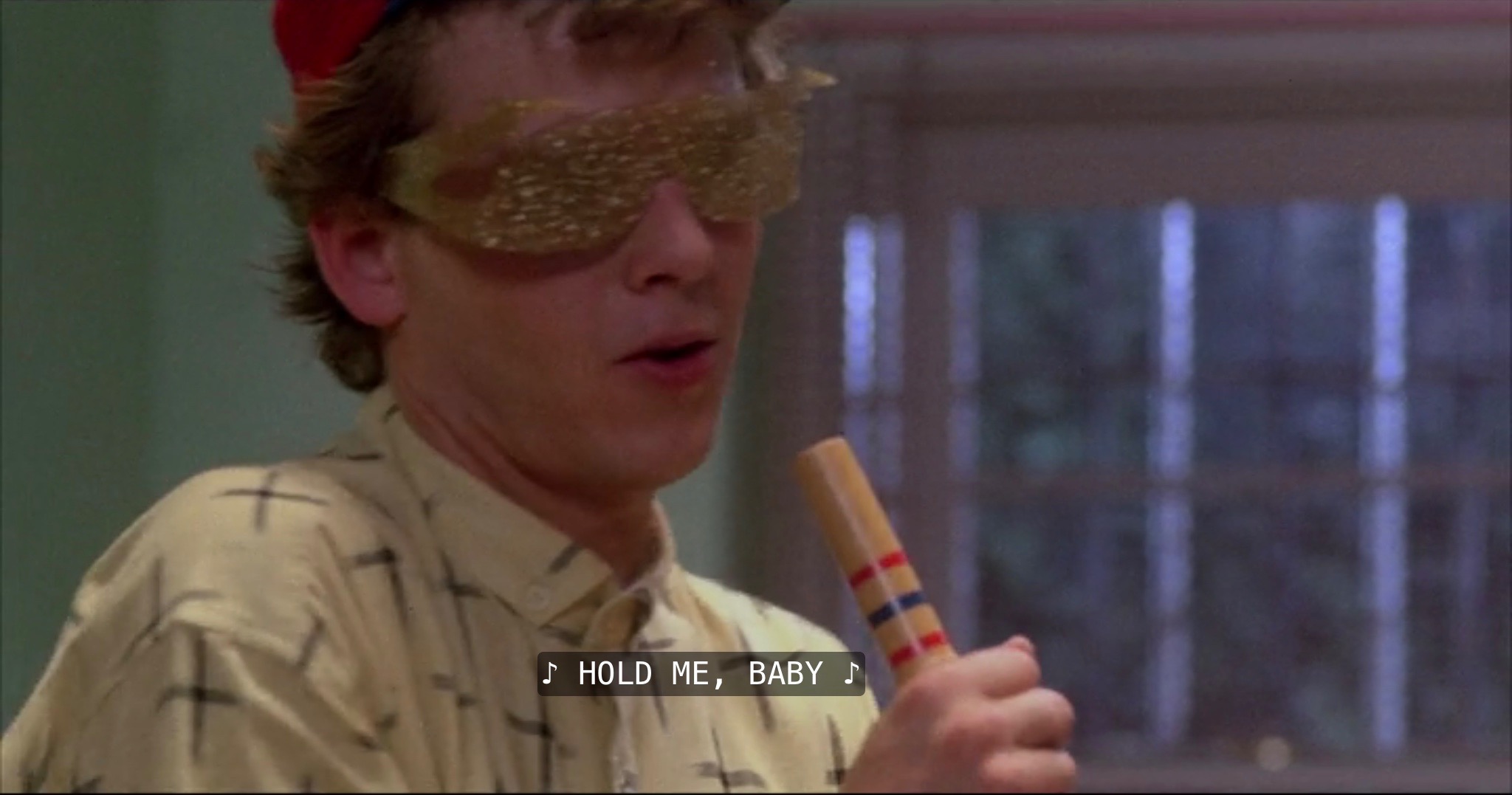
Music Video of the Day: Breakaway by Tracey Ullman (1983, dir. Dave Robinson)


When I was a kid, all I knew about Tracey Ullman was that she did a show called Tracey Takes On… I’m pretty sure I didn’t even know that she did a show prior to that called The Tracey Ullman Show. So all I knew was that she was a comedian famous for impersonations. I most certainly didn’t know she ever did music. Much to my surprise, this video recently showed up in my YouTube feed.

Apparently, she had short-lived music career in the early-to-mid-80s that sprung out of a encounter with the wife of the head of Stiff Records, Dave Robinson. This was the first single off her debut album.

Dave Robinson himself appears to have directed this appropriately 1960s-inspired video for Ullman’s cover of the 1964 song originally performed by Irma Thomas.

It’s quite cheap. It appears to be best remembered for Ullman singing into a brush.

A Nightmare On Elm Street Part 2: Freddy’s Revenge (1985, dir. Jack Sholder)

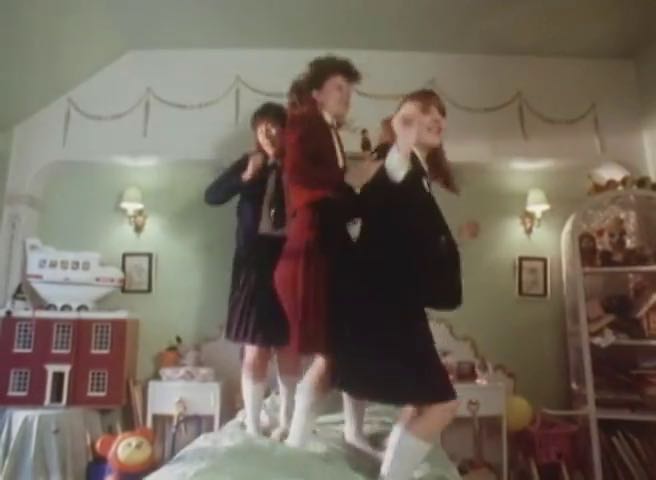
I want to know why there is a plane on top of the building (left) and what looks like a creepy clown head on the top shelf (right).

It’s still catchy, fun, and the editing does draw you in into the song, regardless of it having to use the white dimension several times.

From taking a quick glance at her next video for the song They Don’t Know, her videos got more impressive. But we can’t jump right to the video where we see the Rank Films gong-guy with a package, and Paul McCartney ending up with Ullman. We need to start with her first video.

Dave Robinson appears to have directed around 22 videos.

The video was produced by John Mills and prolific music video director Nigel Dick, who were also the art directors.

Enjoy!

Cleaning Out The DVR #5: Around The World In 80 Days (dir by Michael Anderson)


Last night, as a part of my effort to clean out my DVR by watching and reviewing 38 movies in 10 days, I watched the 1956 Best Picture winner, Around The World In 80 Days.

Based on a novel by Jules Verne, Around The World In 80 Days announces, from the start, that it’s going to be a spectacle.  Before it even begins telling its story, it gives us a lengthy prologue in which Edward R. Murrow discusses the importance of the movies and Jules Verne.  He also shows and narrates footage from Georges Méliès’s A Trip To The Moon.  Seen today, the most interesting thing about the prologue (outside of A Trip To The Moon) is the fact that Edward R. Murrow comes across as being such a pompous windbag.  Take that, Goodnight and Good Luck.

Once we finally get done with Murrow assuring us that we’re about to see something incredibly important, we get down to the actual film.  In 1872, an English gentleman named Phileas Fogg (played by David Niven) goes to London’s Reform Club and announces that he can circumnavigate the globe in 80 days.  Four other members of the club bet him 20,000 pounds that he cannot.  Fogg takes them up on their wager and soon, he and his valet, Passepartout (Cantinflas) are racing across the world.

Around The World in 80 Days is basically a travelogue, following Fogg and Passepartout as they stop in various countries and have various Technicolor adventures.  If you’re looking for a serious examination of different cultures, this is not the film to watch.  Despite the pompousness of Murrow’s introduction, this is a pure adventure film and not meant to be taken as much more than pure entertainment.  When Fogg and Passepartout land in Spain, it means flamenco dancing and bullfighting.  When they travel to the U.S., it means cowboys and Indians.  When they stop off in India, it means that they have to rescue Princess Aouda (Shirley MacClaine!!!) from being sacrificed.  Aouda ends up joining them for the rest of their journey.

Also following them is Insepctor Fix (Robert Newton), who is convinced that Fogg is a bank robber.  Fix follows them across the world, just waiting for his chance to arrest Fogg and disrupt his race across the globe.

But it’s not just Inspector Fix who is on the look out for the world travelers.  Around The World In 80 Days is full of cameos, with every valet, sailor, policeman, and innocent bystander played by a celebrity.  (If the movie were made today, Kim Kardashian and Chelsea Handler would show up at the bullfight.)  I watch a lot of old movies so I recognized some of the star cameos.  For instance, it was impossible not to notice Marlene Dietrich hanging out in the old west saloon, Frank Sinatra playing piano or Peter Lorre wandering around the cruise ship.  But I have to admit that I missed quite a few of the cameos, much as how a viewer 60 years in the future probably wouldn’t recognize Kim K or Chelsea Handler in our hypothetical 2016 remake.  However, I could tell whenever someone famous showed up on screen because the camera would often linger on them and the celeb would often look straight at the audience with a “It’s me!” look on their face.

Around The World in 80 Days is usually dismissed as one of the lesser best picture winners and it’s true that it is an extremely long movie, one which doesn’t necessarily add up to much beyond David Niven, Cantinflas, and the celeb cameos.  But, while it may not be Oscar worthy, it is a likable movie.  David Niven is always fun to watch and he and Cantinflas have a nice rapport.  Shirley MacClaine is not exactly believable as an Indian princess but it’s still interesting to see her when she was young and just starting her film career.

Add to that, Around The World In 80 Days features Jose Greco in this scene:

Around The World In 80 Days may not rank with the greatest films ever made but it’s still an entertaining artifact of its time.  Whenever you sit through one of today’s multi-billion dollar cinematic spectacles, remember that you’re watching one of the descendants of Around The World In 80 Days.

Cleaning Out The DVR: Goodbye, Mr. Chips (dir by Sam Wood)


220px-Goodbye,_Mr._Chips_(1939_film)_poster

After watching Yankee Doodle Dandy, I watched another old best picture nominee that was sitting on my DVR.  Goodbye, Mr. Chips was nominated for best picture of 1939, a year that many consider to be one of the best cinematic years on record.  Just consider some of the other films that were nominated in that year: Mr. Smith Goes To Washington, Dark Victory, Ninotchka, The Wizard of Oz, Stagecoach, Love Affair, Wuthering Heights, Of Mice and Men, and, of course, Gone With The Wind.  Goodbye, Mr. Chips may not have won best picture but its star, Robert Donat, did win the Oscar for Best Actor, defeating Clark Gable, Jimmy Stewart, Laurence Olivier, and Mickey Rooney.

Robert Donat plays the title character, a British teacher named Charles Edward Chipping (affectionately known as Mr. Chips).  The film follows Mr. Chips over the course of 63 years, from his arrival as a new Latin teacher to the last night of his life.  When he first starts to work at Brookfield Public School, the young and inexperienced Mr. Chips proves himself to be a strict teacher, the type who enforces discipline and may be respected but will never be loved by his students.  It’s only after he falls in love with the outspoken Kathy Bridges (Greer Garson) that Mr. Chips starts to truly enjoy life.

After marrying Kathy, Mr. Chips relaxes.  He becomes a better teacher, one who is capable of inspiring his students as well as teaching them.  After Kathy dies in childbirth, Mr. Chips deals with his sadness by devoting all of his time to his many pupils.

While Mr. Chips deals with both new students and headmasters who view him as being too old-fashioned, the world marches off to war.  When World War I breaks out and there is a shortage of teachers, the elderly Mr. Chips serves as headmaster.  Each Sunday, in the chapel, he reads the names of former students (many of whom he taught) who have been killed in the war.  In perhaps the film’s best scene, he teaches a class while German bombs fall nearby, keeping his students calm and positive by having them translate Julius Caesar’s account of his own battle against the Germans.

The bombing scene is interesting for another reason.  Mr. Chips was filmed and released in 1939, shortly before Britain declared war on Nazi Germany.  Goodbye, Mr. Chips is not just a sentimental tribute to a teacher.  It’s also a tribute to the strength and resilience of the British people.  With the world on the verge of a second great war, Goodbye, Mr. Chips said that it was going to be tough, it was going to be scary, and there was going to be much loss but that the British would survive and ultimately be victorious.

And, as we all know, the film was right.

While the Oscar definitely should have gone to Jimmy Stewart for his performance in Mr. Smith Goes To Washington, Robert Donat still gives a sweet and touching performance as Mr. Chips.  And the film’s ending brought very real tears to my mismatched eyes.  Goodbye, Mr. Chips may be sentimental but it’s sentimental in the best possible way.

http://www.youtube.com/watch?v=edCDsaEjEf8

Lisa Reviews An Oscar Winner: Gandhi (dir by Richard Attenborough)


Gandhi-poster

I just finished watching the 1982 best picture winner Gandhi on TCM.  This is going to be a tough movie to review.

Why?

Well, first off, there’s the subject matter.  Gandhi is an epic biopic of Mohandas Gandhi (played, very well, by Ben Kingsley).  It starts with Gandhi as a 23 year-old attorney in South Africa who, after getting tossed out of a first class train compartment because of the color of his skin, leads a non-violent protest for the rights of all Indians in South Africa.  He gets arrested several times and, at one point, is threatened by Daniel Day-Lewis, making his screen debut as a young racist.  However, eventually, Gandhi’s protest draws international attention and pressure.  South Africa finally changes the law to give Indians a few rights.

Gandhi then returns to his native India, where he leads a similar campaign of non-violence in support of the fight for India’s independence from the British Empire.  For every violent act on the part of the British, Gandhi responds with humility and nonviolence.  After World War II, India gains its independence and Gandhi becomes the leader of the nation.  When India threatens to collapse as a result of violence between Hindus and Muslims, Gandhi fasts and announces that he will allow himself to starve to death unless the violence ends.  Gandhi brings peace to his country and is admired the world over.  And then, like almost all great leaders, he’s assassinated.

Gandhi tells the story of a great leader but that doesn’t necessarily make it a great movie.  In order to really examine Gandhi as a film, you have to be willing to accept that criticizing the movie is not the same as criticizing what (or who) the movie is about.

As I watched Gandhi, my main impression was that it was an extremely long movie.  Reportedly, Gandhi was a passion project for director Richard Attenborough.  An admirer of Gandhi’s and a lifelong equality activist, Attenborough spent over 20 years trying to raise the money to bring Gandhi’s life to the big screen.  Once he finally did, it appears that Attenbrough didn’t want to leave out a single detail.  Gandhi runs three and a half hours and, because certain scenes drag, it feels ever longer.

My other thought, as I watched Gandhi, was that it had to be one of the least cinematic films that I’ve ever seen.  Bless Attenborough for the nobility of his intentions but there’s not a single interesting visual to be found in the entire film.  I imagine that, even in 1982, Gandhi felt like a very old-fashioned movie.  In the end, it feels more like something you would see on PBS than in a theater.

The film is full of familiar faces, which works in some cases and doesn’t in others.  For instance, Gandhi’s British opponents are played by a virtual army of familiar character actors.  Every few minutes, someone like John Gielgud, Edward Fox, Trevor Howard, John Mills, or Nigel Hawthorne will pop up and wonder why Gandhi always has to be so troublesome.  The British character actors all do a pretty good job and contribute to the film without allowing their familiar faces to become a distraction.

But then, a few American actors show up.  Martin Sheen plays a reporter who interview Gandhi.  Candice Bergen shows up as a famous photographer.  And, unlike their British equivalents, neither Sheen nor Bergen really seem to fit into the film.  Both of them end up overacting.  (Sheen, in particular, delivers every line as if he’s scared that we’re going to forget that we’re watching a movie about an important figure in history.)  They both become distractions.

I guess the best thing that you can say about Gandhi, as a film, is that it features Ben Kingsley in the leading role.  He gives a wonderfully subtle performance as Gandhi, making him human even when the film insists on portraying him as a saint.  He won an Oscar for his performance in Gandhi and he deserved one.

As for Gandhi‘s award for best picture … well, let’s consider the films that it beat: E.T., Tootsie, The Verdict, and Missing.  And then, consider some of the films from 1982 that weren’t even nominated: Blade Runner, Burden of Dreams, Class of 1984, Fast Times At Ridgemont High, My Favorite Year, Poltergeist, Tenebrae, Vice Squad, Fanny and Alexander…

When you look at the competition, it’s clear that the Academy’s main motive in honoring Gandhi the film was to honor Gandhi the man.  In the end, Gandhi is a good example of a film that, good intentions aside, did not deserve its Oscar.

http://www.youtube.com/watch?v=6oWqlb_TlLQ

Horror on the Lens: Dr. Strange (dir by Philip DeGuere, Jr.)


I knew that we’re all looking forward to seeing Benedict Cumberbatch play the title character in the 2016 MCU film, Doctor Strange.  However, did you know that the Cumberbatch film will not be the first time that a movie has centered around the character of Dr. Stephen Strange?

It’s true!  In 1978, there was a made-for-TV movie that featured the sorcerer Dr. Strange (played here by Peter Hooten) battling none other than Morgan Le Fay (Jessica Walter)!  I watched it a few months ago with my friends in the Late Night Movie Gang and it was actually a lot of fun.  I should admit that I have absolutely no idea whether or not it was true to the original comic book but still, it was enjoyable in a trippy 70s sort of way.

And you can watch it below!