Retro Television Review: The American Short Story #17: The Greatest Man In The World


Welcome to Retro Television Reviews, a feature where we review some of our favorite and least favorite shows of the past!  On Saturdays, I will be reviewing The American Short Story, which ran semi-regularly on PBS in 1974 to 1981.  The entire show can be purchased on Prime and found on YouTube and Tubi.

This week, The American Short Story comes to a close.

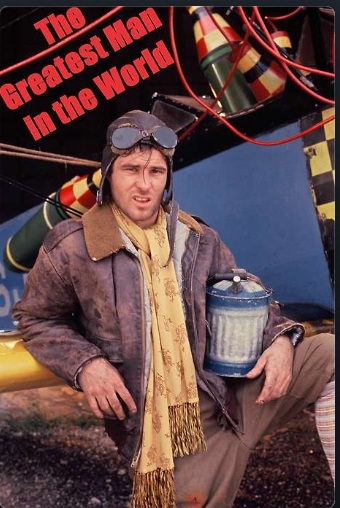
Episode #17: The Greatest Man In The World

(Dir by Ralph Rosenbaum, originally aired in 1981)

In this adaptation of a James Thurber short story, a country boy named Jack Smurch (Brad Davis) briefly becomes a celebrity when he breaks Charles Lindbergh’s record for flying nostop around the world.  Two reporters (Reed Birney and John McMartin) are assigned to write a glowing profile of him.  The U.S. Secretary of State (William Prince) wants to make him a symbol of America.  The only problem is that Smurch himself is a violent and dull-minded habitual criminal who can barely fly his plane and who almost crashes when he comes in for a landing at the end of his flight.  Before he took off in his plane, the only person who cared about Smurch was his girlfriend (Carol Kane).  Even Smurch’s own mother says that she hopes that he crashes and drowns.  But once he manages to land, Smurch becomes a hero.  As the saying goes, print the legend.

Smurch, unfortunately, isn’t smart enough to play along with the hero routine.  At a meeting with the Secretary of State and the President (who is implied to be FDR), Smurch proves to be so obnoxious that he’s tossed out of a window.  He plunges to his death but he dies an American hero.

The final episode of The American Short Story was also the best, a wonderfully dark satire on the media and our cultural need for heroes.  Brad Davis’s naturally obnoxious screen presence — the same presence that made audiences enjoy seeing him get tortured in Midnight Express — is put to good use here.  Jack Smurch is such a jerk that you really can’t blame anyone for tossing him out that window.  If nothing else, it got him to stop talking.

The American Short Story was, overall, an uneven series.  Too often, the episodes failed to really capture the tone and style that made the original stories so memorable.  That said, there were a few good episodes, like this one.  If nothing else, perhaps this series inspired people to read the original stories for themselves.  That would have been the best possible outcome.

Next week …. something new will premiere in the time slot!  What will it be?  I’ll give you a clue — it’s set on the beach but it’s not Pacific Blue.  Let’s just say that some people stand in the darkness….

A Shock To The System (1990, directed by Jan Egleson)


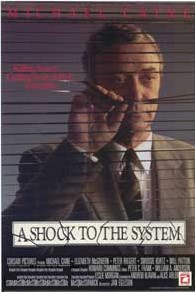
Graham Marshall (Michael Caine) has spent years toiling away as an executive at an advertising firm and being nagged by his wife (Swoosie Kurtz), who claims that Graham doesn’t have enough of a killer instinct to get ahead.  When Graham is passed over for a promotion that he felt was promised to him, Graham starts to reconsider everything that he once believed.  While Graham is waiting for the train to take him home, he is approached by an obnoxious panhandler who always asks him for money.  That night, instead of ignoring the panhandler, Graham shoves him in front of the train.  When no one notices that Graham has murdered the panhandler, Graham decides to get revenge on everyone who he blames for the sorry state of his life.

With each murder, Graham rises higher in the company and he feels better about his life.  But each murder brings to Graham a new set of complications that he has to clean up.  Lt. Laker (Will Patton) thinks that Graham is responsible for all of the deaths that have recently occurred but he doesn’t have the evidence to charge him.  His murder spree brings him a chance of romantic redemption with Stella (Elizabeth McGovern) but soon, even she suspects that Graham might actually be a killer.  Luckily for him, Graham learns that he can get away with his crimes because the system is set up to protect men like him.

A Shock To The System is a pitch-black comedy that benefits from the casting of Michael Caine in the lead role.  Caine is one of the few actors who can make a resentful and bitter sociopath likable and he does that in A Shock To The System.  Graham starts out beaten down by the world and being passed over for younger executives like Bob Benham (Peter Reigert) but, by the end of the film, he’s become as ruthless a killer as Jack Carter.  Just as in Get Carter, A Shock To The System features Michael Caine making evil very compelling.

Citizen Cohn (1992, directed by Frank Pierson)


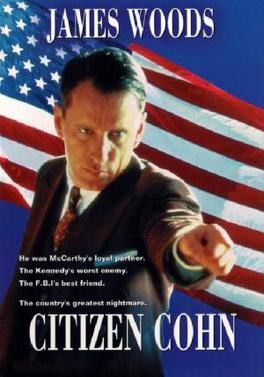
The year is 1986 and the powerful attorney Roy Cohn (James Woods) is dying.  The official story is that Cohn has liver cancer but the truth is that he’s dying of AIDS.  As he lies in his hospital bed, he thinks about his past and the events the led to him becoming one of the most feared and powerful men in America.  He is haunted by the ghosts of his many enemies, people like communist spy Ethel Rosenberg (Karen Ludwig) and his former colleague, Bobby Kennedy (David Marshall Grant).

Not surprisingly, a good deal of Cohn’s memories center around his association with Sen. Joseph McCarthy (Joe Don Baker), a charismatic alcoholic who, in the 50s, charged that he had a list with the names of communist spies deep within the government.  Cohn and Kennedy served as the counsels on McCarthy’s committees.  Cohn is with McCarthy from the beginning and he’s with him until the end of the senator’s career.  In fact, it’s Cohn’s own shadowy relationship with an army private that ultimately leads to McCarthy’s downfall.

Except for one aspect of the film, Citizen Cohn is one of the best films to ever be produced by HBO.  The film covers a lot of history in a little less than 2 hours and it does so in a way that is always interesting and easy to follow.  By including incidents from every phase of Cohn’s life, as opposed to just focusing on his time as McCarthy’, the film also shows how someone like Roy Cohn can become a behind-the-scenes power player despite the majority of the country having no idea who he is.  James Woods gives one of his best performances as the hyperactive and unapologetically corrupt Cohn while Joe Don Baker is perfect as the self-pitying Joseph McCarthy.

The problem with the film, and your mileage may vary on how big an issue this is, is that it almost presents Cohn’s final days — dying of AIDS in a lonely New York hospital room — as being some sort of deserved fate for everything that he did wrong in life.  For me, even in the case of someone like Roy Cohn, that’s a step too far and it comes very close to presenting AIDS as some sort of divine punishment (which, itself, comes dangerously close to mirroring the homophobic statements that were made — and still are being made — by anti-gay activists).  That may not have been the film’s intention but, with the flashback structure and all of his dead enemies materializing to taunt Cohn as he lies dying, it’s still a very valid interpretation.

Some of that is perhaps unavoidable.  Cohn, in both real life and the film, died largely unrepentant for anything he did during his life.  As the central character of a biopic, Cohn never has the type of big moment that you would hope for, where he would realize that it was wrong for him to destroy so many lives and show at least a hint of contrition for his past behaviors.  That Roy Cohn is even a compelling character is a testament to the talent of James Woods because it’s certainly not due to any sort of hidden goodness lurking underneath the surface of Cohn’s snarling personality.  The lack of apologies and regrets that made Cohn a powerhouse in real life also makes him an ultimately unsatisfying subject for a movie.

Lisa Reviews An Oscar Nominee: A Thousand Clowns (dir by Fred Coe)


thousand_clowns

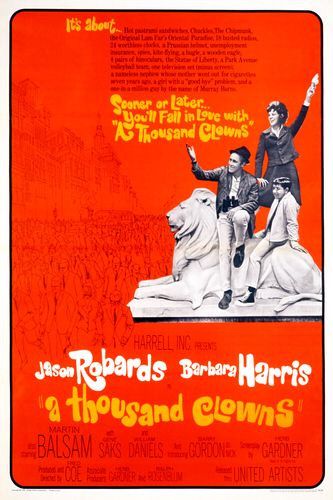
The 1965 film A Thousand Clowns is one of the most annoying films to ever be nominated for best picture.

I know what you’re thinking.

Really, Lisa — even more annoying than Extremely Loud and Incredibly Close?

Well, no.  No movie is as annoying as Extremely Loud and Incredibly Close.  In fact, even if it didn’t particularly work for me, I can kind of understand why A Thousand Clowns was apparently a box office success in 1965.  To be honest, part of my annoyance with the film comes from the fact that not only can I understand why other people would love it but I probably would have loved it if I had been alive to see it when it was first released.  A Thousand Clowns isn’t an awful film but to say that it has not aged well is a bit of an understatement.

It tells the story of Murray Burns (Jason Robards).  Murray lives in a cluttered New York apartment with his 12 year-old nephew, Nick (Barry Gordon).  Seven years ago, Nick’s mother abandoned him with Murray.  Murray views Nick as being his own son.  Nick worships his Uncle Murray.  Murray randomly sings Yes, Sir, That’s My Baby.  Nick picks up on the habit and is soon wandering around and humming Yes, Sir, That’s My Baby.  By the end of A Thousand Clowns you will be so freaking sick of hearing that song.  (Fortunately, Murray never sings Send In The Clowns.  The film dodged a bullet on that one.)

Murray’s a nonconformist, the type who starts his day by standing outside and mocking everyone who is getting ready to go to work.  Murray used to have a job.  He was a TV writer.  He wrote jokes for a detestable entertainer known as Chuckles The Chipmunk (played by noted Broadway director Gene Saks).  Five months ago, Murray quit his job.  He’s now unemployed and proud of it.  He swears that he will never again sacrifice his freedom for a paycheck.  He raises Nick to take the same attitude towards life.

Two social workers, Albert (Williams Daniels) and Sandra (Barbara Harris), show up at Murray’s apartment.  They say that unless Murray gets a job and proves that he’s a good guardian, Nick will be taken away from him.  Murray explains that he’s a nonconformist and that he’s raising Nick to reject anything conventional.  Albert is offended.  Sandra is charmed.  Soon, Sandra and Murray are going for bike rides through New York City.  Murray sings Yes, Sir, That’s My Baby some more…

And it all sounds good but the film just didn’t work for me.  First off, I’ve actually experienced what it’s like to grow up with a frequently unemployed father and, sorry, it’s not all studio apartments and cheerful trips to Central Park.  Secondly, A Thousand Clown‘s message of carpe diem might have seemed groundbreaking in 1965 but today, it just seems like a cliché.  I mean, everyone claims to be a nonconformist today.

Watching the film, it’s hard not to feel that it doesn’t really play fair.  It’s easy for the film to always portray Murray as being enlightened when the only people who ever disagree with him are humorless strawmen.  Albert is a self-righteous prig while Chuckles The Chipmunk is a heavy-handed caricature, the type of TV star who could only be created by a writer who is resentful that more people are watching TV than reading his latest masterpiece.  Martin Balsam appears as Murray’s brother, Arnold, and gets a chance to defend his decision to lead a normal, conventional life.  When it comes to the brothers, the film obviously want us to side with Murray but instead, you feel more sympathy for Arnold, largely because Martin Balsam was such an authoritative actor that your natural tendency is to assume that he must know what he’s talking about.  It’s interesting to note that it was Balsam, as the voice of mainstream conformity, that won the film’s only Oscar.

Jason Robards was not even nominated, though his performance is often better than the material.  He and Barbara Harris have a sweet chemistry, even though Harris is stuck playing a rather demeaning role.  (When we first meet Sandra, she is dating Albert and assuming that he’s correct about anything.  Then she falls for Murray and assumes that he is the one who is correct about everything.  What the film never bothers to really explore is what Sandra herself thinks about anything.)  But then you’ve got Barry Gordon, who, in the role of Nick, comes across as being a bratty know-it-all weirdo.  Nick is so obnoxious that it undercuts the movie’s claim that Murray deserves to be his guardian.

Also not nominated, despite the film winning a best picture nomination, was the director, Fred Coe.  (Nominated in his place were William Wyler for The Collector and Hiroshi Teshigahara for The Woman In The Dunes.)   His omission is less surprising than that of Jason Robards.  If you didn’t know that A Thousand Clowns was based on a stage play, you’d guess it after watching the first ten minutes of the film.  Despite a few shots of Murray and Sandra in New York City, A Thousand Clowns never breaks free of its stage origins.  Taking place on largely one set, it feels rather confining for a film meant to celebrate nonconformity.

As I said, I didn’t care much for A Thousand Clowns but I can understand why it was probably a hit with 1965 audiences.  Murray’s a transitional figure, standing between the Beats and the Hippies.  With America’s confidence shaken by the Kennedy assassination and growing social unrest, I’m sure a lot of people wanted to drop out of society just like Murray.  To be honest, a lot of people feel like that right now.  I just hope that, if you do decide to follow Murray’s example, you’ll sing something less annoying than Yes, Sir, That’s My Baby.

A Thousand Clowns was nominated for best picture but it lost to a film that Murray probably would have hated, The Sound of Music.