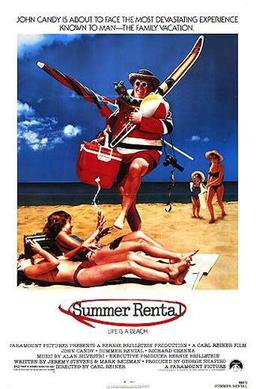
Summer Rental (1985, directed by Carl Reiner)


After a blow-up at work, air traffic controller John Chester (John Candy) is given five weeks of paid leave.  He takes his family to Florida, where they rent a beach house and discover that their summer town is controlled by snobbish sailing champion Al Pellett (Richard Crenna).  It’s the snobs vs slobs as Pellett tries to kick John and his family out of their summer rental and John tries to prove himself to his son and daughter (Joey Lawrence and Kerri Green) by winning the local sailing championship.  Luckily, John has Sully (Rip Torn), a modern-day pirate captain, on his side.

John Candy was a remarkable talent.  It’s just a shame that he didn’t appear in more good films.  He will always be remembered for films like Splash, Uncle Buck, Planes, Train, and Automobiles, and Only The Lonely but unfortunately, most of his starring roles were in lightweight, forgettable far like Summer Rental.  Candy is likable as John Chester and sympathetic even when he’s losing his temper over every minor inconvenience.  But the film itself never really does much to distinguish itself from all of the other 80s comedies about middle class outsiders taking on the richest man in town.  Candy is stuck playing a role that really could have been played by any comedic actor in 1985.  It’s just as easy to imagine Dan Aykroyd or even Henry Winkler in the role.  It feels like a waste of Candy.

The best thing about the film is Rip Torn’s performance as Sully.  Torn’s performance here feels like a dry run for his award-winning work as Artie on The Larry Sanders Show.  I would have watched an entire movie about Sully.  As it is, Summer Rental is inoffensive and forgettable.

Madhouse (1990, directed by Tom Ropelewski)


Mark (John Larroquette) and Jessa Bannister (Kirstie Alley) have a perfect yuppie lifestyle going until their respective family members show up at their California home and refuse to leave.  First, it’s Mark cousin (John Diehl) and his wife (Jessica Lundy).  Then it’s Jessa’s sister, Claudia (Alison LaPlaca), who has just left her husband and now has to find a new man to support her lifestyle.  Mark and Jessa just want some time alone but instead, they have to deal with a cat who is frequently mistaken for dead, broken marriages, a shipment of cocaine, and a neighbor (Robert Ginty) who builds weird bed frames.  Mark has a big contract to land and Jessa is trying to succeed as a television news reporter but it’s not easy when you’re living in a madhouse.

There are some films that you just like despite yourself and that’s the way I feel about Madhouse.  It’s very much an 80s film, with its emphasis on material goods and achieving the perfect lifestyle.  (The appearance of Dennis Miller as Mark’s co-worker only reminds us of just how much a product of its era that Madhouse is.)  There are a lot of jokes that don’t work and some, like the cat that is continually mistaken for dead, that shouldn’t work but do.  It’s a sitcom transferred to the movies and the humor rarely rises above that level.  It ever stars two of the decade’s biggest sitcom stars, John Larroquette and Kirstie Alley.  Larroquette shows us why he was better suited for television while Alley shows how tragic it was that she didn’t have a bigger film career.  Kirstie Alley gives such a dedicated and fearless performance as someone who has been driven to the end of her rope that it keeps you interested in the film.  Alley, like the great comedic actresses of Hollywood’s golden age, was an actress who could mix physical comedy with barbed one-liners and who was undeniably appealing as she moved from one disaster to the next.  In Madhouse, she was beautiful, frantic, sexy, neurotic, relatable, and funny all at the same time.  By the end of this movie, you really do wish she had gotten more and better opportunities to show off her talents in the years after Cheers went off the air.

Madhouse is nothing special.  It’s a generic comedy about unwanted family guests.  But I’ll always appreciate it for Kirstie Alley.

Scenes That I Love: The Opening Of The Texas Chainsaw Massacre


Since today is Tobe Hooper’s birthday, it seems fitting that today’s scene of the day should come from his best-known film.  The opening of 1974’s The Texas Chainsaw Massacre is genuinely unsettling, from the opening narration to the scene of the body being dug up to the news reports of grave robbery.  Even the opening credits feel ominous!

The narration was, of course, provided by a young John Larroquette, who has since said that he was “paid in marijuana” for what would become his first feature film credit.


Stripes (1981, directed by Ivan Reitman)


Bill Murray and Harold Ramis join the army.

Wait, that can’t be right, can it?  Bill Murray and Harold Ramis were cinematic anarchists.  Early in his career, Bill Murray was the ultimate smart aleck slacker who did not have any respect for authority.  Harold Ramis was hardly a slacker but he came across as someone more likely to be marching on the Pentagon than guarding it.  Stripes is one of the ultimate examples of a comedy where the laughs come from things  that don’t seem to go together suddenly going together.

John Winger (Murray) at least has a reason to join the army.  He has a dead end job.  He has just broken up with his girlfriend.  The country appears to be at peace so why not spend four years in the Army?  It’s harder to understand why John’s friend, Russell (Ramis), also decides to enlist, other than to hang out with John.  Along with Ox (John Candy), Cruiser (John Diehl), Psycho (Conrad Dunn), and Elm0 (Judge Reinhold), they enlist and go through basic training under the watchful eye of Sgt. Hulka (Warren Oates).  John and Russell go from treating everything like a joke to invading East Germany in a tank that’s disguised as an RV.  They also meet the two sexiest and friendliest MPs in the service, Stella (P.J. Soles) and Louise (Sean Young).  Russell goes from being an proto-hippie who teaches ESL to asking John if he thinks he would make a good officer.  John goes from not taking anything seriously to picking up a machine gun and rescuing his fellow soldiers.

It’s a comedy that shouldn’t work but it does.  It’s actually one of my favorite comedies, full of memorable lines (“Lighten up, Frances.”), and stupidly funny situations.  The cast is full of future comedy legends and P.J. Soles shows that she deserved to be a bigger star.  This was early in Bill Murray’s film career and he was still largely getting by on his SNL persona but, in his confrontations with Hulka, Murray got a chance to show that he could handle drama.  With all the comedic talent in the film, it’s Warren Oates who gets the biggest laughs because he largely plays his role straight.  Sgt. Hulka is a drill sergeant who cares about his men and who knows how to inspire and teach  but that doesn’t mean he’s happy about having to deal with a collection of misfits.  (Watch his face when Cruiser says he enlisted so he wouldn’t get drafted.)

The movie does get strange when the action goes from the U.S. to Germany.  What starts out as Animal-House-In-The-Army instead becomes an almost straight action movie and the movie itself sometimes feels like a recruiting video.  Join the Army and maybe you’ll get to steal an RV with PJ Soles.  That would have been enough to get me to enlist back in the day.  But the combination of Murray, Ramis, and Oates makes Stripes a comedy that can be watched over and over again.

Horror Film Review: Altered States (dir by Ken Russell)


You gotta watch out when it comes to those sensory deprivation tanks.  They may look like fun and it might seem like a pleasant idea to spend a while floating in and out of a state of consciousness but those tanks will mess you up.  Especially if you’ve got unresolved issues with your family and religion.

Also, if you’re going to go to Mexico to try a powerful hallucinogenic, make sure you’re not appearing in a Ken Russell film because again, those drugs will mess you up.  It’s like you’ll close your eyes and, when you reopen them, you’ll be in an 80s music video or something.

Now, to be honest, Altered States came out in 1980 so it’s a bit unfair to complain that it looks like a music video from the 80s or, for that matter, the 90s.  Instead, it’s more fair to say that a lot of the music videos from those two decades looked like Altered States.  That shouldn’t be particularly surprising since this film was directed by Ken Russell and Russell was a director who specialized in combining music with wild imagery.

Altered States may have been directed by Ken Russell but it was written by Paddy Chayefsky.  Chayefsky, of course, is best known for writing the script for Network.  (He also wrote the script for the Oscar-winning film, Marty.)  Chayefsky is one of those writers who is always cited as an inspiration by writers who are trying justify being heavy-handed.  For instance, when Aaron Sorkin was criticized for both Studio 60 On The Sunset Strip and The Newsroom, his supporters started talking about how he was just carrying on the proud tradition of Paddy Chayefsky.  In his autobiography, A British Picture, Ken Russell portrays Chayefsky as being a pompous control freak who refused to allow any changes to his dialogue-heavy script.  Russell responded by directing his actors to speak the dialogue as quickly as possible, rendering much of it incoherent.  In a few scenes, he even specifically had the actors eating so that their mouths would be full as they spoke.  Chayefsky was not amused and eventually demanded to be credited under his real name, Sidney Aaron.

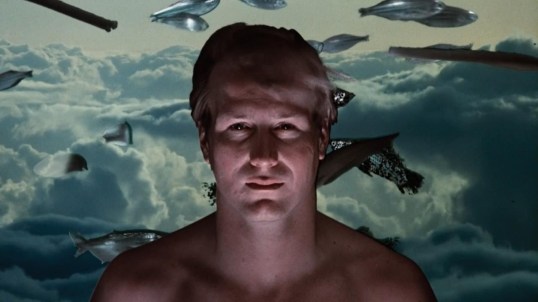
As for the film itself, it tells the story of Dr. Eddie Jessup (William Hurt, in his film debut), who is convinced that he can cure schizophrenia by exploring states of altered consciousness.  As mentioned above, this leads to him floating in a tank and taking hallucinogenics in Mexico.  Somehow, this leads to him turning briefly into a caveman and then into some sort of primordial energy creature.  His wife (Blair Brown) is not happy that Eddie appears to be determined to reverse evolution and return to mankind’s original form.  For that matter, Eddie’s bearded colleagues (Charles Haid and Bob Balaban) all think that he’s playing a dangerous game as well.  Eddie’s daughter (Drew Barrymore, making her film debut) isn’t particularly concerned but that’s just because she’s like five and probably thinks it would be fun to have a primordial energy monster to play with.  Anyway, it all becomes a question of whether or not all questions need to be answered and whether love can defeat science.

Anyway, this is a deeply silly movie but it’s also kind of compelling, mostly because the uneasy mix of Chayefsky’s pompous, serious-as-Hell script and Ken Russell’s aggressive and semi-satiric directorial style.  Chayefsky obviously meant for the story to be taken very seriously whereas Russell takes it not seriously at all.  Though Chayesfky and Russell ended up hating each other, Russell keeps the film from becoming the cinematic equivalent of Neil DeGrasse Tyson’s twitter account.  Chayefsky’s greatest objection was that Russell directed the actors to not only speak quickly but to also speak over each other but this actually works to the film’s advantage.  Eddie and his colleagues are young, arrogant, and determined to make their mark.  Of course, they’re going to speak quickly.  They’re excited and there’s no time to lose.  The film’s best moments are the early ones, where it’s hard not to get swept up in Eddie’s enthusiasm.  Of course, once Eddie turns into a caveman, it pretty much becomes impossible to take anything that follows seriously.

For all the talk about the origins of mankind and whether or not love can save the day, the main appeal of this film is to watch William Hurt totally freak out.  Jessup’s hallucinations allow Russell to do what he did best and they’re the highlight of the film.  Despite Chayefsky’s ambitions, you don’t watch this film for the science.  You watch it for the seven-eyed ram and the scenes of Eddie walking into a mushroom cloud.  Ken Russell was smart enough to know that audiences would take one look at William Hurt, with his WASP bearing, and totally want to see just how fucked up Eddie Jessup actually was.  On that front, Russell totally delivers.

This film is a mess but at least it’s a Ken Russell mess.


Horror Film Review: The Texas Chainsaw Massacre (dir by Tobe Hooper)


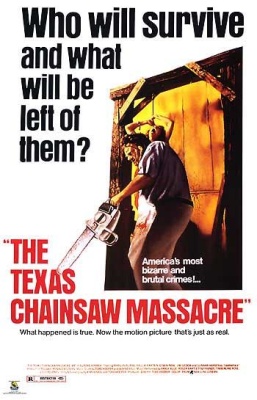
TheTexasChainSawMassacre-poster

Occasionally, I get asked why I am always making mean-spirited jokes about Vermont.  Well, believe it or not, there is a reason!  Would you believe that it all goes back to The Texas Chainsaw Massacre?

In an editorial that was posted on this very site, I argued that one reason why, ever since it was initially released in 1974, The Texas Chainsaw Massacre has remained an iconic horror film is because the title specifically alerts you that the film takes place in Texas.  For whatever reason, people across America are terrified of my home state.  Despite the fact that we’re all pretty friendly down here, people are scared to death.  They think we’re all walking around with guns or that something’s bad is going to happen if you make a wrong turn.  (And, of course, folks from up north can’t handle the fact that the temperature occasionally gets above 85. “OH MY GOD, IT’S GLOBAL WARMING!” the tourists shout.  No, morons — it’s just summer in Texas.)  In order to prove my point, I pointed out that no one would want to see a movie called The Vermont Chainsaw Massacre.

For good measure, I may have then added, “Fuck Vermont.”  Because — well, why not?*

Within hours of posting that editorial, I heard from someone in Vermont and OH MY GOD, she was so offended!  Seriously, she seemed to be really upset that I was suggesting that nobody would be scared of getting horribly murdered while driving through Vermont!

So, to the people of Vermont, accept my apologies.  Y’all are just as capable of killing people with a chainsaw as we are, okay?

Seriously, though, The Texas Chainsaw Massacre would never work if it was set in Vermont.  That’s not just because Vermont su …. uhmm, is a lovely state.  That’s because The Texas Chainsaw Massacre is a uniquely Texan film.  One reason why this film is so successful is because it was made by Texans and it starred Texans (no inauthentic accents here!) and it was filmed in Texas during the summer.  From the minute we see that van driving down the road, we feel the isolation of the characters.  Every frame of the film is filled with Texas heat and humidity and, as such, the audience can almost literally feel how uncomfortable it is inside the van, so much so that you really can’t blame everyone for wanting to get out and walk around for a while.  Ultimately, the burning sun is as important a character in this film as Sally (Marilyn Burns), her obnoxious wheelchair-bound brother Franklin (Paul A, Partain), or Leatherface (Gunnar Hansen), the hulking cannibal who chases after them with a chainsaw.

Actually, it’s a little bit difficult to know what to say about The Texas Chainsaw Massacre.  It’s such a famous film that even people who haven’t seen it feel as if they had.  And every review always points out the reasons why it works: the film is shot in an almost documentary style, Marilyn Burns was one of the great scream queens, Leatherface’s final dance with his chainsaw is pure nightmare fuel, and, despite the fearsome title, next to no blood is actually seen on screen.  This is one of those films where we imagine we see a lot more than we actually do.  Despite being advertised as being a “chainsaw massacre,” only one person actually falls victim to a chainsaw and he’s so obnoxious that you’re kind of happy that he finally stopped talking.

They may not be much blood on the screen but this is still one of the most stomach-churning films ever made.  When Sally finds herself trapped in the house with Leatherface and his family, that house is so filthy and disgusting that you can literally smell the rotting flesh coming off the screen.  This may be a case of my own OCD speaking but the squalor of that house tends to disturb me even more than some of the murders.

Speaking of the murders, the death of Jerry (Allan Danziger) always freaks me out.  Jerry is looking for his other dead friends when Leatherface appears out of nowhere and hits him with a sledgehammer.  Up until that point, Jerry seemed like the smartest of the five people to find themselves wandering around that desolated part of South Texas.  Certainly, if I had been there, I probably would have wanted to stay with Jerry.  Perhaps that’s why Jerry’s high-pitched scream before getting killed always disturbs me.  If you’ve seen enough slasher movies, you know that the men in these movies — no matter what is happening to them — hardly ever scream.  When Jerry does so, it makes the movie feel real in a way that most film influenced by Texas Chainsaw do not.

Listen, Vermont … I’m sorry you can’t have a chainsaw massacre of your very own.  But The Texas Chainsaw Massacre is a part of our history and, despite the negative implications of the name, we do take a certain amount of pride in it.  It is truly one of the great horror films.  Ignore the remakes, which were made by non-Texans and are all so excessively stylized that you have to wonder if the filmmakers even saw the original.

One final note: The Texas Chainsaw Massacre also has one of the truly great trailers.  Check it out below!

http://www.youtube.com/watch?v=eY4ldz615FA

——

* I should mention that I can usually trust someone around here to ask me if I really want to say something like “Fuck Vermont” before I hit publish.  But that weekend, Arleigh was on vacation and this was before I had recruited my sister to come work here so there really wasn’t anyone else around the TSL offices who was used to dealing with me and my impulsive nature.  I tried to show the post to Leonard to get his opinion about the F Vemont line but he was busy watching hockey…

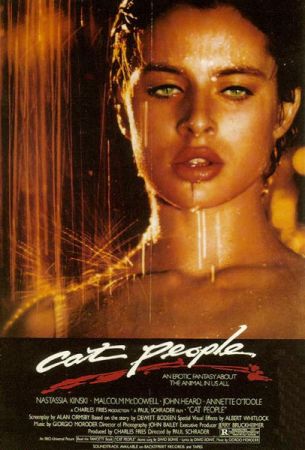
Horror Film Review: Cat People (dir by Paul Schrader)


Cat_People_1982_movie

Before I get around to actually reviewing Paul Schrader’s 1982 reimagining of Cat People, I’m going to suggest that you take a few minutes to watch the film’s opening credits.  Say what you will about Schrader’s Cat People, it has a great opening, one that perfectly sets up the rest of the film.

In this version of Cat People, Irena (Natassja Kinski) is a naive young woman (and virgin) who, after the death of her parents, has spent most of her previous life in foster care.  Irena travels to New Orleans, where she reconnects with her older brother, Paul (Malcolm McDowell).  From the minute that Irena meets her brother and his housekeeper (Ruby Dee), it’s obvious that something is off.  When Paul looks at her, he does so with an unsettling intensity.  At night, while Irena sleeps, Paul wanders the dark streets of New Orleans.

One morning, Irena wakes up to discover that Paul is missing.  Having nothing else to do, Irena wanders around New Orleans.  When she visits the zoo, she feels an immediate connection to a caged panther who stares at her with a familiar intensity.  It turns out that the panther was captured the previous night, after he mysteriously appeared in a sleazy motel and mauled a prostitute.

It’s at the zoo that Irena meets zookeeper Oliver Yates (John Heard).  Oliver gets Irena a job working at the zoo gift shop. where Irena is befriended by Oliver’s co-worker, Alice (Annette O’Toole).  One day, Irena witnesses the panther kill another zookeeper before it then escapes from its cage.

That night, Paul suddenly shows up in Irena’s bedroom.  He explains to her that they are a cursed species.  Having sex causes them to turn into panthers and the only way to avoid the curse is through incest.  A terrified Irena flees her brother and soon finds herself living with and falling in love with the increasingly obsessive Oliver, all the while knowing that giving herself to him physically will lead to her transformation.

From the very first second of the film. Schrader’s Cat People is an exercise in pure style.  If the original Cat People was largely distinguished by its restraint, Schrader’s version is all about excess.  Everything that was merely suggested in the original is made explicit in this version.  As tempting as it may be to try, it’s somewhat pointless to try to compare these two versions.  Though they may both be about a woman who turns into a panther when she has sex, they are two very different films.

Schrader’s Cat People walks a very fine line between moodiness and absurdity, which is perhaps why I enjoyed it.  Making great use of both the sultry New Orleans setting and Giorgio Moroder’s atmospheric score, Cat People is compulsively dream-like and enjoyably over-the-top.  Cat People is often described as being an example of a movie that could have only been made in the coked up 80s  and truly, this is one of those films that’s so excessive that it’s becomes fascinating to watch.

(I think that often we are too quick to assume that excess is necessarily a bad thing.  If you can’t be excessive when you’ve got Malcolm McDowell playing an incest-minded cat person in New Orleans, when can you be excessive?)

Schrader’s Cat People may not have much in common with the original version but the film’s best scene is the only one that is a direct recreation of a scene from the original.  In fact, in recreating the scene where Alice is menaced while swimming in a public pool, Schrader actually improves on the original.  Brilliantly performed by both Annette O’Toole and Natassja Kinski (whose cat-like features made her perfect for the role of Irena), it’s the only scene in the film that can truly be called scary.  Starting with a tracking shock that follows Alice as she jogs, the stalking scene is practically a master class in effective horror cinema.  If nothing else, you should see Cat People for that one scene.

And you should also see it for the wonderful soundtrack!  Let’s end this review with David Bowie’s theme song, which you may also remember from Quentin Tarantino’s Inglourious Basterds.