Welcome to Retro Television Reviews, a feature where we review some of our favorite and least favorite shows of the past! On Wednesdays, I will be reviewing the original Love Boat, which aired on ABC from 1977 to 1986! The series can be streamed on Paramount Plus!
This week, we begin season 7!
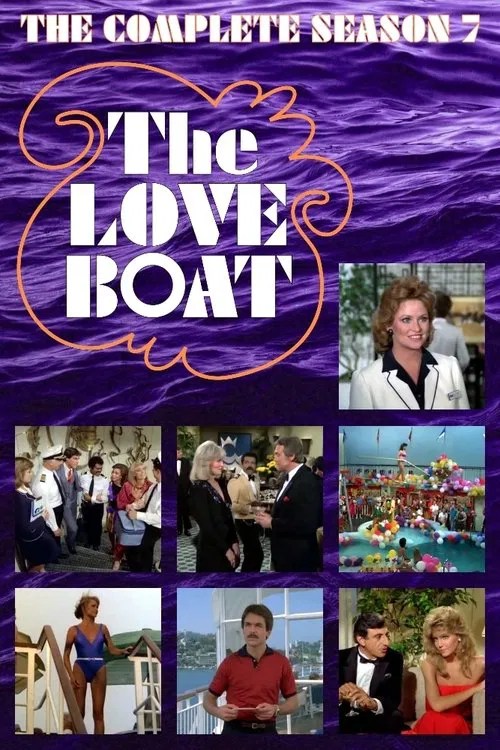
Episodes 7.1 and 7.2 “China Cruise: The Pledge/East Meets West/Dear Roberta/My Two Dumplings”
(Dir by Robert Scheerer, originally aired on October 1st, 1983)
It’s time for season seven of The Love Boat!
Gopher has been promoted to head purser. For six seasons, he was assistant purser and I always wondered who the head purser was. Apparently, there wasn’t one because Stubing promoted him without firing anyone. It’s possible that I just don’t know how cruise ships work.
The Love Boat crew starts off the season with a cruise around China! I guess the old saying is true — only Stubing could go to China. I kept waiting for Stubing to announce that he recognized Taiwan as an independent nation but he didn’t. I was a little bit disappointed by that. Instead, Stubing and the crew saw the sights. There’s a panda bear! There’s the Great Wall of China! There’s a bunch of young people all singing, almost as the future of their loved ones depended on doing a good job! In fact, this premiere episode is really more about seeing the sights of China than it is about any of the drama playing out on the boat. I guess that makes since. This episode aired in the pre-Internet age of 1983, so for the audience, this really was a chance to see a world that they probably couldn’t otherwise experience. It’s not like they could go on YouTube and do a search for China or something like that. It was up to The Love Boat to open up the world!
That said, Chinese medicine came in for a bit of criticism. Susan Anton played a woman who didn’t trust doctors and who thought buying a Chinese symbol for good luck would keep her safe. However, when she suddenly had intense stomach pain, it was up to Doc to save her life. Where’s your good luck charm now!?
Linda Evans played a woman who fell in love with Lee Majors, little suspecting that Majors was the author of the “Dear Roberta” advice column. Some of “Roberta’s” advice led to Evans divorcing her previous husband.
Lee Horsley played a man with two girlfriends (Erin Moran and Pat Klous). Uh-oh! They all ended up on the boat at the same time!
Finally, Ursula Andress played a dying woman who fell for a mysterious but charming passenger (John Forsythe). Unfortunately, Forsythe had a warrant out for his arrest and Detective Michael Constantine was determined to take him into custody. This story was unique in that it had an unhappy ending! While the crew had a few unhappy endings (Remember when Julie was left at the altar?), this was the first time that things didn’t work out for a passenger.
Was this a good episode? It was, strictly from the point of view that I like The Love Boat crew and I enjoy spending time with them. This episode was occasionally a bit too much of a travelogue but the Andress/Forsythe story carried some weight. All in all, it was a decent start for season 7.
In 1959, the Clutter Family was murdered in Holcomb, Kansas.
Herbert Clutter was a farmer and was considered to be prosperous by the standards of small-town Holcomb. Neither he nor his wife nor his teenage son and daughter were known to have any enemies. The brutality of their deaths took not just the town but the entire state by surprise. People like the Clutters were not supposed to be brutally murdered. They certainly weren’t supposed to be brutally murdered in a tight-knit community like Holcomb or in a state like Kansas.
The Clutters
The author Truman Capote traveled to Holcomb with his friend Harper Lee, looking to write a story about how the heartland was dealing with such a brutal crime. Six weeks after the murders, while Capote and Lee were still conducting their interviews, two small-time criminals named Dick Hickock and Perry Smith were arrested for the crime. Capote’s proposed article about Holcomb instead became the basis for his best-known book, In Cold Blood. Capote followed the case from the initial investigation to the eventual execution of both Hickok and Smith. He examined the backgrounds of the two criminals, especially Perry Smith’s. (Indeed, there were some who felt that Capote saw something of himself in the mentally-fragile Smith.) In Cold Blood was Capote’s most successful book and it also launched the entire “true crime” genre. It also may have been Capote’s downfall as Capote reportedly spent the rest of his life haunted by the feeling that he would never top the book and that he had potentially exploited Perry Smith while writing it. In Cold Blood may be critical of the death penalty but, if Smith and Hickok hadn’t gone to the gallows, Capote would never have had an ending for the book.
(The writing of In Cold Blood and Capote’s subsequent struggles are dramatized in the excellent Capote.)
When it was published in 1965, In Cold Blood shot up the best seller lists. A film version was an inevitability. Otto Preminger — who had already made films out of Anatomy of a Murder, Exodus, Advice and Consent, and The Cardinal — was eager to turn the book into a film and one can imagine him churning out some epic version with his usual all-star cast. (Sal Mineo as Perry Smith? Peter Lawford as Dick Hickok? With Preminger, anything was possible.) However, Capote sold the rights to Richard Brooks, an independent-minded director who was also an old friend. Brooks decided to duplicate Capote’s “non-fiction novel” approach by actually shooting his film in Holcomb and having several residents of the town play themselves. He also rejected Columbia’s suggestion that Smith and Hickok should be played by Paul Newman and Steve McQueen. Instead, he cast former child actor Robert Blake as Perry Smith and an up-and-coming character actor named Scott Wilson as Dick Hickok. The only “star” who appeared in the film was television actor John Forsythe, who played the Kansas detective who was placed in charge of the investigation.
The story plays out in deliberately harsh black-and-white. (Legendary cinematographer Conrad Hall made his debut with this film.) The opening contrasts scenes of Smith and Hickok, both recently released from prison, meeting up in Kansas with scenes of the Clutter family innocently going about their day. Perry Smith is neurotic and quick to anger, a wannabe tough guy who wears a leather jacket and whose greasy hair makes him look less like a cunning criminal and more like an understudy in a regional production of West Side Story. Dick Hickok is friendly and slick, a compulsive shoplifter who claims that his smile can get him out of anything. In jail, Hickok heard a story that suggested that Mr. Clutter kept a lot of money hidden away in a safe on his farm. Hickok’s plan is to tie up and rob a family of strangers, with the assumption being that, by the time the Clutters get loose and call the police, he and Smith will already be far out of town. Neither he nor Smith seem like natural-born murderers. Smith seems to be too sensitive. Hickok seems like the epitome of someone who brags but doesn’t follow through. And yet, the morning after the robbery, four of the Clutters are discovered murdered in their own home.
The film delves quite a bit into Perry Smith’s background. Throughout the film, he has flashbacks to his abusive father and his promiscuous mother. When Alvin Dewey (played by John Forsythe) investigates Smith’s family, the recurring theme is that Perry never really had much of a chance to become anything more than a criminal. We learn less about Dick Hickok’s background, beyond the fact that he was a popular high school jock who turned mean after a car accident. And yet, despite the fact that the film is clearly more interested in Perry Smith than Dick Hickok, it’s Scott Wilson who dominates the film. It’s not that Robert Blake gives a bad performance. It’s just that Perry is such a neurotic mess and Blake gives a performance that is so method-y that occasionally, you’re reminded that you’re just watching a movie. Scott Wilson, on the other hand, gives a very natural performance as Dick Hickok. There’s nothing particularly showy about his performance and that makes Hickok all the more disturbing as a criminal and a potential murderer. If you’ve spent any time in the country, you’ve met someone like Dick Hickok. He’s the friendly guy who always knows that right thing to say but there’s something just a little bit off about him. He’s likable without being trustworthy.
A few years ago, when I saw that In Cold Blood was going to be airing on TCM, I told my aunt that I was going to watch the film. She replied that I shouldn’t. She saw the film when it was originally released and she described it as being incredibly disturbing. Despite her warning, I watched the film and I have to admit that she was right. Even though it’s nearly 60 years old and not particularly explicit when compared to the true crime films of today, In Cold Blood is still a disturbing viewing experience. Towards the end of the film, we finally see the murders in flashback and the image of Smith and Hickok emerging from the darkness of the farmhouse will haunt you. There’s not a lot of blood. The camera often cuts away whenever the actual murders occur (we hear more gunshots than we see) but the Clutters themselves are sympathetic and innocent victims and their deaths definitely hurt. Indeed, considering that the film falls on the more liberal side of the question of root causes, In Cold Blood deserves a lot of credit for not shying away from the brutality of the crimes. After spending 90 minutes emphasizing Perry Smith’s terrible childhood, it was important to remind the audiences of what he and Dick Hickok actually did.
The murder scene is so nightmarish that it actually makes it a bit difficult to buy into the film’s anti-death penalty argument. The film may end with Smith remorseful and a reporter (Paul Stewart) talking about how revenge is never the answer but the film’s liberal talking points feel hollow after witnessing the murder of four innocent people. (Ironically, it turned out there was no safe so those four people died so Smith and Hickok could steal about forty dollars.) A few years ago, I probably would have been very moved by the film’s anti-death penalty message. While I’m still opposed to the death penalty because I think there’s too much of a risk of a wrongly convicted person being executed, I’m long past having much personal sympathy for the Perry Smiths of the world.
Overall, In Cold Blood remains a powerful and disturbing movie. It was a film that was nominated for several Oscars, though it missed out on Best Picture due to 20th Century Fox’s huge campaign for Dr. Dolittle. Neither Blake nor Wilson were nominated, which is evidence that they were perhaps too convincing as Smith and Hickok for the Academy’s taste. While Robert Blake would go on to have the more storied career, Scott Wilson was a dependable character actor up until his death in 2018. A whole new generation of fans knew him not as Dick Hickok but instead as The Walking Dead‘s beloved Herschel Greene.
One final note: Both the book and the film present the murders as being an aberration, something that neither Smith nor Hickok originally planned. In 2013, new evidence was released that revealed the Smith and Hickok were the number one suspects in the murder of Christine and Cliff Walker and their two children, a crime that occurred in Florida shortly after they fled Kansas. The two of them were questioned at the time and given a polygraph test, which they both passed. The bodies of Smith and Hickok were exhumed for DNA testing, The tests came back inconclusive.
First released in 1979, ….And Justice For All will always be remembered for one scene.
Yell it with me, “YOU’RE OUT OF ORDER! THE WHOLE TRIAL IS OUT OF ORDER! THEY’RE OUT OF ORDER!”
When attorney Arthur Kirkland (Al Pacino) starts screaming in the middle of the courtroom, it’s a cathartic moment. We’ve spent nearly two hours watching as Arthur deals with one insane situation after another. One of Arthur’s partners, Warren (Larry Bryggman), cares more about his car than actually delivering the right documents to a judge. Another of Arthur’s partners, Jay (Jeffrey Tambor), has a nervous breakdown and, after shaving his head, ends up throwing cafeteria plates at people in the courthouse. Arthur has three clients, one of whom is indigent, one of whom is innocent, and one of whom is a wealthy and despised judge (John Forsythe) who has been accused of a rape that Arthur suspects he committed. The system offers no mercy for Arthur’s innocent (or, at the very least, harmless) clients while going out of it’s way to defend the judge. Meanwhile, another judge (Jack Warden), is driven to take suicidal risks, like flying a helicopter until it runs out of fuel and comes down in a nearby harbor. The assistant district attorney (Craig T. Nelson) only cares about his political ambitions and finally, after one incident after another, Arthur snaps. And it’s cathartic because we’re all on the verge of snapping as well.
That final moment, with its signature Al Pacino rant, is such a strong and iconic scene that it’s easy to forget that the film itself is actually rather uneven. The script, by Barry Levinson and Valerie Curtin, owes a good deal to the work of Paddy Chayefsky. Just as Chayefsky often wrote about men being driven mad by institutional failure, ….And Justice For All features character after character snapping when faced with the screwed-up realities of the American justice system. The final “out of order” speech is obviously meant to be this film’s version of Howard Beale’s “I’m as mad as Hell and I’m not going to take it!” speech from Network and, much like George C. Scott in the Chayefsky-written The Hospital, Arthur spends a lot of time talking about what he doesn’t like about his job. The thing that sets ….And Justice For All apart from the best works of Chayefsky is that Levinson, Curtin, and director Norman Jewison all take Arthur Kirkland at his word while one gets the feeling that Chayefsky would have been a bit more willing to call out Arthur on his self-righteousness. Arthur has every right to be angry when Warren forgets to give a judge an important document while Warren is substituting for him in court. At the same time, Arthur is the one who trusted Warren to do it. In the end, the document was not about one of Warren’s client. In fact, Warren knew absolutely nothing about the case or Arthur’s client. The document was about Arthur’s client and Arthur was the one who decided trust someone who had consistently shown himself to not be particularly detailed-orientated. One gets the feeling that Chayefsky would not have let Arthur off the hook as easily as Levinson, Curtin, and Jewison do. Arthur’s perpetual indignation can sometimes be a little hard to take.
It’s a very episodic film. Arthur goes from one crisis to another and sometimes, you do have to wonder if Arthur has ever had any human or legal interactions that haven’t ended with someone either going insane or dying. There’s no gradual build-up to the film’s insanity, it’s right there from the beginning. And while this means the narrative often feels heavy-handed, it also makes that final speech all the more cathartic. It’s an uneven film and, of all of the characters that Pacino played in the 70s, Arthur is probably the least interesting. But that final rant makes up for a lot and, fortunately, Pacino was just the actor to make it memorable. For all it’s flaws, the final few minutes of ….And Justice For All make the film unforgettable.
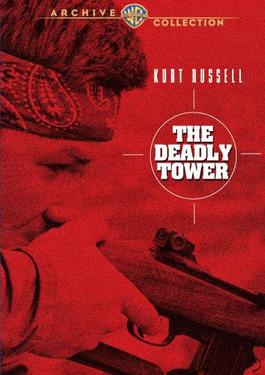
Made for television, The Deadly Tower is a recreation of the terrible day in 1966 that a 25 year-old former Marine named Charles Whitman shot his wife and mother and then climbed to the top of the tower at the University of Texas in Austin and started to indiscriminately firing on the people below. It was one of the first mass shootings of its kind. What drove All-American boy Charles Whitman, who was eventually taken down by the police, to start his rampage is not known though the autopsy revealed that he did have a small brain tumor at the time of his death.
The Deadly Tower focuses mostly on the efforts of the policeman Ramiro Martinez (Richard Yinguez) and civilian Allan Crum (Ned Beatty) to get to the top of the tower and stop Whitman’s shooting rampage. (Pernell Roberts, John Forsythe, and Clifton James all appear as other police officials, trying to deal with what was then an almost unheard of occurrence.) Martinez risks his life to stop Whitman’s rampage while Allan worries that other shootings will follow. One of the first examples of a true crime event being turned into a movie for television, The Deadly Tower a tense and effective docudrama. Kurt Russell, who was then still known for being Disney’s top-paid star, plays Whitman. Russell doesn’t have much dialogue in the film. He’s blandly friendly while buying bullets and, when he’s sitting up in the tower with his rifle, he could just as easily pass for a teenager out hunting with his father during deer season. Russell’s clean-cut appearance made him ideal for playing the role of someone who no one would have ever suspected could be capable of committing such a terrible crime. It took courage to cast an actor then known for Disney films as one of America’s worst mass murderers and it also took courage for Russell to accept a role that was the total opposite of his family-friendly image.
The Deadly Tower used to show up on television frequently when I was a kid. It’s still a scary movie, even if you know how it’s going to end. Whitman may have been one of the first of his kind but sadly, he wouldn’t be the last.


 Through the Shattered Lens