Film Review: Gia (dir by Michael Cristofer)


Today is Angelina Jolie’s 50th birthday.

As I sit here writing this, Jolie is very much a respectable figure, one who doesn’t appear in as many movies she once did.  When she does act, it’s almost always in the type of big and rather glossy films that inevitably seem to be destined to be described as potential Oscar contenders.  She’s so identified with the work that she does for UNHCR that it can be argued that she’s even better known now as a human rights activist than as an actor.  (On Wikipedia, her career is listed as being “actress, director, humanitarian.”)  Angelina Jolie has made the move from acting to directing and even though none of her directorial efforts have been especially memorable, they still tend to get a lot of attention because she’s Angelina Jolie.  Angelina Jolie is definitely a part of the establishment and, let me make this very clear, there’s nothing wrong with that!  She’s still a good actress.  She seems to be far more sincere about her activism than many of her fellow Hollywood performers.  Personally, I think the efforts to get her to run for political office have been a little over-the-top (and they seem to have died down after an attempted presidential draft in 2016) but again, she’s earned her success and she deserves it.

That said, it can sometimes be surprising to remember that, before she became so acceptable, Angelina Jolie was Hollywood’s wild child, the estranged daughter of Jon Voight who talked openly about being bisexual, using drugs, struggling with her mental health, and playing with knives in bed.  This was the Jolie who, long before she married Brad Pitt, was married to Billy Bob Thornton and used to carry around a vial of his blood.  This was the Angelia Jolie who had tattoos at a time when that actually meant something and who went out of her way to let everyone know that she was a badass who wasn’t going to let anyone push her around.  This was the Angelina Jolie who was dangerous and unpredictable and who wore her wild reputation like an empowering badge of honor.

That’s the Angelina Jolie who starred in Gia.

Made for HBO in 1998, Gia was a biopic in which Jolie played Gia Carangi, one of the first supermodels.  The film followed Gia, from her unhappy childhood (represented by Mercedes Ruehl as Gia’s mother) to her early modeling days when she was represented by the famous Wilhelmina Cooper (Faye Dunaway) to her struggles with heroin and cocaine to her eventual AIDS-related death.  During the course of her short life, Gia falls in love with a photographer’s assistant named Linda (Elizabeth Mitchell) but, as much as Linda tries to help her, Gia simply cannot escape her demons.

That Gia is a fairly conventional biopic is not a shock, considering that it was directed by the reliably banal Michael Cristofer.  He starts the film with people talking about their memories of Gia and he doesn’t get anymore imaginative from there.  That the film works and is memorable is almost totally due to performances of Elizabeth Mitchell and Angelina Jolie, both of whom give such sincere and honest performances that they make you truly care about Gia and Linda.  Jolie, in particular, portrays Gia as being an uninhibited and impulsive agent of chaos, one who follows her immediate desires and who makes no apology for who she is and what she does.  There’s a lot of physical nudity in this film but the important thing is that Jolie allows Gia’s soul to be naked as well.  There’s nothing hidden when it comes either the character or Jolie’s empathetic and passionate performance.

Jolie won an Emmy for her performance in Gia and her work in this film led to her being cast in 2000’s Girl, Interrupted, the film for which she would win the Oscar for Best Supporting Actress.  Since then, Jolie’s become, as I said at the start of this review, very much a member of America’s cultural establishment.  My hope, though, is that someday, someone will give Jolie a role that will remind viewers of who she was before she became respectable.  I think she still has the talent to take audiences by surprise.
Film Review: Buffalo Bill and the Indians, or Sitting Bull’s History Lesson (dir by Robert Altman)


1976’s Buffalo Bill and the Indians, or Sitting Bull’s History Lesson takes place in the waning years of the Old West.  Civilization is coming to America and the “wild” west’s days are numbered.  And yet, even as the days of outlaws and gunslingers come to an end, America is already in the process of building up its own mythology.

Buffalo Bill (Paul Newman) owns a popular wild west show, one where his stars put on a show that claims to recreate the great moments of western history.  The show is made up of a motely collection of performers, some of whom are more talented than others.  This is a Robert Altman film and, as usual, the emphasis is more on watching how his large ensemble of actors interact as opposed to highlighting any one actor.  Indeed, it can be hard to keep everyone in the film straight and one gets the feeling that this was intentional on Altman’s part.  Buffalo Bill and the Indians may be a revisionist western and a satire of American history but it’s also a showbiz film.  The emphasis is on people continually coming and going, sticking around long enough to either prove their worth as a performer or moving on to a hopefully more receptive audience.

Geraldine Chaplin plays Annie Oakley, the sharp shooter who takes joy in firing her gun and who barely seems to notice that her husband (John Considine) is terrified of getting shot.  Joel Grey serves as the unflappable manager of the show while Harvey Keitel is miscast as Buffalo Bill’s somewhat nerdy assistant.  (Keitel, with his natural intensity, seems like he’s desperately waiting for a chance to explode, a chance that never really comes.)  Burt Lancaster plays Ned Buntline, the writer who made Buffalo Bill into a celebrity and who provides a somewhat sardonic commentary as Bill’s current activities.  Shelley Duvall shows up as the wife of President Grover Cleveland (played by Pat McCormick), who comes to the show and is amused until an Indian points a gun towards the president.

Throughout it all, Buffalo Bill enjoys his fame and pushes his vision of the Old West on those who come to see his show.  Newman plays Bill as being a blowhard, an eccentric who is obsessed with opera and whose entire persona is a fake.  He can’t shoot straight.  He can barely ride a horse.  His trademark long hair is actually a wig.  The only people who take Bill seriously as those who come to see his show.  Those who know him view him as being a buffoon but they also understand that he’s a very successful and very famous buffoon and that ultimately matters more than any sort of historical truth.

What conflict there is in the film occurs when Sitting Bull (Frank Kaquitts) and his translator (Will Sampson) arrive on the scene.  Sitting Bull has agreed to appear in the show but only under his own terms.  Buffalo Bill grows frustrated with Sitting Bull and his refusal to pretend to be a savage but he also knows that this audience wants to see the last remaining great Indian chief.

It’s a big and sprawling film and it’s really not entirely successful.  Altman was an intelligent director who was willing to take risks and no one deserves more credit for popularizing the idea of the ensemble film.  That said, he could also be a bit heavy-handed and that’s certainly the case here.  It takes a certain amount of courage to cast a star like Paul Newman as a thoroughly unlikable character and it also took a bit of courage on Newman’s part to give the performance that he did.  At the same time, neither the shallow Buffalo Bill nor the dignified Sitting Bull are really compelling enough characters to carry a film that runs for more than two hours.  The film’s message is an obvious one and it’s also one that Altman handled in a much more memorable way with Nashville.

That said, the film is a memorable misfire.  It’s at its best when it abandons the politics and just concentrates on the community of performers that popular Buffalo Bill’s show.  The film’s best moments are not the ones with Paul Newman growling but instead the ones with John Considine hoping that Geraldine Chaplin won’t accidentally shoot him.  As with many of Altman’s film, Buffalo Bill and the Indians works best when it focuses on the misfit community at the center of its story.


Spring Beakdown: The Thirsty Dead (dir by Terry Becker)


So, imagine this.

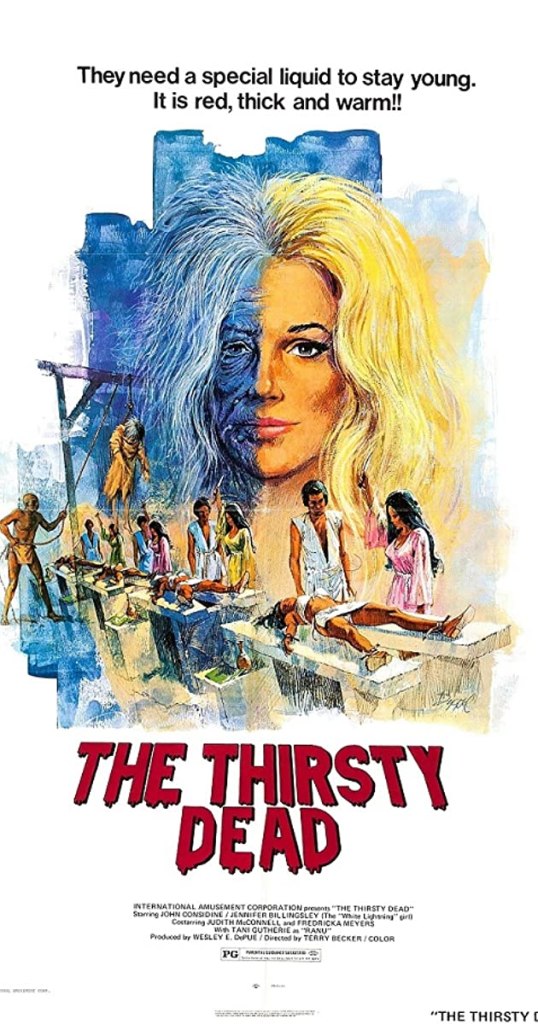
You’re on vacation in a tropical paradise.  (Maybe you’re even there on Spring Break, just so we can justify including this review in my series of Spring Break film reviews.)  One night, while wandering around the city, you get grabbed by a bunch of robe-wearing monks.  The monks proceed to tie you up and then force you to take a canoe ride from the sewer to the middle of the jungle.  Once you reach the jungle, you’re informed that you’ve been kidnapped by a cult that worships a shrunken head in a box.  The members of the cult have been around for centuries but they’ve managed to retain their youth by drinking the blood of the women who they kidnap off the streets of the city.  Like you, for example.

That would probably freak most people out.  That would certainly freak me out.  Not only do I not particularly care for the jungle but I’m also pretty attached to my blood.  However, when this exact same thing happens in the 1974 film The Thirsty Dead, no one seems to be particularly shocked to hear about it.  Instead, the kidnapped women all kind of shrug and accept their fate as if it all makes total sense.

In fact, Claire (Judith McConnell) appears to develop Stockholm Syndrome within record time.  She’s a dancer in Manila who, within hours of being kidnapped, is soon joking with her abductors.  She makes it clear that she’s apparently fine with being kidnapped and donating her blood to a good cause.  It’s never really clear why she’s okay with that but Claire is so determined to do what she wants to do (even if that means being subservient to a bunch of 100 year-old cultists) that it’s hard not admire her stubbornness.

On the other hand, Laura (Jennifer Billingsley) is determined to escape.  Even though the members of the cult believe that she’s the reincarnation of one of their goddesses, Laura wants to get back to civilization.  She thinks that one of the cultists, Baru (John Considine), might be willing to help her.  However, as Baru explains, if he goes too far into the jungle, he’ll lose his youth and basically just waste away.

(Just in case there’s any doubt on the part of anyone reading this review, the cult is right about the whole eternal youth thing.  One cultist makes the mistake of venturing too far out into the jungle and transforms from 49 to 50 right in front of our eyes!)

The Thirsty Dead is an odd film.  On the one hand, the first few minutes of the film is undeniably sordid.  Claire dances in a cage.  Laura gets knocked over the head by a cultist and ends up with her hands tied behind her back.  The camera lingers on a doll of a baby floating in a sewer.  When the women first find themselves in the jungle, Claire jokes about being sold into prostitution and the whole film, up until that point, has had a rather icky feel to it.  However, once the cult shows up, The Thirsty Dead suddenly becomes a rather tame film, one that’s almost totally free of graphic gore and sexual innuendo.  The Thirsty Dead ultimately feels less like a film and more like an extended episode of some 70s sci-fi show.  For a film about a blood-sucking cult, there’s surprisingly little blood.  It feels a bit off and, to be honest, it’s a little boring.  This is the type of film that calls out for a sleazier approach.

Despite being rather forgettable, The Thirsty Dead has achieved the dubious immortality of being included in several Mill Creek box sets, the ones with names like 100 Horror Classics or 50 Chilling Thrillers.  So, in all probability, you’ve got The Thirsty Dead on DVD or Blu-ray without even realizing it.  If you somehow don’t already have The Thirsty Dead in your film collection, you can always watch it on YouTube or Prime or probably a hundred other streaming sites.  The Thirsty Dead will never die.

Film Review: The Greatest Story Ever Told (dir by George Stevens)


The 1965 biblical epic, The Greatest Story Ever Told, tells the story of the life of Jesus, from the Nativity to the Ascension.  It’s probably the most complete telling of the story that you’ll ever find.  It’s hard to think of a single details that’s left out and, as a result, the film has a four hour running time.  Whether you’re a believer or not, that’s a really long time to watch a reverent film that doesn’t even feature the campy excesses of something like The Ten Commandments.

(There’s actually several different version of The Greatest Story Ever Told floating around.  There’s a version that’s a little over two hours.  There’s a version that’s close to four hours.  Reportedly, the uncut version of the film ran for four hour and 20 minutes.)

Max von Sydow plays Jesus.  On the one hand, that seems like that should work because Max von Sydow was a great actor who gave off an otherworldly air.  On the other hand, it totally doesn’t work because von Sydow gives an oddly detached performance.  The Greatest Story Ever Told was von Sydow’s first American film and, at no point, does he seem particularly happy about being involved with it.  von Sydow is a very cerebral and rather reserved Jesus, one who makes his points without a hint of passion or charisma.  When he’s being friendly, he offers up a half-smile.  When he has to rebuke his disciples for their doubt, he sounds more annoyed than anything else.  He’s Jesus if Jesus was a community college philosophy professor.

The rest of the huge cast is populated with familiar faces.  The Greatest Story Ever Told takes the all-star approach to heart and, as a result, even the minor roles are played by actors who will be familiar to anyone who has spent more than a few hours watching TCM.  Many of them are on screen for only a few seconds, which makes their presence all the more distracting.  Sidney Poitier shows up as Simon of Cyrene.  Pat Boone is an angel.  Roddy McDowall is Matthew and Sal Mineo is Uriah and John Wayne shows up as a centurion and delivers his one line in his trademark drawl.

A few of the actors do manage to stand out and make a good impression.  Telly Savalas is a credible Pilate, playing him as being neither smug nor overly sympathetic but instead as a bureaucrat who can’t understand why he’s being forced to deal with all of this.  Charlton Heston has just the right intensity for the role of John the Baptist while Jose Ferrer is properly sleazy as Herod.  In the role Judas, David McCallum looks at the world through suspicious eyes and does little to disguise his irritation with the rest of the world.  The Greatest Story Ever Told does not sentimentalize Judas or his role in Jesus’s arrest.  For the most part, he’s just a jerk.  Finally, it’s not exactly surprising when Donald Pleasence shows up as Satan but Pleasence still gives a properly evil performance, giving all of his lines a mocking and often sarcastic bite.

The Greatest Story Ever Told was directed by George Stevens, a legitimately great director who struggles to maintain any sort of narrative momentum in this film.  Watching The Greatest Story Ever Told, it occurred to me that the best biblical films are the ones like Ben-Hur and The Robe, which both largely keep Jesus off-screen and instead focus on how his life and teachings and the reports of his resurrection effected other people.  Stevens approaches the film’s subject with such reverence that the film becomes boring and that’s something that should never happen when you’re making a film set in Judea during the Roman era.

I do have to admit that, despite all of my criticism of the film, I do actually kind of like The Greatest Story Ever Told.  It’s just such a big production that it’s hard not to be a little awed by it all.  That huge cast may be distracting but it’s still a little bit fun to sit there and go, “There’s Shelley Winters!  There’s John Wayne!  There’s Robert Blake and Martin Landau!”  That said, as far as biblical films are concerned, you’re still better off sticking with Jesus Christ Superstar.

Sundance Film Review: Circle of Power (dir by Bobby Roth)


With the Sundance Film festival currently taking place in Utah, I am currently reviewing films that originally made a splash at the Sundance Film Festival!

(a.k.a. Circle of Power, Mystique, Naked Weekend, and probably a handful of other titles)

The Sundance Film Festival wasn’t always the Sundance Film Festival.

Up until 1984, it was known as the US Film Festival.  Because of the involvement of Robert Redford, it was something of a big deal but still nowhere as big a deal as it is today.  In fact, many of the films that were showcased and celebrated at the US Film Festival have slipped into obscurity.  While winning an award at the US Film Festival may have been nice a ego boost for an independent filmmaker, it certainly didn’t bring a film anywhere near the amount of attention that winning at Sundance does now.

Take the long and strange saga of Circle of Power, for instance.

From my own research, it appears that Circle of Power was originally filmed in 1980.  At that time, it was called Mystique.  It premiered at the Chicago International Film Festival in 1981.  A year later, under the title Circle of Power, it played at the US Film Festival.  It was awarded the Dramatic prize (which was the forerunner for Sundance’s Grand Jury Prize).

After that, it still took Circle of Power two years to achieve national distribution.  In 1984, when it was reviewed by Roger Ebert, the film had been released as Naked Weekend, a title that was as commercial as it was misleading.  (There is nudity in the film but probably not the type of nudity that Naked Weekend‘s audience was expecting.)  By the time the film was finally released on VHS, it had picked up yet another title: Brainwash.

That’s the poster for Brainwash at the top of this video.  There are two images on that poster.  One is of a woman holding a riding crop and showing off her bra.  The other is of a naked man in a cage.  Only the latter image actually appears in the movie.

The film’s distributors were obviously trying to sell Circle of Power as an exploitation film.  Actually, it’s not.  It’s … well, it’s hard to describe what exactly it is.  It starts out with a title card, informing us that what we’re about to see is based on a true story.  The rest of the film deals with a group of executives and their wives who are required to spend the weekend attending a “training course” at a beautiful hotel.  The weekend gets off to a good start, with lots of dancing and laughing.  Of course, none of the executives seem to notice that the hotel staff is watching them with a mix of scorn and pity.

(The film continually contrasts the privileged white executives with the largely black and Hispanic hotel staff.)

Before the training sessions begin, all of the executives and their wives are forced to sign a paper that states they understand that they will be psychologically and physically abused over the weekend.  Only one executive objects and he is quickly bullied into signing by his co-workers.  Apparently, they can’t do the training unless everyone agrees to sign.

The men and the women are separated.  (Interestingly, all of the executives are men.)  The men are “trained” by Bianca Ray (Yvete Mimieux, who is chilling in her final performance to date) while the women are left with Jordan Carelli (John Considine).  The training turns out to be a combination of ego stripping and physical abuse.  One overweight executive (Walter Olkewicz) is ordered to strip naked and is then locked in a cage, where food is dumped on him.  An alcoholic is forced to lay down in a coffin.  Soon, everyone is covered in bruises.  What’s remarkable is that only one executive and his wife actually seems to find any of this to be objectionable.  In fact, everyone else reacts to the abuse by hugging their abusers and crying for joy.

It’s a strange little film, one that often seems to be unsure of what it’s saying but which, at the same time, still possesses an undeniable power.  The film may be 38 years old but brainwashing is a timeless subject.  One need only spend an hour or two on twitter to see how easily people can be brainwashed.  While the film probably disappointed those seeking a naked weekend, it’s still an undeniably watchable oddity.

Previous Sundance Film Reviews:

  1. Blood Simple
  2. I Don’t Feel At Home In This World Anymore

Embracing the Melodrama #31: When Time Ran Out (dir by James Goldstone)


If I had been alive in the 70s, I would have been terrified if I had ever found myself in the same general location of Paul Newman, William Holden, Ernest Borgnine, Red Buttons, Jacqueline Bisset, or Burgess Meredith.  Just based on the movies that they spent that decade appearing in, it would appear that disaster followed them everywhere.

Just consider:

Both Paul Newman and William Holden were trapped in The Towering Inferno. 

Ernest Borgnine and Red Buttons both ended up taking an unexpected Poseidon Adventure together.

Jacqueline Bisset was a flight attendant in the first Airport and nearly got killed by a mad bomber.

And finally, Burgess Meredith was a passenger on The Hindenburg.

Seriously, that’s a dangerously disaster-prone bunch of thespians!

So imagine how terrifying it must have been on the set of the 1980 film When Time Ran Out when all 6 of those actors — along with a lot of other disaster film veterans — were first gathered in one place.  People were probably running for their lives, both on-screen and off.

Lava3

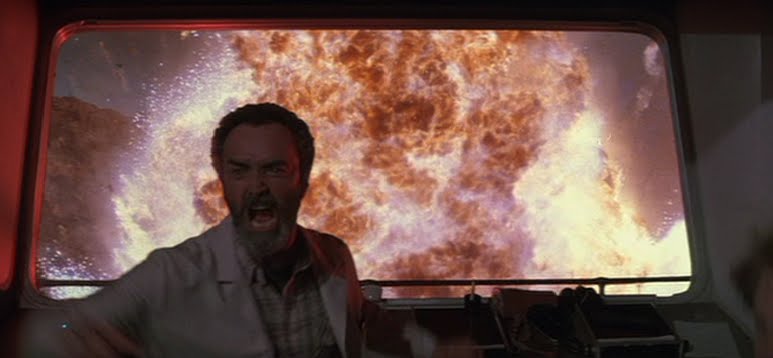
When Time Ran Out takes place on an island in the South Pacific.  Shelby Gilmore (William Holden, playing yet another ruthless but essentially good-hearted businessman) owns a luxury resort that happens to be sitting dangerously close to an active volcano.  Oil rigger Hank Anderson (Paul Newman) is convinced that the volcano is about to erupt but Shelby’s son-in-law, Bob Spangler (James Franciscus), refuses to listen and claims that even if the volcano does blow, the resort will be safe.

(As a sidenote, why were William Holden’s son-in-laws always too blame in disaster movies?  First, you had Richard Chamberlain in The Towering Inferno and now, it’s James Franciscus in When Time Ran Out…)

Suspended over a volcano

Suspended over a volcano

You can just look at the film’s title (When Time Ran Out!) and guess that Bob is probably wrong.  However, Bob has other things on his mind.  First off, he’s cheating on his neurotic wife (Veronica Hamel) with a native islander (Barbara Carrera) who happens to be married to the hotel’s general manager, Brian (Edward Albert).  Brian also happens to be Bob’s half-brother and is therefore owed at least half of Bob’s fortune but nobody but Bob realizes that.

And, of course, there are other colorful guests at the hotel who will soon find themselves either fleeing from or drowning in molten lava.  There’s a white-collar criminal (Red Buttons) who is being pursued by a detective from New York (Ernest Borgnine, of course).  There’s also two retired tightrope walkers (Burgess Meredith and Valentina Cortese) and you better believe that there’s going to be a scene where one of them is going to have to walk across a plank that happens to be suspended over a river a lava…

Told ya!

Told ya!

Eventually, that volcano does erupt and…well, let’s just say that When Time Ran Out is no Towering Inferno as far as the special effects are concerned.  The scene where one random fireball flies out of the volcano and heads for the resort is particularly amusing for all the wrong reasons.  Not only does the volcano apparently have perfect aim but it’s also painfully obvious that the fireball is streaking across a matte painting.  This is the type of film where, when people plunge into a river lava, they do so with heavy lines visible around their flailing bodies.  That, along with the cast’s obvious lack of interest in the material, adds up to make When Time Ran Out a film that is memorable for being so ultimately forgettable.

The Horror!

The Horror!

(It’s odd to consider that this film was directed by the same James Goldstone who directed such memorable films as Rollercoaster and Brother John.)

When Time Ran Out is something of a historical oddity because it was the last of the old 70s all-star disaster films.  (This may have been released in 1980 but it’s a 70s film through and through.)  The movie was such a monumental failure at the box office that it pretty much ended an era of disaster films.

For that reason, it also feels like an appropriate film with which to close out the 70s.  Tomorrow, we’ll continue to embrace the melodrama with the 1980s.

when time