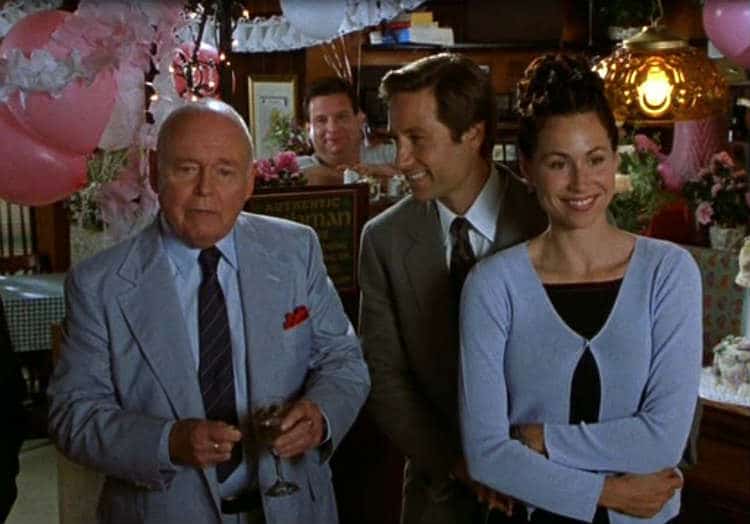
Brad reviews RETURN TO ME (2000), starring David Duchovny and Minnie Driver!


I’m a sucker for a good romance. Every year during tax season, I like to stream romantic films while I prepare my clients’ tax returns late into the evening. They make me feel good and help my mood as I work the necessary 80 to 90 hours every week leading up to April 15th. My list of favorites includes movies like HITCH (2005) with Will Smith, NOTTING HILL (1999) with Julia Roberts and Hugh Grant, and YOU’VE GOT MAIL (1998) with Tom Hanks and Meg Ryan. I also really enjoy the period romance movies based on the novels of Jane Austen, films like Ang Lee’s SENSE AND SENSIBILITY (1995) and the five-hour mini-series version of PRIDE AND PREJUDICE (1995) starring Colin Firth and Jennifer Ehle. There’s a decent chance that if you walk into my office at the end of one of these films you might even catch me wiping a tear from my eye as the obstacles finally clear, and we’re left with two people in love embarking on their specific “happily-ever-after” together. One such movie, that I don’t hear mentioned very often, but that I personally love, is the 2000 romantic film RETURN TO ME.

RETURN TO ME opens by introducing us to two families. First, we meet Bob Rueland (David Duchovny), a successful architect, and his wife Elizabeth (Joely Richardson), a kind-hearted zoologist, who are clearly very much in love. We follow the couple as they attend a fund-raising dinner that’s been organized to help expand the zoo’s gorilla habitat, a cause that’s very dear to Elizabeth’s heart, with Bob volunteering his own time and talents to design the new facility. The evening includes many sweet words and some quality slow dancing. Next, we meet Grace Briggs (Minnie Driver), who is very sick and in need of a heart transplant in the worst possible way. Her Catholic family and her friends, which includes her loving grandpa Marty O’Reilly (Carroll O’Connor) and her best friend Megan Dayton (Bonnie Hunt), are a wonderful support system, but without the new heart, she won’t be able to live much longer. On the same night that unspeakable tragedy strikes the Rueland’s on their way home from the fundraiser, Grace and her Grandpa’s prayers are answered when they get the call that a healthy heart is now available. A year later, Bob and Grace meet by chance at Marty’s business, O’Reilly’s Italian Restaurant. Bob has been a shell of the man he once was as he’s been unable to deal with his wife’s passing, while Grace has attempted to figure out life with her new heart. There’s just something about Grace though, so Bob asks her out and, after a series of sweet dates, it seems the two may be falling in love. But when Grace accidentally discovers that the heart that Bob is falling in love with was once beating inside the chest of his deceased wife Elizabeth, Grace doesn’t know how to tell him. Feeling guilty, as well as fearful of how Bob may respond to the shocking information, Grace decides she has no choice but to tell him. Will their blossoming love survive this unexpected and tragic revelation?

I love RETURN TO ME, and the main reason is that I love the characters, and especially the world that director Bonnie Hunt creates inside the film. The love story at the center is played well by Duchovny and Driver, but the greater love of family and friends is what sets this movie apart for me. In a way, Hunt creates a world that contains the kind of friends and family that we’d all love to have in real life. She does this by spending a lot of time with the entertaining supporting characters, showing them to be kind and decent people, the kind who make our lives valuable. As an example, O’Connor’s performance as the doting grandpa to Grace is wonderful, but we also get to see the interplay between Grace, Marty and their “family” at the restaurant, played by such great character actors as Robert Loggia, Eddie Jones, William Bronder and Marianne Muellerleile. Hunt herself is excellent in the role as Grace’s best friend Megan, but the time we spend with her blue-collar husband, played perfectly by James Belushi, and their kids are some of the best and funniest of the film. Based on the time and attention to these characters, as well as the time spent at “O’Reilly’s Italian Restaurant,” Hunt has created a scenario that feels like we’re watching real family and friends, in the best possible way. I never watch this film that I don’t want to go eat a big plate of spaghetti afterwards. The relationship between Bob and his best friend Charlie (David Alan Grier) isn’t quite as successful, but it has its moments as well.

RETURN TO ME is the kind of romantic film that we don’t get to see very often these days. A snarky, cynic would probably have a field day with this film, with its outrageous set-up, its old-fashioned values, and even older-fashioned characters. But that’s what I love about this film. As an example, this is the kind of movie where characters ask each other to pray, they do it, and the only purpose of it being shown is so we know how much these people care about each other. That feels very old-fashioned for 2025, but based on my own experiences in life, it’s something I can completely identify with.

Ultimately, RETURN TO ME is not a perfect film. Clocking in at almost 2 hours, there are definitely some scenes that could have been shortened or eliminated all-together. And it may seem like a criticism that I find the central love story of the film less appealing than the love shown by the main characters’ family and friends, but it’s really not. RETURN TO ME is a movie I return to every year because, at the end of the day, it’s an entertaining film that helps me appreciate the love of a family and the possibility that sometimes love is just meant to be.
Horror Review: Event Horizon (dir. by Paul W. S. Anderson)


“You know nothing. Hell is only a word. The reality is much, much worse.” — Dr. Weir

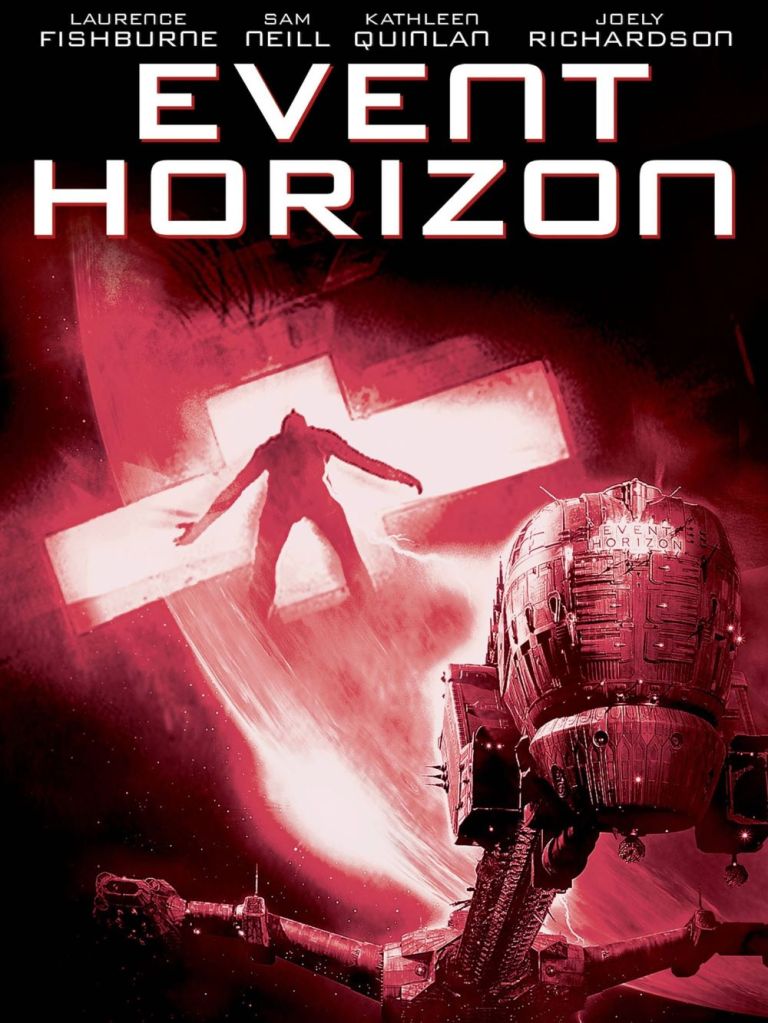
Paul W.S. Anderson’s 1997 film Event Horizon stands out as a memorable mix of science fiction and horror, remembered for its gripping atmosphere and disturbing visuals. The story is set in 2047: a rescue crew aboard the Lewis and Clark is sent out to recover the long-missing spaceship Event Horizon, a vessel built to test a new kind of faster-than-light travel. Onboard with them is Dr. William Weir, the Event Horizon’s creator, who explains that the ship vanished after first activating its “gravity drive,” which can fold space to allow for instant travel across vast cosmic distances.

Soon after reaching the drifting Event Horizon, the crew discovers signs of mass violence and horror. They recover a disturbing audio message and realize something traumatic happened to the original crew. As they search for survivors, they experience intense and personal hallucinations—memories and fears brought to life by the ship. It becomes clear that the Event Horizon didn’t just jump through space; it traveled to a place outside reality, a nightmarish interdimensional realm resembling hell.

What makes Event Horizon particularly unique is its concept of hell as an alternate dimension that can infect and corrupt whatever or whoever crosses into it. The ship’s gravity drive doesn’t simply facilitate faster travel—it accidentally opens a gateway to this chaotic, malevolent place. This portrayal of hell as a dangerous interdimensional reality that preys on minds and bodies echoes the idea found in the massive gaming property Warhammer 40K, where hell is depicted as the Warp, a dimension of chaos that corrupts and drives people insane. Like the Warp, the film’s hell is an unpredictable, hostile realm where sanity and physical form break down, infecting and warping everything that comes into contact.

Visually, the film relies on claustrophobic corridors, flickering lights, and unsettling sounds to keep the audience off-balance. The design of the ship itself—part gothic cathedral, part industrial nightmare—adds to the sense of unease and dread throughout. The use of practical effects and detailed sets grounds the sci-fi terror in something tangible, making it all feel more immediate and believable.

Event Horizon also hints at bigger philosophical questions: how far should science go, and what happens when the drive for knowledge is unchecked by ethics or humility? The gravity drive is a technological wonder, but it’s treated with little caution by its inventor, and the catastrophic results suggest that some discoveries may be better left unexplored. The ship becomes both a literal and figurative vehicle for exploring the limits of human ambition and the dangers of pushing beyond them.

As the movie builds toward its climax, the rescue crew faces increasingly desperate odds. The possessed Dr. Weir, now an outright villain, sees the hellish dimension the gravity drive visited as the next step for humanity—a place of chaos and suffering. Multiple characters die in gruesome ways, and the survivors have to fight their own fears and the haunted ship itself. The ending is chilling and ambiguous, leaving open the possibility that the ship’s evil has not been fully contained.

At release, Event Horizon divided critics and audiences. Some found the violence and nightmare imagery too intense or the story too messy to follow. Others praised its ambition and the way it blends psychological horror with cosmic sci-fi. Over the years, the film has developed a cult reputation, frequently cited as one of the more effective and original space horror movies. Its legacy can be seen in later media, especially in video games that tackle similar haunted spaceship scenarios.

However, the film is not without flaws. Many viewers and critics point out uneven pacing, especially in the second half where tension sometimes drains away. The characters often act inconsistently or make choices that feel unrealistic for trained astronauts, which undermines the suspense. The script’s tonal shifts—from serious psychological drama to moments that unintentionally verge on camp—can jolt the viewer out of the experience. The use of jump scares is sometimes predictable, and the film’s heavy reliance on loud, chaotic sequences instead of quiet suspense can feel overwhelming. Some CGI effects haven’t aged well, contrasting with the otherwise impressive practical effects and set design. Acting performances are mixed too; while Sam Neill and Laurence Fishburne are strong, some supporting cast members lack conviction, making emotional engagement uneven.

Importantly, Event Horizon represents Paul W.S. Anderson at his most subtle and effective in directing. Compared to many of his later films, where his style often becomes frenetic and unchecked—possibly due to a lack of producer control—Event Horizon is more controlled, atmospheric, and haunting. This balance between style and substance makes it one of Anderson’s better directorial works, if not his best to date. The film showcases his interest in spatial geography, the use of negative space, and claustrophobic production design, all elements he would expand on in his later work but never as effectively deployed as here. The haunting visual touches, combined with his ability to direct actors and maintain tension, set Event Horizon apart from his more bombastic, less focused later entries.

Despite its flaws, Event Horizon remains gripping and memorable. Its strengths lie in combining deeply personal psychological horror with the vast, terrifying unknown of space and alternate realities. The film explores not just external threats, but also how guilt, fear, and trauma can be weaponized by forces beyond human understanding. For viewers seeking more than a standard haunted spaceship story, Event Horizon offers a disturbing, thought-provoking glimpse into the dark frontier of science, faith, and madness. It stands as a cult classic of sci-fi horror that continues to inspire discussion about the dangers of pushing too far into the unknown.

Horror Film Review: Event Horizon (dir by Paul W. S. Anderson)


event_horizon_ver1

Event Horizon, a sci-fi/horror hybrid from 1997, is one of those films that starts out with a series of title cards:

“2015 First permanent colony established on moon.”

Wait … 2015?  How did I miss that?

” 2032 Commercial mining begins on Mars.”

Yay!  Only 16 more years to wait until we’re finally on Mars!

“2040 Deep space research vessel ‘Event Horizon’ launched to explore boundaries of Solar System. She disappears without trace beyond the eighth planet, Neptune. It is the worst space disaster on record.”

Wow, that sucks.  But things happen…

“2047 Now…”

Alright, let’s get this story going!

Seven years after it disappeared, the Event Horizon suddenly sends out a distress signal.  It turns out that it didn’t blow up like everyone assumed.  Instead, it’s still out in space.  The surly crew of the Lewis & Clark is called off of leave and sent on a rescue mission.  (And when I say surly, I do mean sur-ly!  Seriously, nobody on the Lewis & Clark is in a good mood … ever!)  Accompanying the crew is Dr. Weir (Sam Neill), the scientist who designed the Event Horizon.  Captain Miller (Laurence Fishburne) may not be happy about having Dr. Weir on his ship but, then again, Captain Miller always seems to be annoyed about something.

The Event Horizon appears to be deserted.  The walls are covered with blood.  The captain — at least it appears to be the captain — has been crucified and left on display.  Dr. Weir explains that the Event Horizon was designed to create an artificial black hole and it’s possible that the ship went into another dimension and that it may have brought something back with it.  Other crew members speculate that the Event Horizon may have accidentally been transported to Hell.  Either way, it’s not a good thing but, after the Lewis & Clark suffers some damage, the crew find themselves stranded on the Event Horizon.

Soon, the crew members are having hallucinations.  The ship’s doctor (Kathleen Quinlan) sees her son running through the ship.  Captain Miller sees the burning corpse of a friend that he had to abandon during a previous mission.  Another crewman appears to be possessed and attempts to commit suicide by opening up the airlock.  Dr. Weir has visions of his dead wife.  Things get darker and darker.  People die.  Eyes are ripped out of sockets.  A video of the original crew is found and it’s like something out of a painting by Hieronymus Bosch.  Miller wants to blow up the Event Horizon.  Dr. Weir replies, “We are home!”

Agck!

Seriously, Event Horizon is a curious film.  I’ve seen it a few times and I have to admit that it’s never quite as good as I remembered.  If you want to get really technical about it, Event Horizon is a poorly paced film that is overly derivative of the Alien franchise and it features perhaps the worst performance of Laurence Fishburne’s career.

(Yes, even worse than his performance in Contagion…)

But, at the same time, even if I’m always somewhat disappointed with the film, Event Horizon is also a movie that stays with you.  Whatever flaws the film may have, it is genuinely scary and disturbing.  Director Paul W.S. Anderson does a good job of turning that spaceship into the ultimate floating haunted house and, even more importantly, he keeps you off-balance.  This is one of the few horror films where literally anyone can die, regardless of whether they’re top-billed or have an Oscar nomination to their name.  Whatever the evil is that has possessed the Event Horizon, it is ruthlessly and sadistically efficient.

Plus, there’s that video.  If you’ve seen the movie, you know what I’m talking about.  Anderson has complained that the studio made him cut a lot of footage out of the video but what remains is disturbing enough.  Seriously, you’ll never want to hear another Latin phrase after watching Event Horizon.

Film Review: Maggie (dir by Henry Hobson)


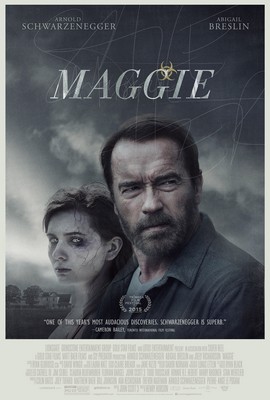
Maggie_(film)_POSTERMaggie is a terrific and sad film about a father who finds himself helpless as his teenage daughter slowly dies.  It’s a thoughtful and heart-rendering film and it’s one of the best of the year so far.  Unfortunately, you wouldn’t necessarily know that from looking at some of the reviews.

Of course, there’s nothing new about a good film getting bad reviews.  I’m actually surprised that anyone even bothers with reviewers anymore, considering just how often they get things wrong.  There are any number of reasons why good films get dismissed.  Some movies are genuinely ahead of their time.  Some critics prefer to judge based on genre than by what they actually see on screen.  Occasionally, a critic feels obligated to like or dislike a movie based on the politics or culture of the moment.  The fact of the matter is that most film critics like to feel important and the easiest way to feel important is to hop onto a bandwagon with all of the other critics.

So, what’s the excuse as far as Maggie is concerned?  Why does Maggie, one of the best films of the year so far, only have a rating of 51% on rotten tomatoes?  In Maggie‘s case, it’s a combination of genre (Maggie is a zombie film and there’s a lot of critics who still feel guilty over liking The Walking Dead) and star.  Maggie has been promoted as being an Arnold Schwarzenegger film, even though his role is essentially a supporting one.  The majority of critics have been willing to admit that Schwarzenegger gives a good performance but they always have to qualify the praise.  As a result, you have critics at both Hitflix and the A.V. Club writing that Schwarzenegger’s performance works because his character is designed to take advantage of Schwarzenegger’s limitations as an actor, as if all good performances aren’t, to some degree, the result of good casting.  In order to make up for praising Schwarzenegger (who is not only an action star but a Republican as well, which is a combination that many reviewers — especially those who work exclusively online — will never be able to see beyond), many critics undoubtedly feel obligated to be overly critical of Maggie.

(What does that 51% mean anyway?  That Maggie is 51% good?)

Maggie_1

As for the film itself, it tells a simple story, one to which a lot of people will undoubtedly relate.  As the film opens, we learn that the zombie apocalypse has already begun.  The world has been hit by a virus.  The infection spreads slowly, forcing the victims and their loved ones to watch as the infected are gradually transformed into mindless and cannibalistic zombies.  However, the U.S. government has reacted with swift and ruthless efficiency.  Martial law has been imposed.  The infected are allowed to say with family up until the disease enters its final stages.  At that point, they’re taken into quarantine and are euthanized.  Though we never actually see a quarantine center, we hear enough about it to know that there is nothing humane about it.  (Indeed, one reason why Maggie is so effective is because we know that the real-life government would probably be even less humane than the film’s government.)  Society has contained the plague but it’s done so at the cost of its own humanity.

College student Maggie (Abigail Breslin) has been infected.  She was bitten by  a zombie and, as a result, she now has a grotesque black wound on her arm.  As the virus moves through her body, her eyes grow opaque.  Her veins blacken.  When she breaks a now dead finger, she reacts by chopping it off with a kitchen knife.  As there is no cure, all Maggie can do now is wait until she is sent to quarantine.

Her father, a farmer named Wade (Schwarzenegger), brings Maggie back to his farm with him so that he can take care of her during her final days.  Wade knows what quarantine is like and he has no intention of forcing his daughter to go through that.  With government doctors and police officers constantly and, in some cases, forcefully demanding the he give her up, Wade protects Maggie as best he can.  He sleeps with a rifle at his side, knowing that eventually he’s going to have to use it on his own daughter.

And I’m crying again.  Between this review and the one I did for Terms of Endearment, my face is going to be a mascara-smeared mess.

arnie-crying-e1427327024932

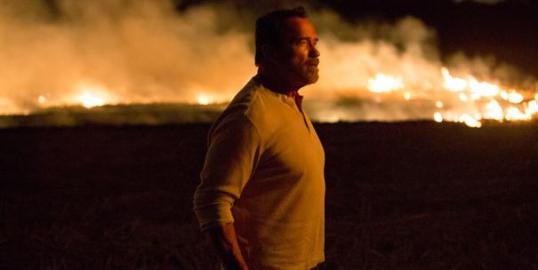
Maggie is a low-key and thoughtful film, a meditation on life, love, family, and death.  Though the film does feature Schwarzenegger fighting zombies, most of the action happens off-screen.  Instead, we just see the haunting aftermath.  Schwarzenegger doesn’t deliver any one liners in this film and the film deliberately plays down his action hero past.  He’s still got the huge body and the muscles but, in Maggie, they’re not intimidating.  Instead, they’re evidence that Wade has spent his life working the land and they actually emphasize just how helpless Wade is in the face of Maggie’s disease.  Director Henry Hobson makes good use of Schwarzenegger’s heavily-lined and weather-beaten face.  His sad and suspicious eyes communicate everything that we need to know.  When he cries, you don’t consider that you’ve never seen him cry before.  Instead, the moment captures you because the tears and the emotions behind them are real.

Breslin

But really, the film ultimately belongs to Abigail Breslin.  It’s appropriate that the film is named after her character because the film really is her story.  Maggie is about how she deals with knowing that she’s going to die and how she searches for meaning in her final days.  It’s a good and heartfelt performance, one that reminded me of Brigitte LaHaie’s poignant work in Jean Rollin’s Night of the Hunted.

So, ignore the critics.

Ignore that stupid 51% on Rotten Tomatoes.

See Maggie.

Arnold-Schwarzenegger-in-Maggie


Film Review: Endless Love (dir by Shana Feste)


EDL_31_5_Promo_4C_2F.indd

Oh, what a disappointing film this turned out to be!

When the trailer for Endless Love came out way back in the closing days of 2013, both me and my BFF Evelyn were seriously excited about seeing it.  The trailer was great!  It featured Florence + The Machine!  The movie looked hot and sexy and fun and…

Well, let’s just rewatch the trailer, shall we?

Here’s the thing:  Sometimes, trailers lie.

I saw Endless Love when it was originally released in February but I didn’t review it.  I meant to review it but somehow I never got around to doing so.  And, unfortunately, the film itself was so bland and forgettable that I actually struggled to think of anything to say about it.  Some movies make you laugh.  Some movies make you cry.  Some movies make you mad.  And some movies are just there.

Endless Love is a just there type of movie.

That said, when I saw that Endless Love would be making its cable debut on Cinemax on Saturday night, I decided to give it a second chance.  “Who knows?” I thought to myself, “Maybe I just went into the film with unrealistic expectations.  Maybe I was just in a bitchy mood when I saw it.  Maybe, on a second viewing, I’ll discover that Endless Love works on a purely emotional level…”

No such luck!  Having watched Endless Love a second time, I can now actually remember enough about the film to finally get around to writing a review.  However, I have also now been reminded why I didn’t care much about the film the first time I saw it.

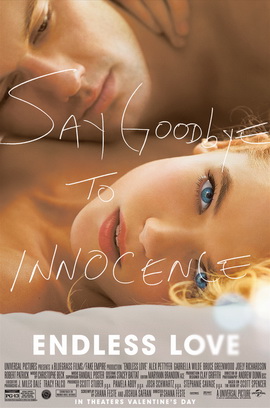
Endless Love is essentially a collection of generically pretty scenes that all feature pretty performers thinking about love, talking about, and making love.  Recent high school graduates David (Alex Pettyfer) and Jade (Gabriella Wilde) start going out.  Jade comes from a wealthy family.  David does not.  Jade’s overly protective father, Hugh (Bruce Greenwood), does not approve of the relationship because Jade has an ivy league future ahead of her while David has no plans to attend college at all.  Jade becomes more rebellious.  David lectures Hugh on the fact that nothing is more important than love.  Hugh takes out a restraining order against David.  Jade goes off to college.  David tries to secretly see her.  And, of course, there’s a fire.

(Though, unlike in the original Endless Love, the fire is not deliberately set.  This is Endless Love  reimagined as a Nicholas Sparks novel.)

And who really cares?

The problem with Endless Love is that we’re supposed to care about David and Jade and we’re supposed love how obsessed they are with each other but David and Jade are two of the most boring people ever so who cares?  Alex Pettyfer is nice to look at.  Gabriella Wilde is pretty.  But, as a couple, they have next to no chemistry.  Instead, they come across like one of those vapid couples that my boyfriend and I always worry we’re going to end up getting trapped in an endless conversation with.

(“How did you two meet?  Wait, before you start — let me tell you how we met… It’s a great story…you guys are going to love this…we were both attending kindergarten on a dance scholarship but the ballet kids all hated the ballroom kids.  Then they moved to Iceland and I asked my dad if we could move to Greenland and then…”)

And again, this just shows the power of a good trailer.  Watching the trailer, you would never guess how boring David and Jade truly are.  Incidentally, the best parts of the trailer are all taken from a “David and Jade dating” montage that occurs about halfway through the film.  As such, the scenes that made me want to see Endless Love pretty much just serve as filler in the actual film.

Also, Florence + The Machine are nowhere to be heard in the actual film.  And their haunting, atmospheric music would have been out of place anyway.  Florence + The Machine embraces the power of ambiguity and Endless Love takes place in a world where there is no ambiguity.

However, there is a lot of blue.

Seriously!  (And yes, I do realize that there’s a typo in my tweet but everyone is allowed to be illiterate on twitter so get off my back.)  This movie opens with a high school graduation where everyone is wearing a blue robe and the entire cast is so oppressively cheerful and overwhelmingly pleasant-looking that I briefly wondered if they were supposed to be a graduating class or a cult.  Later on, David works at a valet at a country club and, of course, he wears a blue shirt.  Everyone who belongs to the club also appears to be wearing a blue shirt, except that it’s a lighter shade of blue than David’s blue.  It’s just odd-looking and reinforces the feeling that Endless Love is less a movie and more a collection of commercial outtakes.

Endless Love, of course, is a remake of a film from the early 80s.  The first Endless Love isn’t very good but it’s at least a lot of unintentional fun!  And you can read my review of it (and even watch the film!) by clicking here.

What If Lisa Marie Was In Charge of the Golden Raspberry Awards


If you’re following the Awards ceremony, you know that two major events are coming up next week.  On Tuesday, the Oscar nominations will be announced.  But before that, on Monday, the Golden Raspberry Award nominations will be announced.  For 32 years, the Golden Raspberries have been honoring the worst films of the year and they’ve always served as a nice counterpoint to the self-congratulatory nature of the Academy Awards.

Now, on Monday night, I’ll be posting what I would nominate if I was in charge of the Oscars but first, I’d like to show you what I’d nominate if I was solely responsible for making the Golden Raspberry nominations.

Now before anyone leaves me any pissy comments, these are not predictions.  I know that these are not the actual nominations.  I know that the actual Golden Raspberry nominations will probably look a lot different.  These are just my individual picks.

(My “winners” are listed in bold print.)

Worst Picture

Anonymous

The Conspirator

Dylan Dog: Dead of Night

The Rum Diary

Straw Dogs

Worst Actor

Daniel Craig in Dream House, Cowboys and Aliens, and The Girl With The Dragon Tattoo

Aaron Eckhardt in Battle: Los Angeles

James Marsden in Straw Dogs

James McAvoy in The Conspirator

Brandon Routh in Dylan Dog: Dead of Night

Worst Actress

Kate Bosworth in Straw Dogs

Anita Briem in Dylan Dog: Dead of Night

Claire Foy in Season of the Witch

Brit Marling in Another Earth

Sara Paxton in Shark Night: 3-D

Worst Supporting Actor

Paul Giamatti in The Ides of March

Mel Gibson (as the Beaver) in The Beaver

Sir Derek Jacobi in Anonymous

Giovanni Ribisi in The Rum Diary

James Woods in Straw Dogs

Worst Supporting Actress

Jennifer Ehle in Contagion

Amber Heard in The Rum Diary

Willa Holland in Straw Dogs

Vanessa Redgrave in Anonymous

Oliva Wilde in Cowboys and Aliens

Worst Director

Roland Emmerich for Anonymous

Rod Lurie for Straw Dogs

Kevin Munroe for Dylan Dog: Dead of Night

Robert Redford for The Conspirator

Bruce Robinson for The Rum Diary

Worst Screenplay

Anonymous, written by John Orloff.

Another Earth, written by Mike Cahill and Brit Marling

The Beaver, written by Kyle Killen

Dylan Dog: Dead of Night, written by Thomas Dean Donnelly and Joshua Oppenheimer.

Straw Dogs, written by Rod Lurie.

(That’s right, it’s a tie.)

Worst Screen Couple 

Rhys Ifans and Joeley Richardson in Anonymous

Rhys Ifans and Vanessa Redgrave in Anonymous

Brit Marling and any breathing creature in Another Earth

Mel Gibson and The Beaver in The Beaver

James Marsden and Kate Bosworth in Straw Dogs

Worst Prequel, Sequel, or Remake

Arthur

The Girl With The Dragon Tattoo

Scream 4

Straw Dogs

Transformers 3

The Girl With The Dragon Tattoo (dir. David Fincher)


I’ve probably gone back and rewritten this review multiple times over the past few hours. I’ve been struggling to come to a final conclusion to how I felt about the film. On one hand it is a hollow crime thriller, all polish and no substance, and on the other it is an exceptionally crafted dark and mysterious tale of sex, corruption and murder that oozes with atmosphere. One could make the case for either, and many critics have argued in favor of one side or the other. After a lot of contemplation, I’ve come to decide that it actually seems to rely on both being hollow and atmospheric, but what continues to conflict me is whether the former can truly be overlooked even if crucial to the final product.

‘The Girl With The Dragon Tattoo’ stars Daniel Craig as Mikael Blomkvist, a journalist who has recently come under a lot of scrutiny after being accused of making up a story about a wealthy executive and losing the case of libel brought upon him. Facing financial and credibility problems he is hired by Henrik Vanger (Christopher Plummer) a wealthy entrepreneur  who wants Mikael to solve a ‘cold case’ that has haunted him for forty years, that being the disappearance of his grand-niece Harriet who he believes was murdered by a member of his corrupt family filled with Nazis and recluses. As Mikael delves deeper into the mystery of her disappearance he hires the assistance of Lisbeth Salander, a goth-hacker with a dark past who has her own personal issues to deal with, specifically a financial guardian who wants sexual favors in order for her to access her money. When they are finally brought together they discover the dark secrets of the Vanger family and its links to a serial murderer case that begins to threaten their own lives.

David Fincher, who directed ‘Zodiac’ and ‘Se7en’, is no stranger to graphic and dark thrillers so it is no surprise that he handles the creation of ‘The Girl With The Dragon Tattoo’ with a level of competence few other directors could have. Along with the help of cinematographer Jeff Cronenweth and being set in Sweden the film has a very dark and cold (often literally) tone, making an atmosphere just as chilling as the subject matter and beautiful to look at. Sadly under the gorgeous and dark visuals and the bleak and mysterious atmosphere there isn’t much to be had. There is a real lack of emotion and soul.

I can only assume that Fincher’s intentions from the beginning were to avoid any real substance, and to make a film just as hollow and sadistic as the story is was trying to tell. There is just about no emotion and so no reason to be attached to anyone except Lisbeth, but our empathy for her stems more from the vial acts we see acted upon her and less from truly knowing who she is, and why she is so emotionally restrained. It is not until the last twenty minutes that she gets any sort of development, but was it too little too late? Again I cannot decide. One could argue that this insight into the character earlier on would have made us care for her more, which I can understand. But I also question whether or not she could have even opened up the way she does at the end without having first gone through the events of the film, in particular the relationship she has with Mikael. Either way, I’m just glad Fincher went with Rooney Mara to play Lisbeth.

It is hard not to compare both film versions of the Lisbeth character, and even harder to choose which was better. This is mainly because both films, although similar in many ways, have very different tones. The Swedish version is a much more straight forward thriller and Rapace’s Lisbeth fits that film in being just a strong and tough individual, though there doesn’t seem to be too much below her surface and most of the development of her past is shown. Mara’s Lisbeth is a much more complex character, and although the film doesn’t give her much depth in terms of story until the very end, Mara gives off hints of a disturbing past just in the way she talks and moves, especially when men get too close to her. In reality she is a much weaker character than in the Swedish version. I personally liked that soft side because it makes her feel more like a vulnerable woman so when she fights back it feels more powerful.

It is this humanization that really helps propel Fincher’s adaptation over the Swedish version in my eyes. Even Daniel Craig, who put on a very good performance, is given a lot more to do and a much more interesting personality. He gives the character a bit of charisma, and wasn’t just a monotonous individual, like in the original, making it easier for us to care for both him and Lisbeth. It also makes their odd but provocative relationship seem more genuine and intimate.

All of this stuff I loved…but then I fall back to feeling like it was all for nothing. I mean it looks pretty, and the mystery is intriguing and the atmosphere is dark and cool, but once it is all over nothing really sticks other than the technical aspects. This isn’t helped by the fact that it over stays its welcome for the last few minutes, even if it adds to the characters. Luckily the pacing is done well enough to never make it feel boring but it does end up being rather anti-climactic. But I feel a second viewing is necessary.

With that said, as conflicted I am about everything else one thing that I can say for certain was fantastic is the score. It was crucial in the creation of the moody and dark atmosphere. Trent Reznor and Atticus Ross, who did the Oscar winning score for ‘The Social Network’, continue to impress and help give the film a pounding and chilling heartbeat. Also the ‘Bondesque’ opening credits, a brilliant animation of dark tar, leather and gothic imagery set to Karen O’s cover of Led Zeppelin’s ‘Immigrant Song’, was absolutely stunning.

So overall I will say that it is an incredibly well-crafted and dark thriller with fantastic visuals and a wonderful performance by Rooney Mara and because of that it certainly deserves a lot of credit but below the surface it is a rather hollow and anti-climactic story making it hard for me to love it as much as I might have wanted to. It also did not help that going into it my anticipation was at an all-time low due to the hype that was built up around it and by how much I liked the original. So for now I’ll just say I enjoyed it for what it was, it certainly is well crafted enough to deserves the praise it is getting, but a second viewing will determine whether or not I truly thought it was a great film. Still I recommend it for those interested.

Quick Review: The Girl With The Dragon Tattoo (dir. by David Fincher)


Addendum: Leonth3duke has added his own thoughts on The Girl With The Dragon Tattoo, which are worth reading. Lisa Marie has also added her own viewpoint on the film.

I think had I not seen the Swedish version of The Girl With The Dragon Tattoo, this would be a far easier review to write, really. I tried reading the book a number of times, and found it really tough with Larsson’s exposition to stay with it. As such, this review is somewhat biased, perhaps heavily so, and it may be a little spoiler-ish. My assumption here is that with the novel having been available for some time now, and a separate movie to watch, there are very few people who don’t know what the story’s about.

A funny thing happened while watching David Fincher’s The Girl With The Dragon Tattoo the other night.  In the middle of the film, the projector turned off. After I calmed down, eyeing the exits and thinking the Blob might have made it’s way into my theatre, the audience had fifteen minutes of quiet to wait and give their thoughts on the movie.

One fellow stepped down from the seats, ready to ask for his money back when he stopped and turned around.

“Does anyone know what the F this movie is about? ‘Cause I’m frickin’ confused!” he raised his arms to the audience, pleading for reason.

“It’s about a girl with a Dragon Tattoo.”, Someone yelled back.

“What is supposed to mean!?” The angry man replied, sounding a lot like Rooney Mara in The Social Network. “All I’ve seen is Bond shiver his butt off and this chick type away on her laptop. This is garbage.” And with that, he left.”

“Yeah, this is some bulls—.”, Another fellow said as he left.

Needless to say, the movie resumed. There was a problem that caused their fire alarm to shut off and it stopped every film in the theatre. I’m not sure how much I may have missed, but I’ll probably see this again during the weekend.  I know, it’s not the best of review lead ins.

The simplest thing I can say about The Girl With the Dragon Tattoo is this:

– If you read the book and saw the Swedish film, this version only puts on a coat of Fincher Paint on the story. From the opening credits that rival the one in Se7en to the fade to black, it’s all distinctly Fincher’s touch on things.  You could almost argue that it feels like a Bond film, the way they did it. This basically means that the lighting might be dimmer in some places and the film may be more stylized. It comes across feeling more like a motion picture than the Swedish version, which to me felt a little more like a tv movie.

If you never read the book, I would highly recommend the Swedish version first. It’s on Netflix, and as some of the material is delicate, doing so would give you the freedom to hit the pause or fast forward button should you find yourself uncomfortable. That’s kind of hard to do in a movie theatre without walking out on the money you spent on a movie ticket.

And if you saw the Swedish Version, missed the book and are wondering if you should spend your money on this, Rooney Mara really is the only reason to give this a try. It’s essentially the same story, but with a different ending that’s tighter and closer to the book than the Swedish Film. While Rooney’s Salander may not be hard hitting as Noomi Rapace’s Salander , she deserves so much credit for throwing herself into this as deep as she did, and helping to create her own version of Lisbeth.  Daniel Craig, on the other hand, seems to be more restrained here.

The Girl With the Dragon Tattoo is the story of Mikael Blomkvist, an editor in chief of a magazine called Millenium in Sweden who is dealing with a mishap on a libel case against a magnate named Hans-Erik Wennerstrom. His recent notoriety catches the attention of Henrik Vanger (Christopher Plummer, who’s really having a great year), who asks him to investigate the 40 year old murder of his niece, Harriet. Of course, prior to asking Blomkvist to take on the case, Vanger’s lawyers perform a background check on him with the help of Lisbeth Salander (Rooney Mara). Salander happens to be both an ace Hacker and sports a photographic memory, which makes snooping into Blomkvist’s files a cinch.

Eventually, through his investigation of the Vanger Family on their private island, it becomes apparent that Blomkvist needs a little assistance, so he asks the lawyers if Salander can be brought on to work with him. It’s when the two characters meet that the story really picks up some steam.

While I loved it (I’m going back to see it again over the weekend, I think), there was the odd feeling that something was really off. At one point in the film, I find myself quirking my brow, because it occurred to me that there was just a little too much sex in the movie. I understand that’s not something one should complain about, but the Swedish version of the film led me to believe that Salander’s motives for any kind of passion were just a “want, need, have” and move on. In this version, she came across almost needy. It’s not even the right word. Where Rapace’s Salander felt cold and calculating even though the later parts of the story, Mara’s Salander feels like she’s warming up to Blomkvist emotionally. Of course, this could be attributed to screenwriter Steven Zaillian (Schindler’s List, Searching for Bobby Fischer) playing the story closer to the book than the other film, but it was strange for me in that sense. Fincher, who is notorious for control over his scenes may also be to blame here. If you have access to the behind the scenes for The Social Network, you can watch some of his interviews on the behind the scenes to get an idea of just how much he likes to control where a scene goes.

I don’t hate Fincher. I own Se7en, Fight Club and The Social Network and love all three of these, but even I have to admit that as cool and as stylish as the film is, something’s just off. I loved the film, but it’s just different.

The movie was advertised as the ‘feel bad film of the year’, and in that sense, they’re not lying. Keep the kids home, please. All three versions of the story contained a rape scene. Fincher and Co. Don’t pull any punches here, making it all a little disturbing for anyone not actually prepared for it. One standout to the film has to be the score, developed by Oscar Winners Trent Reznor and Atticus Ross (something I’ll never be fully able to handle saying, having been a Nine Inch Nails fan since the mid ‘90s). The movie has no clear-cut theme to it, but the music that fuels the scene add an extra layer to things. That I really enjoyed.

So, overall, the remake didn’t really need to be made, but it does make me interested to see what Fincher and Zaillian have in store if they decide to continue the Millenium Trilogy. My hopes are that they give Lisbeth Salander a bit of a sharper edge than she already has. Mara herself, they don’t have to worry about. She’s a definite lock as Salander, and I’m happy for her on that. It’s where they choose to take her that I’m concerned about.