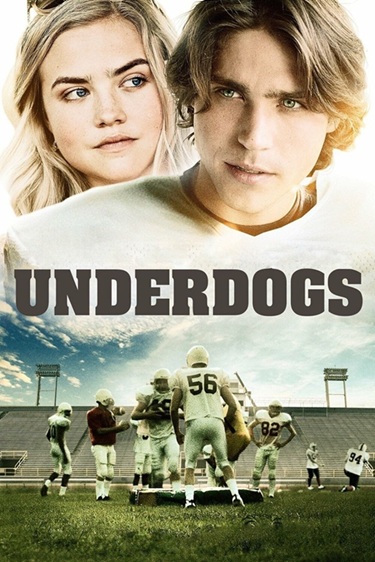
So, I Watched Underdogs (2013, Dir. by Doug Dearth)


In a rural Ohio, a working class high school football teams plays an exhibition game against the rich school on the other side of town.  The working class team is coached by Vince DeAntonio (D.B. Sweeney), a former NFL offensive coordination and the son of a coach.  Vince is a tough taskmaster who tells his players that winning is not going to easy and it’s not going to be fun but he also has the connections necessary to get Joe Namath to stumble into the locker room and give a speech to his team.  The quarterback (Charlie Carver) of the rich high school is the son of the businessman (Richard Portnow) who is planning on moving his factory down to Mexico and putting the entire town out of work.  The quarterback (Logan Huffman) of the working class high school team is the son of an inventor (Willlam Mapother) who is being sued by a corporation that wants to steal his invention.  Both of the quarterbacks like the same cheerleader (Maddie Hasson).  This game is about more than just who scores the winning touchdown.  It’s about town pride.

I love a good underdog story but Underdogs didn’t seem to know what story it wanted to tell.  It spent as much time with the inventor and his court case as it did with the football team and the whole thing ended up becoming a commercial for his product.  (The movie is based on a true story.)  When it actually did get around to the football scenes, it was all too predictable.  The team was bad and then the team was good and the entire game came down to one final throw of the football with the clock counting down.  One weird thing about the movie is that it put a lot of emphasis on Vince recruiting unlikely players to his team but once he had them on the team, we hardly ever saw them again.

At least the movie’s heart was in the right place and it didn’t turn the cheerleaders into stereotypes, like so many high school football movies do.  D.B. Sweeney was okay as the coach but I don’t know if William Mapother’s character was supposed to come across as being as strange as he did.  I’m glad the underdogs proved themselves but the movie could have been better.
Retro Television Review: The Love Boat 4.27 “Maid for Each Other/Lost and Found/Then There Were Two”


Welcome to Retro Television Reviews, a feature where we review some of our favorite and least favorite shows of the past!  On Wednesdays, I will be reviewing the original Love Boat, which aired on ABC from 1977 to 1986!  The series can be streamed on Paramount Plus!

This week, a baby is abandoned, an aunt visits, and for some reason, Joe Namath is on the boat.

Episode 4.27 “Maid for Each Other/Lost and Found/Then There Were Two”

(Dir by Howard Morris, originally aired on May 9th, 1981)

Ted Harper (Joe Namath) boards the boat with his best friend, Richard Henderson (Fred Willard).  Ted and Richard were fraternity brothers.  While in college, the members of the frat decided that, whenever one of them got married, some money would be contributed to a pot.  The last single member of the frat would end up getting all of the cash, which is now up to $60,000.  Ted and Richard are the last two single members of the frat and they’re competing to see who can hold out the longest.

(Can we just agree that guys are weird?)

Ted has a plan to get the money. He’s gotten his ex-girlfriend, Paula (Karen Grassle), to agree to trick Richard into falling in love with and marrying her, in exchange for some of the money.  However, Richard is smarter than Ted realizes and instead offers Paula even more of the money to get Ted to marry her.  However, Karen falls for Ted for real.  Karen and Ted do get married when the ship docks in Mexico.  When Richard announces that he paid Karen to marry Ted, Ted is hurt at first but then he realizes that he was willing to do the same thing to Richard and nothing matters more than love.  Awwww!

Now, it may seem strange to cast Joe Namath and Fred Willard as friends.  To me, it’s even stranger that this was not the first time that Joe Namath, who was not much of actor, appeared on The Love Boat.  Just as he did the last time he was on the boat (and also just as he did when he last visited Fantasy Island), Namath wanders through the story with a goofy grin on his face.

Speaking of goofy, Gopher is super-excited when his wealthy aunt Loretta (Jane Powell) boards the boat.  Loretta, however, is scared to tell Gopher that she has lost all of her money and is now working as a maid.  Loretta need not have worried.  I mean, it’s not as if Gopher has a particularly glamorous job.  Plus, Loretta’s not going to be poor for long, not after she meets and falls in love with wealthy Duncan Harlow (Howard Keel).

Finally, Eddie Martin (Gary Burghoff) is a mechanic on the Love Boat who decides to abandon his baby with the captain.  The captain, who apparently doesn’t know much about the people who work for him, has no idea who the baby’s father is.  But when the baby is taken ill and needs a transfusion of super-rare AB blood, Eddie is forced to stand up and accept the responsibility of being a father.  Good for him, I guess.  Personally, I like fathers who don’t abandon their babies in the first place.

This was a fairly bland episode.  The fourth season is nearly over and, with this cruise, everyone seemed to mostly be going through the motions.  This episode seemed like a collection of stories that the show had already handled (and handled better) in the past.

Next week …. season 4 comes to an end!

Retro Television Review: Fantasy Island 4.21 “Basin Street/The Devil’s Triangle”


Welcome to Retro Television Reviews, a feature where we review some of our favorite and least favorite shows of the past!  On Tuesdays, I will be reviewing the original Fantasy Island, which ran on ABC from 1977 to 1984.  Almost the entire show is currently streaming on Daily Motion.

This week is a bit uneven.  Let’s dive into it!

Episode 4.21 “Basin Street/The Devil’s Triangle”

(Dir by George W. Brooks, originally aired on May 2nd, 1981)

Pilot Clay Garrett (Joe Namath — yes, the goofy football player) and cameraman Tom Spencer (Christopher Connelly) have come to Fantasy Island with Kerry Dawson (Trish Stewart).  Kerry is the host of a show where she explores isolated locations of the world.  Clay flies her where she’s going.  Tom films her.  Throughout the episode, it is suggested that — much like the characters at the center of Cannibal Holocaust — they’ve occasionally been guilty of staging the footage that has made them famous.

Kerry wants to search for the remains of an airplane that disappeared over 40 years ago.  The plane was flown by the famed aviatrix Wilma Deitrich.  Why they don’t just admit that Wilma is a stand-in for Amelia Earhart, I have no idea.  Mr. Roarke warns Kerry that the fantasy could be dangerous but he does not stop Clay, Tom, and Kerry from boarding a plane and then flying out across the ocean.

The plane ends up in the Devil’s Triangle, which I guess is this show’s version of the Bermuda Triangle.  The plane crashes on an uncharted island.  Kerry gets bitten by a snake and Clay sucks out the poison before he and Tom set off to look for the remains of Wilma’s plane.  Clay and Tom, incidentally, are both in love with Wilma.  Will Wilma select the boring cameraman or the boring pilot who sucked snake venom out of her body?

It’s a question that would perhaps be more compelling if Kerry had the slightest bit of chemistry with either man.  But she doesn’t.  Joe Namath is as stiff here as he was in C.C. and Company.  Christopher Connelly looks bored.  Kerry does eventually pick Clay so hopefully, they’ll be happy together.

(And yes, they do get off the island.  They find the wreckage of Wilma’s plane and use it to repair their own plane.  Amazingly, Wilma’s plan is still full of operational parts despite having spent over 40 years sitting on a deserted island.)

As for the other fantasy, Charlie Raines (Cleavon Little) wants to go to turn of the century New Orleans and meet his hero, jazzman Camptown Dodd (Raymond St. Jacques).  Roarke and Tattoo give him a magic clarinet and send him to New Orleans, where he immediately finds himself auditioning for Camptown.  Camptown wants Charlie to not only join his band but also lead it after his death.

DEATH!?

Yes, death.  Camptown refuses to sell Opium in his club and, as a result, he has been targeted for assassination by a corrupt police officer.  Charlie is so upset about this that Roarke himself steps into the fantasy to let Charlie know that he can’t change the past.

Okay, so Charlie can’t save Camptown but surely, he can bring Billie Joe (Berlinda Tolbert) into the present with him, right?  Afterall, Charlie has fallen in love with her.  No, Roarke says, that’s not how it works.

Fear not, though!  Once he’s in the present, Charlie discovers that Billie Joe was actually a guest at the Island and that Roarke combined two fantasies into one.  Yay!

The jazz fantasy was predictable but it was still better than the other fantasy.  Cleavon Little, Raymond St. Jacques, and Berlinda Tolbert all actually seemed to be invested in their characters, which made them a lot more fun to watch than the stiffs on the deserted island.

This week’s trip to the Island was a bit uneven.  The jazz fantasy was occasionally entertaining.  The other fantasy was forgettable.  I don’t hold that against, Mr. Roarke.  That’s just the way it goes sometimes.

Retro Television Reviews: The Love Boat 3.20 “Rent a Romeo/Matchmaker, Matchmaker/Y’ Gotta Have Heart”


Welcome to Retro Television Reviews, a feature where we review some of our favorite and least favorite shows of the past!  On Wednesdays, I will be reviewing the original Love Boat, which aired on ABC from 1977 to 1986!  The series can be streamed on Paramount Plus!

This week, the Pacific Princess continues to be a lawsuit waiting to happen.

Episode 3.20 “Rent a Romeo/Matchmaker, Matchmaker/Y’ Gotta Have Heart”

(Dir by Roger Duchowny, originally aired on January 26th, 1980)

It’s time for another cruise on the Love Boat and once again, Doc Bricker is trying to get laid.

As I’ve often said in the past, The Pacific Princess really was a floating HR nightmare and that’s especially clear in any episode that opens with Doc bragging about how his latest girlfriend is about to board the ship.  This time, Doc is excited because he’s going to be joined by Sherry Holtham (Misty Rowe), who apparently took an acting class with Doc.  Imagine Doc’s surprise when Sherry boards the ship with her sister, the insecure and recently dumped Carol (Vicki Lawrence)!

Doc desperately wants some alone time with Sherry but, in order for that to happen, he’s going to have to find someone to show Carol a good time.  Gopher turns Doc down.  The Captain turns Doc down.  Fortunately, however, there is a legendary swinger on the boat.  Rod Baylor (football star Joe Namath) is on the boat and he’s always looking for a good time!  Gopher lies and tells Rod that Carol is notorious for being wild.  Rod takes a shot….

….and gets turned down because he came on too strong.  Gopher suggests that Rod open up to her about his insecurities.  Rod doesn’t have any insecurities but he lies to Carol and tells her that he’s actually very shy and reserved.  Carol is sympathetic and gives Rod her therapist’s card.

I guess the important thing here is that Sherry and Doc got to spend some time together.  They even get to wear matching red kimonos!  At the end of the cruise, Doc says a cheerful goodbye to Sherry but Rod is stuck with Carol and he looks absolutely miserable about it so …. wow, that was kind of a mean-spirited story, to be honest.

Speaking of sex, Sarah Conkle (Brett Somers) refuses to have sex with her husband, Harvey (Phil Harris), because she’s worried he’ll have another heart attack and die.  In fact, she spends almost the entire cruise telling Harvey not to do anything because she doesn’t think he’s healthy enough.  Finally, Harvey takes two bottle of champagne down to the cabin and he and Sarah not only have sex (off-screen, of course) but Harvey lives!  Sarah is so impressed that she lets Harvey carry their suitcases off the boat.  I’m going to guess that Harvey probably died a few days later.

Finally, young Jimmy Hopkins (Mark James) boards the ship with his amicably divorced parents, Evelyn (Ja’net DuBois) and Andrew (Cleavon Little).  Jimmy hopes that he can bring his parents back together (awwww!) and Vicki decides to help Jimmy come up with a plan.  That plan is to basically lie to every single man on the ship about Evelyn being married to a scary football player so that they’ll all stay away from her.  Jimmy also helps out by telling one of Evelyn’s suitors that he can’t wait for him to be his new stepfather.  (That guy is never seen again.)  Eventually, Evelyn and Andrew tell Jimmy that, though their marriage didn’t work, they will always love each other and that they will always be a part of his life.  Awwwww!

This was a mixed bag of an episode.  The storyline about Jimmy and his parents was sweet (even if it did involve a lot of lying) and featured good performances from DuBois and Little.  The storyline about the old couple was, if you’ll forgive the expression, dead in the water.  As for the Namath/Lawrence/Rowe storyline, it was pretty silly.  To be honest, any story that features Doc successfully seducing someone while wearing his red kimono is pretty silly.  Vicki Lawrence’s character didn’t go to do much, other than cry and complain.  Joe Namath, while hardly an actor of great range, had a goofy likability to him.  This episode was a breezy way to pass the time, even if it’s not one of the more memorable episodes of the series.

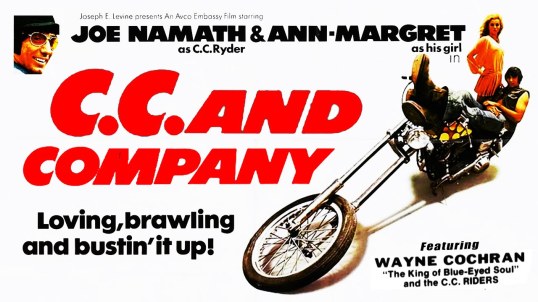
The TSL’s Grindhouse: C.C. and Company (dir by Seymour Robbie)


As our long-time readers know, I’ve seen my share of bad movies but it’s been a while since I’ve seen one as bad as 1970’s C.C. and Company.

C.C. and Company is about a drifter named C.C. Ryder (played by Joe Namath, who was a pro football quarterback at the time).  Ryder rides through the desert on his dorky motorcycle.  He doesn’t have a job.  He doesn’t have much money.  He does have a lot of hair and he also has a lot of teeth.  We know that because it’s rare that there’s ever moment when C.C. isn’t smiling.  C.C. is perhaps the most cheerful amateur criminal that I’ve ever seen.  Even when C.C. really shouldn’t be smiling, he’s smiling.  There are moments when people try to kill C.C. and he responds with a smile.  This could be a sign of C.C.’s devil-may-care-attitude but I think it has more to do with Joe Namath being a really bad actor.

C.C. is apparently a member of a motorcycle gang.  I say apparently because no one in the gang seems to like him and they’re constantly beating up on him.  The leader of the gang is Moon (William Smith) and among the members of the gang is an intimidating figure named Crow (Sid Haig).  Smith and Haig were both professional actors and genuine tough guys.  They not only knew how to act on camera but they also knew how to throw a punch without faking it.  Having them act opposite Namath doesn’t really accomplish much beyond emphasizing just how terrible an actor Namath was.  Even though Moon is a Mansonesque creep, you still find yourself rooting for him whenever he and C.C. get into a fight because Smith creates an actual character whereas Namath…. well, he doesn’t.  I sat through this entire film and never once did I find myself wondering what C.C.’s initials stood for.  That’s how uninterested I was in C.C.’s life.

Anyway, C.C. meets the wealthy and chic Ann McCalley (Ann-Margaret) after Ann’s limo breaks down in the middle of the desert.  C.C. not only fixes the limo but he also saves Ann from Crow and Lizard (Greg Mullaney).  It’s love at first sight but, unfortunately, Ann has places to go so she drives off and C.C. returns to the biker camp and watches as Moon sends his girlfriend, Pom Pom (Jennifer Billingsley), out to make money on the highway.  As I watched all of this, I found myself wondering how everyone else in the gang got stuck with names like Moon, Lizard, Crow, Rabbit, Pom Pom, and Zit-Zit (my favorite) but somehow C.C. was able to keep his innocent initials.  The movie never explained the ritual behind receiving motorcycle gang names and I think that was a missed opportunity.

Eventually, C.C. trades in his dorky motorcycle for a Kawasaki, largely because Kawasaki apparently paid the film’s producers a lot of money.  C.C. enters a race and wins.  Ann sees him win and falls even more in love with him.  C.C. gets into a fight with the gang and then he and Ann head to …. well, it looked a lot like Reno but honestly, who knows for sure?  Eventually, Moon and the gang track C.C. and Ann down and it all leads to one last fight.  We never do find out if the “company” of the title referred to Ann and her rich friends or Moon and the gang.  Not even C.C. seems to know for sure.

So, there’s a lot of reasons why C.C. and Company doesn’t really work but mostly it all comes down to the lead non-performance of Joe Namath as C.C.  There’s nothing tough or intimidating or rebellious about Namath.  C.C. is the biker you can bring home to meet your parents.  William Smith and Sid Haig are a lot more fun but they’re playing totally disreputable characters.  Namath and Ann-Margaret have zero romantic chemistry and the entire film has the look of a cheap made-for-TV movie.  Between C.C. and Company and Altamont, 1970 was not a good year to be a biker groupie.

That said, there is one good scene in C.C. and Company, where C.C. and Ann go out dancing.  While Joe Namath awkwardly shakes his shoulders while flashing that ever-present grin, Ann-Margaret dances as if the fate of the world depended upon her.  One year after the release of this movie, she would prove herself as dramatic actress and receive her first Oscar nomination for Carnal Knowledge.

Norwood (1970, directed by Jack Haley, Jr.)


Norwood Pratt (played by country singer Glenn Campbell) is a just a good old boy who has just returned home from serving in the Marines over in Vietnam.  After saying goodbye to his Marine buddy, Joe William Reese (played by quarterback Joe Namath), Norwood heads to his hometown of Ralph, Texas.  Norwood discovers this his sister (Leigh French) has married an idiot named Bill (Dom DeLuise!)

Norwood gets a job working at the local garage but he’s got his guitar and he’s got his dreams.  All he wants to do is play his music on the Louisiana Hayride radio program.  But with no money and no connections, how is he going to make it there?  When a shady businessman (Pat Hingles) offers to pay him fifty bucks to drive a car and prostitute (Carol Lynley) to New York City, Norwood agrees.  When Norwood discovers the car is stolen, he abandons both the vehicle and the girl but he still heads up to New York City.

Norwood has plenty of adventures and he meets plenty of people, like a hippie (Tisha Stirling) who invites him to open mike night at a coffee house in the Village.  Later, she invites him to join her in a bathtub by asking him if his guitar plays underwater.  “No, ma’m,” Norwood says, “but I do.”  He also meets a pregnant teenager (Kim Darby, Campbell’s co-star from True Grit) and a little person (Billy Curtis) who is traveling with a super intelligent chicken.

There have been a lot of very good films made about the struggle of military veterans to transition back to civilian life after their tour of duty comes to an end.  Unfortunately, Norwood is not one of those films.  Both Norwood and Joe have just returned from Vietnam but neither one of them seems to carry any lingering effects from their time overseas.  Neither of them shares any war stories or any thoughts on war in general.  (Someone does point out that Norwood has a scar.  Norwood says it’s a war wound that he got when he accidentally fell off a water truck.)  There’s no hint that the war itself was not going well for the United States in 1970 or that it wasn’t a popular war and that returning veterans often felt as if they had been rejected by the same country that asked (or forced) them to serve.  Even when Norwood meets the hippies in the Village, there’s no mention of protests.  Instead, Norwood presents 1970 as a time with no real conflicts, which is the perfect era for someone as forgettable as Norwood Pratt to become a star.

Norwood has the same basic and episodic structure as an Elvis movie, except that Elvis could actually act when he wanted to.  No one can deny Glenn Campbell’s talent as a singer but as an actor, he had very little screen presence.  In True Grit and this movie, the best that he could come up with was an amiable dullness.  In True Grit, it didn’t matter because John Wayne was in the movie.  But in Norwood, Campbell had to carry the story and his acting limitations were much more obvious.  Campbell even managed to get outacted by Joe Namath, who, as far as pro football player-turned-actors were concerned, was no Alex Karras.  Wisely, Campbell didn’t further pursue a career as an actor and instead concentrated on singing.  When Campbell died in 2017, he was praised for both his musical legacy and his honesty and courage while facing Alzheimer’s.  He may not have made it as an actor but he still touched a lot of lives.

CLEANING OUT THE DVR Pt1: Five Films from Five Decades


gary loggins's avatarcracked rear viewer

I record a LOT of movies. Probably around ten per week, more or less. And since I also have to do little things like work, exercise, cook, clean, breathe,  etc etc, I don’t always have time to watch  them all (never mind write full reviews), so I’ve decided to begin a series of short, capsule reviews for the decades covered here at Cracked Rear Viewer. This will be whenever I find my DVR getting cluttered, which is frequent! I’ll try to make CLEANING OUT THE DVR a bi-weekly series, but there are no guarantees. Monthly is more realistic. Anyway, here are five films from the 1930s to the 1970s for your reading pleasure.

View original post 748 more words