Original Gangstas (1996, directed by Larry Cohen)


Original Gangstas opens with shots of the deserted streets and burned-out store fronts of Gary, Indiana and narration telling us how a once great American city came to be in such disrepair.  The steel plant closed and put much of the city out of work.  While the politicians and the police looked the other way, violent street gangs rose up and took over entire neighborhoods.  Now, Gary is a shell of its former self.  Even the local movie theater has closed down.  The narrators tells us that the last movie to play at the theater was Star Wars.

Led by Spyro (Christoper B. Duncan) and Damien (Eddie Bo Smith, Jr.), the Rebels are the most feared and powerful gang in Gary.  They rule through violence and intimidation.  Talk to the police and your business is liable to get torched and you’re likely to get shot.  However, Spyro and Damien have finally gone too far and now, two men who previously escaped from Gary are returning to town to dish out some justice.

John Bookman (Fred Williamson) is a former football player who wants to avenge the shooting of his father.  Jake Trevor (Jim Brown) is a boxer who once killed a man in the ring and who wants revenge for the death of his son.  When they were young men, John and Jake were the original Rebels and now they’re getting the old gang back together again.  With the help of Laurie (Pam Grier), Bubba (Ron O’Neal), and Slick (Richard Roundtree), the original gangstas are going to take back the streets of Gary.

Original Gangstas was released at a time when, largely thanks to the influence of Quentin Tarantino, people were just starting to feel nostalgic for the old blaxploitation movies.  The main appeal of the film, not surprisingly, is that it brings together so many of the great blaxploitation stars and sets them loose in what was then the modern era.  (Jim Kelly is missed.)  When John and Jake talk about how they’re responsible for the Rebels, they could just as easily be talking about how they’re responsible for both all of the independent crime films that came out in the wake of Reservoir Dogs and Pulp Fiction.

Original Gangstas is a tribute to both the Blaxploitation genre and the oversized personalities that made that era so memorable.  Neither Fred Williamson, Jim Brown, nor Richard Roundtree were particularly good actors but they all had so much screen presence and such an innate sense of cool that it didn’t matter whether they could convincingly show emotion or not.  (Original Gangstas gives all of the big dramatic scenes to Pam Grier, who was not only naturally cool but a damn good actress to boot.)  The minute Fred Williamson lights his cigar, he control the entire movie.  He and Jim Brown make a good team and Original Gangstas is an entertaining and violent trip down memory lane.

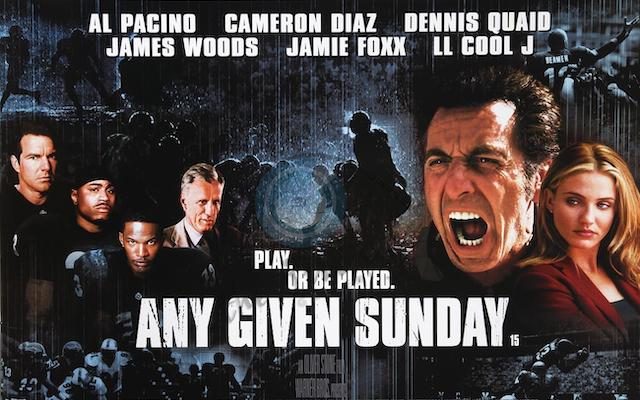
Any Given Sunday (1999, directed by Oliver Stone)


With Any Given Sunday, Oliver Stone set out to make the ultimate football movie and he succeeded.

Any Given Sunday is not just the story of aging coach Tony D’Amato (Al Pacino).  It’s also the story of how third-string quarterback Willie Beamon (Jamie Foxx) allows celebrity to go to his head while the injured starter, Cap Rooney (Dennis Quaid), deals with his own mortality and how, at 38, he is now over-the-hill.  It’s also about how the team doctors (represented by James Woods and Matthew Modine) are complicit in pushing the players beyond their limits and how the owners (Cameron Diaz) view those players as a commodity to be traded and toyed with.  It’s about how the Sharks represent their home city of Miami and how cynical columnists (John C. McGinley plays a character that is obviously meant to be Jim Rome) deliberately set out to inflame the anger of the team’s fans.  It’s about how politicians (Clifton Davis plays Miami’s mayor and asks everyone to “give me some love”) use professional sports to further their own corrupt careers while the often immature men who play the game are elevated into role models by the press.  It’s a film that compares football players to ancient gladiators while also showing how the game has become big business.  In typical Oliver Stone fashion, it tries to take on every aspect of football while also saying something about America as well.

In the role on Tony D, Pacino famously describes football as being “a game of inches” but you wouldn’t always know it from the way that Oliver Stone directs Any Given Sunday.  As a director, Stone has never been one to only gain an inch when he could instead grab an entire mile.  (Stone is probably the type of Madden player who attempts to have his quarterback go back and throw a hail mary on every single play.)  Tony tells his players to be methodical but Stone directs in a fashion that is sloppy, self-indulgent, and always entertaining to watch.  One minute, Al Pacino and Jim Brown are talking about how much the game has changed and the next minute, LL Cool J is doing cocaine off of a groupie’s breast while images of turn-of-the-century football players flash on the screen.  No sooner has Jamie Foxx delivered an impassioned speech about the lack of black coaches in the league then he’s suddenly starring in his own music video and singing about how “Steamin’ Willie Beamon” leaves all the ladies “creamin’.”  (It rhymes, that’s the important thing.)  When Tony invites Willie over to his house, scenes of Charlton Heston in Ben-Hur are on TV.  Later in the movie, Heston shows up as the Commissioner and says, about Cameron Diaz, “she would eat her young.”

Any Given Sunday is Oliver Stone at both his best and his worst.  The script is overwritten and overstuffed with every possible sports cliché  but the football scenes are some of the most exciting that have ever been filmed.  Only Oliver Stone could get away with both opening the film with a quote from Vince Lombardi and then having a player literally lose an eye during the big game.  Stone himself appears in the commentator’s both, saying, “I think he may have hurt his eye,” while the doctor’s in the end zone scoop up the the torn out eyeball and put it into a plastic bag.  Only Stone could get away with Jamie Foxx vomiting on the field during every game and then making amazing plays while a combination of rap, heavy metal, and techno roars in the background.  Stone regulars like James Woods and John C. McGinely make valuable appearances and while Woods may be playing a villain, he’s the only person in the film willing to call out the coaches, the players, the owners, and the fans at home as being a bunch of hypocrites.  Stone’s direction is as hyper-kinetic as always but he still has no fear of stopping the action so that Foxx can see sepia-toned images of football’s past staring at him from the stands.  Stone directs like defensive lineman on steroids, barreling his way through every obstacle to take down his target.  No matter what, the game goes on.

Any Given Sunday is the ultimate football movie and more fun than the last ten super bowls combined.

Embracing the Melodrama Part III #4: The Grasshopper (dir by Jerry Paris)


“It’s very simple what I want to be: totally happy; totally different; and totally in love.”

— Christine Adams (Jacqueline Bisset) in The Grasshopper (1970)

Seriously, is Christine asking for too much?

Total happiness?  That may sound like a lot but trust me, it can be done.

Totally different?  That’s a little bit more challenging because, to be honest, you’re either different or you’re not.  If you have to make the effort to be different, then you definitely are not.

Totally in love?  Well, it depends on how you define love…

At the start of The Grasshopper, Christine thinks that she’s heading to America to find love.  While an oh-so late 60s/early 70s theme song plays in the background, Christine leaves her small hometown in Canada and she heads down to California.  She’s planning on meeting up with her boyfriend Eddie (Tim O’Kelly) and taking a job as a bank teller.

Of course, it soon turns out that working in a bank isn’t as exciting as Christine originally assumed.  Eddie expects Christine to just be a conventional girlfriend and that’s not what Christine is looking for. As well, it’s possible that Christine may have seen Targets, in which O’Kelly played an all-American boy who picks up a rifle and goes on a killing spree.

And so, Christine abandons Eddie and heads to Las Vegas.  Since this movie was made in 1970 and Uber didn’t exist back then, Christine’s preferred method of traveling is hitchhiking.  This gives her a chance to meet the usual collection of late 60s weirdos who always populate movies like this.  One driver crosses herself when Christine says that she plans to have a baby before getting married.  Another is a hacky Las Vegas comic.

In Vegas, Christine applies for a job as a showgirl.  As she explains to sleazy casino owner Jack Benton (Ed Flanders), she “once did Little Women in school.”

“Did you do it nude?” Jack replies.

Yep, that’s Vegas for you!  It’s the city of Showgirls, Casino, and Saved By The Bell: Wedding in Vegas, after all!

Anyway, thing do get better once Christine meets and falls in love with Tommy Marcott (Jim Brown), a former football player who is now working as a door greeter in Jack’s casino.  Everyone tells Christine not to get involved with Tommy.  One of Jack’s men, a menacing hitman who looks just like Johnny from Night of the Living Death (he even wears glasses), warns Christine to watch herself.

Through a long series of events, Christine ends up on her own again.  The usual collection of 70s events occur: murder, drugs, prostitution, and ultimately a stint as the mistress of a rich man played by Joseph Cotten.  The important thing is that it all eventually leads to Christine and a skywriter getting stoned, stealing a plane, and deciding to write a message in the sky.

That’s when this happens:

Yes, it’s all very 1970!

Anyway, The Grasshopper is one of those films that tries to have it both ways.  Establishment audiences could watch it and think, “Wow, those kids are really messed up.”  Counterculture audiences could watch it and say, “Old people are such hypocrites.”  Oddly enough, The Grasshopper was written by future director Garry Marshall and it’s an incredibly overwrought film.  There’s not a subtle moment to be found in the entire film and the film’s direction is flashy but empty.  However, for those of us who love history, it’s as close to 1970 as we’re going to get without hopping into a time machine.

That’s Blaxploitation! 11: Jim Brown in SLAUGHTER (AIP 1972)


gary loggins's avatarcracked rear viewer

Jim Brown  is one bad mother… no wait, that’s Richard Roundtree as Shaft! Jim Brown is one bad dude as SLAUGHTER, a 1972 Blaxploitation revenge yarn chock full of action. Brown’s imposing physical presence dominates the film, and he doesn’t have to do much in the acting department, ’cause Shakespeare this ain’t – it’s a balls to the wall, slam-bang flick courtesy of action specialist Jack Starrett (RUN ANGEL RUN, CLEOPATRA JONES , RACE WITH THE DEVIL) that doesn’t let up until the last second, resulting in one of the genre’s best.

Ex-Green Beret Slaughter (no first name given) is determined to get the bad guys who blew up his dad’s car, with dad in it! Seems dear ol’ dad was mob connected and knew too much. Slaughter’s reckless abandon in seeking revenge lands him in hot water with Treasury agents, and he’s “persuaded” to assist them in taking down…

View original post 339 more words

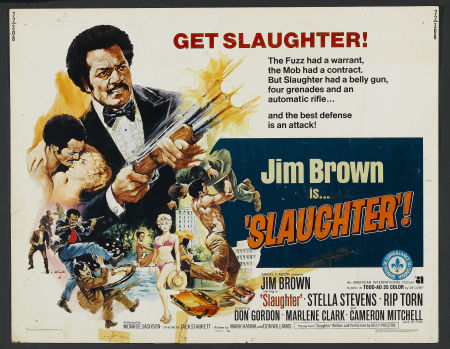
A Movie A Day #156: Slaughter (1972, directed by Jack Starrett)


The Mafia just pissed off the wrong ex-Green Beret.
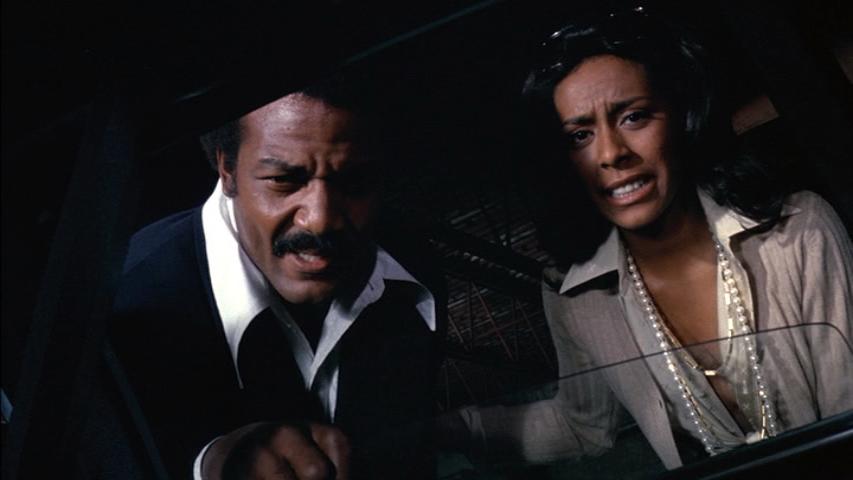
After his father is blown up by a car bomb, Captain Slaughter (Jim Brown) single handily wipes out the Cleveland mob.  Only one gangster, Dominic Hoffo (Rip Torn), escapes to South America.  The Treasury Department (represented by Cameron Mitchell) sends Slaughter and two other agents (Don Gordon and Marlene Clark) after Hoffo.  Along with being a ruthless gangster, Hoffo is a viscous racist and is convinced that he will be able to easily take care of Slaughter.  Hoffo does not understand how much trouble he’s in.  No one stops Slaughter.

Produced by American International Pictures, Slaughter is one of the classic blaxploitation films. While it may not have the political subtext of some of the best blaxploitation films, Slaughter is a fast and mean action film, directed in a no nonsense manner by B-movie veteran Jack Starrett.  There is not a wasted moment to be found in Slaughter.  It starts and ends with cars exploding and, in between, it doesn’t even stop to catch its breath.

In the 1970s, Richard Roundtree was John Shaft, Ron O’Neal was Superfly, Jim Kelly was Black Belt Jones, Fred Williamson was Black Caesar, and Jim Brown was Slaughter.  Whatever skills Jim Brown lacked as an actor, he made up for with sheer presence.  He commanded the screen.  Whether he was playing football on television or beating down the Mafia in the movies, no one could stop Jim Brown.  Slaughter is Brown at his toughest.  Rip Torn is the perfect villain, screaming out racial slurs even when Slaughter has him trapped in an overturned car.   Jim Brown has said that, of all the films he has made, Slaughter is one of his three favorites.  (The other two were The Dirty Dozen and Mars Attacks!)

Slaughter‘s cool factor is increased by the presence of Stella Stevens, playing the role of Ann, Hoffo’s mistress.  It only takes one night with Slaughter for Ann to switch sides.  Nothing stops Slaughter.

That’s Blaxploitation! 9: THREE THE HARD WAY (Allied Artists 1974)


gary loggins's avatarcracked rear viewer

tthw1

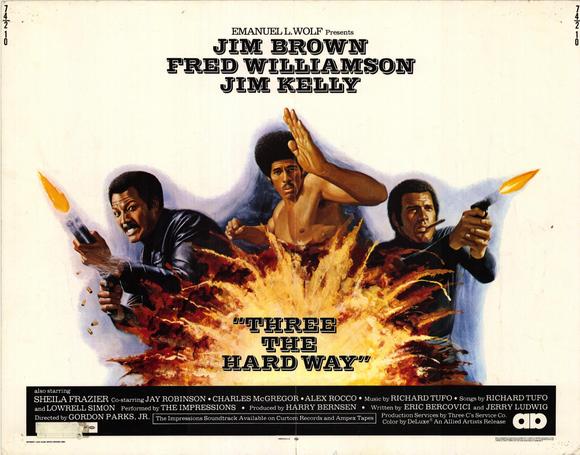
An All-Star Blaxploitation cast barrels their way through THREE THE HARD WAY, director Gordon Parks Jr.’s ultra-violent classic that dives into action from jump street and rarely lets up on the gas pedal straight through til the end. It’s the quintessential 70’s action flick whose thin plot only serves to weave a tapestry of wild action set pieces and well-staged stunt work courtesy of stunt coordinator Hal Needham and his stellar stunt gang.

tthw2

We’re lured into the action right from the get-go in a pre-credits scene of a desperate young black man escaping from a concentration-camp-like compound. He makes it to L.A. and contacts his friend, the BMW-driving, hot-shot record producer Jimmy Lait, played by NFL great Jim Brown . The kid is then assassinated in his hospital bed and Jimmy’s girl Wendy (Sheila Fraser) is kidnapped. A scene change lets us in on the plot, as white supremacist Monroe Feather and evil scientist…

View original post 387 more words

Film Review: The Split (1968, directed by Gordon Flemyng)


The Split2The Split is one of the many films to be based on one of Donald Westlake’s Parker novels.  A classic antihero, Parker was a ruthless professional criminal who was only partially redeemed by being so much better at his job than all the other lowlifes around him.  In the movies, Parker has been played by everyone from Lee Marvin to Robert Duvall to Mel Gibson to Jason Statham.  In The Split, Parker is renamed McClain and he is played by Jim Brown.

McClain and his partner, Gladys (Julie Harris), have a plan to rob the Los Angeles Coliseum during a football game.  (Actual footage of the Rams playing the Falcons was used.)  McClain personally recruits a crew of criminals to help him pull off the heist.  Harry Kifka (Jack Klugman) is the getaway driver.  Bert Clinger (Ernest Borgnine) is the muscle.  Marty Gough (Warren Oates) is the electronic expert.  Dave Negli (Donald Sutherland) is the sharpshooter.

After pulling off the robbery, McClain stashes the money with his ex-girlfriend, Ellie (Diahann Carroll).  When her landlord, Herb Sutro (James Whitmore), finds out that Ellie has the money, he murders her and steals it.  When homicide detective Walter Brill (Gene Hackman) solves Ellie’s murder, he kills Herb and takes the money for himself.  Meanwhile, Gladys and the crew are convinced that McClain knows where the money is.  With everyone out to kill him, McClain tries to find the money.

The Split is mostly interesting because of its cast.  For all of his physical presence, Jim Brown was never much of an actor but the large supporting cast more than makes up for his limitations.  It’s fun to watch Sutherland, Borgnine, Harris, and Klugman compete to see who can steal the most scenes.  Meanwhile, a youngish Gene Hackman is as cantankerous as ever.  Then there’s the great Warren Oates.  Warren Oates was one of the greatest actors of all time and he spent his far too brief career stealing movies like The Split.

(The Split was released a year after Jim Brown, Ernest Borgnine, and Donald Sutherland had all appeared in The Dirty Dozen.  A year after The Split, Warren Oates and Ernest Borgnine would both be members of The Wild Bunch while Hackman and Brown would costar in Riot.)

The Split has some historical significance as the first film to ever be given an R rating.  Though tame by today’s standards, at the time of its release, The Split was considered to be extremely violent and audiences were also shocked by a brief flash of nudity.  Seen today, The Split is a conventional heist movie but it still shows what a group of good actors can do with so-so material.

The Split

6 Trailers For A Doomed Society


Hi there and welcome to yet another edition of Lisa Marie’s Favorite Grindhouse and Exploitation Film trailers!

1) Damnation Alley (1977)

This movie was actually on the Fox Movie Channel last night.  The trailer’s better.

2) The Tenement (1985)

As this trailer makes clear, this film is also known as Slaughter In The South Bronx.

3) Enter The Ninja (1981)

It’s Franco Nero!

4) Eat My Dust (1976)

It’s Ron Howard!

5) Beatrice Cenci (1969)

Before Lucio Fulci devoted himself to making zombie films, he made this one.  It tells the true story of Beatrice Cenci, an Italian noblewoman who, in 1599, conspired to murder her abusive father.  Fulci considered it to be his second best film.  I’ve never seen it but I hope to do so someday soon.

6) The Slams (1973)

Finally, let’s conclude this edition with Jim Brown in … The Slams!

12 Trailers In Case of the Rapture, Part Two


Hi there!  It’s Saturday morning — are you still with us?  If you’re not, don’t worry.  You have all day to get raptured.  Until then, here’s the second part of this weekend’s edition of Lisa Marie’s Favorite Grindhouse and Exploitation Trailers.

(And if you haven’t read part one, it’s right here.)

Anyway, let’s waste no more time because who knows how long we’ve got left.

7) Requiem for a Vampire (1971)

Seeing as this could very well be the last things that I ever post or that you ever read pre-Rapture, there’s no way I can’t start things out without including this trailer for Jean Rollin’s unique, twisted, and very French vampire fairy tale, Requiem for a Vampire.  One thing to note here is that when this film was released in the U.S., the American distributor felt the need to emphasize that the two girls were virgins and even went so far as to retitle the film Caged Virgins.  However, the original French print of this film makes no reference to whether or not the girls are virgins and, despite all that happens to them in the film, the girls themselves are never presented as being helpless.  Whenever I feel the need to explain the difference between American culture and French culture, this is one of the examples I always cite.

8 ) Kenner (1969)

Jim Brown is Kenner!  And that’s about all I really know about this film.  Well, that and small bundles of heroin are worth millions…

9) The Three Dimensions of Greta (1973)

I was recently reading about 3-D Sex and Zen: Extreme Ecstasy, a movie from Hong Kong that is apparently setting box office records because it’s being advertised as the first 3-D pornographic film.  And, as the linked article shows, a lot of people are reporting that claim as fact.  And they’re wrong.  3-D Sex and Zen might be the first recent 3-D porn film but it’s hardly the first.  There was a spate of 3-D porn films in the mid-70s and one of my favorite trailers (which I can’t post here because 1) it’s too explict and 2) I can’t remember the title of the film) features a stereotypical, curly-haired, guy with a mustache type of porno actor going, “Soon, my giant schlong with be hanging right over the head of that redhead in the 3rd seat in the backrow.”  And of course, I was all like, “Oh my God, can he see me through the screen!?”   Anyway, the 3 Dimensions of Greta was a part of this wave.  This is another one of those trailers that will probably be yanked off YouTube in a few more days (assuming there isn’t a Rapture first).

(By the way, why were so many porno films made about girls named Greta?  I mean, was that name a turn-on?  Were the films of the 70s exclusively made by guys named Hansel?  Seriously, boys are weird.)

10) The Violent Professionals (1973)

They’re violent alright!  Before the Italian exploitation industry devoted itself to cannibals and zombies, they devoted themselves to ripping off The French Connection and The Godfather.  This film from Sergio Martino actually features Don Barzini himself, Richard Conte.

11) Wonderwall (1968)

If I didn’t tell you this film was from 1968, you’d guess it just from watching the trailer.  The soundtrack was done by George Harrison.  Though this film was certainly not designed to be an exploitation film in the way most of the other films featured here were, it definitely is one.

12) The Beyond (1981)

Can you believe I went this long without featuring the trailer for Lucio Fulci’s best known (after Zombi 2) film?  Well, I love Fulci, I love this film, and I was waiting for the right occasion to feature this trailer.  And the end of the possible end of the world seemed like the right time.  Anyway, this is one of those love it or hate it films (and I know that one of our regular readers is not a huge fan of this film but I love him anyway).  At his best, director Lucio Fulci made some of the most visually stunning and dramatically incoherent films ever and never was that more apparent than with the Beyond.  Out of the film’s cast, Catriona MacColl plays one of the few strong women to ever appear in a Fulci film while David Warbeck (a personal fave of mine) is the perfect hero.  My favorite performance in the film (and a lot of this has to do with the fact that she co-starred in one of my favorite movies ever, Beyond the Darkness) is given by Cinzia Monreale, who plays the blind Emily.

And so there you go.  If you do get raptured later today, thank you for reading.  It’s been a pleasure telling you about the films I love and hopefully, someday, we’ll all meet in the beyond.

And if, as I suspect, there is no rapture today, I look forward to sharing even more.

Ciao!