A Movie A Day #209: Assassination (1987, directed by Peter R. Hunt)


Charles Bronson, man.

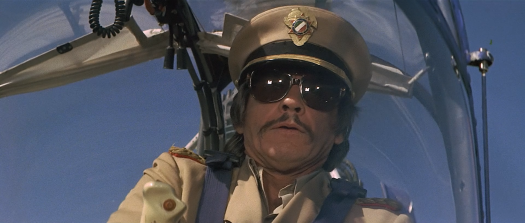
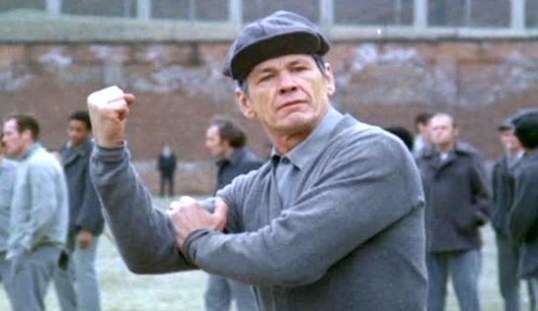
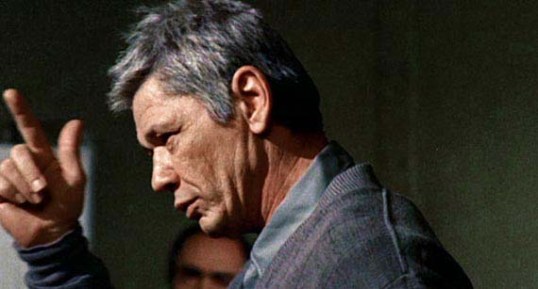
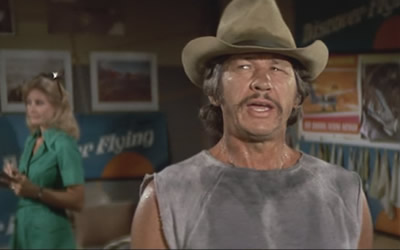
Long before Clint Eastwood starred in In The Line of Fire, Charles Bronson played an over the hill secret service agent in Assassination.  Having just returned to active service after a six month leave of absence, Jay Killian (Charles Bronson), thinks that he is going to be assigned back to the presidential detail.  Instead, he is given the job that no one wants.  Jay is assigned to protect the first lady, Lara Craig (Jill Ireland, Bronson’s real-life wife).

Lara is a handful.  Every one tells Killian that she is “even worse than Nancy.”  (This running joke probably played better in 1987.  If Assassination had been released ten years later, Lara would have been described as being “even worse than Hillary.”)  Lara does not like being told what she can and cannot do. When she refuses to follow Killian’s orders not to ride in a convertible, she ends up getting a black eye when a motorcycle crashes and Killian instinctively throws her to the floor.  Lara may not like Killian but when, she is targeted by a notorious terrorist (Erik Stern), she will have to learn to trust him.  Her life depends on it, especially when it becomes clear that the order to have her killed is coming from inside the White House.  It turns out that the President has been impotent for years.  That may not have troubled Lara before but now Killian is showing her that a real man looks like Charles Bronson.  A divorced president will never be reelected.  A widowed president, on the other hand…

Assassination was one of the last films that Bronson made for Cannon.  It’s never as wild as Murphy’s Law, Kinjite, or many of Bronson’s other Cannon films but it is always interesting to watch Bronson acting opposite of Ireland.  Bronson famously did not get along with many people but he loved Ireland and that was something that always came through in the 15 movies that they made together.  Whenever Bronson and Ireland acted opposite each other, Bronson actually seemed to be enjoying himself.  And while it may be subdued when compared to his other Cannon films, Assassination provides just enough scenes of Bronson being Bronson.

Who other than Bronson could tell his much younger girlfriend that, because of her, he might “die of terminal orgasm?”

Who other than Bronson could drive around a motorcycle with machine gun turrets and execute a jump that would put his old co-star Steve McQueen to shame?

Who other than Bronson could use a bazooka to kill one man and then smile about it?

Charles Bronson, man.  No offense to Bruce Willis, who will be trying to step into Bronson’s gigantic shoes with the upcoming Death Wish remake, but nobody did it better than Bronson.


A Movie A Day #141: Breakheart Pass (1975, directed by Tom Gries)


California.  The 1870s.  Sheriff Pearce (Ben Johnson) boards a train with his prisoner, an alleged outlaw named John Deakin (Charles Bronson).  The train is mostly full of soldiers, under the command of Major Claremont (Ed Lauter), who are on their way to Fort Humboldt.  The fort has suffered a diphtheria epidemic and the soldiers are supposedly transporting medical supplies.
However, it’s not just soldiers on the train.  There’s also Gov. Fairchild (Richard Crenna) of Nevada, his fiancée (Jill Ireland), the Reverend Peabody (Bill McKinney), and a conductor named O’Brien (Charles Durning).  As the train continues on its journey, it becomes obvious that all is not as it seems.  People start to disappear.  A man is thrown from the train.  Two cars full of soldiers are separated from the train and plunge over a cliff.  There is also more to Deakin than anyone first realized and soon, he is the only person who can bring the murderers to justice.

In both real life and the movies, Charles Bronson was the epitome of a tough guy, so it’s always interesting to see him playing a more cerebral character than usual.  There are some exciting and surprisingly brutal action scenes, including a scene where Bronson fights a cook (played by former professional boxer Archie Moore) on top of the speeding train, but Breakheart Pass is more of a murder mystery than a typical action film.  If Louis L’Amour and Agatha Christie had collaborated on a story, the end result would be much like Breakheart Pass.  Bronson spends as much time investigating as he does swinging his fists or shooting a gun.  It’s not a typical Bronson role but he does a good job, showing that he could think as convincingly as he could kill.  Acting opposite some of the best character actors around in the 70s, Bronson more than holds his own.

Apparently, back in 1975, audiences were not interesting in watching Bronson think so Breakheart Pass was a disappointment at the box office and it is still not as well known as Bronson’s other films.  However, even if you’re not already a fan of the great Bronson, Breakheart Pass is worth discovering.

Let’s Go to the Drive-In with Charles Bronson in BREAKOUT (Columbia 1975)


gary loggins's avatarcracked rear viewer

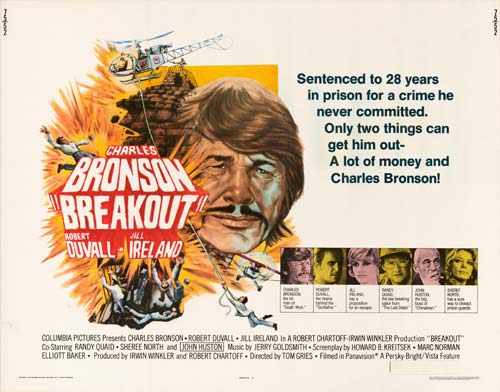
Charles Bronson  finally achieved superstar status in the 1970’s after years of toiling in supporting parts thanks to drive-in fare like THE MECHANIC, MR. MAJESTYK, and the DEATH WISH films. 1975’s BREAKOUT had a bigger budget, a better than average cast, and major studio support, but at it’s heart it’s still a drive-in movie, albeit a cut above the usual action flick.

Bronson casts aside his normal stoic, stone-faced screen persona as Nick Colton, a somewhat shady pilot/mercenary who’ll do anything for a buck. Charlie’s quite a charmer here, displaying a sense a humor and talking a lot more than usual. He’s in rare form, getting to display his acting chops, honed through over two decades in the business, and is obviously having a good time in the role.

Nick is hired by Ann Wagner to rescue  her husband Jay, framed by his own grandfather and sentenced to a ruthless Mexican pennitentary…

View original post 399 more words

A Movie A Day #23: The Valachi Papers (1972, directed by Terrence Young)


The best thing about The Valachi Papers is this:

valachi-0

That is Charles Bronson, playing real-life mob informant Joe Valachi and making a gesture that expresses the way many people feel about the world right now.  Valachi, in both the film and real life, was a bit player in the Cosa Nostra, a driver and an occasional hitman who was lucky enough to marry the daughter (played by Bronson’s real-life wife, Jill Ireland) of one of the bosses.  In prison for smuggling heroin, Valachi runs into one of those bosses, Vito Genovese (Lino Ventura).  Genovese, convinced that Valachi has broken the code of omerta, gives Valachi the kiss of death.  Valachi kisses him right back and then becomes a rat.

Valachi’s 1963 testimony to the U.S. Senate was the public’s first glimpse into life in the Mafia.  Many of the cliches that have since appeared in every mob movie or television show were the result of Valachi’s testimony and Peter Maas’s subsequent book, The Valachi Papers.  (In the “Test Dream” episode of The Sopranos, Tony can be seen holding a copy of The Valachi Papers.)

Over the years, doubts have been raised about both the validity of Valachi’s testimony and his claim that he only turned rat because Genovese put a contract on his life.  The film version of The Valachi Papers takes Valachi’s claims at face value, telling Valachi’s story in a series of flashbacks.

The Valachi Papers is often compared to another mob movie that came out in 1972, The Godfather, though there’s really not much of a comparison to be made.  Whereas The Godfather was a family saga, The Valachi Papers is much more concerned with the day-to-day operations of the Mafia.  It never comes close to matching The Godfather‘s epic feel and the cheap production values don’t help.  (Keep an eye out for the twin towers of the World Trade Center, anachronistically towering over depression-era New York City.)

Storywise, The Valachi Papers actually has more in common with Goodfellas than with The Godfather.  Like Henry Hill, Joe Valachi is not a major player.  He’s just a working man whose employer happens to be the Mafia.  Stylistically, of course, The Valachi Papers has nothing in common with Goodfellas.  If not for the violence and some the language, it would be easy to mistake The Valachi Papers for an old made-for-TV movie.

The best thing about The Valachi Papers is Charles Bronson as Joe Valachi.  When The Valachi Papers was made, Bronson was a huge draw in Europe but was still largely unknown in the United States.  It was not until Death Wish came out, two years later, that Bronson became a star.  He does a good job as Joe Valachi.  In a way, it’s the perfect role for Bronson, who was a genuine tough guy who, like Valachi, spent decades working in the trenches before eventually becoming a household name.

I don’t think Charles Bronson ever would have turned informant, though.

Not our Chuck.

the_valachi_papers_still