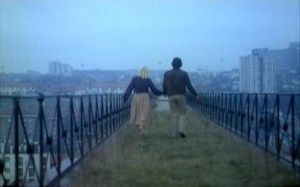
Jean Rollin, la clef à mes désirs secrets, R.I.P.


My favorite film director, France’s Jean Rollin, passed away on December 15th at the age of 72. 

There are three types of people in the world: those who love Rollin, those who will eventually love Rollin once their eyes are opened, and those who just don’t matter.

When I first told Arleigh that Rollin had passed, he mentioned that the American director Blake Edwards had died as well.  Oddly enough, I sometimes think of my favorite Rollin film — Night of the Hunted (which I reviewed on this site) — as being a rather grim, Grindhouse version of another one of my favorite films, Breakfast at Tiffany’s.  The main difference, of course, is that Edwards’ Holly Golightly is allowed to triumph at the end while Rollin’s version is destroyed by an embarrassed mainstream establishment.  History, I think, has given us little room for doubt concerning which vision is closer to the truth.

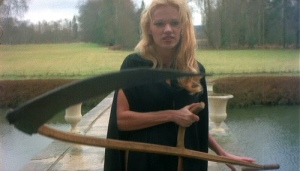
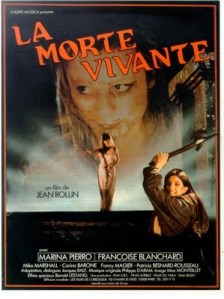
In his best films (Night of the Hunted, The Living Dead Girl, Two Orphan Vampires, Requiem For A Vampire, The Grapes of Death, Fascination, Lost In New York, The Sidewalks of Bangkok, Shiver of the Vampires), Rollin proved himself to be a cinematic poet with an eye for dream-like imagery and a special skill for capturing the mysteries, ambiguities, and ultimate beauty of female friendship and sisterhood.

Je ne crois pas au bon. Je ne crois pas au mal. Je ne crois pas en Dieu. Je crois seulement à l’amour et au Rollin.

The Daily Grindhouse: Le Raisins de la Mort (dir. by Jean Rollin)


The latest pick for the Daily Grindhouse should delight fellow site contributor Lisa Marie. I say this because I know of no one else who loves all things Jean Rollin as much as she does. I also picked this particular grindhouse flick because it has the lovely Brigitte Lahaie in it. Those who know need no explanation as to why that coulnts a lot in my pick and for those not in the know will just have to figure it out themselves.

I picked Jean Rollin’s Le Raisins de la Mort (also known as The Grapes of Death) because the title just spoke to me. A zombie (or at least zombie-like) flick with the word “raisins” in the title. What’s not to love and, not to continue repeating myself, it has the lovely Brigitte Lahaie in it even if for just a supporting role. A role that definitely shows her best front, sides and back (I’m a guy so sue me).

If there was ever a reason Jean Rollin has my undying props it’s for always finding a reason to cast Brigitte Lahaie in his films. Now, if Steven Soderbergh can just follow his lead and just keep casting Sasha Grey in all his future films then he’ll have my undying support as well.

This particular grindhouse pick definitely doesn’t make for a good way to promote France’s great wine traditions and their fabulous vintages. What it does promote is France’s own particular take on the zombie genre of the 70’s. Where zombie flicks were always seen as American and Italian provinces of the horror scene other countries had their hand in pushing the genre, but France (with some help from Rollin himself) added their own spin on it by shamelessly (one I applaud and am thankful for) keeping the lovely female performers in them in differing modes of undress.

For that I just have to say one thing: Vive la France!

Scenes I Love: Two Orphan Vampires


Sometimes, I feel that there are only two types of people in the world.  There’s the minority who appreciate the dreamlike atmosphere and sensual obsessions that dominate the vampire films of French director (and genius) Jean Rollin.

And then there’s the majority who don’t.  We refer to this majority as being “the idiots.”

As for me, Jean Rollin is one of my favorite directors.  I’ve previously reviewed his low-budget masterpiece, Night of the Hunted, on this site.  I hope, in the future, to review even more of his films.

For now, I’d just like to share a scene from one of his later films, the hauntingly beautiful and elegiac Two Orphan Vampires

Rollin is a director best known for spending the past five decades making films in which he continually and obsessively returns to a few key themes: the importance of memory, a nostalgia for the innocence of youth mixed with the knowledge that youthful innocence could also be destructive, a fascination with the beach, an obvious love of architecture (Rollin films old castles the way that an American director might film an action sequence), and — most notoriously — the use of two female protagonists who are usually portrayed as possessing a very strong, sister-like bond even though it’s rare that they actually are blood-related. 

A good deal of Rollin’s current following comes from men who feel that there’s an erotic element to Rollin’s portrayal of female friendship.  And to an extent, they’re right.  But to an even greater extent, it doesn’t matter.  Regardless of why the relationships between Rollin’s protagonists exists, the important thing is that they are portrayed as sharing an unbreakable bond.  Whether they’re linked by lust, friendship, or just memory, Rollin’s women are bonded by a very true, very real love and that’s what makes his movies special to me.

This is what the scene below is all about.  The two orphan vampires of the title are two teenage sisters.  During the day, they are blind but when the sun goes down, they can not only see but they become vampires as well.  Two Orphan Vampires is a surprisingly sad and haunting look at their attempts to survive in a world that has no place for them.  In the scene below, after failing in several attempts to get the blood they need to continue to live, each sister resorts to drinking the blood of the other.  To me, every thing that Rollin had directed before was leading up to this scene.

(This scene is also prototypical Rollin in that the budget is obviously low, the actors are more than adequate but, at the same time, are obviously not professionals, and the English dubbing is poorly done.  And yet the scene itself — especially when seen in the larger context of both the entire film and Rollin’s movies as a whole — is actually more sincere and memorable than the majority of what is produced by the mainstream.  In short, this is pure Rollin in that you either get it or you don’t.)


Poll: Which Movie Should Lisa Marie Review?


Last night, with the help of my friend Jeff, I conducted an experiment. 

First, I took out my contacts which basically left me blind.  Then, just to make sure I was totally without sight, I had Jeff blindfold me.  He then took me by the hand and led me over to my DVD collection.  Clumsily, I grabbed 10 DVDs at random and handed them back to Jeff.  I then proceeded to walk into a wall, at which point I tried to take off the blindfold and ended up losing my balance and falling down flat on my ass. 

Why was I risking life and limb to randomly select 10 DVDs?

I did it so you could have the chance to tell me what to do.  At the bottom of this article, you will find a poll listing the 10 DVDs I randomly selected.  Come next Saturday (June 19th to be exact), I will watch and review whichever movie receives the most votes in the poll.  In short, I’m giving you all the power.

Now, to be honest, I’m feeling just a little trepidation about doing this.  Whenever you set up a poll, you’re running the risk of absolutely no one voting.  Fortunately, I have a plan B in that I recently got the 1st season of Gossip Girl on DVD.  If nobody votes in the poll, I’ll just spend next Saturday watching Gossip Girl and writing several long — very long —  essays on how different Chuck is in the books as compared to the TV show.

The choice, as they say, is yours.

The 10 movies I blindly selected are listed below in alphabetical order.

1) Anatomy of a Murder (1959) — Jimmy Stewart asks Lee Remick a lot of questions about her panties.

2) Darling (1965) — Julie Christie claws her way to the top of the modeling industry and discovers ennui.

3) Emanuelle in America (1978) — Emanuelle investigates decadence in America.  Some people think that this movie contains footage taken from an actual snuff film.  We call those people “idiots.”

4) Hatchet For The Honeymoon (1969) — Mario Bava directs this film about a man driven to murder by the sight of an unflattering bridal gown.

5) Lost in Translation (2003) — I will admit that I squealed with joy when I discovered that I had randomly selected one of my favorite movies of all time.

6) Primer (2004) — Engineers play with time and space.  Oddly enough, this movie was filmed a few miles away from where I live.

7) The Sidewalks of Bangkok (1986) — Like most of Jean Rollin’s film, this is something of a misunderstood masterpiece.

8 ) Sole Survivor (1982) — An atmospheric little horror film with a sadly generic title.

9) Starcrash (1978) — Strange sci-fi movie in which Christopher Plummer recruits space pirate Caroline Munro to battle a pre-Maniac Joe Spinell.  This film also marks the screen debut of David Hasselhoff.

10) The Sweet House of Horrors (1989) — One of Lucio Fulci’s last films.

So, those are our ten options.  On Saturday, July 19th, I will sit down, watch, and review whichever movie receives the most votes.  On that day, for four to six hours, I will give up my independence and submit to the wishes of the majority.

Review: Night of The Hunted (dir. by Jean Rollin)


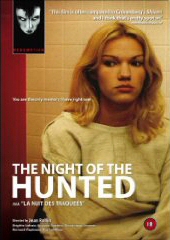
When, at that age of 22, I first saw Jean Rollin’s Night of the Hunted, I cried as much as the first time I saw Titanic at the age of 12.  In both cases, the tears were inspired by a “doomed” love story.  The main difference between the two films is that I don’t cry over Titanic anymore.  But Night of Hunted still brings me to tears every time I see it.

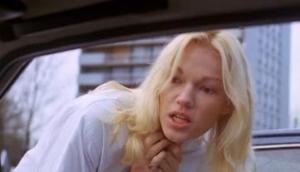
The film opens with the image of a terrified young woman (Brigitte Lahaie) running through a dark forest until she eventually reaches a highway.  She’s picked up by a young man (Vincent Gardere) who, being a guy, proceeds to take her back to his apartment in Paris.  She confesses that she can’t remember who she is, why she was running, or even being picked up by the young man in the first place.  Saying that she needs some sort of memory to fill the emptiness, she proceeds to make love to Gardere.  Gardere, being a guy, doesn’t object.

However, he does make the mistake of later leaving Lahaie alone in the apartment afterwards.  As soon as Gardere leaves, Lahaie forgets ever meeting him and why she’s even in the apartment in the first place.  Even as she tries to figure out what’s going on, the apartment is visited by a doctor who tells Lahaie that she is his patient and that she needs to go with him to a “clinic” where he can treat her.  No longer remembering her encounter with Gardere, Lahaie agrees.

Needless to say, the “clinic” turns out to be what Lahie was so desperately trying to escape just a few hours before.  We learn that Lahie is merely one of several hundred people who, months earlier, were exposed to a biological warfare experiment gone wrong.  Now, as a result, her brain is slowly dying one cell at a time.  The clinic is actually a government-run prison where she and her fellow victims have been sent to be forgotten about and to eventually die.  Lahie finds herself surrounded by men and women who, as they slowly lose everything that made them unique, revert back to their most primal instincts.  While Gardere tries to find her, Lahie struggles to survive just one final night in both the clinic and in the prison of her own fading mind.

Director Jean Rollin is best known for his sexually-themed vampire films but the Night of the Hunted is not as huge a departure for him as it may first seem.  One of Rollin’s reoccurring themes is the importance of our memories, no matter how idealized they may sometimes be and this theme is present in every frame of Night of the Hunted.

The lead role is played by Rollin’s frequent muse and collaborator, Brigitte Lahaie.  Because the majority of Lahaie’s career has been spent making adult films, she’s never gotten the due she deserves as an actress.  Playing a difficult role here, Lahaie is the movie’s greatest strength.  She brings a real sincerity and empathy to her role and its impossible to imagine this movie working without her.  If nothing else, this movie is a wonderful display of Lahaie’s often underrated talent. 

Rollin made the film for very little money and used a cast made up almost entirely of nonprofessionals and French adult film veterans.  So, yes the film does sometimes have a grainy look and the editing is definitely jagged.  When the characters shoot at each other, it is obvious that they’re firing toy cap guns.  To me, however, this works in the film’s favor.  The raw quality of the film perfectly mirrors that constant fear and confusion that Lahaie and her fellow prisoners live in.  No, the film is not technically perfect but a flawed masterpiece is preferable to uninspired technical perfection any day.

Despite working with a miniscule budget, Rollin captures some haunting images in this film.  Never has Paris looked as desolate as in this movie.  One of Rollin’s trademarks has always been his own fascination with architecture and, as a result, the cold skyscraper where Lahaie is held prisoner almost becomes a character itself.  I’ve always considered Jean Rollin to be horror cinema’s equivalent to Jean-Luc Godard and, with its images of a sterile city run by passionless autocrats, Night of the Hunted brings to mind Godard’s Alphaville.

 The film’s most haunting image comes at the end and it is this image that brings tears to my eyes every time.  Whatever flaws the film may have, Night of the Hunted has one of the best final shots in the history of cinema.  Even if everything preceeding it had been worthless, this movie would be worth sitting through just for the stark beauty of the final shot.  Night of the Hunted ends on a note that manages to be darkly sad and inspiringly romantic at the same time.  It’s an ending that makes Night of the Hunted one of the most romantic films of all time.

Night of the Hunted was released in 1980 and, like the majority of Rollin’s films, was never released in the States.  Redemption, however, has released it on DVD (which is how I first saw it in 2008.)   While the transfer is undeniably rough, that actually gives the movie a documentary-like quality that works in its favor.  The film is in French with English subtitles.   As is so often the case with subtitles, a lot of the film’s nuance is sacrificed in translation.  Fortunately, the combination of Rollin’s visual sense and Lahaie’s lead performance more than makes up for it.

My Top Ten Books About The Movies


I love movies and I love books so I guess it would stand to reason that I love books about movies the most of all.  (I also love movies about books but there are far fewer of those, unfortunately.)  Below are my personal favorites.  I’m not necessarily saying that these are the ten greatest film books ever written.  I’m just saying that they’re the ones that I’m always happy to know are waiting for me at home.

10) Soon To Be A Major Motion Picture by Theodore Gershuny — This is one of the great finds of mine my life.  I found this in a used bookstore and I bought it mostly because it only cost a dollar. Only later did I discover that I had found one of the greatest nonfiction books about the shooting of a movie ever written!  Gershuny was present during the filming of a movie called Rosebud in the early 70s.   I’ve never seen Rosebud but, as Gershuny admits, it was a critical disaster that managed to lose a ton of money.  The book provides a fascinating wealth of backstage gossip as well as memorable portraits of director Otto Preminger and actors Robert Mitchum (who was originally cast in the lead role), Peter O’Toole (who took over after Mitchum walked off the set), and Isabelle Huppert.   If nothing else, this book should be read for the scene where O’Toole beats up critic Kenneth Tynan.

9) Suspects by David Thomson — A study of American cinema noir   disguised as a novel, Suspects imagines what would happen if George Bailey from It’s a Wonderful Life fell in love with Laura from the movie of the same name.  Well, apparently it would lead to Sunset Boulevard’s Norma Desmond having an affair with Chinatown’s Noah Cross and to one of George’s sons, sensitive little Travis, getting a job in New York City as a Taxi Driver.  And that’s just a small sampling of what happens in this glorious mindfuck of a novel.

8 ) Profondo Argento by Alan Jones — Long-time fan Alan Jones examines each of Dario Argento’s films (even Argento’s obscure historical comedy The Five Days of Milan) and proceeds to celebrate and (in many cases) defend Argento’s career.  Jones also interviews and profiles several of Argento’s most frequent collaborators — Daria Nicolodi, Asia and Fiore Argento, Simon Boswell, Claudio Simonetti, Keith Emerson, George Romero, Lamberto Bava, Michele Soavi, and many others.  Jones’ sympathetic yet humorous profile of Luigi Cozzi is priceless.

7)  Spaghetti Nightmares by Luca Palmerini — Spaghetti Nightmares is a collection of interviews conducted with such Italian filmmakers as Dario Argento, Ruggero Deodato, Umberto Lenzi, Lucio Fulci, and others.  Among the non-Italians interviewed are Tom Savini (who, as always, comes across as appealingly  unhinged) and David Warbeck.  (Sadly, both Warbeck and Fulci would die shortly after being interviewed.)  What makes this interesting is that, for once, Argento, Fulci, et al. are actually being interviewed by a fellow countryman as opposed to an American accompanied by a translator.  As such, the subsequent interviews turn out to be some of the most revealing on record.

6) Sleazoid Express by Bill Landis and Michelle Clifford — Landis and Clifford’s book is both a history and a defense of the old grindhouse theaters of New York City.  Along with describing, in loving and memorable detail, some of New York’s most infamous grindhouses, they also write about some of the more popular movies to play at each theater.  Along the way, they also offer up revealing profiles of such legendary figures as David Hess and Mike and Roberta Findley.  Reading this book truly made me mourn the fact that if I ever did find myself in New York City, I won’t be able to hit the old grindhouse circuit.

5) Beyond Terror: The Films of Lucio Fulci by Stephen Thrower — Fulci has always been a terribly underrated director and, indeed, it’s easy to understand because, in many ways, he made movies with the specific aim of alienating and outraging his audience.  It requires a brave soul to take Fulci on his own terms and fortunately, Stephen Thrower appears to be one.  Along with the expected chapters on Fulci’s Beyond Trilogy and on Zombi 2, Thrower also devotes a lot of space to Fulci’s lesser known works.  Did you know, for instance, that before he became the godfather of gore, Fulci specialized in making comedies?  Or that he also directed two very popular adaptations of White Fang?  Thrower also examines Fulci’s often forgotten westerns as well as his postapocalyptic sci-fi films.  And, best of all, Thrower offers up a defense of the infamous New York Ripper that, when I read it, actually forced me to consider that oft-maligned film in a new light.  That said, Thrower does admit to being as confused by Manhattan Baby as everyone else.

4) Immoral Tales by Cathal Tohill and Pete Toombs — Tohill and Toombs offer an overview of European “shock” cinema and some of the genre’s better known masters.  The book contains perhaps the best critical examination of the work of Jean Rollin ever written.  The authors also examine the work of Jesus Franco and several others.  This is a great book that reminds us that the Italians aren’t the only ones who can make a great exploitation film.
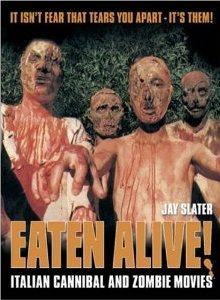
3) Eaten Alive by Jay Slater — This book offers an overview of the Italian film industry’s legendary cannibal and zombie boom.  Along with reviewing every Italian movie to feature even the slightest hint of cannibalism or the living dead (this is one of the few books on Italian cinema that discusses both Pasolini and Lucio Fulci as equals), Eaten Alive also features some very revealing interviews with such iconic figures as Catriona MacColl, Ian McCullough, and especially Giovanni Lombardo Radice.  Radice, in fact, also contributes a memorable “guest” review of one of the movies featured in the book.  (“What a piece of shit!” the review begins.)  Memorable reviews are also contributed by Troma film founder Lloyd Kaufman who brilliantly (and correctly) argues that Cannibal Holocaust is one of the greatest films ever made and Ramsey Campbell who hilariously destroys Umberto Lenzi’s infamous Nightmare City.

2) The Book of the Dead by Jamie Russell — If, like all good people, you love zombies then you simply must do whatever it takes to own a copy of this book.  Starting with such early masterpieces as White Zombie and I Walked With A Zombie, Russell proceeds to cover every subsequent zombie film up through George Romero’s Land of the Dead.  Russell offers up some of the best commentaries ever written on Romero’s Dead films, Fuci’s Beyond Trilogy, Rollin’s Living Dead Girl, and Spain’s Blind Dead films.   The pièce de résistance, however, is an appendix where Russell describes and reviews literally ever zombie film ever made.

1)  All The Colors Of the Dark by Tim Lucas  — This is it.  This is the Holy Grail of All Film Books.  If you’ve ever asked yourself if any book is worth paying close to 300 dollars, now you have your answer.  This one is.  Tim Lucas offers up the most complete biography of director Mario Bava ever written.  In fact, this may be the most complete biography of any director ever written!  Lucas examines not only Bava’s life but also every single movie that Bava was ever in any way connected to, whether as a director or as a cameraman or as the guy in charge of the special effects.  This is 1,128 pages all devoted to nothing but the movies.  This is the type of book that makes me thankful to be alive and I owe a huge debt of gratitude to Tim Lucas for writing it.