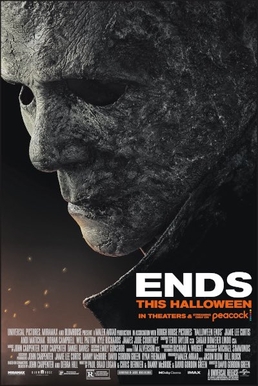
Halloween Ends? Not likely.
It is true that, with this movie, David Gordon Green does close out his version of the Halloween trilogy and, for that, we should all be thankful. For all the critical acclaim that the film received, none of Green’s Halloween films seem destined to stand the test of time. I like almost all of David Gordon Green’s work except for his Halloween films and, unfortunately, I find his version of Halloween to be so self-important and annoying that it overshadows what I previously liked about his other movies. (Don’t even get me started on the news that he will next be rebooting The Exorcist.) Watching the Green Halloween trilogy, you find yourself wondering why Green made the films at all since he seems to consider the whole slasher genre to be beneath him. Say what you will about Rob Zombie’s Halloween films, Zombie at least loves the horror genre. Green, like so many Blumhouse filmmakers, only seems to make horror films so that he can remind us that he’s better than them.
But I doubt that this will be the final Halloween film. It will be the last Halloween film produced under Blumhouse, as the rights to the story and the characters now revert back to Malek Akkad. And, as long as there is money to be made off of the franchise, there will be new Halloween films. Someone else will come along and reboot the franchise and hopefully wipe out the Green continuity just as ruthlessly as Green wiped out the previous franchise’s continuity. In an age of franchises and prequels and cinematic universes, the Halloween franchise is proud to say, “Ha! You mean you actually kept track of what happened in all the other movies!? Sucks to be you, dumbass.”
But let’s talk about Halloween Ends.
As you may remember, Halloween Kills ended with Michael killing Laurie Strode’s daughter and Laurie (Jamie Lee Curtis) grabbing a shotgun and heading out to get revenge. Well …. ha ha, joke’s on you. Laurie never got her revenge. Michael vanished. Four years later, Laurie has gone from being a badass survivalist to being a cheerful, cookie-baking grandma because she had to let go of the anger. Laurie spent forty years preparing for Michael to return and then, when Michael does return and brutally murders her daughter, Laurie decides that she has to let go of her anger. Laurie’s main concern is that the town of Haddonfield is now a traumatized and angry place. Maybe she can spread positivity by writing a memoir about her life. Sadly, this means that we also have to listen to passages from Laurie’s memoirs. Laurie Strode is good at fighting psychotic killers but she sucks as a writer.
Unfortunately, whenever Laurie leaves the house that she shares with her granddaughter, Allyson (Andi Matichak), she runs the risk of being accosted by all of the angry people who all lost a relative or a friend to Michael Myers. All of them view Laurie as being a reminder of the pain caused by Michael. They actually do have a point and you have to wonder about Laurie’s claim that she’s staying in Haddonfield to help the town heal. First off, I don’t know why Laurie would have so much loyalty to what appears to be a fairly generic suburb. Secondly, the townspeople are so traumatized that is actually seems a bit a selfish for Laurie to remain in Haddonfield and to continually remind everyone of the worst night of their lives. I mean, Laurie could move. You know who can’t leave? The wheelchair-bound woman who was paralyzed while Michael was killing everyone in town because he wanted to find Laurie.
Michael disappeared after killing Laurie’s daughter. No one knows where Michael is. Michael is a big and fearsome serial killer who nearly wiped out an entire town and he’s out there somewhere and apparently, no one is looking for him. That’s what one has to assume because, according to the film, he’s spent the last four years living underneath a bridge. He’s still wearing his mask. He looks and acts exactly the same way as he did previously. He’s still killing people. He’s just doing it under a bridge. How, in four yeas time, has it not occurred to anyone in law enforcement to not check under the bridge? It’s the most obvious hiding spot in town but no one looked under the bridge. And why, if Michael is obsessed with killing Laurie, has he spent four years under a bridge as opposed to going to Laurie’s house?
Michael is pretty much treated as a supporting character in Halloween Ends. For that matter, so is Laurie. The majority of the film centers around a new character named Corey (Rohan Campbell). Corey was a college student with a bright future until a terrible babysitting accident led to the death of a boy named Jeremy. Corey was blamed for the death, even though it really wasn’t his fault. (The scenes with Corey and Jeremy open the film and are so well-handled that it leaves little doubt that Green was far more emotionally invested in Corey’s storyline than he was in any of the Michael/Laurie nonsense.) Even though Corey was acquitted of manslaughter, he is now the town pariah. Corey meets and falls in love with Allyson but, unfortunately, the town’s constant taunting and suspicion causes him to snap. He becomes a disciple and then a rival of Michael’s.
Corey is the type of damaged character who has been at the center of many of David Gordon Green’s non-Halloween films. One gets the feeling that Green wanted to make a movie about Corey but, since he’s abandoned indie films in order to spend his time screwing up venerable horror franchises, Green and co-writer Danny McBride instead jammed Corey’s story into a Halloween film. While Corey has the potential to be an interesting character, he doesn’t belong here. Making Corey into a killer means reducing Michael’s powers. Michael goes from being a fearsome symbol of pure evil to being some guy in the sewers who gets beaten up and mugged by a nerdy guy who previously couldn’t even stand up to the members of the school band. It not only goes against the spirit of the original Halloween films but also against everything that was previously established in the Green Halloween films. I mean, Corey beats up Michael after Corey gets beaten up by a bunch of band kids. Maybe if the posse in Halloween Kills had been made up of the high school marching band, Laurie’s daughter would still be alive.
It all gets to be a bit annoying. There are so many little things that don’t make any sense. My favorite is that the family of that hired Corey to babysit moves out of their house after the death of their son. Corey continues to break into the now abandoned house, which has sat empty for four years. And yet, the abandoned house is remarkably well taken care of. For some reason, the family took all of their furniture but left behind a grand piano. Why wouldn’t they take the piano with them? In the drawing room, there’s a book shelf that is empty except for three books. Why would the family leave those three books behind? When Green rebooted the Halloween franchise, he ignored all of the sequels because, according to him, the sequels weren’t any good and didn’t make sense. But Halloween Ends feels as rushed and nonsensical as any of the films that featured Danielle Harris as Laurie’s daughter.
The film ends with the community of Haddonfield coming together once again. It’s a scene that I wish I could describe but to do so would mean spoiling the end of the movie. Let’s just say that it’s incredibly dumb and it almost feels like a parody of the previous Green films. One of the worst thing about the Green films is the insistence of presenting Haddonfield as being some sort of iconic location as opposed to just being a generic anytown USA. The whole reason why the original Halloween films were so effective was because Haddonfield could have been anywhere. Green tries to turn Haddonfield into another Twin Peaks and it’s another sign that he never really understood what made John Carpenter’s original film work in the first place. Ironically, a lot of what happens during the final moments of Halloween Ends would make more sense if Michael was Laurie’s brother but, again, the Green films did away with all that.
Halloween Ends is not necessarily the worst film of 2022. As a director, Green is still capable of coming up with an effective shot or two. But, considering the hype that accompanied it, it is one of the most disappointing. And it also has the most unintentionally funny ending of any film you’re likely to see in 2022. Whenever I feel down, I just think about that solemn procession to the auto yard and it cheers me right up.
As I said at the start of this review, Halloween will never end as long as there is money to be made. So, in another few years, we’ll get another reboot and, once again, we’ll discover with Laurie, Tommy Doyle, Linsdey, and Sheriff Brackett have been doing since the night Michael came home. My idea for a reboot is that they should make Michael and Laurie into siblings. That would be interesting.
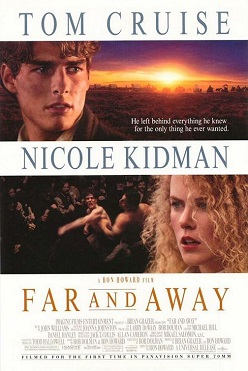 The year is 1892 and Joseph Donnelly (Tom Cruise) is a poor tenant famer in Ireland, used and exploited by the wealthy landowners. Joseph falls in love with Shannon Christie (Nicole Kidman), the rebellious daughter of his landlord. Shannon dreams of going to America, where rumor has it that land is being given away in the territory of Oklahoma on a first come/first serve basis. Shannon even has some valuable spoons that she can use to raise money once they arrive in America. Joseph, after being challenged to a duel by the Christies’ money manger, Stephen Chase (Thomas Gibson), also decides that heading to America might be a good idea.
 Through the Shattered Lens