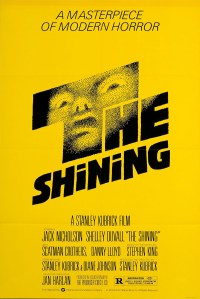
This scene, of course, is from 1980’s The Shining.
Technically, this is before Jack Torrance met the ghosts and started to lose his mind but, in this scene, you can tell that Jack’s already getting a little bit tired of his family. Jack Nicholson’s delivery of, “See? It’s okay. He heard it on the television,” gets me every time.
Today is a very special day! It’s Roger Corman’s 92nd birthday!
Here at the Shattered Lens, we traditionally celebrate this day with a special edition of Lisa Marie’s Favorite Grindhouse and Exploitation Film Trailers! Below, you’ll find the trailers for 12 films that were either directed by, produced by, or distributed by the legendary Roger Corman!
Five Guns West (1955)
This western was the first film that Roger Corman was credited with directing.
2. The Day The World Ended (1955)
Though Corman worked in almost every type of film genre imaginable, he’s probably best remembered for his science fiction and horror films. This was one of the first of them.
3. Machine Gun Kelly (1958)
Along with westerns and sci-fi films, Corman also directed several gangster classics. Machine Gun Kelly is remembered as one of his best.
4. The Intruder (1962)
Corman was an exploitation filmmaker with a conscience. At a time when other films were avoiding social issues, Corman dove right in with challenging films like The Intruder.
5. The Terror (1963)
Corman was famous for his ability to spot new talent. His 1963 film The Terror starred a then unknown actor named Jack Nicholson.
6. The Masque of the Red Death (1964)
In the 60s, Corman was also well-known for his Edgar Allan Poe adaptations, the majority of which starred Vincent Price. With these colorful and flamboyant films, Corman showed himself to be a pop artist at heart.
7. Boxcar Bertha (1972)
In the 70s, Corman moved away from directing and focused on producing. His ability to spot talent undiminished, Corman helped to launch the careers of the some of the important directors of all time. In 1972, he hired a young director named Martin Scorsese to direct Boxcar Bertha.
8. Cries and Whispers (1973)
While Corman was producing exploitation films, he was also distributing “difficult” foreign-language films that might otherwise have never been seen in an American theater. In 1973, he distributed this classic Ingmar Bergman film. Cries and Whispers was nominated for best picture of the year, losing to The Sting.
9. Caged Heat (1974)
Jonathan Demme was another director who got his start directing Corman-produced films like Caged Heat. Demme would later thank Corman by casting him in several of his films, including the 1991 Best Picture winner, The Silence of the Lambs.
10. Piranha (1978)
Piranha was one of Corman’s biggest hits as a producer.
11. Carnosaur (1993)
With Carnosaur, Corman showed that you didn’t need a lot of money to bring dinosaurs back to life.
12. Dinocroc vs Supergater (2010)
Corman has continued to produce films in the 21st century. Films like Dinocroc vs Supergator not only won him legions of new fans but they also paved the way for films like Sharkando.
There’s a lot of good stuff being broadcast this month, so it’s time once again to make some room on the ol’ DVR. Here’s a quartet of capsule reviews of films made in that mad, mad decade, the 1960’s:
THE FASTEST GUITAR ALIVE (MGM 1967; D: Michael D. Moore) – MGM tried to make another Elvis out of rock legend Roy Orbison in this Sam Katzman-produced comedy-western. It didn’t work; though Roy possessed one of the greatest voices in rock’n’roll, he couldn’t act worth a lick. Roy (without his trademark shades!) and partner Sammy Jackson (TV’s NO TIME FOR SERGEANTS) peddle ‘Dr. Ludwig Long’s Magic Elixir’ in a travelling medicine show, but are really Confederate spies out to steal gold from the San Francisco mint to fund “the cause” in the waning days of the Civil War. The film’s full of anachronisms and the ‘comical Indians’ aren’t all that funny…
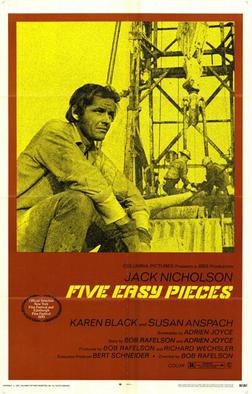
First released in 1970, Five Easy Pieces tells the story of a lost man named Bobby Dupea (Jack Nicholson).
When we first meet Bobby, he’s working at a California oil field. He likes to go bowling. He has a girlfriend named Rayette (Karen Black), who is a country music-obsessed waitress. His best friend is Elton (Billy “Green” Bush), a friendly redneck with a memorable laugh. Bobby may have a girlfriend and Elton may be married but that doesn’t stop either one of them from going out at night, getting drunk, and trying to pick up women.
Bobby seems to be just another blue-collar guy with a grudge against the bosses but it doesn’t take long to realize that there’s something different about him. Bobby may be friends with Elton but it’s obvious that the two of them come from very different background. No matter how much he tries to hide it, Bobby is smarter than everyone else around him. When he and Elton get stuck in a traffic jam, Bobby spots a piano sitting on the back of a pickup truck. Getting out of his car, Bobby yells at everyone who is honking and then climbs up to the piano. He sits down, he puts his fingers to the keys and he starts to play. Knowing Bobby, you’re expecting him to just bang the keys and make noise. Instead, he plays beautiful music.
Later, Bobby steps into a recording studio. Paritia (Lois Smith), a neurotic woman, is playing the piano. The recording engineers joke about her lack of talent. Bobby glares at them, annoyed. It quickly becomes apparent why Bobby is so protective. Paritia is Bobby’s sister.
Bobby, it turns out, comes from a wealthy family of musicians. Everyone in the family has dealt with the pressure to succeed differently. Paritia continues to play, despite not having much talent. Bobby’s older brother, the buffoonish Carl (Ralph Waite), plays violin and has staid home with their father (William Challee). Bobby, on the other hand, ran away from home. He’s spent his entire life trying to escape from both his talent and his family. However, when Paritia explains that their father has suffered from two strokes and might not live much longer, Bobby reluctantly decides to return home and try to make some sort of peace with his father.
It’s not as easy a journey as Bobby would have liked. For one thing, Rayette demands to go with him. On the drive up to Washington, they pick up two hitchhikers (Helena Kallionetes and Toni Basil), one of whom is obsessed with filth. In the film’s most famous scene, an attempt to get a simple lunch order modified leads to Bobby losing control.
See, that’s the thing with Bobby. In many ways, he’s a jerk. He treats Rayette terribly. While his family is hardly perfect, the film doesn’t hide from the fact that Bobby isn’t always the easiest person to deal with. And yet, you can’t help but sympathize with Bobby. If he seems permanently annoyed with the world … well, that’s because the world’s annoying. And, to Bobby’s credit, he’s a bit more self-aware than the typical rebel without a cause. When one of the hitchhikers praises his temper tantrum at the diner, Bobby points out that, after all of that, he still didn’t get the order that he wanted.
In Washington, Bobby tells Rayette to stay at a motel and then goes to see his family. Bobby seems as out-of-place among his wealthy family as he did hanging out in the oil fields with Elton. He ends up cheating on Rayette with Carl’s fiancee, a pianist named Catherine van Oost (Susan Anspach).
And then Rayette shows up for dinner…
Five Easy Pieces is a sometimes funny and often poignant character study of a man who seems to be destined to always feel lost in the world. Bobby spends the whole movie trying to find a place where he can find happiness and every time, reality interferes with his plans. Nicholson gives a brilliant performance, playing Bobby as a talented guy who doesn’t really like himself that much. Bobby’s search for happiness leads to a rather haunting ending, one that suggests that some people are just meant to spend their entire life wandering.
Five Easy Pieces was nominated for Best Picture but lost to Patton.
Three cowboys — Vern (Cameron Mitchell), Wes (Jack Nicholson), and Otis (Tom Filer) — are riding their horses across the old west when they come upon a cabin that is inhabited by one-eyed Blind Dick (Harry Dean Stanton) and his friends. Though they suspect that Dick may be an outlaw, the cowboys accept his offer to stay the night. The next morning, they wake up to discover that they are surrounded by a posse. Mistaken for members of Dick’s gang, Vern and Wes go on the run. Eventually, they find themselves hiding out at the home of Evan (George Mitchell), Catherine (Katherine Squire), and their daughter, Abigail (Millie Perkins). While Wes and Vern wait for their chance to escape, the posse grows closer and closer.
A minimalistic western with a fatalistic outlook, Ride In The Whirlwind is today best known for being a pre-Easy Rider credit for Jack Nicholson. Nicholson not only co-produced the film but he also wrote the script. With that in mind, it’s not surprising that Nicholson not only gets the best lines but that he also comes close to getting the girl. Of all the roles that Nicholson played before his star-making turn in Easy Rider, Wes probably comes the closest to being what would be considered to be a typical Jack Nicholson role. Wes is sarcastic, quick with a quip, and alienated by mainstream society (represented here by the relentless posse). Nicholson gives a confident performance and it is interesting to see him co-starring with some of the same actors, like Harry Dean Stanton, who would continue to be associated with him once he became a star. Though the film may be dominated by Nicholson, Stanton also makes a strong impression and comes close to stealing the whole movie.
(Also of note is an early appearance by Rupert Crosse. Years later, Crosse was set to co-star with Nicholson in The Last Detail but his early death led to Otis Young being cast in the role.)
With its dark outlook and anti-establishment theme, Ride In The Whirlwind was before its time and it struggled at the American box office. (According to Monte Hellman, it was very popular in France.) It would be another three years before American culture would catch up with Nicholson’s anti-establishment persona and Easy Rider would make him a star.
The time is World War II. The place is the Philippines, shortly before the famous return of Douglas MacArthur. Three U.S. soldiers have been sent on a very important mission to knock out a Japanese communication center before the American invasion. Lt. Craig (Jimmie Rodgers) is their leader and he worries that he might not have what it takes to kill a man. Sgt. Jersey (John Hackett) is cynical and tough. Cpl. Burnett (Jack Nicholson) is the radio man with a sarcastic sense of humor. They have been told to meet up with a rebel leader named Miguel but, shortly after arriving, they discover that Miguel has been killed and the new leader is Paco (Conrad Maga), who distrusts the Americans almost as much as he dislikes the Japanese. Meanwhile, a Japanese captain (Joe Sison) threatens to execute all of the children in a nearby village unless the Americans either surrender or are captured.
The main reason that most people will probably want to see this low-budget, black-and-white war film is because it features a youngish Jack Nicholson in a supporting role. (It was one of two films that a pre-stardom Nicholson made in the Philippines with director Monte Hellman.) This is one of the best of Nicholson’s pre-Easy Rider performances, with none of the stiffness that’s evident in most of his early work. Nicholson is relaxed and there are even a few hints of the persona that would eventually make him famous.
This was not just an early role for Nicholson. This movie was also an early work of Monte Hellman’s, who went on to direct some of the biggest cult films of the 70s. Hellman makes the most of his low-budget, emphasizing character over action and complexity over simple flag-waving. There is a hard edge to Back Door To Hell. When Craig asks Paco to interrogate a Japanese soldier, both the movie and Paco understand that Craig is asking Paco to torture the prisoner, something that Craig cannot do because he is bound by international law. After conducting his interrogation, Paco does not hesitate to call the American out on his hypocrisy, even while ordering the prisoner to be executed. By the end of the movie, the surviving soldiers and rebels are so emotionally drained that they cannot even celebrate the liberation of the Philippines. When someone asks, “What do we do now?,” no one has an answer. Even beyond the presence of Jack Nicholson, Back Door To Hell is an effective and underrated war film.
(It’s tradition here at the Lens that, every October, we watch the original Little Shop of Horrors. And always, I start things off by telling this story…)
Enter singing.
Little Shop…Little Shop of Horrors…Little Shop…Little Shop of Terrors…
Hi! Good morning and Happy October the 29th! For today’s plunge into the world of public domain horror films, I’d like to present you with a true classic. From 1960, it’s the original Little Shop of Horrors!
When I was 19 years old, I was in a community theater production of the musical Little Shop of Horrors. Though I think I would have made the perfect Audrey, everybody always snickered whenever I sang so I ended up as a part of “the ensemble.” Being in the ensemble basically meant that I spent a lot of time dancing and showing off lots of cleavage. And you know what? The girl who did play Audrey was screechy, off-key, and annoying and after every show, all the old people in the audience always came back stage and ignored her and went straight over to me. So there.
Anyway, during rehearsals, our director thought it would be so funny if we all watched the original film. Now, I’m sorry to say, much like just about everyone else in the cast, this was my first exposure to the original and I even had to be told that the masochistic dentist patient was being played by Jack Nicholson. However, I’m also very proud to say that — out of that entire cast — I’m the only one who understood that the zero-budget film I was watching was actually better than the big spectacle we were attempting to perform on stage. Certainly, I understood the film better than that screechy little thing that was playing Audrey.
The first Little Shop of Horrors certainly isn’t scary and there’s nobody singing about somewhere that’s green (I always tear up when I hear that song, by the way). However, it is a very, very funny film with the just the right amount of a dark streak to make it perfect Halloween viewing.
So, if you have 72 minutes to kill, check out the original and the best Little Shop of Horrors…
In Bucket of Blood, Dick Miller plays, for the first time, a character named Walter Paisley. Walter is an artist who discovers that the dead make the best models!
2. Little Shop of Horrors (1960)
Dick Miller returned to play a supporting role in Little Shop of Horrors, where his co-stars included a young Jack Nicholson.
3. The Terror (1963)
Both Jack Nicholson and Dick Miller returned for The Terror and they were joined by Boris Karloff.
4. The Raven (1963)
At around the same time, Karloff and Nicholson were co-starring with Vincent Price and Peter Lorre in The Raven.
5. The Masque of the Red Death (1964)
Price would return for The Masque of the Red Death.
6. The Tomb of Ligeia (1964)
To my knowledge, this film was the final time Corman directed Vincent Price, though he produced a few more films that featured him.
What do you think about all the trailers, random director with a tommy gun?
Let’s kick off the third annual “Halloween Havoc” with Vincent Price, Peter Lorre, Boris Karloff, Hazel Court, young Jack Nicholson , director Roger Corman , screenwriter Richard Matheson , and an “idea” by Edgar Allan Poe. How’s that for an all-star horror crew? The film is THE RAVEN, Corman’s spoof of all those Price/Poe movies he was famous for, a go-for-the-throat comedy guaranteed to make you spill your guts with laughter!
Sorcerer Erasmus Craven (Price ), still pining for his late, lost Lenore, hears someone gently rapping on his chamber door… er, window. It’s a raven, a talking raven, in reality Adolpho Bedlo (Lorre ), who’s been put under a spell by the Grand Master of magicians, Dr. Scarabus (Karloff ), who like Craven is adept at “magic by gesture”. After Craven mixes up a potion to reverse the spell, Bedlo tells him he’s seen Lenore alive at Scarabus’s castle.
After Tom Logan (Jack Nicholson) and his gang of rustlers (played by Randy Quaid, Frederic Forrest, and Harry Dean Stanton) rob a train, Logan uses the money to buy a small ranch. Their new neighbor is Braxton (John McLiam), a haughty land baron who considers himself to be an ambassador of culture to the west but who is not above hanging rustlers and hiring gunmen. One such gunman is the eccentric Robert E. Lee Clayton (Marlon Brando), a “regulator” who speaks in a possibly fake Irish brogue, is a master of disguise, and uses a variety of hand-made weapons. Braxton hires Clayton to kill Logan and his men, despite the fact that his daughter (Kathleen Lloyd) has fallen in love with Logan.
A flop that was so notorious that it would be five years before Arthur Penn got a chance to direct another film, The Missouri Breaks is best remembered for Marlon Brando’s bizarre performance. Brando reportedly showed up on the set late and insisted on largely improvising his part, which meant speaking in a comical Irish accent, singing an impromptu love song to his horse, and disguising himself as an old woman for one key scene. (According to Patrick McGilligan’s Jack’s Life: A Biography of Jack Nicholson, co-star Harry Dean Stanton grew so incensed at Brando’s behavior that he actually tried to rip the dress off of Brando, saying that he simply would not be “killed’ by a man wearing a dress.) Brando’s later reputation for being a disastrously weird performer largely started with the stories of his behavior on the set of The Missouri Breaks.
I had heard so many bad things about Brando and The Missouri Breaks that I was surprised when I finally watched it and discovered that it is actually a pretty good movie. For all of his notoriety, Brando does not enter this leisurely paced and elegiac western until after half a hour. The majority of the movie is just about Jack Nicholson and his gang, with Nicholson giving a low-key and surprisingly humorous performance that contrasts well with Brando’s more flamboyant work. While Arthur Penn may not have been able to control Brando, he still deftly combines moments of comedy with moments of drama and he gets good performances from most of the supporting cast. Quaid, Stanton, Forrest, and Nicholson are all just fun to watch and the rambling storyline provides plenty of time to get to know them. Whenever Brando pushes the movie too close to self-parody, Nicholson pulls it back. The Missouri Breaks may have been a flop when it was released but it has aged well.


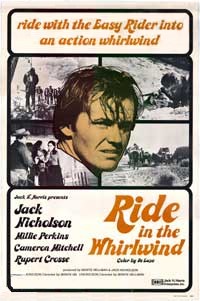 Three cowboys — Vern (Cameron Mitchell), Wes (Jack Nicholson), and Otis (Tom Filer) — are riding their horses across the old west when they come upon a cabin that is inhabited by one-eyed Blind Dick (Harry Dean Stanton) and his friends. Though they suspect that Dick may be an outlaw, the cowboys accept his offer to stay the night. The next morning, they wake up to discover that they are surrounded by a posse. Mistaken for members of Dick’s gang, Vern and Wes go on the run. Eventually, they find themselves hiding out at the home of Evan (George Mitchell), Catherine (Katherine Squire), and their daughter, Abigail (Millie Perkins). While Wes and Vern wait for their chance to escape, the posse grows closer and closer.
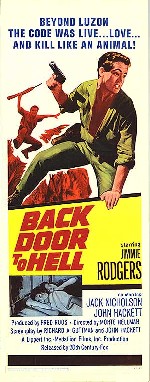 The time is World War II. The place is the Philippines, shortly before the famous return of Douglas MacArthur. Three U.S. soldiers have been sent on a very important mission to knock out a Japanese communication center before the American invasion. Lt. Craig (Jimmie Rodgers) is their leader and he worries that he might not have what it takes to kill a man. Sgt. Jersey (John Hackett) is cynical and tough. Cpl. Burnett (Jack Nicholson) is the radio man with a sarcastic sense of humor. They have been told to meet up with a rebel leader named Miguel but, shortly after arriving, they discover that Miguel has been killed and the new leader is Paco (Conrad Maga), who distrusts the Americans almost as much as he dislikes the Japanese. Meanwhile, a Japanese captain (Joe Sison) threatens to execute all of the children in a nearby village unless the Americans either surrender or are captured.


 After Tom Logan (Jack Nicholson) and his gang of rustlers (played by Randy Quaid, Frederic Forrest, and Harry Dean Stanton) rob a train, Logan uses the money to buy a small ranch. Their new neighbor is Braxton (John McLiam), a haughty land baron who considers himself to be an ambassador of culture to the west but who is not above hanging rustlers and hiring gunmen. One such gunman is the eccentric Robert E. Lee Clayton (Marlon Brando), a “regulator” who speaks in a possibly fake Irish brogue, is a master of disguise, and uses a variety of hand-made weapons. Braxton hires Clayton to kill Logan and his men, despite the fact that his daughter (Kathleen Lloyd) has fallen in love with Logan.
 Through the Shattered Lens