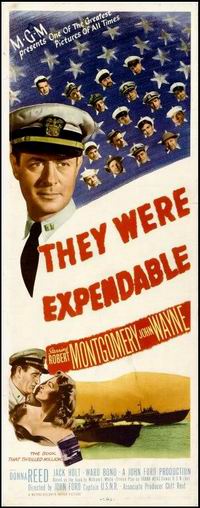
They Were Expendable (1945, directed by John Ford)


In December of 1941, Lt. John Brickley (Robert Montgomery) commands a squadron of Navy PT boats, based in the Philippines.  Brickley is convinced that the small and agile PT Boats could be used in combat but his superior officers disagree, even after viewing a demonstration of what they can do.  Brickley’s second-in-command, Rusty (John Wayne), is frustrated and feels that he will never see combat.  That changes when the Japanese attack Pearl Harbor and then turn their attention to the Philippines.  Brickley gets his chance to show what the PT boats can do but both he and his men must also deal with the terrible risks that come with combat.  Brickley and his men have been set up to fight a losing battle, only hoping to slow down the inevitable Japanese onslaught, because both they and their boats are considered to be expendable.  The hot-headed Rusty learns humility when he’s sidelined by blood poisoning and he also falls in love with a nurse, Sandy (Donna Reed).  However, the war doesn’t care about love or any other plans that its participants may have.  With the invasion of the Philippines inevitable, it just becomes a question of who will be sent with MacArthur to Australia and who will remain behind.

One of John Ford’s best films, They Were Expendable is a tribute to the U.S. Navy and also a realistic look at the realities of combat.  The movie features Ford’s trademark sentimentality and moments of humors but it also doesn’t deny that most of the characters who are left behind at the end of the movie will not survive the Japanese invasion.  Even “Dad’ Knowland (Russell Simpson), the fatherly owner of a local shipyard who does repair work on the PT boats, knows that he’s expendable.  He resolves to meet his fate with a rifle in hand and a jug of whiskey at his feet.  Rusty, who starts out thirty for combat, comes to learn the truth about war.  Ford was one of the many Hollywood directors who was recruited to film documentaries during World War II and he brings a documentarian’s touch to the scenes of combat.

Robert Montgomery had previously volunteered in France and the United Kingdom, fighting the Axis Powers before America officially entered the war.  After the war began, he entered the Navy and he was a lieutenant commander when he appeared in They Were Expendable.  Montgomery brought a hardened authenticity to the role of Brickley.  (Montgomery also reportedly directed a few scenes when Ford was sidelined with a broken leg.)  John Wayne is equally good in the role of the hot-headed Rusty, who learns the truth about combat and what it means to be expendable.  The cast is full of familiar faces, many of whom were members of the John Ford stock company.  Keep an eye out for Ward Bond, Cameron Mitchell, Leon Ames, Jack Holt, and Donald Curtis.

They Were Expendable is one of the best of the World War II movies.  It’s a worthy film for Memorial Day and any other day.
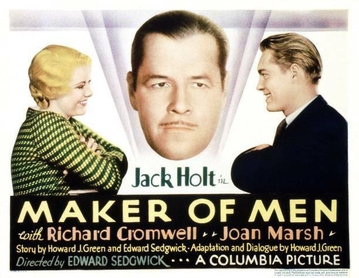
Maker Of Men (1931, directed by Edward Sedgwick)


Bob Dudley (Richard Cromwell) is the wimpy son of Coach Dudley (Jack Holt), who is in charge of the local college’s football team.  Bob joins the team out of a sense of family obligation but he turns out to be a cowardly player who would rather fumble the ball than take a hard hit.  Coach Dudley is disgusted with his son.  Bob’s girlfriend (Joan Marsh) dumps him.  Bob drops out of school and disappears for two years and no one seems to care. Then, on the day of a big game, Bob reappears playing for another college.  Despite Coach Dudley’s team being led by All-American Dusty Rhoades (John Wayne!), Bob leads the rival team to victory.  He’s won Coach Dudley’s respect.  Coach Dudley is probably going to get fired.

This was one of the weirdest sports films that I’ve ever seen.  Usually, you would expect Coach Dudley to bring out the best in his son or to understand that his son is just not meant to be a football player.  Instead, Bob is forced to drop out of college!  Bob returns just so he can defeat his father.  The slight Richard Cromwell is not a convincing football player.  On the other hand, John Wayne is a convincing football player but his role is tiny.  The movie is a little over an hour long and 20 minutes of that running time is taking up with grainy footage of an actual football game.

The best thing about the film?  It reminds us that everyone, even John Wayne, had to start somewhere.

Renegade Girl (1946, directed by William Berke)


Missouri in 1864.  The Civil War is raging and the state is divided between those who support the Union and those secretly support the Confederate guerillas led by Willian Quantrill (Ray Corrigan).  The Union’s Major Baker (Jack Holt) is determined to track down rebel Bob Shelby (Jimmie Martin) and he enlists the Native American Chief Whitecloud (played by Chief Thundercloud) to help find him.  Whitecloud has a personal vendetta against the Shelby family and, when he finds Bob, he executes him in cold blood.  Bob’s sister, Jean Shelby (Ann Savage), is also a Confederate sympathizer and she seeks revenge.  Complicating things is that Jean has fallen in love with Union Captain Fred Raymond (Alan Curtis).

One of the many B-westerns produced by Robert L. Lippert and directed by William Berke, Renegade Girl packs a lot of plot into just 65 minutes.  The action is nonstop and fans of westerns will find all of the horse chases, gunfights, and threats of hanging that they could want.  The main thing that distinguishes Renegade Girl from other B-westerns is the fierce performance of Ann Savage as Jean Shelby, a woman who will not stop until she gets her revenge.  While the film’s portrayal of the Quantrill and Chief Whitecloud definitely goes against modern sensibilities, Ann Savage’s performance feels ahead of her time.  No one is going to stand in Jean Shelby’s way.

Chief Thundercloud’s real name was reportedly Victor Daniels, though his past is shrouded in mystery.  He claimed to be a Cherokee from Arizona, though he was listed as being Mexican on a marriage record that was filed before he started his film career.  As Chief Thundercloud, he was a mainstay in westerns from the 30s to the time of his death in 1955.  He was the first actor to play the Lone Ranger’s Tonto and he also played Geronimo in a 1939 Paramount film of the same name.  His final film role was a posthumous appearance in John Ford’s The Searchers.

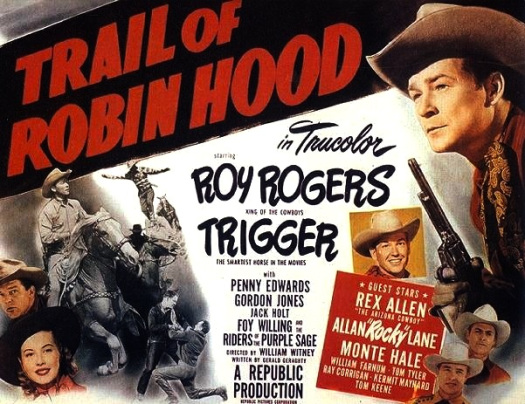
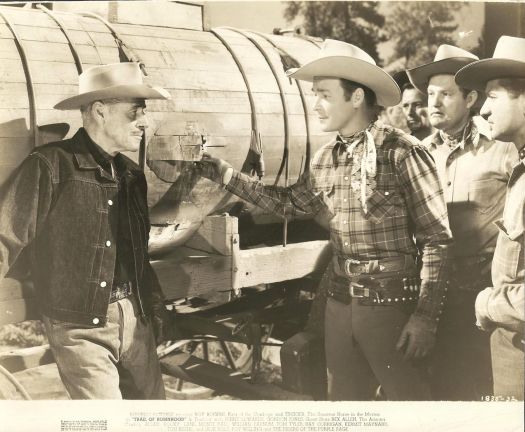
Cowboy Christmas: TRAIL OF ROBIN HOOD (Republic 1950)


gary loggins's avatarcracked rear viewer

There’s no sign of Robin Hood to be found in the Roy Rogers vehicle TRAIL OF ROBIN HOOD. However, the film has gained a cult following among sagebrush aficionados for the plethora of cowboy stars gathered together in this extremely likable little ‘B’ Western directed by Republic Pictures workhorse William Whitney William Whitney, with plenty of songs by Roy and the Riders of the Purple Sage to go along with that trademark Republic fightin’ and a-ridin’ action (thanks, stuntmen Art Dillon, Ken Terrell, and Joe Yrigoyen!).

Some rustlers have been stealing Christmas trees from ‘retired actor’ Jack Holt’s tree farm. The benign Jack raises his trees to sell at cost to parents of poor kids, but avaricious J.C. Aldridge (Emory Parnell ) and his foreman Mitch McCall (former Our Gang member Clifton Young ) want to put an end to it and corner the Christmas tree market! U.S. Forestry Agent…

View original post 421 more words

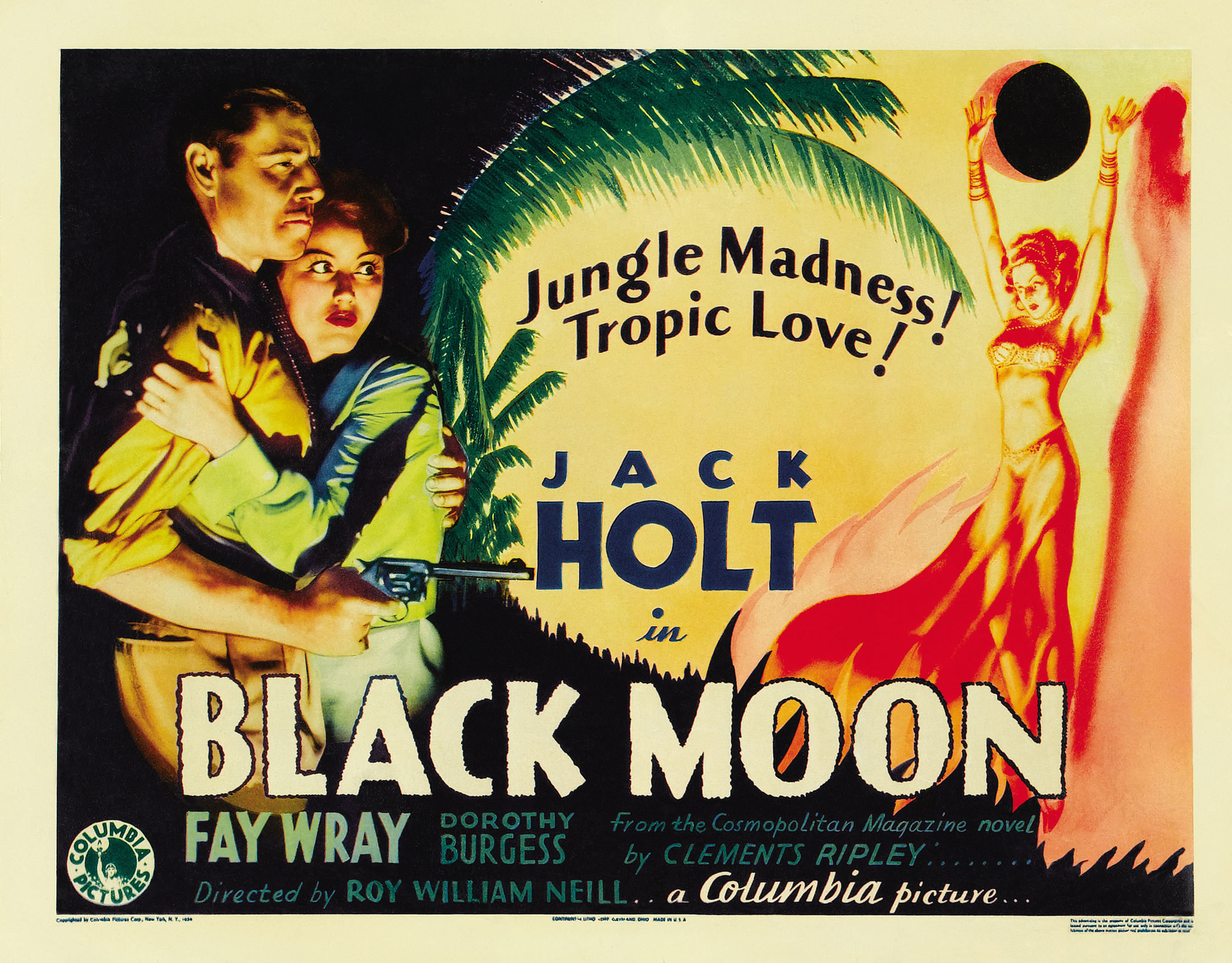
Halloween Havoc!: BLACK MOON (Columbia 1934)


gary loggins's avatarcracked rear viewer

moon1

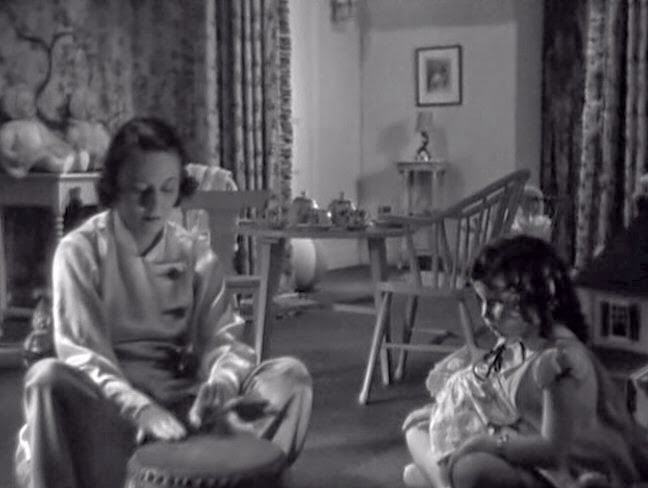
I thought I’d seen, or at least heard of, all the horror films made during the 1930’s. I was wrong. BLACK MOON was new to me when I viewed it recently as part of TCM’S Summer Under the Stars salute to KING KONG’s  main squeeze, Fay Wray. It’s a voodoo tale also starring square-jawed Jack Holt and Pre-Code favorite Dorothy Burgess . The director is Roy William Neill, who would later work with genre giants Karloff (THE BLACK ROOM), Lugosi and Chaney (FRANKENSTEIN MEETS THE WOLF MAN), and helm eleven of the Universal Sherlock Holmes films with Basil Rathbone.

moon2

The film open with the pounding of jungle drums, and we see Nita Lane (Burgess) is the one pounding them in her luxurious home. Nita grew up on the Caribbean isle of San Christopher, where her parents were murdered during a native uprising. Hubby Stephen (Holt) is against Nita returning to the…

View original post 456 more words

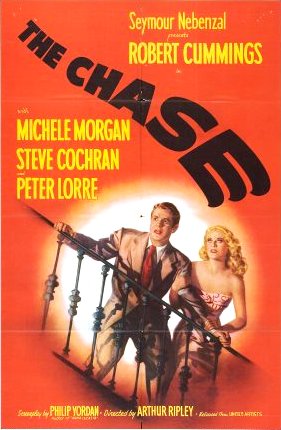
The Fabulous Forties #18: The Chase (dir by Arthur Ripley)


The_Chase_1946_posterThe 18th film in Mill Creek’s Fabulous Forties box set was 1946’s The Chase, which turned out to be a pretty nifty little film noir.  Did I actually just use the word nifty in a film review?  Yes, I did but then again, everyone should use the word “nifty” at least once in their lives.

The Chase tells the story of Chuck Scott (Robert Cummings), whose life is anything but nifty.  When we first meet him, he’s standing outside in the rain, staring into a restaurant, and enviously watching the people eating inside.  Chuck is a returning serviceman.  He helped to win World War II but he’s now returned to a society that has changed in his absence.  He has no money, he has no home, and he suffers from what we would today call PTSD.

Things change for Chuck when he finds the wallet of a man named Eddie Roman (Steve Cochran).  He returns the wallet, discovering that Eddie not only lives in a mansion but he also has a sinister henchman named Gino (Peter Lorre!).  Eddie is so impressed that Chuck returned the wallet and didn’t try to steal any of the money that he offers to put Chuck on the payroll.

Soon, he is working as Eddie’s driver.  Of course, Eddie has an accelerator installed in the backseat, so that he can control how fast the car is going.  Eddie enjoys freaking Chuck out by randomly speeding up the car.  Along with being a spectacularly bad passenger, Eddie also turns out to be a gangster.

When Chuck meets the mysterious Lorna (Michele Morgan), it’s love at first sight but there’s a big problem.  Lorna happens to be married … to Eddie!  Chuck and Lorna flee to Cuba, with Eddie and Gino in pursuit…

Or do they?

Chuck, it turns out, has been suffering from nightmares since he returned from the war.  Often times, he wakes up with amnesia.  Are Eddie, Gino, and Lorna real or are they just figments of Chuck’s dream state?  Is Chuck really living in a film noir or is he just dreaming that he is?

The Chase is an effectively dark little film noir, one that will keep you guessing.  Steve Cochran appears to be having a lot of fun as the cheerfully sociopathic Eddie (and it’s interesting to note that, in the same year as The Chase, Cochran had a supporting role in another film about the struggles of returning servicemen, the Oscar-winning Best Years Of Our Lives) and, of course, Peter Lorre is great as Gino.  Michele Morgan is both sympathetic and enigmatic as Lorna and Robert Cummings does a good job of playing a man who is never quite sure whether he’s awake or he’s asleep.

The Chase is a classic mix of film noir and psychological melodrama.  Watch it below!

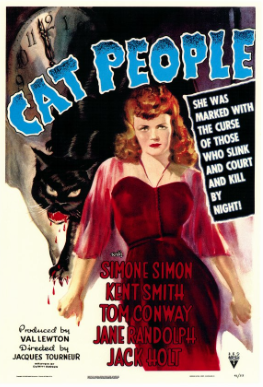
Horror Film Review: Cat People (dir by Jacques Tourneur)


Cat_People_poster

The 1942 horror classic Cat People is often described as being a horror film where, up until the last few minutes, the monsters are mostly psychological.  And there is some definite truth to that.  The title creatures remain a mystery for the majority of the film and, up until those final minutes, the audience would have every right to wonder whether or not they actually existed.  This is a film that seems to take place almost totally in the shadows, a film noir without detectives or gangsters but featuring a memorable and compelling femme fatale.

However, I would argue that there is a monster who is present on-screen long before the audience first sees the shadowy form of a cat person.  That monster is named Louis Judd and he’s the true villain of this story.  As played by Tom Conway, Louis Judd is a psychiatrist and, from the minute we first see him, we know that he’s not to be trusted.  He’s far too smooth for his own good and his soothing tones barely disguise the arrogant condescension behind his words.  If his pencil-thin mustache didn’t make him sinister enough, Dr. Judd also keeps a sword concealed inside of his walking stick.

Irena Reed (Simone Simon) is one of Dr. Judd’s patients.  A fashion designer from Serbia, Irena has recently married an engineer named Oliver Reed (Kent Smith).  Despite the fact that she loves Olivier, she cannot bring herself to be intimate with him.  As Dr. Judd discovers, Irena fears that she has been cursed and, if she ever allows herself to become aroused, she will be transformed into a panther.  Dr. Judd repeatedly tells her that her belief is just superstition and that her fears are the result of repressed trauma from her childhood.  When Irena refuses to accept his diagnosis and continues to insist that she is cursed, Dr. Judd assumes that he can prove her wrong by forcing himself on her.  (Big mistake.)

Meanwhile, Oliver loves Irena but her refusal to consummate their marriage is driving him away.  He finds himself growing more and more attracted to his co-worker, Alice (Jane Randolph).  At first, Irena is upset to discover that Oliver has been telling Alice about their problems.  But eventually Irena realizes that all she can do is watch as Oliver and Alice grow closer and closer.  Irena knows that she can’t give Oliver what he desires but the confident and outspoken Alice can.  As Irena grows more and more jealous, Alice starts to feel as if she’s being watched and followed.  She starts to hear growls in the shadows and when she’s at her most vulnerable — swimming alone at night — she is shocked when Irena suddenly appears and demands to know where Oliver is.

And really, that’s what makes Cat People such a great film.  It’s not necessarily a scary film, at least not to modern audiences.  Sadly, we have seen so much graphic real-life horror and have become so jaded by CGI that we’re no longer scared by the mere cinematic suggestion of a monster.  But the film still works because we can relate to both Irena and Alice.  When I look over my relationships, I can see times when I’ve been both the insecure Irena and the confident Alice.  For a film where the word “sex” is never uttered once, Cat People is a penetratingly honest look at relationships, love, and sexuality.

And it also features a truly memorable monster.

Seriously, that Dr. Judd is the worst!

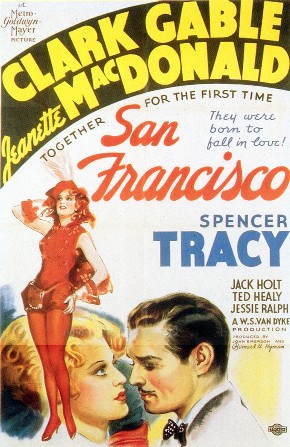
Lisa Watches An Oscar Nominee: San Francisco (dir by W.S. Van Dyke)


San_Francisco_(film)_poster

As I sit here writing this, I’m snowed in, my asthma’s acting up, and our cat is quickly losing patience with me.  On the plus side, however, this weather has given me an opportunity to watch some more of the old best picture nominees that I had saved up on my DVR.

For instance, I just finished watching the 1936 best picture nominee, San Francisco.

San Francisco was one of the first disaster films, a film that follows a group of characters as they attempt to survive the 1906 earthquake that destroyed the town of San Francisco.  And it has to be said that, nearly 80 years after the film was first released, the climatic earthquake remains effective and scary.  San Francisco, of course, was made long before there was any such thing as CGI.  Many of the film’s sets were built on special platforms that were designed to shake back and forth, just like in an actual earthquake.  When you see walls and buildings collapsing in San Francisco, you know that those walls are breaking apart and collapsing for real and the extras running for their life are literally doing just that.  After the earthquake, Clark Gable, as the film’s hero, walks through the ruins of San Francisco with the haunted look of a true survivor.  Gable was such a confident actor that it’s still jarring to see him looking overwhelmed.

Unfortunately, before you get to that spectacular earthquake, you have to sit through the rest of the film.  It’s a massive understatement to say that the pre-earthquake portion of San Francisco drags.  Clark Gable is Blackie Norton, a notorious gambler and saloon keeper.  Blackie may be a rogue but he’s a rogue with a heart of gold.  His childhood friend, Father Tim (Spencer Tracy), wants Blackie to run for the board of supervisors.  Blackie, however, is more interested in Mary Blake (Jeanette MacDonald), the newest singer at his club.

From the minute she first appears to the very end of the film, Jeanette MacDonald is singing.  Even when she’s not at the center of the scene, you can often hear her singing in the background.  And, after a little while, you just want her to stop singing.  But, whenever that happens, she tries to act and you realize that the only thing more boring than Jeanette MacDonald singing is Jeanette MacDonald acting.

Anyway, the film goes through all of the expected melodrama.  Blackie wants to reform.  Blackie decides not to reform.  Father Tim believes that there’s good in Blackie.  Father Tim gives up on Blackie.  Father Tim decides to give Blackie another chance.  Mary loves Blackie.  Mary fears Blackie.  Mary leaves Blackie.  Mary comes back to Blackie.  Mary leaves Blackie again.  Mary sings.  And sings and sings and sings…

But then, just when you’re about to fall asleep, the city starts to shake and all is forgotten in the wake of a natural disaster.  Even earthquakes serve a purpose…

San Francisco was a huge box office success.  It was nominated for best picture.  Somehow, Spencer Tracy received a nomination for best actor, despite the fact that he’s really not that impressive in the film. (His role is primarily a supporting one and he’s consistently overshadowed by Gable.)  The only Oscar that San Francisco won was for best sound recording and it must be said that, after all these years, the earthquake still sounds terrifying.

As for the film itself, I’d suggest skipping ahead to the earthquake.  That, after all, is the main reason anyone would be watching the film and, by skipping ahead, you’re spared having to sit through an hour and a half of Jeanette MacDonald singing.