Film Review: Deepwater Horizon (dir by Peter Berg)


2016’s Deepwater Horizon tells the story of the 2010 explosion that led to the biggest oil spill in American history.

Owned by British Petroleum, the Deepwater Horizon was an oil rig sitting off the coast of Louisiana and Texas.  A series of explosions, which were found to be the result cost-cutting and negligence on the part of BP, killed eleven men, injured countless others, and led to an 87-day oil spill that leaked 210 million gallons of oil into the Gulf of America (or the Gulf of Mexico, as it was known back then.  I know, it can be heard to keep track).  I can still remember when the disaster happened.  It was seen as an early test of the “government-can-fix-anything” philosophy of the Obama era and it pretty much proved the opposite.  Private citizens (including Kevin Costner) offered to help and were rebuffed.  The governor of Louisiana was criticized for ordering the construction of barrier islands, even though they were more effective than was that the federal government was offering up.  The CEO of British Petroleum issued a self-pitying apology.  For a generation coming of political age in 2010, witnessing the government’s ineffective attempts to deal with the oil spill was as radicalizing a moment as the COVID lunacy would be for people coming of age in 2020.

In all the chaos surrounding the oil spill, it was often overlooked that 11 people died in the initial explosion.  In all the rightful criticism that was directed towards British Petroleum, the heroic efforts of the workers on the Deepwater Horizon, all of whom risked their lives to try to prevent the disaster from getting worse, were also often overlooked.  To an extent, Deepwater Horizon corrects that oversight, paying tribute to the men on that rig while also portraying the extent of the environmental disaster caused by BP’s negligence.

The film centers of Jimmy Harrell (Kurt Russell) and Mike Williams (Mark Wahlberg), two engineers who attempt to warn BP execs like Donald Virdrine (John Malkovich) that cutting costs on safety will inevitably lead to disaster.  Russell, Wahlberg, and Malkovich are all ideally cast, with Russell and Wahlberg capturing the spirit of men who try to do their job well and who live their life by the philosophy of not leaving anyone behind.  Malkovich is playing a corporate stooge, the man who many people blamed for the disaster.  But, to his credit, Malkovich is able to turn Virdrine into a complex character.  Virdrine makes terrible mistakes but he never becomes one-dimensional corporate villain.  Though Deepwater Horizon is dominated by its special effects and the explosion is an undeniably intense scene, the film doesn’t forget about the human cost of the disaster.  Russell, Wahlberg, and Malkovich are supported by good performances from Ethan Suplee, Gina Rodriguez, and Kate Hudson.  (Hudson, in particular, deserves a lot of credit for making her thinly-written role into something compelling.)  Kurt Russell does such a good job of capturing Jimmy’s quiet confidence and his expertise that, the minute he’s injured by the explosion, the audience knows that Deepwater Horizon is doomed.  If even Kurt Russell can’t save the day, what hope is there?

Director Peter Berg specialized in films about ordinary people who found themselves caught up in extraordinary situations.  His well-made and earnest films — like Lone Survivor, Patriots Day, and this one — were rarely acclaimed by critics, many of whom seemed to take personal offense at Berg’s unapologetically patriotic and individualistic vision.  Personally, I appreciate Berg’s pro-American aesthetic.  At a time when we were being told that individuals didn’t matter and that everyone should be content with merely being a cog in a bigger machine, Berg’s films came along to say, “This is what team work actually means.”  It’s been five years since Berg’s last film.  Hopefully, we will get a new one soon.


Film Review: Live By Night (dir by Ben Affleck)


Remember Live By Night?

Released in December of 2016, Live By Night was one of those highly anticipated films that ended up bombing at the box office and leaving critics cold.  The anticipation was due to the fact that Live By Night was the first film that Ben Affleck had directed since Argo won best picture.  It was seen as Affleck’s next prestige picture, the one that would remind everyone that he was more than just the latest actor to be cast as Batman.  Live By Night was expected to be a huge Oscar contender.  As for why it bombed at the box office, that may have had something to do with the fact that Live By Night is not a very good film.

It’s a gangster film, one that takes place during prohibition.  Joe Coughlin (Ben Affleck) is the most boring gangster in Boston.  Or, at least, he is until he falls for the wrong woman and he ends up having to flee down to Tampa.  Once down there, Joe sets himself up as the most boring gangster in Florida.  There’s all sorts of themes running through Live By Night — racial themes, economic themes, even some heavy-handed religious themes — but ultimately, the main impression that one gets from the film’s story is that Joe Coughlin was a very boring gangster.

Anyway, Joe gets involved in all sorts of corruption and violence.  He brings down his friend, Dion (Chris Messina), to help him out.  Whereas Joe is rational and dull, Dion is violent and dull.  You spend the entire movie waiting for the moment when Dion will turn on Joe but it never happens.  I guess that’s a good thing since Joe and Dion are busy battling the Klan.  Joe may be a 1920s gangster but he’s got the political and cultural outlook of a 21st century movie star.

Joe knows that prohibition is going to end someday, so he hopes to make money through opening up a casino.  Standing in the way of the casino is a prostitute-turned-evangelist named Loretta (Elle Fanning).  Loretta is the daughter of the local police chief (Chris Cooper), with whom Joe has an uneasy friendship.  You keep expecting this plot to go somewhere but it really doesn’t.  Loretta’s just kinda there.  That said, we do get a hilarious shot of a tearful Chris Cooper repeating the word repent over and over again so there is that.

Zoe Saldana is also just kind of there, playing Joe’s Cuban wife.  Again, you expect a lot to happen with Saldana’s character but, for the most part, she’s mostly just a plot device who exists solely so that Joe can have some sort of motivation beyond simply wanting to get rich.

It’s a big, sprawling film that never quite feels like an epic.  A huge part of the problem is that Ben Affleck the director is let down by Ben Affleck the actor.  Regardless of what’s happening in the scene, Affleck always has the same grim look on his face.  At times, it seems as if he’s literally been chiseled out of a marble and you find yourself wondering if he’s actually capable of any facial expression beyond glum annoyance.  A gangster film like this need a bigger-than-life protagonist but, as played by Affleck, Joe always seems to be in danger of vanishing into the scenery.

I think part of the problem is that Affleck’s previous films all dealt with places and subjects that Affleck felt comfortable with, perhaps because he could relate their stories to his own personal experiences.  Gone, Baby, Gone and The Town both took place exclusively in Boston.  Argo dealt with the film industry.  Live By Night is a period piece set in the South and Affleck is obviously lost from the minute Joe arrives in Florida.

Live By Night, I think, could have been a good movie if it had been directed by someone like Paul Thomas Anderson and maybe if an actor like Colin Farrell played the role of Joe.  But, as it is, it’s just a rather stolid and uninspiring gangster film.

Film Review: Maggie (dir by Henry Hobson)


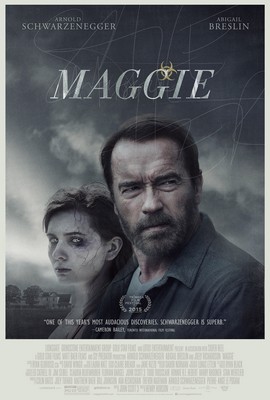
Maggie_(film)_POSTERMaggie is a terrific and sad film about a father who finds himself helpless as his teenage daughter slowly dies.  It’s a thoughtful and heart-rendering film and it’s one of the best of the year so far.  Unfortunately, you wouldn’t necessarily know that from looking at some of the reviews.

Of course, there’s nothing new about a good film getting bad reviews.  I’m actually surprised that anyone even bothers with reviewers anymore, considering just how often they get things wrong.  There are any number of reasons why good films get dismissed.  Some movies are genuinely ahead of their time.  Some critics prefer to judge based on genre than by what they actually see on screen.  Occasionally, a critic feels obligated to like or dislike a movie based on the politics or culture of the moment.  The fact of the matter is that most film critics like to feel important and the easiest way to feel important is to hop onto a bandwagon with all of the other critics.

So, what’s the excuse as far as Maggie is concerned?  Why does Maggie, one of the best films of the year so far, only have a rating of 51% on rotten tomatoes?  In Maggie‘s case, it’s a combination of genre (Maggie is a zombie film and there’s a lot of critics who still feel guilty over liking The Walking Dead) and star.  Maggie has been promoted as being an Arnold Schwarzenegger film, even though his role is essentially a supporting one.  The majority of critics have been willing to admit that Schwarzenegger gives a good performance but they always have to qualify the praise.  As a result, you have critics at both Hitflix and the A.V. Club writing that Schwarzenegger’s performance works because his character is designed to take advantage of Schwarzenegger’s limitations as an actor, as if all good performances aren’t, to some degree, the result of good casting.  In order to make up for praising Schwarzenegger (who is not only an action star but a Republican as well, which is a combination that many reviewers — especially those who work exclusively online — will never be able to see beyond), many critics undoubtedly feel obligated to be overly critical of Maggie.

(What does that 51% mean anyway?  That Maggie is 51% good?)

Maggie_1

As for the film itself, it tells a simple story, one to which a lot of people will undoubtedly relate.  As the film opens, we learn that the zombie apocalypse has already begun.  The world has been hit by a virus.  The infection spreads slowly, forcing the victims and their loved ones to watch as the infected are gradually transformed into mindless and cannibalistic zombies.  However, the U.S. government has reacted with swift and ruthless efficiency.  Martial law has been imposed.  The infected are allowed to say with family up until the disease enters its final stages.  At that point, they’re taken into quarantine and are euthanized.  Though we never actually see a quarantine center, we hear enough about it to know that there is nothing humane about it.  (Indeed, one reason why Maggie is so effective is because we know that the real-life government would probably be even less humane than the film’s government.)  Society has contained the plague but it’s done so at the cost of its own humanity.

College student Maggie (Abigail Breslin) has been infected.  She was bitten by  a zombie and, as a result, she now has a grotesque black wound on her arm.  As the virus moves through her body, her eyes grow opaque.  Her veins blacken.  When she breaks a now dead finger, she reacts by chopping it off with a kitchen knife.  As there is no cure, all Maggie can do now is wait until she is sent to quarantine.

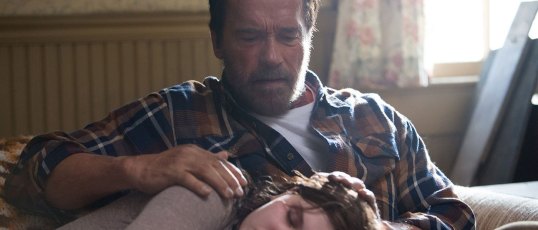
Her father, a farmer named Wade (Schwarzenegger), brings Maggie back to his farm with him so that he can take care of her during her final days.  Wade knows what quarantine is like and he has no intention of forcing his daughter to go through that.  With government doctors and police officers constantly and, in some cases, forcefully demanding the he give her up, Wade protects Maggie as best he can.  He sleeps with a rifle at his side, knowing that eventually he’s going to have to use it on his own daughter.

And I’m crying again.  Between this review and the one I did for Terms of Endearment, my face is going to be a mascara-smeared mess.

arnie-crying-e1427327024932

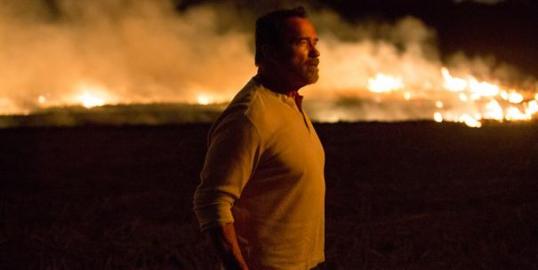
Maggie is a low-key and thoughtful film, a meditation on life, love, family, and death.  Though the film does feature Schwarzenegger fighting zombies, most of the action happens off-screen.  Instead, we just see the haunting aftermath.  Schwarzenegger doesn’t deliver any one liners in this film and the film deliberately plays down his action hero past.  He’s still got the huge body and the muscles but, in Maggie, they’re not intimidating.  Instead, they’re evidence that Wade has spent his life working the land and they actually emphasize just how helpless Wade is in the face of Maggie’s disease.  Director Henry Hobson makes good use of Schwarzenegger’s heavily-lined and weather-beaten face.  His sad and suspicious eyes communicate everything that we need to know.  When he cries, you don’t consider that you’ve never seen him cry before.  Instead, the moment captures you because the tears and the emotions behind them are real.

Breslin

But really, the film ultimately belongs to Abigail Breslin.  It’s appropriate that the film is named after her character because the film really is her story.  Maggie is about how she deals with knowing that she’s going to die and how she searches for meaning in her final days.  It’s a good and heartfelt performance, one that reminded me of Brigitte LaHaie’s poignant work in Jean Rollin’s Night of the Hunted.

So, ignore the critics.

Ignore that stupid 51% on Rotten Tomatoes.

See Maggie.

Arnold-Schwarzenegger-in-Maggie


Film Review: Wild (dir by Jean-Marc Vallee)


reese-witherspoon-wild-slice

Wild opens with Cheryl Strayed (played by Reese Witherspoon) standing on the edge of a cliff.  She has been hiking for days and, because her hiking boots are too small, she’s limping and in a great  deal of pain.  She takes off a boot and a sock and stares at her bloody big toe.  With trembling fingers, she removes what is left of her big toenail.  And then, she throws her boot over the edge of the cliff while screaming, “FUCK YOU!”

And, from that moment, Wild had me.

For the next two hours, I sat there and I was absolutely enthralled as Cheryl, an aspiring writer and a recovering drug addict who was still struggling to come to terms with the death of her mother (played, in heart-breaking flashbacks, by Laura Dern), hiked her way from the Mexican border up to the Canadian border.  I watched as she learned how to survive in the wilderness, how she cautiously learned to trust some of her fellow hikers, and as she dealt with sexist rangers and creepy hunters.

And there were a lot of reasons why Wild held me so enthralled.  There was Reese Witherspoon’s performance, for one thing.  Reese is on screen during every minute of Wild and, for a lot of that time, she’s alone with her thoughts and her emotions.  She gives an amazingly focused performance, one that should regain her some of the respect that she sacrificed by appearing in movies like This Means War and publicly asking, “Do you know who I am?”  Both the film and Reese’s performance resist the temptation to idealize Cheryl.  Instead, both the film and the performance feel real and because Cheryl comes across as a real person (flaws and all), it makes her journey and her achievement all the more powerful.

I couldn’t help but relate to Cheryl.  Like her, I’m an aspiring writer.  Like her, I’m still learning how to deal with the loss of my mom.  Like her, I have trust issues.  Like her, I am sometimes too stubborn for my own good.  Like her, I like to leave quotes in guest books.  Like her, I always pack a few paperbacks before I go on a trip and I like to write in my journal.  Like Cheryl, I’m a survivor and I’m proud of it.

Unlike Cheryl, however, I’ve never gone hiking and I doubt if I ever will.  As much as I loved Wild (and it’s definitely one of my favorite films of 2014), it didn’t leave me with any great desire to go on a hike.  That’s largely because of that first scene.  When Cheryl threw away her boots and screamed, I thought to myself, “That would so be me.”  Of course, the difference is that Cheryl did that after hiking for a month.  I would probably end up doing that after the 2nd day.  And then I’d turn around, go back home, and spend the weekend watching Netflix.

But here’s the thing: Wild is not really about hiking.  Wild is about the journey.  What’s important is not that Cheryl hiked but that Cheryl accomplished what she set out to do.  No matter how difficult it got, no matter how many people told her she should give up, Cheryl walked from Mexico to Canada.  By the end of the film, I felt like, if Cheryl could do that even with boots that were too small, than there was nothing that I could not do.

As a result, Wild is not only one of the best films of 2014.

It’s the most empowering as well.


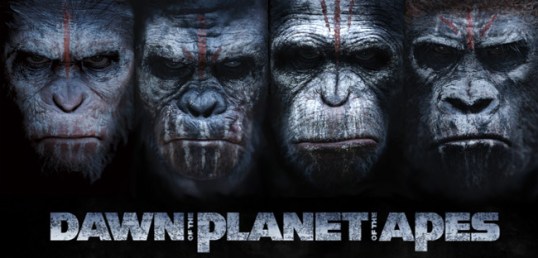
Trailer: Dawn of the Planet of the Apes (Official)


Dawn of the Planet of the Apes

One of my most-anticipated films this summer of 2014 has released it’s latest trailer and it shows the central conflict which will drive this sequel to 2011’s Rise of the Planet of the Apes.

It’s been many years since the pandemic from the “simian flu” tore through the planet as shown during the end credits of the first film. Now the surviving humans must now contend with the growing population of hyper-intelligent apes led by Caesar from the first film.

While the first film showed the rise of Caesar as a revolutionary leader it looks like this sequel will now put him in the role of war leader as his apes must now gear up for a war with the surviving humans that can’t seem to be avoided.

Plus, all I can say is this: Apes on horses with assault rifles.

Dawn of the Planet of the Apes is set for a July 11, 2014 release date.

Trailer: Dawn of the Planet of the Apes


Dawn of the Planet of the Apes

To say that 2011’s Rise of the Planet of the Apes went a long way in washing out the taste out of fans mouth after having seen Tim Burton’s reboot of Planet of the Apes would be an understatement. Rupert Wyatt was able to bring the franchise back to prominence by actually treating the story as a sort of scifi allegory instead of a platform to once again exercise one’s filmmaking quirks.

It was a no-brainer that a sequel will follow up the success of the 2011 film. But with a fast-moving schedule there were several casualties. Rupert Wyatt didn’t think he had enough time to shoot the film the way he wanted to so he was replaced by Matt Reeves. James Franco is also gone from the project. Instead we get several veteran actors like Gary Oldman, Jason Clarke, Keri Russell and Kirk Acevedo joining Andy Serkis.

The film seems to take places a decade or so after the release of the deadly virus at the end of the first film. Humanity has survived both the virus and the wars which followed it, but civilization as we know it now are a thing of the past. With humanity trying to rebuild it must now deal with a rising nation of genetically-enhanced apes led by Andy Serkis’ Caesar. With Gary Oldman on one side seeming to be the leader of humanity’s survivors I don’t see peace as being a goal in this film.

Dawn of the Planet of the Apes is set for a July 11, 2014 release.