If you haven’t, you’re probably just old or else you don’t keep up with what’s happening in the world of popular music. His real name is Conner Friel and he used to be a member of the Style Boyz. Of course, the Style Boyz eventually broke up. Kid Brain became a farmer. Kid Contact became a DJ. And Kid Conner — well, he became Conner4Real and he became a bigger star as a solo artist than he ever was as a Style Boy. His debut album, Thriller, Also, broke records.
But the follow-up, Connquest … well, Connquest wasn’t quite as acclaimed. In fact, it was hated by just about everyone. This is despite featuring classic songs like:
Finest Girl (Bin Laden Song)
Mona Lisa
and Equal Rights (featuring P!nk).
Fortunately, when Conner4Real was facing his greatest existential crisis, a film crew was present to record his struggle. For those of us who were fascinated by the career of Conner4Real, Popstar: Never Stop Never Stopping is a chance to see how Conner dealt with everything from his terminally ill pet turtle to the elaborate marriage proposal ceremony that led to Seal being attacked by wild wolves. We would have gotten to see Conner and his manager defeat a swarm of mutant bees but, unfortunately, that happened right after the only time that Conner’s manager asked the film crew to stop filming.
Oh well, these things happen.
So, as you should have guessed from all that, Popstar is not a serious film. It’s a mockumentary, with the emphasis on mock. It was also one of the funniest films of 2016, a spot-on parody of the silliness and pretensions of fame. Conner is a combination of Justin Bieber and Macklemore at their shallowest, a well-meaning but thoroughly empty-headed singer. In fact, if Conner was played by anyone other than Andy Samberg, he would be so annoying that the film would run the risk of being unwatchable.
But fortunately, Conner is played by Andy Samberg. It’s hard to think of anyone who plays dumb with quite the same panache as Andy Samberg does. There are plenty of lines in Popstar that shouldn’t work but they do, specifically because they’re being delivered by Samberg. He brings just the right amount of sweetly sincere stupidity to the role. Almost despite yourself, you find yourself hoping that things will work out for Conner and the other Style Boyz. Conner may not deserve to be as big a star as he is but it was obviously going to happen to some idiot so why not a sincere one?
Samberg is not the only funny person in Popstar. The movie is full of funny people, from Sarah Silverman to Bill Hader to the always underrated Tim Meadows. It’s also full of celebrity cameos and I have to admit that I usually tend to cringe when I see too many people playing themselves. But in Popstar, it works. One need only rewatch something like Zoolander 2to see how well Popstar pulls off its celebrity cameos.
Sadly, as funny as Popstar was, it was also one of the biggest bombs of 2016. (The trailer, it must be said, did not do the film justice.) However, I expect that it will soon develop a strong cult following. In a few years, we’ll get a sequel. It probably won’t be as as good.
Jeremy Saulnier’s Green Room is one of the best films of the year but I don’t know if I’m ever going to be able to bring myself to watch it a second time.
Why?
There’s two reasons:
Number one, Green Room is one of the most intense films that I’ve ever seen. Much like Saulnier’s previous film, Blue Ruin, this is a violent movie that never makes violence look fun. The violence here is all too real and the pain that the characters feel is all too real as well. I watched a good deal of Green Room through my fingers, hiding my face behind my hands. Seriously, I’ve seen some pretty gory movies. (I’m an unapologetic fan of Italian horror, after all.) But Green Room still left me shaken. Occasionally, it even left me gasping for breath. It’s just that intense. It’s a film about four people battling for survival and I’m surprised (and a little proud) that I survived all the way to the end.
The other reason is that the film stars Anton Yelchin. It was one of the final films that he made before his death and he gives such a likable and committed performance that it’s impossible for me to think about the film without getting a little emotional. Far more than his supporting work in the Star Trek films, Green Room showcased what a good actor Anton Yelchin truly was. It’s impossible for me to think about Green Room without mourning a talent taken from us far too soon. And though it might be difficult to watch the film a second time, everyone should watch Green Room at least once. If you ever wonder why some of us still get emotional when we talk about Anton Yelchin, it’s all there in the movie.
In Green Room, Yelchin plays Pat. Pat is the bass player for a punk band called the Ain’t Rights. The Ain’t Rights have been touring the northern part of the country. It’s a low-budget tour, one that perfectly reflects that anti-corporate politics of the Ain’t Rights. For them, the tour means crashing with friends, siphoning gasoline, and doing interviews with underground radio stations. In fact, one interviewer — the rather dorky Tad (David W. Thompson) — arranges for them to do a show at an isolated bar in Oregon. Tad tells them that the bar attracts a rough crowd but that they’ll be okay because his cousin Daniel (Blue Ruin‘s Macon Blair) works there.
The Ain’t Rights arrive and discover that the club appears to have a clientele that is exclusively made up of Neo-Nazi skinheads. After some hesitation, the Ain’t Rights take the stage and, for a few brief moments, Saulnier shows them performing in slow motion and those of us in the film’s audience — even someone like me, who would probably otherwise never listen to a band like the Ain’t Rights — are briefly caught up in the joy and excitement of their performance.
Unfortunately, while the band is performing, the Nazis are busy murdering a woman in the green room. And, after the band walks in on the aftermath of the murder, they soon find themselves marked for death as well. The band is smart enough to lock themselves in the green room and to take one of the Nazis as a hostage. However, they know that they can’t stay in that room forever. At some point, they’re going to have to figure out how to escape from the bar…
Green Room is a harrowing and violent film, one that maintains an almost feverish intensity from start to end. Making it all the more difficult to watch is that Saulnier keeps the horror rooted in reality. The Neo-Nazis never turn into cardboard movie slashers. Instead, they are a very real and disturbing threat. (It’s interesting to note that occasionally, a Neo-Nazis will express some doubt about killing the band but none of them have the courage to actually refuse any of the orders that they receive. We often hear that people need to respect authority. Well, Green Room shows what happens when people blindly respect authority to the extent that they can no longer think for themselves.) Though the film may be violent, it never celebrates that violence and when one character does get a chunk of arm chopped off, it’s literally one of the most painful images to ever be captured on film. You like every member of the band so, when they get hurt, you feel their pain as well. Though Yelchin may be the main character, the other members of the Ain’t Rights — played by Alia Shawkat, Joe Cole, and Callum Turner — all make a good impression as well. You want them all to escape and dread the realization that not all of them will.
As for the owner of the club, his name is Darcy and he’s played by Patrick Stewart. At first, it may sound like stunt casting. Patrick Stewart as a Neo-Nazi? But interestingly enough, Darcy doesn’t really seem to care about ideology. Instead, you get the feeling that he realized that there was money to be made by catering to racists so that’s what he decided to do. When he barks out orders and demands that the members of the band be killed, his main motivation seems to be pure greed. If the band escapes and reports the murder, he’ll lose his club. Stewart gives a chilling performance. When he first appears, you do think, “Hey, it’s Patrick Stewart!” But, within minutes, you forget who is playing him. He becomes Darcy and you’re scared to death of him and his followers.
Green Room is an incredibly intense and scary film. It also features perhaps the best performance of Anton Yelchin’s career. Green Room stands as a testament to a talent taken too early.
(On a purely personal note: I’m glad that Green Room took place in Oregon. Too often, movies tend to portray racism as being an exclusively Southern issue, one that somehow magically disappears once you head up north. It often feels as if people spend so much time talking about racism in other states that they fail to actually look at what’s happening in their own backyard. It’s easier to laugh at a state like Alabama than to ask why someone like Eric Garner died on the streets of New York City. Racism is an American issue, and that includes the states both below and above the Mason-Dixon line.)
+ Fast cars doing interesting stunts that don’t feel like a CGI stunt reel. Take the Mustang chase from Drive and stretch it out.
+ It’s a tightly shot film. The chances of saying “Come on, go somewhere.” Are small and the driving camera work does its best to invoke a sense of being in the scene.
+ Imogen Poots steals practically every scene she’s in, and the cast overall seemed to enjoy themselves. Michael Keaton may be the most animated he’s been since Beetlejuice. Aaron Paul sounds like a mix between Charlie Hunnam and Solid Snake.
Reasons to hold off for now:
– It’s not the tightest story in the world. You’ll probably be able to easily call out plot angles as the movie progresses. There is also one scene in the film that never connects to anything after it, leaving something of a hole there. Overall, the film gives you just enough to understand why everyone’s doing what they’re doing, but don’t search for a whole lot of character growth here.
– The Air support moments seem a little implausible, given air traffic rules and what not.
The Long Take:
Ever since The Fast and The Furious hit the big screen in 2001, you’ve had a number of race related movies. I think the worst I can recall was 2007’s Redline, which tried to throw some wild extortion theme into the mix. The movie adaptation for Need for Speed may actually be a better movie than some of Electronic Arts’ games. It may not be Hamlet, but it handles itself just fine.
The premise for Need for Speed is very simple. A young racer (Aaron Paul, whose voice sounds he’s channelling Sons of Anarchy’s Jax Teller) seeks vengeance against a former business partner (Dominic Cooper, Howard Stark from the Marvel Cinematic Universe) by way of a dangerous high speed race known as the Deleon. He assembles a team of friends, and goes about trying to reach his goal. There you go, all you need. It might sound as bad as this year’s Robocop, but at least the audience laughed along with this one.
Although many know Aaron Paul from his Emmy winning run on Breaking Bad, but he isn’t new to movies. He’s had a great turn in Smashed with Mary Elizabeth Winstead and worked previously with co-star Imogen Poots on The Long Way Down. Here in Need for Speed, I felt he did really well with what was given as racer Tobey Marshall, granted that it wasn’t a whole lot. Still, he sells it as best he can. Poots, on the other hand is as much the bright light in the film as Hayley Atwell was in Captain America: The First Avenger. Overall, the casting was okay here. Dominic Cooper plays the rival role well, though doesn’t come off as sinister in any way and Michael Keaton seems to enjoy himself in this as the host of the Deleon, a high stakes private race. He channels his inner Beetlejuice and is one of the high points of the film. Between he and Scott Mescudi (Kid Cudi to those who know him musically), they have the best scenes apart from the main cast.
The car scenes themselves are okay. You may find yourself leaning back in your seat in some instances, but they don’t quite have the tight feel of say Ronin. Still, you won’t see anything happen in these cars that go beyond the extreme. Truth be told, it’s almost similar to the first Fast and the Furious, save for all the wavy speed lines in the high speed chases. One of the remarkable things about Need for Speed is that it tries its best to avoid throwing too many CGI driving moments. It has a feel that’s similar to Tarantino’s Death Proof or, as the film highlights in the beginning of the movie, Bullitt. This being only his second major film (Act of Valor being the first), Director Scott Waugh gets away with making the racing moments as intense as they can be without getting too crazy…well, almost. It’s cut quick, and there are very few lag scenes as far as I could notice.
If the movie has any bad points, it’s that almost everything happens in a bubble. The plot has someone who is effectively on the run, and yet I would have imagined there’d be more of a police presence, especially given the exposure. Then again, this is Need for Speed, where you only need to avoid the cops or 2 minutes before being given the chance to hide in a cooldown zone (in NFS: Most Wanted, anyway). Fans of the games will see some of those elements in play during the film and they are functional here, if not realistic.
Additionally, there’s one other scene that involves the recruiting of a reluctant team member that goes almost no where. The reason for bringing the person along (having to do with a car issue) never appears to be addressed either visually or verbally. This left me asking, “Well, was it fixed?” and then shaking my head later on. It’s not a terrible mistake to have while munching on popcorn ( you won’t choke for not getting an answer), but someone really could have taken the time to dot that particular “i” on George Gatins’ script.
Overall, Need for Speed is a fun ride. It’s predictable in a lot of ways, and you’ll see some of it coming, but you may also find yourself smiling and swerving in your seats with the traffic.
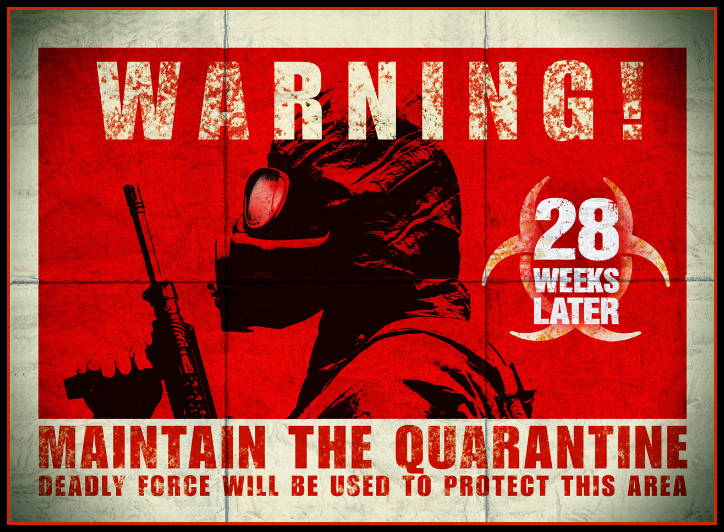
Danny Boyle and Alex Garland’s 28 Days Later was made in such a way that any sequel was almost destined to struggle in its shadow. Their film was not only one of the most influential horror films of the early 2000s, but also an exercise in experimental filmmaking and cinematic reinvention. It fused realism and terror through its digital photography, unconventional pacing, and minimalist score. Any follow-up would have to contend not just with its fresh twist on the zombie mythos (despite the infected not technically being zombies) but also its unique atmosphere, music, and stripped-down aesthetic. Against those odds, 28 Weeks Later manages to stand as an impressive and worthy successor—one that in some respects even surpasses the original.
Spanish director Juan Carlos Fresnadillo approaches the material with a clear reverence for Boyle and Garland’s vision while imprinting his own stylistic and emotional signature on the sequel. From the very first scene, Fresnadillo establishes a tone that blends despair and dread with human frailty. The film opens on a stunningly tense prologue in which Don (a gaunt and haunted Robert Carlyle) and Alice (Catherine McCormack) are living with several others in a rural cottage outside London during the first weeks of the Rage virus outbreak. In this sequence, Fresnadillo distills the central moral dilemma that runs through both films: whether to preserve one’s humanity through compassion or to surrender to pure survival instinct. When Don is forced to choose between rescuing his wife and saving himself, his decision—while horrifying to watch—feels horribly plausible. The following chase through open fields as he flees dozens of Rage-infected attackers captures the raw panic that made Boyle’s original so memorable, yet Fresnadillo shoots it with a sharper sense of chaos and movement. It sets the tone for a story that is both intimate in its human tragedy and apocalyptic in its reach.
Following this intense opening, the film transitions through an introductory credits montage that fills in the aftermath. Don’s escape was not the end of the story but the beginning of a grim reconstruction effort. The British Isles, we are told, were swiftly quarantined when it became clear the infection could not be contained. Twenty-eight weeks later, with the infected population presumed dead from starvation, a U.S.-led NATO force spearheads an ambitious effort to repopulate and rebuild. Led by General Stone (played with austere calm by Idris Elba), the military has converted London’s Isle of Dogs into a heavily fortified safe zone. This enclave represents both restoration and repression—a fragile bubble of civilization built atop the bones of horror.
Within this environment lives Don, now employed as a maintenance manager and struggling to suppress the guilt from his past. The arrival of his two children, Tammy (Imogen Poots) and Andy (Mackintosh Muggleton), who were abroad in Spain during the initial outbreak, reopens emotional wounds he had hoped were sealed. Their reunion, though heartfelt, carries an undercurrent of deception. Don’s explanation of their mother’s fate does not align with what the audience has already witnessed. This dishonesty propels the children into dangerous territory when they decide to sneak out of the Green Zone to retrieve personal belongings from their old cottage. While this act of recklessness fits with youthful impulses and emotional longing, it also feels like the film’s only contrived lapse in logic—an inevitable but frustrating horror trope that sets off the story’s next catastrophe.
What the children discover at the cottage reintroduces the virus in a shocking way. Without realizing it, they bring the Rage infection back into the supposedly secure refuge of London. As soon as containment is broken, the military response escalates with brutal efficiency. General Stone declares a “Code Red,” authorizing the use of extreme measures to eradicate the infected—including indiscriminate firebombing of civilian areas. These scenes echo not only classic apocalyptic tropes but also resonate as a grim reflection of post-9/11 militarism. Many viewers and critics interpreted this act of mass destruction as allegory for the United States’ War on Terror and the ethical corruption of occupation forces. Fresnadillo’s direction, while hinting at this reading, avoids heavy-handed political critique. His portrayal of military overreaction feels less ideological than tragic—a manifestation of fear, confusion, and the blunt-force nature of institutional power. The armed forces are not villains so much as desperate men trapped in an impossible moral quagmire. As in George A. Romero’s The Crazies, which 28 Weeks Later strongly recalls, the destructive consequences stem not from malice but from the futility of trying to maintain order amid chaos.
Where 28 Days Later focused on a small group of survivors and the intimate erosion of morality under crisis, 28 Weeks Later expands the scale dramatically. Fresnadillo transforms Boyle’s compact nightmare into a large-scale urban apocalypse. The sweeping aerial shots of a deserted London—bridges empty, streets silent—hammer home the desolation. When the city is engulfed in flames and gas clouds during the firebombing sequence, the imagery becomes both terrifying and grimly beautiful, a vision of civilization consuming itself. The sequel’s tone is darker and more nihilistic than Boyle’s film, which allowed a trace of optimism in its ending. Here, even innocence becomes a catalyst for doom: it is the children’s actions, driven by love and loss, that inadvertently reignite the infection and condemn the survivors to another wave of horror. This subversion of the “innocent child” trope underscores Fresnadillo’s bleak worldview—where sentiment and humanity, however noble, can still create destruction.
In several ways, 28 Weeks Later aligns more closely with Romero’s Living Dead films than with Boyle’s original. Though Boyle borrowed some of Romero’s thematic DNA, Fresnadillo fully embraces it. The infected may not be reanimated corpses, but the societal collapse, moral ambiguity, and recurring cycles of violence all trace back to Romero’s legacy. One of the sequel’s most striking qualities is its unflinching pessimism: even individuals acting out of love or duty become agents of devastation. The so-called survivors are reduced to primal instincts—running, hiding, killing—in a landscape where institutional power and human decency dissolve together. Fresnadillo makes the action kinetic without glamorizing it. His camera work, switching between chaotic handheld intensity and precise, panoramic destruction, keeps the viewer off balance, mirroring the unpredictability of the apocalypse itself.
The performances elevate the material beyond genre expectations. Robert Carlyle’s portrayal of Don is both gut-wrenching and terrifying. His character’s transformation—from remorseful father to infected embodiment of pure rage—serves as the film’s emotional and thematic anchor. Imogen Poots, in an early standout role, conveys resilience and vulnerability in equal measure, while Jeremy Renner delivers a strong supporting turn as Sergeant Doyle, the soldier torn between obedience and morality. Their performances, though sometimes confined within the film’s relentless pace, enrich its exploration of guilt, loyalty, and the futility of control.
Despite sacrificing some character depth for momentum, the film’s taut editing and grim atmosphere sustain tension throughout. Fresnadillo’s direction never loses sight of his central message: that humanity’s efforts to rebuild are perpetually haunted by its capacity for self-destruction. Even as the few surviving characters reach supposed safety, the final scenes undermine any hope of resolution. The closing image—infected sprinting through the streets of Paris—reminds viewers that, although the city itself appears intact and bustling in daylight, the Rage virus has now breached mainland Europe. This ending shifts the scale of threat from the quarantined British Isles to the broader continent, making containment and redemption feel like dangerous illusions.
As a sequel, 28 Weeks Later earns its place alongside 28 Days Later by honoring the original’s DNA while pushing its boundaries. It retains the visceral dread and societal commentary but broadens the lens to encompass collective failure rather than individual struggle. Fresnadillo’s approach feels colder and more apocalyptic, transforming the story into a study of fear’s infectious nature—social, political, and biological. While his film might not achieve the same creative purity as Boyle’s indie landmark, it succeeds in redefining the tone, expanding the mythology, and pushing the series toward a darker, more cinematic landscape.
In the end, 28 Weeks Later is both a continuation and an escalation—a relentless, despairing study of human fragility under crisis. Its pacing, performances, and imagery combine to create an experience that’s not only horrifying but profoundly unsettling in its realism. If 28 Days Later showed us the collapse of civilization, its sequel reveals the hopeless struggle to rebuild it. Few horror sequels accomplish that much, and fewer still end with such haunting inevitability.
I want to say great things about Craig Gillespie’s remake of Fright Night. I want to say that it was worth seeing and it was full of awesome moments. I also wanted to be able to write this review without making so many comparisons to the 1985 Original by Tom Holland. Not that the original was a masterpiece by any means, but I dozed off (just a little) on this film.
If there’s only one reason I could give for recommending Fright Night, it would be to get a taste of what Vampires should be. Don’t read me wrong on this. I own all four Twilight books in hardcover, read them repeatedly, and have seen the three films that came out in the theatre. It’s just nice to see a vampire movie that shows vampires more as predatory creatures than sparkling A&F models. There’s an edge to this film that’s pretty fun in a lot of ways. Both Colin Farrell and David Tennant have great roles here and even Anton Yelchin holds his own, but there’s a weird breakdown that happens. Fright Night is a good film, as long as you don’t try to make any kind of direct comparisons to the source material.
The story focuses on Charlie Brewster (Yelchin), a teenager – the story being in Vegas this time – who discovers he has a vampire named Jerry Dandrige (Farrell) living next door to him. When the vampire confronts Charlie, Charlie is forced to seek out help in the form of Peter Vincent (Tennant) to defeat him. While there were a few scenes that really stood out for me and I found myself smiling more often than rolling my eyes, the pacing of this was off. Other audiences may find that the movie moved well. I felt like they were just throwing things to say “Well, wouldn’t it be cool if they did this, and then that.”
The two problems I had with Fright Night were it’s pacing and Chris Mintz-Plasse. Chris is fun to watch at the start, and I’d love to see him do more, but someone really has to give him something where he’s not playing the “token geek”. While I liked the movie overall, there’s a lot of verbal exposition in the beginning of the film, as Charlie doesn’t so much discover the truth about Jerry, but is pretty much told the entire scenario he’s in about 15 minutes into the start. I had a problem with that. Again, depending on the audience, the movie may move just fine.
Fright Night is one of those films could be a love it or hate it. I’m of the audience that will probably catch it again when it’s out on video, but it doesn’t feel like anything you really have to rush to the theatre for.
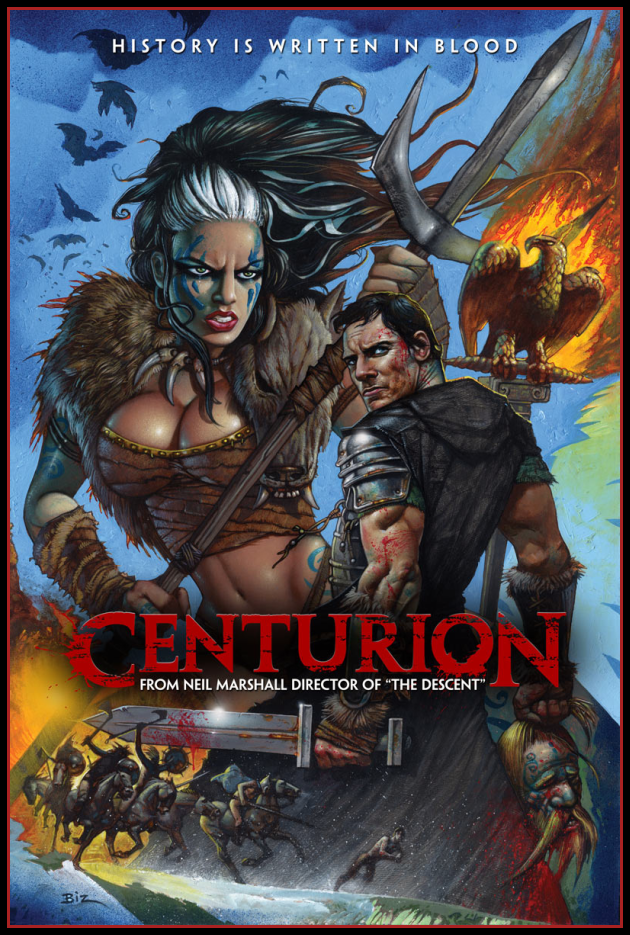
I’ll outright say and admit that one of my favorite filmmakers has to be British-filmmaker Neil Marshall who burst into the scene almost a decade ago with his genre mash-up werewolf film, Dog Soldiers. Since then he has come out with a film every couple years which follows what’s becoming a trademark style of his.He would take a well-worn and used genre and mash it together with a few others to create a film that’s wholly his own. He did this with his follow-up films in The Descent and Doomsday. Now it’s 2010 and we have his latest film and it follows his usual style. Centurion is an adventure, chase and men on a mission film that doesn’t reinvent the genres it’s smashing together but instead embraces their traditions and creates a rip-roaring yarn which moves at a frenetic pace with characters who grow and expose their motivations as the film progresses to it’s bittersweet finale.
Neil Marshall will always be known to fanboys and the action crowd even if the elites of the film industry continues to dismiss the man as nothing more than competent filmmaker. In Centurion he shows that he could work within a traditional sword and sandal story and still show his signature style. We have it’s main character of Roman centurion Quintus Dias (played with a subdued and introspective seriousness by Michael Fassbender) who gets captured by the Picts of Britain during Rome’s occupation of the island. Unlike most Romans captured by the guerilla-warfare conducting Picts, Quintus has learned to speak Pict thus has become a valuable capture. But his loyalty to his Empire and its people dashes the hopes of the Picts ever learning anything from Quintus and decides to play some sport with him as the hunted prey.
It’s during the hunt for Quintus by a band of Pict warriors that he stumbles upon the Roman Ninth Legion led by General Titus Flavius Virilus (Dominic West). Once freed from his captors and hunters, Quintus is more than happy to rejoin his fellow Roman centurions in their hunt to once and for all destroy Pict leader Gorlacon (Urlich Thomsen) and his Pict army. To aid them in their search for this enemy army is the mute Brigantes scout, Etain (played with silent fury by Olga Kurylenko), who knows the lands where the Picts hide and do their hit-and-run raids.
It’s once the whole Ninth Legion has been led into the thick forests by Etain that the trap was sprung with Etain herself the catalyst for what amounts to as the massacre of the Legion. It’s this event which Marshall in his own way tries to explain one of history’s mysteries: The mysterious fate of the Roman Ninth Legion. Historians have never agreed as to why the Legion disappeared from Roman and historical records and Marshall’s film is one theory.
The rest of the film has the handful of the Legion who has survived trying, at first, to free their general from Pict captivity and when that mission fails with deadly results the remaining men who has chosen to follow Quintus try to make a run back to Roman lines. On their heels like a she-wolf leading a pack of wolves is Etain whose thirst for vengeance for what the Romans did to her (raped her as a young child and cut out her tongue in addition to wiping out her family and tribe) pushes her to get these Romans with near-supernatural drive. It’s rare to find a film where the main villain is a woman, but one whose abilities surpasses that of the men she’s hunting and whose motivations make her more than a tad sympathetic to her cause.
Centurion does action well with sequences involving a jump off of a steep cliff and into the river below to last stand inside an abandoned Roman fort. Marshall knows how to stage and shoot these scenes so we never lose sight of where the participants are. Most filmmakers nowadays try to hide their inability to choreography action sequences by using quick cut editing, hand-held camera jittery viewpoints and, at times, just shooting it from a distance. Neil Marshall doesn’t do anyone of these gimmicks and tricks which just shows that while his hybrid style in terms of storytelling might be new and refreshing he still embraces the traditional ways if it serves his films properly.
The acting in this film was quite good from not just its leads in Fassbender and Kurylenko but from everyone. This film’s ensemble cast includes veteran British actors just as Liam Cunningham, Paul Freeman and David Morrissey. Other supporting players such as Imogen Poots, Urlich Thomsen and Dominic West do a great job in the limited roles they’re given. The fact that Kurylenko utters not one word in her scenes yet commands each and everyone she’s in shows just how well Marshall can direct not just action pieces but how to direct his actors in doing their jobs.
This film doesn’t do anything to reinvent the action genre that is it’s foundation, but what it does is show that action films sometimes could be just as good when it’s filmmaker leans on practices from traditions past. Outside of the CGI-blood used to show the brutality of the fights and deaths this film is quite lacking in the CG department. Shot on location in the highlands of Scotland and studios near and around London, Centurion is quite a throwback to the sword and sandal films which dominated the film industry during the late 50’s and most of the 60’s. Marshall’s latest will not win any mainstream awards, but the genre crowd will definitely embrace it as something that will entertain and thus welcome it with cult status.


 Through the Shattered Lens