A Quick Review: The Hobbit: The Battle of the Five Armies (dir by Peter Jackson)


TheHobbit5Armies

It seems kind of weird to do a quick review for a 144 minutes film that not only serves as the end of one epic trilogy but also as a prequel for yet another epic trilogy.

Well, so be it.  I hate to admit it but I really don’t have that much to say about The Hobbit: The Battle of the Five Armies beyond the fact that I saw it on the day after Christmas, I enjoyed it, and I thought Aidan Turner was really hot.  It’s not a perfect film but then again, The Hobbit has never been a perfect trilogy.  As opposed to the Lord of the Ring films, The Hobbit told a story that could have easily been told in two films.  As a result, whenever you watch one of The Hobbit films, you’re aware of all of the filler that was included just to justify doing three films.

But so what?  The Hobbit films are fun.  Despite the cynical economic reasons behind turning The Hobbit into a trilogy, director Peter Jackson’s love for the material always came through.  In the title role, Martin Freeman was always likable.  Ian McKellan and Christopher Lee made for properly enigmatic wizards.  Though apparently his inclusion caused some controversy among purists, it was nice to Orlando Bloom as Legolas.  I also liked Evangeline Lilly’s elf character, even if everyone else seemed to dislike her and her love story with Aidan Turner.  And then there was Benedict Cumberbatch providing a perfectly evil and self-satisfied voice for Smaug.

I have to admit that, with the exception of Aidan Turner, I was never a big fan of the dwarves.  They were all so surly and bad-tempered and it didn’t take me too long to get tired of Richard Armitage showing up as Thorin and acting like a jerk.  However, in the final part of the trilogy, Armitage’s surly performance started to make sense.  As Thorin grew more and more paranoid, I saw that The Hobbit was actually using both the character and Armitage’s performance to make a much larger point.  Power corrupts and most conflicts are ultimately all about money and property.  It was a good message.

When the Battle of the Five Armies started, I was shocked to discover how little I remembered about the previous two Hobbit films.  It took me a while to get caught up on who everyone was and why they were all fighting over that mountain.  As opposed to the LoTR films, it’s not always easy to get emotionally invested in The Hobbit films.  But, Jackson is a good director and he’s a good storyteller and, even though it took me a while to get caught up, I was still often enthralled with what I was watching on screen.  The images were so stunning and the battle scenes were so spectacularly done that I could handle being occasionally confused.

Battle of the Five Armies is a fitting end for the Hobbit trilogy.  It’s not a perfect film but it is exciting and fun and that’s really all that matters.  At the end of it, the audience in the theater applauded, not just for the film but in recognition of everything that Peter Jackson has given us over the past 14 years.

It was a good way to spend the day after Christmas.

Lisa Reviews The Oscar Nominees: Nicholas and Alexandra (dir by Franklin J. Schaffner)


Nicholas_and_Alexandra-831476012-large

(Depending on how much you know about world history, the review below may contain spoilers.)

It was nearly four years ago that I decided that my goal in life was to watch and review every single film — no matter how obscure or potentially disappointing — that had ever been nominated for best picture.  Of course, that’s not my only goal.  If anything, I may have too many, often contradictory goals in my life.  But seeing all of the best picture nominees was definitely one of them and, all these years later, it’s a goal that I’m still trying to achieve.  With the help of TCM and their nonstop schedule of movies made long before I was born, it’s also a goal on which I am slowly but surely making progress.

Last night, as I scrolled through the guide, I noticed that TCM would be showing Nicholas and Alexandra, a three and a half hour film from 1971.  Now normally, I would be hesitant about watching a film that long, if just because I have ADHD and I doubt I’d be able to concentrate on it.  In a theater, watching the action unfold on a big screen, it wouldn’t be a big deal.  However, it’s totally different when you’re talking watching a movie on TV in a house that is full of potential distractions.  Add to that, Wednesday night is when I usually watch shows like Survivor, Hell’s Kitchen, and South Park.

But, here’s the thing.  The title Nicholas and Alexandra sounded familiar to me and not just because I’m an obsessive history nerd.  I did some checking and I discovered that, regardless of how obscure the film may be today, Nicholas and Alexandra was nominated for best picture.  It lost to The French Connection but it was nominated.

So, of course, I had to watch it.

And you know what?
NA

It’s not a terrible movie.  It’s certainly not great.  It has multiple flaws and it’s hard to imagine this film being nominated alongside films like The French Connection, Last Picture Show, and A Clockwork Orange.  Watching the movie, I got the feeling it was probably nominated because it was a big, expensive epic and not because it was one of the best of the year.  But, if you stick with the film (which, if we’re going to be honest here, is much easier said than done), it’s not quite as disappointing as you might expect it to be.

Nicholas and Alexandra tells the story of the last monarch of Russia, Tsar Nicholas II (Michael Jayston).  Struggling to escape the shadow of his father and incapable of understanding what life is like for those not born into royalty, Nicholas is portrayed as being well-meaning but autocratic and blind to the fact that the days of royalty are rapidly coming to an end.  His wife, Alexandra (Janet Susman) is also unpopular with both the Russian citizenry and the royal court on account of being German.

Alexandra spends most her time doting on her youngest son, Alexei, who suffers from hemophilia.  When a flamboyant Serbian monk named Rasputin (Tom Baker) claims that he has the power to heal Alexei, Alexandra immediately brings him into the court.  Soon, rumors are flying across Russia about Rasputin’s relationship with Alexandra.

Meanwhile, men with names like Lenin (Michael Bryant), Trotsky (Brian Cox), and Stalin (James Hazeldine) are plotting to lead a “worker’s revolution…”

If you know anything about history, it’s not really a spoiler to reveal what happens in the second half of Nicholas and Alexandra.  (And if you’re not into history, you probably would not have any interest in watching the movie in the first place.)   Archduke Franz Ferdinand is assassinated, plunging the entire world into war.  Russia declares war on Germany and the German-born Alexandra becomes even more unpopular than before.  The rest of the royal court, jealous over the mad monk’s influence, plots against Rasputin.  The Tsar is forced from the throne and Nicholas and his family spend their last days as captives of the people they once ruled.  Now a powerless prisoner, Nicholas finally starts to understand the world beyond his palace walls.  However, in the end, Nicholas, Alexandra, their children, and their loyal servants are taken into a small room and violently executed.  End of movie.

NA2

So, there are a lot of things wrong with Nicholas and Alexandra.  Not the least of the film’s problem is an unwieldy length and generally slow pace.  (The film was directed by Franklin J. Schaffner, who also directed the still-fun original Planet of the Apes.  Little of the flair he brought to Planet of the Apes is present here.)  This is one of those films that is full of incident with various characters popping up and discussing the intricacies of international politics with little concern as to whether or not any of this is the least bit cinematic or even compelling on a narrative level.  The film has a huge cast but very few memorable characters.

Even worse is that neither Nicholas nor Alexandra never come across as being all that interesting.  The film makes the case that Nicholas’s downfall was largely a result of him being unlucky enough to rule at a time when people across Europe and Asia were rejecting the old ways for the new ways of revolution and industrialization.  Nicholas is continually portrayed as being well-meaning but isolated and that has the potential to be interesting but, at times, the film feels almost as emotionally detached as its characters.

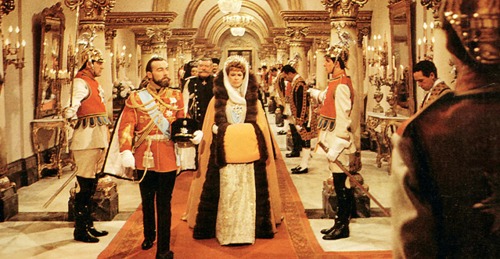
That said, Nicholas and Alexandra does work as a spectacle, as a showcase for beautiful clothing and ornate scenery.  As a character study, Nicholas and Alexandra largely fails but, as a fashion show, it’s actually a lot of fun.    Early on in the film, there’s a lengthy sequence in which Nicholas and Alexandra walk down the red-carpeted hallways of their palace.  It’s shot through Nicholas’s eyes and we see a collection of guards and noblemen and women standing to the side and bowing their heads as the Tsar and his wife walk past.  It’s a good scene and one that perfectly shows not only the life that Nicholas is used to but also why Nicholas doesn’t want to change that life.

baktna03

Perhaps not surprisingly, the first two hours of Nicholas and Alexandra work best when they focus on the flamboyant character of Rasputin.  Baker does a really go job as Rasputin, delivering all of his lines with a ferocious intensity while staring with obviously unhinged eyes.  When he’s with Alexandra, Rasputin is calculating and coldly conniving, providing just enough comfort to keep her under his control.  When he’s with Nicholas or any of the other male members of the court, he reveals himself to be an arrogant libertine, making profane jokes and bragging about his conquests.  It’s a really good performance but, as with so many other good performances in this film, it occasionally gets lost in the film’s dense production.

The best moments of Nicholas and Alexandra come towards the end, with the humbled Nicholas finally revealing his humanity and the Tsar’s family struggling to maintain their dignity even as their inevitable fate approaches.  At this point, the performers came to life.  The film suddenly had an emotional resonance.  It finally became about something!  For those final 20 or so minutes, Nicholas and Alexandra suddenly seemed worthy of being awarded.

In fact, based on those final 20 minutes, I would even be willing to see a sequel called Nicholas and Alexandra and Rasputin Makes Three.  

(Though I’m not sure how that sequel could ever be made.  As @Kev1Media pointed out when I suggested it on twitter, Adam Sandler would have to be somehow involved.)

As for Nicholas and Alexandra, it’s not a great film but if you’re into history or you’re an Oscar completist like me, the film has its occasional charms.  You just have to be willing to look for them.

Nicholas and Alexandra

Review: The Hobbit: An Unexpected Journey (dir. by Peter Jackson)


kinopoisk.ru

It’s hard to believe that’s it’s been 11 years since Peter Jackson released The Lord of the Rings: The Fellowship of the Ring on the masses in 2001. There were much trepidation from Tolkien fans that Jackson (who had been known mostly for low-budget splatter horror-comedies) wouldn’t be able to handle the monumental task of adapting what many consider the greatest novel ever written in the 20th century. Tolkien’s epic fantasy became the standard by which fnatasy epics would be compared to for decades to come and still do. To say that Jackson succeeded in this epic task would be an understatement. The Lord of the Rings trilogy would hoard awards from 2001 to 2003 and also box-office receipts to make any dwarf-lord green with envy.

It’s now 2012 and we finally have the release of Jackson’s next trip into Middle-Earth as he adapts another of Tolkien’s beloved novels. This time he tackles The Hobbit which for some Tolkien fans remains their favorite of the author’s works. It’s a novel that might not have the epic scope and breadth of The Lord of the Rings, but what it lacks in that department it more than makes up in being a fun, adventure tale of a curious hobbit named Bilbo Baggins, a wizard named Gandalf the Grey and a fellowship of twelve dwarfs led by one Thorin Oakenshield of Erebor.

The Hobbit was originally written as a children’s book, but in later years Tolkien would retcon some parts of the novel to better fit with his magnum opus in The Lord of the Rings.It’s this revised version of that children’s story that Peter Jackson, Fran Walsh, Philippa Boyens and Guillermo Del Toro would adapt for the big-screen. Initially a two-film set that would tell the story of Bilbo and his merry band of adventurers, but it has since been expanded to become a trilogy as Jackson and his writers take a page out of Tolkien’s bag of tricks and try to tie-in this latest trilogy to the Lord of the Rings which precedes it by a over a decade.

The first film in this new trilogy is called The Hobbit: An Unexpected Journey and we begin by returning to sometime before the beginning of the first trilogy’s first film. We see the aged Bilbo reminiscing of his adventures 60 years hence and deciding to put it to pen and paper as a sort of memoir of that adventure to reclaim the lost dwarf-hold of Erebor. It’s in this opening that we get to see Frodo once more (played once again by Elijah Wood who doesn’t seem to have aged) prior to him taking up the One Ring.

Bilbo recounts to Frodo the realm of Erebor deep inside the Lonely Mountain east of the Shire to Frodo and how it’s wealth in silver, mithril, gold and precious gems became well-known throughout Middle-Earth. Yet, as Bilbo warns, it’s the very sickness of avarice by Erebor’s Thror the King which seals the dwarf-hold’s doom. We learn that hoards of wealth does more than light up the dwarf king’s eyes with greed but also brings the attention of one of the very last dragon’s in Middle-Earth. The arrival of Smaug to Erebor signals the death of not just that dwarf realm, but the surrounding human town of Dale. The surviving dwarfs of Erebor flee in a massive diaspora towards any safe haven willing to take them in. What was once a proud and powerful realm has now been sundered and it’s afterwards that we get to the meat of the film’s story.

Martin Freeman as a younger Bilbo Baggins was more than just great casting but one which the film needed if one was to believe that this young Bilbo would grow old to be the Ian Holm one fans of the first trilogy have come to know well. His performance as Bilbo Baggins of Bag End becomes the anchor from which the rest of the company would revolve around. When we first meet Freeman as Bilbo he’s not the adventurer that he would become, but a hobbit that’s respectable and one not for doing anything foolish like going on adventures. Yet, his lot in life changes as Gandalf maneuvers the situation so that he becomes embroiled in the quest by Thorin Oakenshield (played by Richard Armitage) to retake his ancestral lands of Erebor and it’s massive wealth from Smaug who has taken it for his lair.

While many would think that a film called The Hobbit would focus on Bilbo I thought the way the film unfolded that this story was all about the dwarfs with extra focus on the single-minded Thorin who comes off initially as both condescending, superior and dismissive of poor old Bilbo. The film never fails to show how much Thorin thinks so less of Bilbo yet throughout the film’s two and a half and more running time we see cracks in Thorin’s ice-cold demeanor towards the young hobbit. By film’s end we see just how wrong Thorin has been of Bilbo’s worth and it makes for one of the film’s more emotional scenes when Thorin realizes this as well.

The Hobbit: An Unexpected Journey is not just about a brooding dwarf prince and his motley band of dwarfs getting into one trouble after the next once they’ve left the Shire with Bilbo. The film also brings on a parallel storyline which tries to lay down the foundation that would tie this new trilogy with the first one. It’s the storyline of the Great Necromancer that Gandalf and a fellow wizard, Radagast the Brown, suspect might be the Great Enemy returned. We learn soon enough during the White Council in Rivendell (attended by Gandalf, Galadriel, Elrond and Saruman the White) that this so-called Necromancer might be Sauron looking to regain his former strength and gather an army to him.

It’s this second storyline that get’s sandwiched within the Thorin Oakenshield Fellowship quest that comes off a bit awkward in the film’s overall narrative flow. Where the film is all about fun adventuring and camaraderie when the dwarfs and Bilbo are on the screen, when they’re not and the film tries to tell us about Sauron’s eventual return the film slows down. These scenes are not uninteresting. On it’s own these sequences bring back the epic tone of the original trilogy and brings it into this film, but it’s that very grandiose theme that seems out of place in what is simply a “men on a mission” story.

Fortunately, we don’t spend too much time dwelling on this side-story. The final third of the film is all about Thorin and company needing to escape from one goblin lair and orc ambush to another. The last 45 minutes or so flies back swiftly after a very uneven first two hours that would make more than a few theater-goers look at their watch. The wait is worth it as we see that Jackson hasn’t forgotten how to choreograph and stage fantasy action scenes. While the use of CGI might be more evident this time around than the previous three films they’re still small compared to other blockbuster films of it’s type. It’s still all about WETA practical effects, make-up and costumes that combine to create a world that’s become familiar yet still have a sense of newness to them as we see new areas of Middle-Earth only mentioned in brief passing in the original trilogy.

The Hobbit: An Unexpected Journey is a wonderful return to the world of Middle-Earth. It is not without it’s missteps and flaws, but it also gets saved by some great performances from the ensemble cast which makes up the dwarfs. The aerial shots of the New Zealand’s eclectic geography shows just how much cinematographer Andrew Lesnie has become such a major component of making Middle-Earth come alive. Even the return of Howard Shore as the film’s composer was a welcome that brought more than a few smiles.

There’s no way of talking about The Hobbit without bringing up the stylistic gamble Peter Jackson has taken in filming this film and the rest of the trilogy in 48fps instead of the traditional 24fps (frames per second) that filmmakers have been using for almost a hundred years now. It’s an aesthetic choice that gives the film a overly realistic look akin to watching a stage production live. Everything looks too perfect and the High-Frame Rate (HFR) takes away some of the cinematic look which many have grown up seeing every time they watch a film. This new filming style works in certain areas like wide shots of the outdoor scenes. Whether it’s the emerald green rolling hills of the Shire to the snowcapped Alpine peaks of the Misty Mountains, these scenes in HFR came out beautiful. It’s when the film switches over to a much more enclosed and personal space within rooms and halls that we get the unusual “soap opera” look some have complained about. It takes a bit of getting used to, but some make the adjustment quickly enough while others may never make the adjustment.

Yet, it is when the film shows a CGI-created sequence that the HFR fails. While the doubling of the frame rate during filming has made the 3D in the film come off smoothly it did make some of the CG-effects come off as too video game-like. A sequence earlier in the film where we see a flashback of Thorin and the dwarfs of Erebor trying to retake another fallen dwarf hold in Moria (Khazadum in dwarfish) looks like a cinematic cutscene as a dwarf army charges and battles it out with an orc and goblin force which had taken Moria as it’s own.

All the scenes where HFR fails to come off as believable turn out better when The Hobbit was seen in traditional 24fps. I actually think that downscaling the film from it’s original HFR to a more traditional film frame speed of 24fps gave the film an even more magical look than the original trilogy. Jackson and his team of filmmakers have two more films to release and hopefully take some of the criticism this first film has received about HFR that they tweak and work on making the new style much more believable instead of taking the audience out of the film’s narrative.

The Hobbit: An Unexpected Journey doesn’t come off as grandiose as the original trilogy and for some that might come as a disappointment. Yet, as an adventure film it more than does it’s job to fully entertain it’s audience while, at the same, time reminding it’s audience how much this film and this trilogy will lead into The Lord of the Rings. I recommend that people just see the film and decide on their own whether it’s a worthy addition to the Middle-Earth saga as seen through the eyes of Peter Jackson. I, for one, think it is and with two more films left we shall see whether Jackson’s return to Middle-Earth has been a triumphant one or not.

Horror Scenes I Love: Alien


Lisa Marie Bowman had chosen her favorite scene from Dario Argento’s Suspiria as her latest “Scenes I Love” post and it’s quite the scene. I will match her choice with a horror scene which remains one of my favorite scenes in film history. It is also a scene from one of the best scifi-horror films ever made and, I would dare to even say, one of the best films ever created. The scene I speak of comes from Ridley Scott’s classic and iconic film Alien.

Anyone who has ever watched this classic scifi-horror will always gravitate towards talking about one particular scene. The scene is the first time the crew of the space tug Nostromo gets together to a meal as a group after the crisis which saw one of their own crew members attacked by an alien creature. This scene started off quite normal. Professionals enjoying food and good company. It’s through Ridley Scott’s direction and the exceptional performances of all involved which elevates the scene to one of the greatest. Through the scene’s depiction of normalcy we start to get a sense that something may not be right even before Kane begins to cough and have convulsions. For me it was a prolonged shot of crew member Ash during the banter around the table. His expression is all subdued smile then for just a split second we see him glance at Kane eating and being merry but he knows something is wrong and about to happen.

Even if people didn’t pick up that moment from Ash it still created a subconscious effect on the audience so that when Kane did begin to cough and convulse uncontrollably the audience was already on the razor’s edge. When the climactic event which punctuates this scene finally occurs the surprise on all the actors, especially that of actress Veronica Cartwright, has gone done as in film history as a classic. It helped that their reactions were quite genuine. Even knowing that the chestburster alien would pop out it was not being told that fake blood would squirt out that made their reaction of surprise and disgust so real. The extended version of this scene even had Cartwright slipping and falling as she screamed in horror at all the blood which had splashed on her.

One last thing which made this scene one I love and also one which I think makes it one of the greatest scenes in film history is that it was done in one take and that single take came out perfectly. This is a scene that has influenced many filmmakers since but its effect has never been fully replicated.