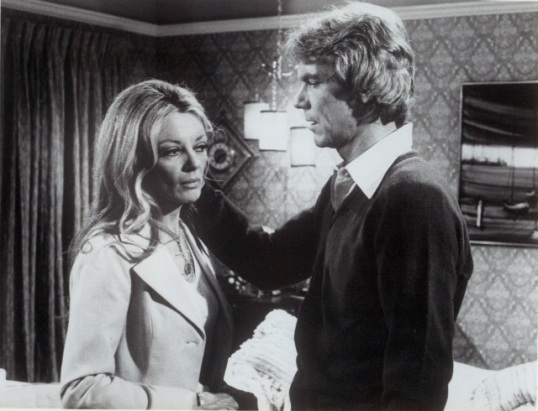
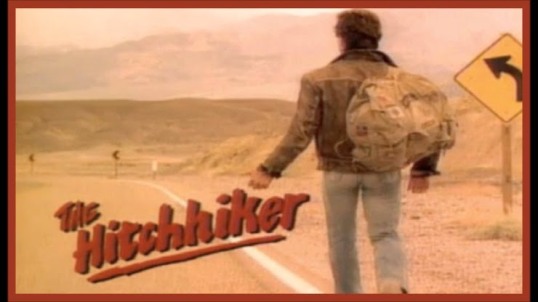
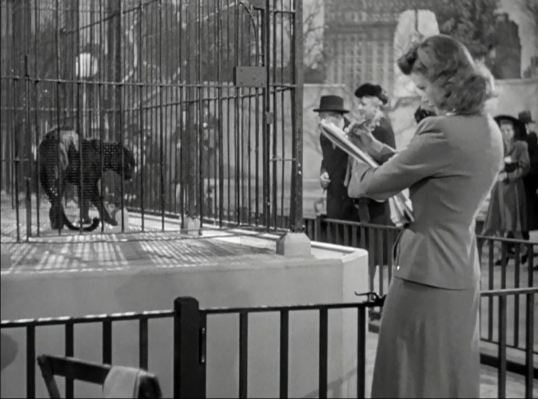
Today’s horror on the lens is 1974’s The Cloning of Clifford Swimmer.
This short but entertaining sci-fi film may be a bit obscure but it’s a personal favorite of mine. Check out my review here and then be sure to enjoy the show!
Today’s horror on the lens is 1974’s The Cloning of Clifford Swimmer.
This short but entertaining sci-fi film may be a bit obscure but it’s a personal favorite of mine. Check out my review here and then be sure to enjoy the show!

by Erin Nicole
“Be warned: I sleep as the earth sleeps beneath the night sky or the winter’s snow; and once awakened, I am servant to no man.” — Anne Rice, “The Mummy

Artist Unknown
This cover is from 1961. The paperback was published as a movie tie-in.
Director Julian Doyle also directed videos for Kate Bush but he may be best known for working as an editor on several Monty Python and Terry Gilliam films, including Life of Brian, Time Bandits, The Meaning of Life, Brazil, and Terry Jones’s Mr. Toad’s Wild Ride.
Enjoy!
Welcome to Late Night Retro Television Reviews, a new feature where we review some of our favorite and least favorite shows of the past! On Fridays, I will be reviewing Friday the 13th, a show which ran in syndication from 1988 to 1990. The show can be found on YouTube!
This week, a cursed teacup wreck havoc and destroys lives!
Episode 1.4 “A Cup In Time”
(Dir by Harvey Frost, originally aired on October 19th, 1987)
Someone is killing the homeless. Every morning, young homeless people are being found dead on the street, apparently strangled. The police don’t really care about the victims and therefore, they aren’t really all that concerned with solving the case. In fact, only a social worker named Birdie (Maxine Miller) really seems to care.
Of course, that’s not all that Birdie cares about. Because she has a crush on Jack, she often drops by the Antique Shop in an attempt to visit with him. Since Jack doesn’t know how to deal with her, Mickey and and Ryan end up talking to her instead. Birdie tells them about the murders and she also mentions that her friend, the elderly Sarah Berrell, is missing.
When Jack hears about the homeless being murdered, he says that it might have something to do with one of the shop’s cursed antiques. Searching through the ledger, he comes across a teacup that was sold to Sarah Berrell’s brother!
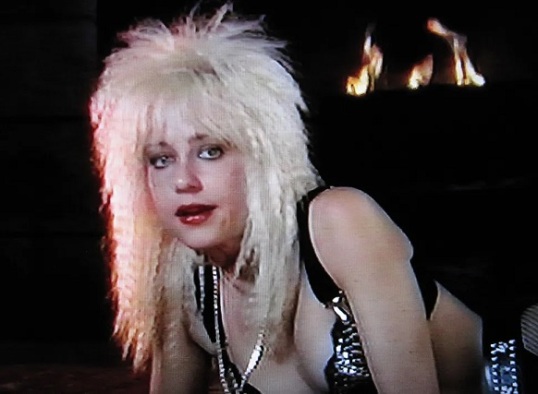
Indeed, it does turn out that Sarah is involved with the murders. She approaches homeless people at night and offers them a warm drink in a tea cup that is illustrated with a picture of a vine. Whenever anyone drinks from the cup, the vine comes to life and strangles them. Their youth is then transferred over to the owner of the cup. Sarah has committed so many murders that she now appears to be in her 20s. Using the name Lady Di (and played by Hilary Shepard), she is now the hottest rock star in America! Ryan loves her music and, in fact, Lady Di is planning on throwing a free benefit concert for the homeless!
What a mess!
This is actually a pretty good episode, one that is reasonably well-acted and scripted, though I do have to wonder just how long Sarah had been missing for her to have time to create an entirely new life for herself as Lady Di. The episode’s true star was Maxine Miller, who gave a sweet and rather poignant performance as Birdie. Eventually, she discovers what the cup is capable of doing and, in the episode’s best scene, she is tempted to do the same thing that Sarah has been doing. And really, you can’t blame her. I mean, who wouldn’t want to stay forever young? As well, there’s a neat auditory moment, towards the end of the episode, when a crowd of concertgoers start to chant “We Want Di” and it sounds like they’re all saying, “We Want To Die!” It’s an effective effect, whether it was deliberate or not.
All in all, this was a good episode of Friday the 13th. That said, I have to wonder about Birdie. I mean, she knows the teacup was cursed. Is she curious about any of the other stuff in the shop? Will her character ever appear again? I guess I’ll have to keep watching to find out.
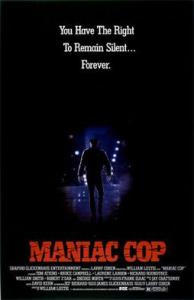
In New York City, murders are being committed by a hulking man dressed in a policeman’s uniform. The NYPD brass (led by William Smith and Richard Roundtree) want to cover up the fact that the murders are being committed by an apparent maniac cop but Lt. Frank McRae (Tom Atkins) leaks the news to the press. With the citizens taking up arms against cops, the brass is eager to frame adulterous cop Jack Forrest (Bruce Campbell) for not only murdering his wife but also committing all of the murders. Lt. McRae believes that Jack is innocent.
Why is the brass so eager to frame Jack? Maybe it’s because they know that the Maniac Cop is actually Matt Cordell (Robert Z’Dar), a formerly good cop who was sent to Sing Sing on trumped up brutality charges. Cordell was killed in prison but he has now come back to life and is seeking revenge on the police force that he feels betrayed him.
Written by Larry Cohen and directed by William Lustig, Maniac Cop is the first of three Maniac Cop films. While the other two Maniac Cop movies largely work and hold up well, the first Maniac Cop is undoubtedly the worst of the trilogy, with most of the kills occurring offscreen and the action moving very slowly. The film is full of genre vets and Tom Atkins gives another one of this good tough guy performances. Bruce Campbell disappointingly plays his role straight and Robert Z’Dar, as intimidating as he is, is actually underused in this film.
As with most films written by Cohen, Maniac Cop has an interesting political subtext. It focuses on cop brutality and corruption with Cordell becoming a symbol of most people’s mixed feelings about the police. But the Maniac Cop trilogy wouldn’t really come to life until the second film. The first spends a lot of time setting Cordell up as a relentless avenger but there’s not much of pay-off.
Everyone likes Linnea Quigley!
The 80s scream queen who brought an uninhibited attitude and an often underrated wit to countless horror films, Linnea Quigley is a true icon of horror. Unfortunately, it’s difficult to find any scenes of Linnea Quigley that are safe to share on this site. Most of them have been slapped with age restrictions on YouTube, for obvious reasons.
Still, I did find this scene from 1984’s Return of the Living Dead, in which Quigley’s Trash talks about her love of cemeteries. It’s a short scene, have no doubt. But it shows everything that has made Linnea Quigley such a popular figure amongst horror fans. Plus, I used to be the same way about cemeteries!
Apparently, R.L. Stine’s readers who so upset over the brilliant (but dark) ending of Best Friend, Stine felt the need to not only give them a sequel but to hold a contest to allow his readers to chime in and have a say in what should happen in the sequel. (To be honest, that sounds like more of a publicity stunt than anything else but hey, whatever works.) The contest was won by a girl in Wisconsin, which should be perfect evidence that the contest was rigged because everyone knows that Wisconsin is a made up place.
Anyway, in 1997 — something like five years after the publication of Best Friend so, seriously, how long did this contest last — Stine gave the world Best Friend 2.
Best Friend ended with Honey Perkins apparently murdering Bill with Becka’s knife and then promising to testify that Becka killed Bill in self-defense in return for Becka being her best friend and Becka …. agreeing! (Woo hoo! Way to go, Stine!) However, the girl from Wisconsin decided that 1) Bill wasn’t really dead (despite the fact that he certainly appeared to be dead at the end of the previous book) and 2) Becka went back on her word and reported Honey to the police. Honey was put in a mental hospital but, as this novel begins, Honey has broken out of the hospital and enrolled at a school near Shadyside. Honey tells everyone that she’s Becka and then she tracks down Eric, who was Becka’s boring boyfriend who was dumped for Bill in the first book. Eric was so heart-broken that he had to transfer to a new school. (Awwwww, poor Eric!) Honey puts Eric out of his memory by murdering him.
At Shadyside, Becka is still trying to recover from the trauma that Honey put her through. Becka is in therapy and she even discovers the true origins of why Honey is so obsessed with her. That’s right, it turns out that Honey is motivated by more than just a fanatical desire for Becka to be her friend and it’s actually kind of lame. Seriously, I hope that girl in Wisconsin never ever wrote anything else because she’s one of those writers who had to overexplain everything.
Anyway, Becka finds herself being stalked again and getting threatening phone calls and all of the usual stuff. Eventually, the stalker is revealed and it’s another twist and …. ugh. It’s a super lame twist. This is why you don’t let contest winners write books. Basically — should I reveal this? What the Hell, this book is over twenty years old. Consider this to be your SPOILER WARNING but basically it turns out that Honey is not the one doing the stalking this time but instead, it’s Becka’s best friend from the previous book who is upset over the fact that Becka never visited her in the hospital after Honey injured her. But there’s nothing about the character, from what we’ve seen of her, that suggests that this sort of thing would drive her mad. This is just a twist that comes out of nowhere. I mean, what are the chances that Becka is going to have two people in her life stalking her because they feel that she wasn’t a good enough friend?
(That said …. why wouldn’t you visit a friend who was put in the hospital by someone who was stalking you? Becka is kind of selfish but still, everyone in this book overreacts. Most people would just say, “Okay, I guess I’ll go find a better friend.”)
Anyway, Best Friend was Stine at his best but this sequel is lame and I blame the imaginary state of Wisconsin.
1989’s The Case of the Hillside Stranglers is based on the killing spree of Angelo Buono and Kenneth Bianchi, two cousins who terrorized Los Angeles in the late 70s. Buono owned his own garage and aspired to be a tough and macho pimp. Bianchi was an aspiring police officer who supported himself as a security guard. Over the course of just five months, they murdered ten women. They probably would never have been caught if not for the fact that Buono eventually tired of Bianchi and kicked him out of his house. Bianchi moved up to Washington where he committed two murders on his own. When he was arrested, he attempted to convince the cops that he was suffering from dissociative identity disorder and that the murders were committed by his other personalities.
The Case of the Hillside Stranglers starts with the murder spree already in progress. Buono is played by Dennis Farina while Bianchi is played by a very young Billy Zane. Both of them are well-cast, with Farina especially making an impression as a misogynistic bully who thinks that he is untouchable. (In real life, Farina spent 18 years as a Chicago cop and, watching his performance in this film, it’s hard not to get the feeling that he had to deal with more than one guy like Angelo Buono over the course of his time on the force.) For all of their cockiness, the film emphasizes that neither Angelo nor Kenneth were particularly clever. The fact that they got away with their crimes for as long as they did was largely due to a combination of luck and witnesses who did not want to get involved. Early on in the film, one woman who is harassed and nearly abducted by Buono and Bianchi refuses to call the police afterwards because she doesn’t want to relive what happened.
That said, the majority of the film actually focuses on Bob Grogan (Richard Crenna), the tough veteran detective who heads up the Hillside Strangler taskforce and who becomes so obsessed with tacking down the elusive killers that he soon finds himself neglecting both his family and his own health. Whenever we see Grogan trying to enjoy any quality time with his children, we know that his beeper is going to go off and he’s going to have to search for a telephone so that he can call into headquarters. (Remember, this film was set in the 70s.) His children are a bit miffed about it, which I can understand though I really do have to say that his son, in this film, really does come across as being a brat. (“Just ignore it, Dad,” he says, as if there aren’t two serial killers murdering innocent people in the city.) The recently divorced Grogan pursues a tentative romance with a woman (played by Karen Austin) who, at one point, decides to investigate Angelo on her own. Crenna, not surprisingly, is sympathetic as Grogan. The film works best as an examination of what it does to one’s soul to spend all day investigating the worst crimes that can be committed. Grogan gets justice but, the film suggests, he does so at the sacrifice of his own peace of mind.
It’s a well-made and well-acted film, one that will probably appeal more to fans of the police procedural genre as opposed to those looking for a grisly serial killer film. In real life, Bianchi is serving a life sentence and Angelo Buono died in prison. And the real Bob Grogan? He appeared in this movie, slapping the handcuffs on Billy Zane.