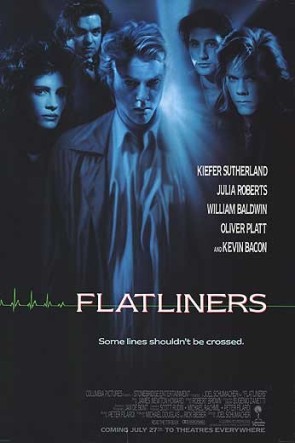
Horror Film Review: Flatliners (dir by Joel Schumacher)


“Our sins have come back in a physical form … and they’re pissed!”

That one line pretty much sums up the original 1990 version of Flatliners.  It’s a good line in that it’s one that you remember and it’s a line that you can use in almost any situation.

Have you gotten a phone call from an unknown caller?  “Our sins have come back in physical form … and they’re pissed!”

Have you and your boyfriend recently been driving across Texas and suddenly noticed that a car has been following you all the way from Lake Dallas to the border of Oklahoma.  “Our sins have come back in physical form … and they’re pissed!”

Have you ever had a stranger fail to hold a door open for you?  There’s only one possible reason for that rudeness.  “Our sins have come back in physical form .. and they’re pissed!”

And don’t even get me started on people who leave negative comments under my reviews.  We all know what’s going on with that!  “Our sins have come back in physical form … and they’re pissed!”

It’s a line that is both oddly memorable and also deeply stupid.  The same description can be applied to Flatliners.  It’s a film about a group of medical students (played by Julia Roberts, William Baldwin, Oliver Platt, and Kevin Bacon) who help Kiefer Sutherland investigate whether or not there’s actually an afterlife.  Sutherland believes that there is but he needs an atheist to be a part of the group, that’s where Kevin Bacon comes in.  And he needs a potential love interest and a Baldwin brother to be a member of the group as well, that’s why Julia Roberts and William Baldwin are there.  And, of course, someone has to provide comedic relief whenever things start to get too dark.  Say hello to Oliver Platt!  Anyway, Sutherland’s plan is to die for a minute or two and then have his fellow medical students bring him back to life.  It sounds like kind of a dumb idea but everyone agrees to it.

Anyway, it turns out that the afterlife looks a lot like an overproduced student film, full of weird camera angles, tinted lighting and disembodied voices.  When Sutherland dies, he sees a boy that he used to bully.  Julia Roberts sees her father, who committed suicide when she was younger.  Kevin Bacon sees a little girl that he used to bully.  (There are a lot of bullies in this movie.)  William Baldwin, a sex addict who is chronically unfaithful to his fiancée, sees hundreds of women, all saying, “But you said you loved me.”  Oliver Platt never actually gets to die and therefore, he sees nothing.  He does make a joke about how his vision would probably involve an angry babysitter.  I laughed.

What happens next?  “Our sins have come back in physical form … and they’re pissed!”

Flatliners has an intriguing premise but oh my God, is it ever a silly film.  It’s not really a spoiler to tell you that all of these returned sins want the characters to either atone for their mistakes or make peace with their past.  For Kevin Bacon, this means tracking down the girl that he used to bully and allowing her to bully him.  For Julia Roberts, it means getting an apology from her Dad and understanding that he was addicted to heroin.  For William Baldwin, it means making peace with never being as well-known as either Alec or Steven.  As for Kiefer … well, things are a bit more complicated for Kiefer Sutherland.

Flatliners starts out as a horror film but then it turns into a squishy movie about letting go of bitterness and learning how to forgive oneself.  It’s kind of annoying that the film couldn’t just stick to being scary because the first half of the film does have some effectively tense moments.  However, it all gets lost as the film’s plot sinks into sentimental, New Age-y quicksand.

Flatliners was directed by Joel Schumacher, who generally does well with shallow films that 1) don’t really mean anything and 2) don’t involve super heroes.  And really, the only film that I can think of that’s more shallow than the original Flatliners is the remake.  (But we’ll talk about that later…)  Schumacher’s direction here is not particularly bad — everyone looks good and the film is never boring.  It’s a very, very pretty film and one that doesn’t add up to much.

I would suggest watching it with your sins, especially after they take physical form.  Maybe they’ll be a little less pissed off afterward.
4 Shots From 4 Films: Special Bob Clark Edition


4 Shots From 4 Films is just what it says it is, 4 shots from 4 of our favorite films. As opposed to the reviews and recaps that we usually post, 4 Shots From 4 Films is all about letting the visuals do the talking.

This October, I am going to be using our 4 Shots From 4 Films feature to pay tribute to some of my favorite horror directors, in alphabetical order!  That’s right, we’re going from Argento to Zombie in one month!

Bob Clark may be best remembered for directing the holiday classic, A Christmas Story, but he started out his career as a horror filmmaker.  Before he spread Christmas cheer with A Christmas Story, he spread Christmas fear with Black Christmas.

4 Shots From 4 Films

Children Shouldn’t Play With Dead Things (1972, dir by Bob Clark)

Black Christmas (1974, dir by Bob Clark)

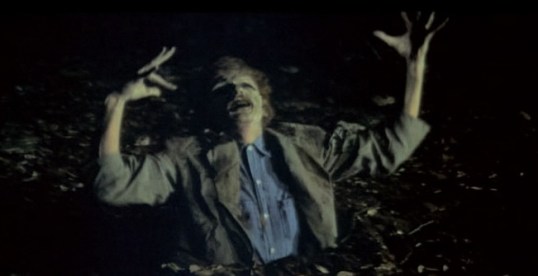
Deathdream (1974, dir by Bob Clark)

Murder By Decree (1979, dir by Bob Clark)


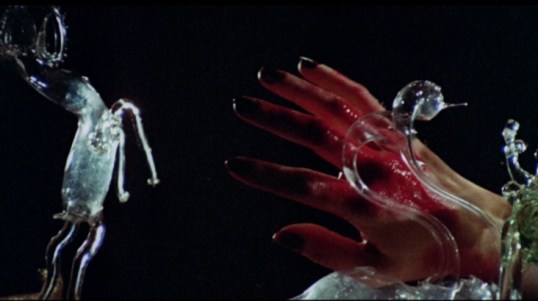
Horror On The Len: The Abominable Dr. Phibes (dir by Robert Fuest)


It’s really not October until you’ve watched at least one Vincent Price film and, for today’s horror on the lens, we have one of his most popular films, 1971’s The Abominable Dr. Phibes!

This is Price at his considerable best.  Be sure to read Gary’ review.

And watch the film below!

Enjoy!


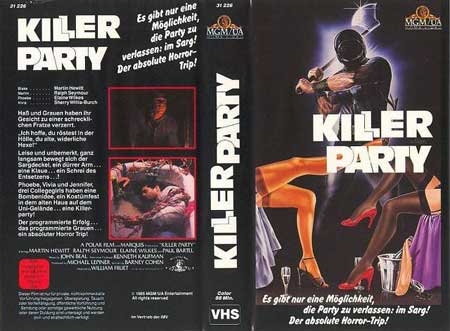
The TSL’s Horror Grindhouse: Killer Party (dir by William Fruet)


The 1986 film Killer Party is one of those late 80s slasher films that somehow has developed a cult following.  Up until recently, there was a fairly active fansite devoted to the history of Killer Party and Killer Party still regularly shows up on TCM Underground.

So, apparently, Killer Party has fans.

I’m just not sure why.

Some of it, I suppose, could have to do with the first ten minutes of the film, which are genuinely clever.  It starts out with a young woman being menaced at a drive-in theater and, just when you’ve gotten invested in her story and have started to wonder whether or not she’ll survive the entire movie, it is suddenly revealed that we’ve actually been watching a movie-within-a-movie.  And that movie-within-a-movie then turns out to be part of an incredibly silly music video, featuring a band that is so 80s that you find yourself expecting them to stop performing so they can do a line of coke and play the stock market.  At one point, the band even performs while standing on the drive-in’s concession stand.

It’s all marvelously silly and kind of clever.  The problem is that the rest of the film never lives up to those ten minutes.  In fact, you spend the rest of the movie wishing you were still watching that movie about the girl trapped at the drive-in.

I also suppose that some of the film’s cult reputation has to do with the fact that Paul Bartel has a small supporting role.  Bartel plays the same basic role that he played in almost every horror film in which he appeared.  He’s a pompous professor who says a few dismissive lines and is then promptly killed off.  Maybe it’s the Bartel factor that has led to this film developing a cult following.

Who knows?

Killer Party is essentially four movies in one.  The first movie is that part that I’ve already talked about.  The opening is clever but it only lasts for ten minutes.

After the opening, the film turns into a rather standard college comedy.  Three girls want to join the wildest sorority on campus but it won’t be easy!  Everyone on this campus is obsessed with playing pranks.  And by pranks, I mean stuff like locking a bunch of people outside while they’re naked in a hot tub and then dumping a bunch of bees on them.  Of course, that prank gets filmed and the footage is later shown at a meeting of stuffy old people.  That’ll teach those uptight members of the World War II generation!  You may have made the world safe for democracy but that was like a really, really long time ago!  So there!  It’s time for a new generation, one that will make the world safe for pranks!

During this part of the film, there are only a few hints that we’re watching a horror movie.  For instance, the sorority wants to have a party in an abandoned frat house.  Their housemother goes by the frat house and kneels in front of a grave.  She speaks to someone named Alan and tells him that it’s time to move on.  Then she promptly gets killed and no one ever seems to notice.

The comedy part of the movie segues into a remarkably bloodless slasher movie.  The cast assembles at the forbidden house.  They have a party.  Someone in a diving mask shows up and kills off the majority of the cast in 20 minutes.  Almost everyone dies off-screen so there’s really not even any suspense as far as that goes.

Then, during the last few minutes of the film, the slasher film suddenly turns into a demonic possession film and that seems like that should be brilliant turn of events but it just doesn’t work in Killer Party.  Usually, I love movies that are kind of messy but Killer Party is a rather bland and listless affair.  If you’re going to combine a campus comedy with a slasher film and a demonic possession film, you owe it to your audience to really go totally over the top and embrace the ludicrousness of it all.  Instead, Killer Party rolls out at a languid and rather dull pace.

I would not accept an invitation to Killer Party.


A Movie A Day #271: Spellbinder (1988, directed by Janet Greek)


Jeff Mills (Tim Daly) is an attorney who might be unlucky in love but who still owns a copy of every movie that Frank Capra has ever directed. (There is even a scene where two of his friends are seen looking at his movie collection and saying, “He’s got every movie Capra ever made!”)  Miranda (Kelly Preston) is the beautiful and mysterious woman who Jeff saves from an abusive boyfriend.  Within minutes of meeting her, Jeff invites Miranda to say with him in his apartment.  For Jeff, it is love at first sight but his friends (Rick Rossovich and Diana Bellamy) worry that Jeff is getting in over his head with a woman about whom he knows nothing.  Weird things start to happen in Jeff’s apartment and a woman (Audra Lindley) shows up in his office, taunting him about how she dug up his mother’s bones and used them in a black magic ceremony.  Eventually, Miranda confesses that she is on the run from a Satanic coven that was planning on sacrificing her but is she telling the whole truth?
Spellbinder is an enjoyably daft movie, especially if you are a fan of Kelly Preston.  It’s not that the rest of the cast isn’t good but this really is Preston’s show and her mix of All-American beauty and otherworldly sexiness is put to good use as the enigmatic Miranda.  It is easy to believe that Jeff would fall in love with her despite not knowing much about her.  The movie also has a few good scare scenes, like one in which the faces of all the members of the coven suddenly appear crowded around a window, staring in.  A slickly made example of how Hollywood made money off of the Satanic panic of the 1980s, Spellbinder is essentially The Wicker Man set in Los Angeles and is more entertaining than Neil LaBute’s actual remake.  (Even if it doesn’t have any bees.)

Horror Scenes That I Love: The Monster Lives in Frankenstein


Today’s horror scene that I love comes from the 1931 Universal classic, Frankenstein!

Though it’s been parodied to death and often used out of context (for example, a few years ago, it was used in a freaking car commercial), the “It’s Alive!” scene from Frankenstein is still a classic piece of horror history.  Colin Clive is often unfairly criticized for going overboard in this scene but let’s be honest here: if you ever reanimated a corpse, you’d probably get pretty damn excited about it.

(After watching the scene, be sure to check out my review of this classic film by clicking here!)

(And if you want to see an alternative take on the creation of Frankenstein’s Monster, check out the 1910 silent version by clicking here!)

Horror Film Review: Village of the Damned (dir by John Carpenter)


At the risk of getting in trouble with at least a few people around the TSL offices, I am going to say something right now.  It may be controversial.  It may be shocking.  It may even make you question your belief in whatever it is that you believe in.

Ready?

Here we go:

I do not think that the 1995 version of Village of the Damned is that bad.

Now, please notice that I didn’t say that I thought it was that great, either.  However, when you listen to some people talk about this movie (which, admittedly, doesn’t seem to happen a lot), they make it sound as if Village of the Damned is one of the worst films ever made.  It is usually cited as being a waste of director John Carpenter’s abilities and Carpenter himself has said that he’s indifferent to the film.  Carpenter has gone as far as to call the film a “contractual assignment.”

Of course, one reason why people dislike the 1995 Village of the Damned is because it’s a remake of an acknowledged classic.  Even worse, it’s an unnecessary remake.  I would not disagree with that opinion.  The 1960 Village of the Damned holds up remarkably well, featuring George Sanders at his best and a lot of creepy little children.  (If anything, the fact that the original is in black-and-white makes the children look even creepier in the original.)  Having recently watched both versions of Village of the Damned, I can say that the remake doesn’t really improve on the original.

And yet, I would still argue that John Carpenter’s Village of the Damned is an underrated and crudely effective little movie.

The film tells the story of the town of Midwich, California.  (The original film took place in the UK and Midwich doesn’t really sound like the name of a town you’d find in California.  Incidentally, my favorite town in California is a place named Drytown, specifically because the town bar advertises itself as being “the only wet place in Drytown.”)  Midwich is a nice, little town.  Everyone is friendly.  Everyone knows everyone else.  Carpenter spends a while establishing Midwich as being the idealized coastal town.  But then, one day, the skies turn dark and everyone in Midwich loses consciousness.  Unfortunately, that doesn’t work out well for some people.  Frank McGowan (Michael Pare), for instance, is driving when the blackout occurs and he ends up dying when his truck goes off the road.  Another unfortunate fellow was manning the grill at the church picnic and, when he passed out, he ended up burning to death.

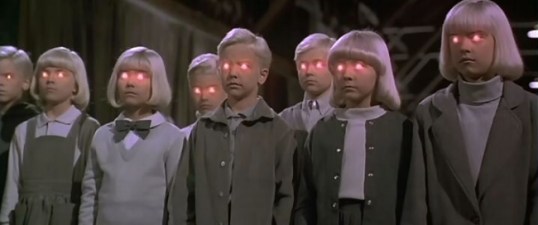
When everyone does wake up, it’s discovered that ten women are now pregnant.  One of them, Kate (Linda Kozlowski), is the widow of Frank.  Another, a teenage girl named Melanie (Meredith Salenger), is a virgin.  Nine months later, all of the babies are born on the same night, though Melanie’s is stillborn.  The 9 babies eventually become 9 very creepy children.  They have pale skin, white hair, glowing eyes, and no emotions.  Soon the government, led by Dr. Verner (Kristie Alley), invades the town so that they can investigate and experiment on the children.  You know that once the government shows up and takes over, everyone’s screwed.

And, while all of this is going on, the once friendly and vibrant town of Midwich becomes a far different place.  We watch as the citizens of the town die, one after another.  Melanie finds herself ostracized and abandoned.  The local reverend (Mark Hamill) goes insane and ends up perched on a hill with a rifle.  The town doctor (Christopher Reeve) loses his wife when she walks into the ocean.

And the children continue to coldly and unemotionally kill anyone who displeases them.  One man is forced to shoot himself.  In perhaps the film’s most disturbing scene, a scientist is forced to dissect herself.

Admittedly, some of the actors do a better than others.  Meredith Salenger gives the best performance while Mark Hamill definitely gives the worst.  At first, Kirstie Alley seems miscast but she actually gives one of the better performances in the film.  As the nominal hero, Christopher Reeve is boring but then again, many small town doctors are.  Of course, nearly everyone in the movie is dead by the time the end credits roll.

It’s a seriously dark movie and, when taken on its own terms, it’s definitely effective.  Carpenter does such a good job of establishing Midwich as a place where anyone would want to live that it does carry an impact to see the town suddenly isolate from the world and the once happy citizens resorting to suicide just to escape the town’s children.  In the end, John Carpenter’s Village of the Damned does capture the anguish of feeling as if there’s no escape from the present nor hope for the future.

Village of the Damned is crudely effective but effective nonetheless.


Jedadiah Leland’s Horrific Adventures In The Internet Archive #5: Baal (1989, Psygnosis Limited)


For my next adventure in the horror section of the Internet Archive, I played Baal (1989, Psygnosis Limited).

In Baal, you are a leader of something called The Time Warriors.  A demon named Baal has stolen a super weapon and it is up to you to infiltrate Baal’s underground lair, kill Baal’s warriors, get the weapon, and destroy Baal.  It sounds simple but this game is biased against people like me who aren’t any good at games like this.

The game starts with you materializing in Baal’s lair.  I think the blue contraption is a transporter.

Yes, there are ladders and multiple levels.  The controls are simple.  Use the arrow keys to move.  Press the space bar to fire our weapon.  If you want jump, press the space bar and an arrow key at the same time.

That serpent is one of Baal’s minions.  You can destroy the serpent by shooting it several times but don’t make my mistake and get too close.  Touching the serpent kills you.

After it kills you, the serpent flies away.  That was cool.

After getting killed by the serpent, I was given a second chance.  This time, instead of running forward, I ran up the ladder.  I discovered that, much like the serpents, you do not want to touch that blue force field.  I also discovered what happens when you fall off a level.

Eventually, I figured out how to jump and I also managed to kill the serpent before it killed me.  This is what I discovered at the other end of the cave.

Another force field!  I decided to test my theory that running into the force field would cause me to die.

It did.

That was it for me.  Baal can have the super weapon.  Hopefully, Baal’s next opponent will be better at games like this than I am.


4 Shots From 4 Films: Special John Carpenter Edition


4 Shots From 4 Films is just what it says it is, 4 shots from 4 of our favorite films. As opposed to the reviews and recaps that we usually post, 4 Shots From 4 Films is all about letting the visuals do the talking.

This October, I am going to be using our 4 Shots From 4 Films feature to pay tribute to some of my favorite horror directors, in alphabetical order!  That’s right, we’re going from Argento to Zombie in one month!

Today’s director is the man who put Halloween on the map and a personal favorite of TSL editor-in-cheif Arleigh Sandoc’s, John Carpenter!

4 Shots From 4 Films

Halloween (1977, dir by John Carpenter)

The Fog (1980, dir by John Carpenter)

The Thing (1982, dir by John Carpenter)

Christine (1983, dir by John Carpenter)