Horror Film Review: The Hunger (dir by Tony Scott)


“Bela Lugosi’s dead….” Peter Murphy sings at the start of 1983’s The Hunger and, in the case of this film, it’s as much of a challenge as a tribute.

Bela Lugosi and Dracula are gone, the film announces, and so is the old-fashioned vampire movie.  Here’s a new look at an old favorite….

Of course, seen today, The Hunger doesn’t seem new.  Since The Hunger‘s release, there’s been  a countless number of films in which vampires have been decadent and chic aristocrats, hanging out in dark nightclubs and looking at the world with ennui-stricken eyes.  By today’s standards, the stylish decadence of The Hunger can seem almost quaint.  Much like Paul Schrader’s remake of Cat People, The Hunger is such a film of the 80s that you half-expect someone to offer you a line coke while you’re watching it.  Also, like Cat People, it’s such a glorious tribute to excess that there’s no way you can’t watch it once it starts.  It’s hypnotic in its excess.

In The Hunger, our vampires are Miriam Blaylock (Catherine Deneuve) and her lover, John (David Bowie).  Miriam has been a vampire since at least the time of the ancient Egyptians.  Rather than sinking her fangs into the necks of her victims, Miriam uses an Ankh pendant to slit their throats.  John was once a cellist in 18th century France.  Now, they live in an expensive New York townhouse, where they teach classical music and occasionally murder anyone that they can convince to come up to see them.

When they first met, Miriam promised John that he would have eternal life but she didn’t promise him eternal youth.  Unfortunately, it takes 200 years for John to notice.  When he starts to rapidly age, he seeks out aging expert Dr. Sarah Roberts (Susan Sarandon) for help.  Though Dr. Roberts is originally dismissive of his claims, she is shocked to see John age several years in just an hour.

When an angry and desperate John kills the music student (Beth Ehlers) that Miriam was hoping to transform into her next lover, Miriam is forced to search elsewhere.  When Sarah shows up, searching for the man who aged years in an hour, Miriam feels that her search may be over.

As one might expect from a film directed by Tony Scott, The Hunger is an extremely stylish film, to the extent that the film’s story is often secondary to the way that Scott chooses to tell it.  The set design is so ornate and every scene is so precisely lit and shot and that, at times, the movie feels a bit like a commercial for vampirism.  It’s easy to imagine Britney Spears singing “Work Bitch” in the background of some of the scenes.  (“You want a hot body?  You want a Bugatti?  You Want a Maserati?  You better work vamp.”)  Throughout the film, New York glows like a neon wonderland while John and Miriam coolly look out over the world like 18th century French aristocrats who have no idea that they have a future date with the guillotine.  At times, it’s a film that becomes almost ludicrous in its celebration of grandeur and style.  One could imagine Jean Rollin telling the same story just as effectively while spending a lot less money.

And yet, it’s that very embrace of the over-the-top ludicrousness of it all that makes The Hunger a memorable film.  The film’s a tribute to excess, with an ending that falters precisely because it attempts to reject precisely what it’s spent the past hour and a half celebrating.  The Hunger doesn’t add up too much but its hypnotically stylish and well-acted by a cast who does their best to keep up with Tony Scott’s camera.

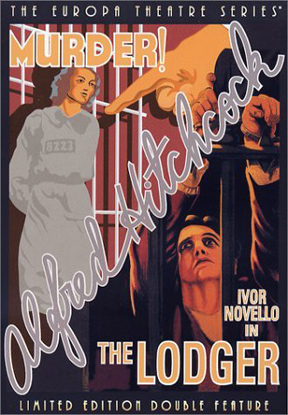
 

Horror on the Lens: The Lodger (dir by Alfred Hitchcock)


A serial killer known as “The Avenger” is murdering blonde women in London (which, once again, proves that its better to be a redhead).  And while nobody knows the identity of the Avenger, they do know that the enigmatic stranger  (Ivor Novello), who has just recently rented a room at boarding house, happens to fit his description.  They also know that the lodger’s landlord’s daughter happens to be a blonde…

Released in 1927, the silent The Lodger was Alfred Hitchcock’s third film but, according to the director, this was the first true “Hitchcock film.”  Certainly it shows that even at the start of his career, Hitchcock’s famous obsessions were already present — the stranger accused of a crime, the blonde victims, and the link between sex and violence.

Also of note, the credited assistant director — Alma Reville — would become Alma Hitchcock shortly before The Lodger was released.

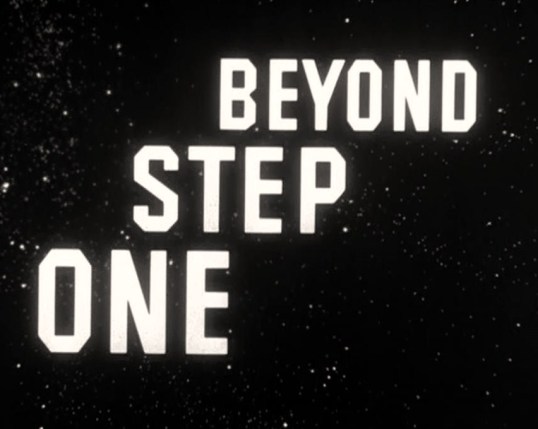
Horror on TV: One Step Beyond 3.6 “Moment of Hate” (dir by John Newland)


On tonight’s episode of One Step Beyond, fashion designer Karen Wadsworth (Joanne Linville) believes that she has the power to cause people to die just by wishing death upon them.  Her psychiatrist tells her that this simply isn’t possible and then dares her to try one little test of her supposed powers.

This episode features a good performance by Joanne Linville and, if nothing else, it perhaps makes the case that we should be a little bit less quick to wish the worst upon other people.  Just imagine all of the damage that Karen could have caused if she had ever set up a twitter account.

This episode originally aired on October 25th, 1960.

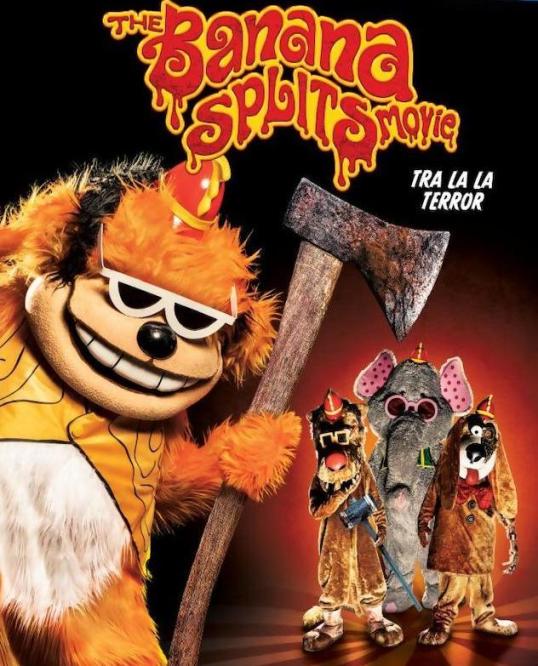
The TSL’s Horror Grindhouse: The Banana Splits Movie (dir by Danishka Esterhazy)


The Banana Splits Movie takes viewers behind the scenes of a children’s television show and shows us the sordid world that nobody knows about.

The stage manager is overworked.  The new head of the network is a jerk.  The star of the show is a drunk.  The lovable Banana Splits, who play silly games and all play music instruments, are all actually robots who are looked down upon by their human coworkers.  When Stevie (Richard White), the star of the show, learns that the show is being canceled, he makes the mistake of telling the robots and, before you know it, all Hell is breaking lose.  People are getting stabbed to death with lollipops.  Network executives are getting dismembered.  One unfortunate person gets slammed in the head with a giant hammer.  You gotta be careful who you piss off, folks.  Robots are ruthless.

To me, the most shocking thing about The Banana Splits Movie was the discovery that it was based on an actual show.  Apparently, the Banana Splits were real and they had their own show in the late 60s and early 70s.  I’m going to guess that the Banana Splits were played by people in costumes as opposed to just being big robots.  At least, I hope that’s the case because, after watching The Banana Splits Movie, I’m kind of over wanting anything to do with robots.

I will say this.  If I imagine the characters from this movie not killing people, I can kinda understand why they would have their own TV show.  I mean, they’re all really cute, except for when they’re covered in blood and brain matter.  My personal favorite was Snorky, who was a big elephant and was a bit less murderous than the other three members of the Banana Splits.  In fact, I have to admit that the film kind of left me feeling a little bit depressed because all of the robots are so cute that you really don’t want to see them murder people or get damaged themselves.  The film actually does a pretty good job of contrasting the adorableness of the Banana Splits with the pain and carnage that they caused.

And make no doubt about it.  There’s a lot of blood spilled in this movie.  The Banana Splits are ruthless murderers and they don’t care how nice you are or if you paid money to see the show or if you’re just trying to make your daughter into a big star.  If they see you, they’ll kill you.  In fact, I have to admit that it sometimes got to be a bit too much for me.  I got a little bit tired of all the violence but, at the same time, I also appreciated the film’s satiric intent.  In a world gone mad, why wouldn’t the stars of a children’s TV show turn out to be a bunch of killer robots?  When you think about all of the once beloved celebrities that have fallen from grace over the past 10 years, it makes an odd sort of sense.

Anyway, The Banana Splits Movie is well made splatter film with a satiric vein running through all blood and guts.  It was a bit much for me but I respected it for sticking to its subversive premise and I do think it will be appreciated by a lot of other horror fans and pop culture fanatics.

I’m just hoping that the sequel features more Snorky.

Horror Scenes I Love: The Cemetery Scene From Plague of the Zombies


Since I reviewed the film earlier today, I guess it makes sense that today’s horror scene that I love should be the cemetery scene from Hammer’s The Plague of the Zombies!

Enjoy and watch your step!

Book Review: David Warbeck: The Man and His Movies by Raymond J. Slater and Harvey Fenton


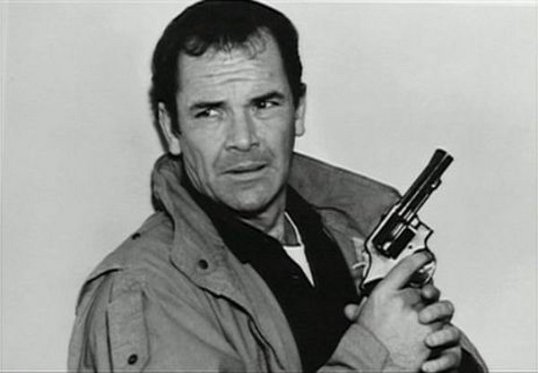
David Warbeck

Anyone who is a fan of Italian exploitation films will knows the name and the face of actor David Warbeck.  Warbeck was the handsome, rugged, and surprisingly likable New Zealand-born actor who went from studying at London’s Royal Academy of Dramatic Arts to appearing in films that were directed by everyone from Russ Meyer to Antonio Margheritti to Lucio Fulci.  He played a small but pivotal roles in Sergio Leone’s A Fistful of Dynamite and then went on to star in The Beyond, The Black Cat, The Last Hunter, Rat Man, and so many others.  While his films may never have been critical favorites at the time of their release (though several have been positively reevaluated), Warbeck’s movie did well enough at the box office that he was even considered for the role of James Bond,  Warbeck was one of those actors who was consistently good, regardless of the quality of the film in which he was appearing.

Sadly, Warbeck passed away in 1997, before many of his films were rediscovered.  It’s a shame because — as the commentary track that he and Catriona MacColl recorded for The Beyond shows — he was a charming raconteur who had a way with a story.  Fortunately, in 1996, Warbeck did sit down and gave a lengthy interview to Jason J. Slater, in which he discussed his career and shared many anecdotes about his life as an international exploitation superstar.  That interview is at the center of a short but interesting book called David Warbeck: The Man And His Movies.

The book not only features the interview with Warbeck but it also takes a detailed look at his filmography, reviewing some of his more interesting (and, in some cases, infamous) films.  The reviews are well-written by people who obviously love these often underappreciated films.

If you’re a fan of Italian exploitation, this book is simply a must-have.  Admittedly, it’s not an easy book to find.  I ordered a copy off of Amazon and it wasn’t cheap.  But it was worth it!

International Horror Film Review: The Iron Rose (dir by Jean Rollin)


“Let’s go to the cemetery.”

That line is actually from another Jean Rollin film, Requiem for Vampire, but it also perfectly sums up the plot of his 1973 masterpiece, The Iron Rose.

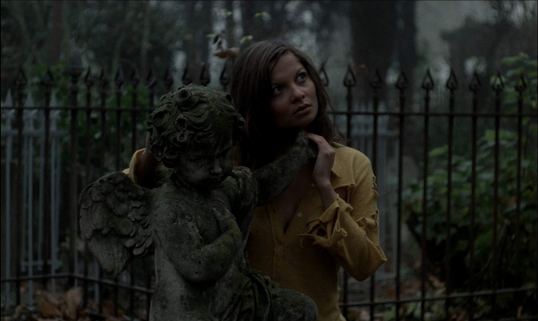
A man (Hugues Quester) meets a woman (Francoise Pascal) at a wedding party.  They agree to go on a date, one which includes a railway station, a picnic, bicycling, and finally a walk that leads to a seemingly deserted cemetery.  On what seems to be a whim, the two of them enter the cemetery.  The woman seems to be fascinated with the place.  The man is dismissive, saying that funerals are an expensive, waste of time.  The woman believes that there is something after death.  The man is cynical, saying that once you’re dead, you’re dead.  As any couple would do after having a theological conversation, the two of them enter a crypt and make love.

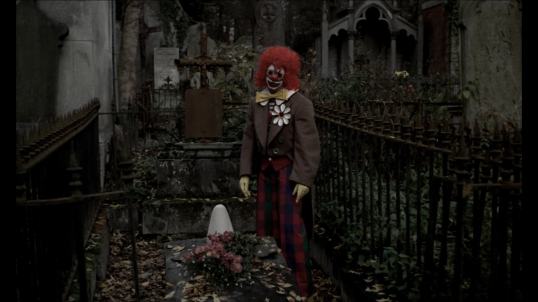
While they’re busy making love, we discover that there actually are others in the cemetery.  There’s a clown that places flowers on a grave.  There’s a mysterious man who has been watching the couple as they walk among the graves.  (In the credits the man is called “Le vampire,” though he never actually does anything in the film that would indicate that he’s a bloodsucker.)  And then there’s the old woman who, as night falls, promptly closes the cemetery gates.

When the man and the woman emerge from the crypt, they discover that they are trapped.  There’s no way to open the gate and there’s no way to get out of the cemetery.  The two of them start to walk around, searching for either an exit or, at the very least, some sort of shelter for the night.  As they walk, strange things start to happen and we’re forced to reconsider our previous assumptions about not only the man and the woman but also the cemetery itself.  Did they enter the cemetery on a whim or did one of them specifically lead in the other?  As the night progresses, the feeling of impending doom only grows.  It all leads to a rather macabre fate for one of our lovers and a dance among the tombstones for another.

The Iron Rose is one of Jean Rollin’s best films and, sadly, it’s also one of his most unjustly obscure.  Even by the standards of Rollin’s early vampire films, The Iron Rose is a surreal film, one that is far more interested in creating a haunting atmosphere than in telling a traditional story.  What is the real reason that leads to the man and the woman entering the cemetery?  The Iron Rose is full of hints but, for most part, it’s left to the audience to answer that question for themselves.  The film’s haunting final scenes force us to reconsider everything that we previously assumed by the characters and their actions.  Are they obsessed with love or are they just in love with death?  There are no easy answers.

Obviously, a 90-minute film about two people walking around a cemetery is going to have some slow spots but, in this case, those occasional moments just add to the film’s ennui-drenched atmosphere.  As filmed by Rollin, the cemetery becomes as important a character as both the man and the woman and a reminder that the present is always going to be tied to the past.  The Iron Rose is Rollin at his dream-like best.

4 Shots From 4 Films: Blade, The Faculty, The Phantom of the Opera, Vampires


4 Shots From 4 Films is just what it says it is, 4 shots from 4 of our favorite films. As opposed to the reviews and recaps that we usually post, 4 Shots From 4 Films lets the visuals do the talking!

This October, we’re using 4 Shots From 4 Films to look at some of the best years that horror has to offer!

4 Shots From 4 1998 Horror Films

Blade (1998, dir by Stephen Norrington)

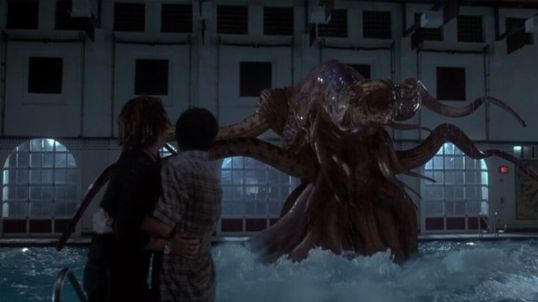
The Faculty (1998, dir by Robert Rodriguez)

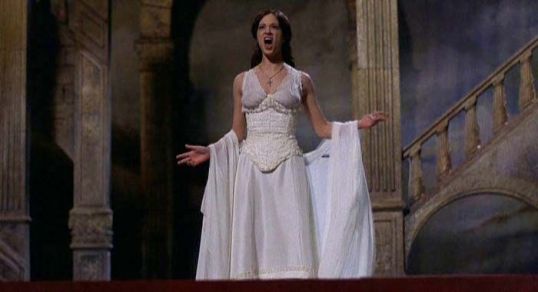
The Phantom of the Opera (1998, dir by Dario Argento)

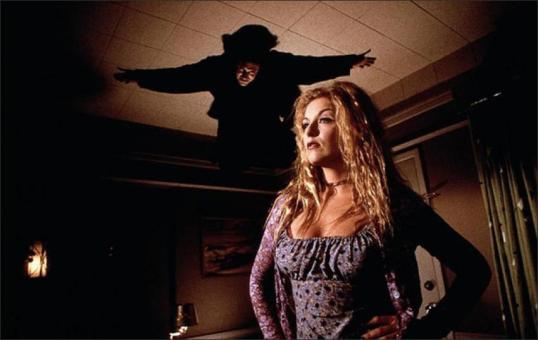
Vampires (1998, dir by John Carpenter)