Horror on the Lens: The Last Man on Earth (dir. by Ubaldo Ragona and Sidney Salkow)


Hi there and Happy October 27th!  For today’s treat from the ranks of horror films that have fallen into the public domain, I present to you one of the most important films in horror history.  Though it wasn’t appreciated when it was first  released back in 1964, The Last Man On Earth was not only the 1st Italian horror film but George Romero has also acknowledged it as an influence on his own Night of the Living Dead.

It’s easy to be a little bit dismissive of The Last Man On Earth.  After all, the low-budget is obvious in every scene, the dubbing is off even by the standards of Italian horror, and just the name “Vincent Price” in the credits leads one to suspect that this will be another campy, B-movie.  Perhaps that’s why I’m always surprised to rediscover that, taking all things into consideration, this is actually a pretty effective film.  Price does have a few over-the-top moments but, for the most part, he gives one of his better performances here and the black-and-white images have an isolated, desolate starkness to them that go a long way towards making this film’s apocalypse a convincing one.  The mass cremation scene always leaves me feeling rather uneasy.

The film is based on Richard Matheson’s I Am Legend and no, it’s nowhere as good as the book.  However, it’s a lot better than the Will Smith version.

If you have 87 minutes to kill, please enjoy The Last Man On The Earth.

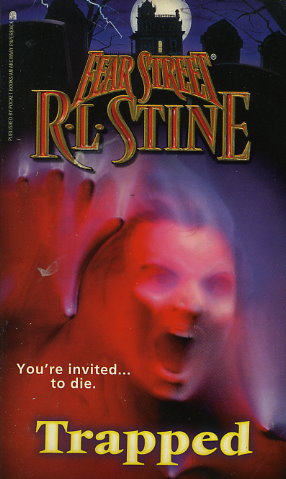
Horror Novel Review: Trapped by R.L. Stine


All good things must come to an end and so must all bad things. The original Fear Street series concluded with Trapped, an enjoyably macabre and kind of grotesque take on The Breakfast Club.

You know how these things go. You’ve got five students and they’re all stuck in detention. Elaine is the smart girl who failed to turn in her homework. (They give you detention for that?) The principal hopes that the other detainees won’t be a bad influence on her. (Then don’t give her detention in the first place, you jerk!) Darlene is the girl who doesn’t take any crap from anyone. Jerry is the Brain, who was sent to detention because he refused to dissect a frog. (I remember an entire episode of Saved By The Bell that dealt with the same issue.) Max is a spray paint artist who uses the school as his canvas. And Bo? Well, Bo’s a good-looking rebel who likes to burn stuff.

Anyway, detention is kind of boring and, since no one wants to have a therapy session like they did n the Degrassi episode that was based on The Breakfast Club, the students decide to explore the tunnels that are underneath Shadyside High. It’s rumored that some kids died down there in the 60s! Stupid hippies! Though some are initially hesitant, all five of the students end up in the tunnels. And that’s where they get trapped!

And, listen, I can understand how this happens. I get lost in mazes too. I once spent hours lost in a hedge maze and it was not fun. (I later got revenge by building a similar hedge maze in the Sims and then setting it on fire. The resulting inferno killed all of my Sims but, fortunately, their ghosts stuck around to haunt the house.) But it’s not just the maze aspect that makes the tunnels difficult to escape. There’s also this red mist that, when it envelopes you, snaps your bones and folds you into a tiny cube and basically kills you in the worst, most painful way possible.

AGCK!

Seriously, that mist is so viscous and the deaths are so drawn out and the book ends on such a downbeat note, I had to remind myself that I was reading a book by R.L. Stine and not Christopher Pike. There’s not much humor to be found in Trapped. Unlike other Fear Street novels, it doesn’t end on a note of hope. Instead, there’s just death, violence, and pain. It makes sense, I guess. This was the final Fear Street book so Stine wasn’t obligated to try to get people to come back for the next one. He could be as morbid as he wanted to be and the end result is actually pretty good. That red mist is actually pretty scary!

I enjoyed Trapped. I’m glad I never explored any of the underground tunnels under my school. Who knows what might have been down there! Hmmm …. now, I’m tempted to find out….

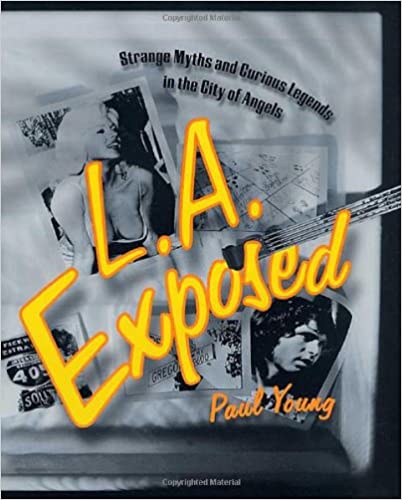
Book Review: L.A. Exposed: Strange Myths and Curious Legends in the City of Angels by Paul Young


Before I say anything about this book, I have to give out a shout out to Recycled Books of Denton, Texas.  Recycled Books is a huge used bookstore.  When I was going to college, I used to visit Recycled Books nearly everyday.  I loved the books.  I love the atmosphere.  I even loved the shag carpeting.  I’ve recently been trying to organize and read all of the books in my collection. As I’ve been going through them, I couldn’t help but notice just how many of them I purchased from Recycled Books!

And yes, L.A. Exposed is one of those books.

First published in 2002, L.A. Exposed is an enjoyably gossipy look at all of the legends and mysteries surrounding Los Angeles.  The book provides a nice mix of celebrity gossip, rock star decadence, and — most importantly — supernatural speculation.  I mean, yes, it was interesting to read about whether or not John Barrymore’re body was stolen from the morgue.  And I’m sure some people will automatically turn the chapter about whether or not Courtney Love had Kurt Cobain murdered.  There’s a lot about OJ Simpson and the corruption of the LAPD as well.  The deaths of Marilyn Monroe, Sam Cooke, and Bobby Fuller are all examined.  Was Charles Manson an FBI informant?  Read the book for yourself.

But, for me, the most interesting parts of the book were the sections dealing with haunted Hollywood, sea serpents, UFO sightings, Bigfoot spottings, cult activities, and the Lemurians.  Do you know who the Lemurians were?  They were like the people of Atlantis but, if you believe the legend, they were smart enough to sail for California before their continent sank.  And, according to some, they currently live inside a mountain near Los Angeles.  I imagine that’s a good way to avoid the IRS.

By this point, our regular readers should realize that I’m a natural skeptic.  I don’t believe in UFOs, ghosts, sea serpents, or Lemurians.  But they’re still a lot of fun to read about.  In fact, it’s even more fun when you don’t believe because you can enjoy the idea of Bigfoot without worrying actually meeting him.

Anyway, this is a fun book and good read.  Order a copy before your next California vacation.  And thank you, Recycled Books, for stocking it where I could easily find it, all those years ago!

Horror on TV: Friday the 13th: The Series 2.17 “The Mephisto Ring” (dir by Bruce Pittman)


Tonight, for our horror on the lens, we have the seventeenth episode of the 2nd season of Friday the 13th: The Series!

In tonight’s episode, Denis Forest plays a gambler who gets an cursed 1919 World Series Ring! It allows him to pick all the winners but it’s fueled, as these cursed antiques often are, by murder! Anyway, consider how excited my sister is over the World Series starting tonight, I had to go with this episode!

This episode originally aired on April 15th, 1989.

The TSL’s Grindhouse: The Naked Witch (dir by Larry Buchanan)


The 1964 film, The Naked Witch, opens with a prologue that explains the role of witchcraft throughout the ages. That, in itself, is not surprising. A lot of supernaturally-themed films opens with a prologue that’s designed to give the film some sort of historical basis. It’s one of the oldest tricks in the book. Give your cheap film some credibility by claiming that it’s “based on a true story.”

What sets The Naked Witch apart is that the prologue just goes on and on. For ten minutes, we stare at Bosch paintings while an officious sounding narrator discusses the history of witchcraft. The paintings are effectively macabre but it all goes on for so long that you can’t help but get the feeling that the prologue was mostly added to pad out the running time. It’s almost as if director Larry Buchanan was basically admitting that he didn’t really have enough of an actual story to justify a feature-length running time. Of course, this shouldn’t come as a shock to anyone who is familiar with Larry Buchanan’s filmography.

Once the narration finally ends, we find ourselves watching The Student (Robert Short) as he drives through central Texas. The Student suddenly takes over the narration, telling us that he’s driving through the Texas German Counties. He’s visiting towns and counties that were founded by German settlers. The townspeople all have German names. Most of them still speak German in private. They all dress like they’ve just returned from a night at a Munich beer hall. Interestingly enough, these counties and towns do actually exist, though I’ve never seen anyone casually wearing lederhosen or a dirndl in Central Texas. Of course, this film was made a bit before my time so maybe that used to be a tradition back in 1964. Maybe people stopped doing it after The Naked Witch came out. Or, even more intriguingly, maybe people stopped doing because The Naked Witch came out. We’ll probably never know for sure.

Anyway, the Student is kind of an idiot because he manages to run out of gas while driving out in the middle of nowhere. I guess it didn’t occur to him to fill up the tank before trying to drive through a largely empty stretch of land. Leaving his car behind, he manages to walk to the real-life town of Luckenbach, Texas. He’s shocked to discover the none of the townspeople want to talk about long-dead witch that was supposedly buried in town. Why, it’s almost as if the people of Luckenbach understand that it’s not a good idea to brag about living under the threat of a supernatural curse.

Largely due to the Student’s stupidity, the Witch (played by Libby Hall) comes back from the dead. She’s naked, which I imagine was probably the film’s main selling point back in 1964. The Witch wants revenge on the descendants of the people who put her to death. The Students just wants to hook up with The Witch.

And that’s really pretty much it. Even by the admittedly low standard set by Larry Buchanan’s other films, the plot of The Naked Witch is pretty much impossible to follow. It’s incoherent and yet, strangely enough, that incoherence sometime works in the film’ favor. The atmospheric Texas landscape, when combined with the overly theatrical performance of Libby Hall, gives the film a dream-like feel. Even the fact that the film features three separate narrators all contribute to the movie’s surreal style. At its best, The Naked Witch is an existential mood piece. At its worst, it’s just a really bad, zero-budget drive-in movie.

The Naked Witch is an odd film but, if you’re looking for a ten minute history on witchcraft followed by a Texas travelouge, the film might be for you.

International Horror Film Review: The Bridge Curse (dir by Lester Hsi)


The 2020 Taiwanese film, The Bridge Curse, is …. well, I don’t quite know how to describe it. It’s a horror film. It’s a found footage film. It’s a ghost film. What it’s not is a particularly memorable film.

It opens with a reporter and her cameraman doing a story on five college students who disappeared after visiting a bridge that is reputed to be haunted by the vengeful spirit of a young girl. There’s a good deal of “found footage”, featuring shaky shots of the students either heading to the bridge or running around campus. And then there’s frequent flashbacks to what actually happened, which basically amounts to slightly less shaky shots of the students either heading to the bridge or running around campus. The important thing is that everything always seems to lead back to the same bridge. The bridge has a curse, by the way. The title is not a lie.

This is one of those films that’s so derivative of other horror films that, as you watch it, you really can’t bring yourself to believe that there isn’t some grand twist hiding somewhere in the film. I watched all 87 minutes of this film, waiting for something to happen that would take me by surprise. By the 20th minute, I was prepared to get on my knees and pray for a surprise. 30 minutes in, I was offering to donate 25% of my next paycheck to charity. After an hour, I was angry and I announced that I actually didn’t care whether the film was going to surprise me or not. 75 minutes in, I admitted that a surprise would be nice but if I didn’t get one, that would be okay. 81 minutes in, I yelled, “PLEASE! SURPRISE ME!” 82 minutes in, I took a break, grabbed a Coke, and played with the cat. 84 minutes in, I announced, “Surprise!,” hope in would be a self-fulfilling prophecy. However, the much hoped-for surprise never happened. Instead, this is just a standard stalker ghost film featuring a bunch of personality-lacking college students being chased around campus by a ghost who is soaking wet. Perhaps if someone would just offer the ghost a towel, a lot of trouble could be avoided.

However, despite the fact that the movie is about as predictable as the leaves changing colors in the fall, The Bridge Curse does have a few effective jump scares. The ghost looks creepy and it has a habit of suddenly appearing in the shadows. The ghost made me jump a few times. That said, the movie’s story certainly didn’t stick with me. It’s been about 30 minutes since I watched the film and it’s already disappearing from my memory. The ghost might grab you but the movie never does. It ends with the promise of a sequel but I can’t imagine what else there’s left to do with this story. I guess more students can go hang out on the bridge but, at some point, you would think people would notice that spending the night on the bridge is a one way ticket to terror. Personally, I’d probably just find a different bridge to visit, one that doesn’t have a history of tragedy and mystery. But that’s just me.

The Bridge Curse isn’t terrible as much as it’s just blandly forgettable. It can currently be viewed on Netflix.

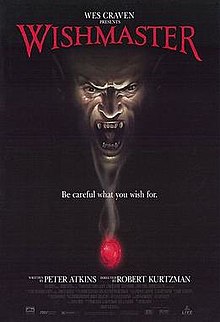
Horror Film Review: Wishmaster (dir by Robert Kurtzman)


Do you all remember Wishmaster?

Played by Andrew Divoff, the Wishmaster was a genie (or a djinn) who made his film debut in the 1997 film of the same name. The Djinn’s schtick is to randomly approach people and say something like, “Would you like to be rich?” or “Would you like all of your enemies to suffer?” He grants wishes but he does so in ironic ways. So, if you say want to be rich, you might very well turn into someone named Rich who is on the verge of getting hit by a bus. If you say that you want to escape from your mundane life, you might end up in a straight-jacket under water, struggling to perform one of Harry Houdini’s signature escapes.

I rewatched Wishmaster a few months ago and what I immediately discovered was the the Djinn wasn’t really that good at his job. He pretended to be clever in the way that he would fool humans but, honestly, it often seemed less like he was tricking people and more like he really wasn’t playing fair. Take the security guard who made the mistake of wishing for an escape. As I just mentioned, The Djinn immediately put him underwater in a straight-jacket. But the guard’s wish was not to have to escape. The guard’s wish was to simply escape. So, putting him in a life-and-death situation and telling him to figure it out for himself wasn’t fulfilling the guard’s wish. It just seemed like the Djinn wanted to drown someone and he decided to use his wish-granting job as an excuse.

The guard, by the way, was played by Tony Todd, one of the many horror icons who appeared in small roles in Wishmaster. (Today, Tony Todd is best known for the Final Destination films but, when Wishmaster came out, he was known for playing the Candyman.) Among the other cameos:

From Phantasm, Angus Scrimm provided the narration while Reggie Bannister played an unlucky pharmacist.

From Friday the 13th, Kane Hodder played a security guard who made the mistake of saying that he wished he could see the Djinn try to walk straight through him.

Day of the Dead’s Joseph Pilato played a crane operator.

John Carpenter vet George “Buck” Flower played an angry homeless man.

Sam Raimi’s brother, Ted Raimi, showed up long enough to get crushed by a crate.

And finally, Robert Englund played the somewhat pretentious professor who was responsible for bringing the Djinn to America in the first place.

As you can probably guess by looking at all of the cameos, Wishmaster is not a film that’s meant to be taken seriously. It’s often deliberately campy. Wes Craven may have produced it and was undoubtedly responsible for recruiting many of the actors who appeared in it but the film’s direction was handled by special effects maestro, Robert Kurtzman and he puts more emphasis on the visual effects than on any sort of serious exploration of the somewhat random series of events that make up the film’s storyline. Of course, when seen today, the film’s special effects look a bit cheap but, for many viewers (like me!), that’s actually a part of the film’s grisly charm.

Wishmaster does have a plot but it’s not particularly important. The Djinn tries to make Alexandra (Tammy Lauren) make three wishes so that he can unleash the forces of Hell. Why he spends all of his time granting wishes to other people instead of just concentrating on Alex is never really explained. It may be an often dumb movie but it’s also undeniably entertaining when taken on its own terms. Andrew Divoff is enjoyably sinister as the Djinn, playing the character with a sarcastic wit to go along with his evil schemes. It’s a fun movie to watch, even if it does feel like it was basically slapped together in a handful of days.

You should always be careful what you wish for but Wishmaster is still an entertaining piece of 90s horror.

(Author’s Note: Wow, this is embarrassing.  Right after I posted this review, I discovered that I previously reviewed Wishmaster in 2018!  Whoops!  Well, it’s nice to see that my thoughts on the film have remained consistent. — LMB)

Great Moments In Comic Book History: The First Appearance on Ghost Rider


Marvel Spotlight was a comic books that existed so Marvel could introduce new characters and showcase heroes who were being considered for a full time series.  Think of it as being the Marvel equivalent of pilot season.  In August, 1972, Marvel Spotlight #5 introduced the world to Johnny Blaze, the motorcyclist who once made a deal with the devil.  Johnny Blaze was better known as Ghost Rider!

While riding through Manhattan on his motorcycle, Johnny spots two criminals committing a murder.  He wants nothing to do with it and tries to drive away.  The two criminals follow him and corner him in an alley.  And then this happens:

The rest of the story is simple.  Ghost Rider makes flames emerge from the ground.  The criminals, who are named Clyde and Dingbat, run away.  How does one criminal end up named Clyde while the the other has to settle for Dingbat?  The rest of the issue is a flashback, telling how stuntman Johnny Blaze sold his soul to Satan (later revealed to be a disguise of frequent villain Mephisto) in order to save the life of his cancer-stricken stepfather Crash Simpson.  Though Crash survives the cancer, he still dies when he attempts a dangerous stunt.  Satan still wants Johnny’s soul but is vanquished by Roxanne, Crash’s daughter who is pure of soul and has been reading up on occult practices. However, every night, Johnny is transformed into Ghost Rider.

It’s nothing complicated but, from such humble beginnings, legends are born!

Marvel Spotlight Vol.1 Issue 5 (August, 1972)