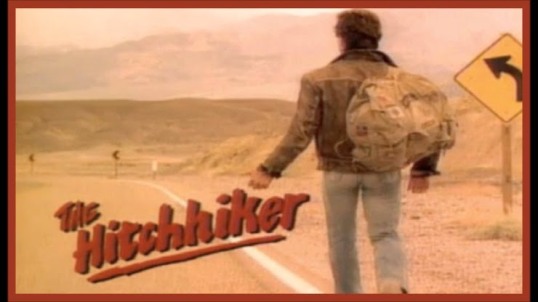
Let’s give some credit to whoever came up with the title of tonight’s episode of The Hitchhiker!
In this episode, Alan Thicke plays a skeevy movie director who likes to pretend to be a tough guy. When he hooks up with the girlfriend of a genuine tough guy, the director discovers that he’s not quite as streetwiswe as he thought he was. The Hitchhiker doesn’t seem to have much sympathy for anyone involved.
This episode originally aired on September 28th, 1990.
So much attention has been devoted to dissecting and discussing the ending of 1983’s Sleepaway Camp, that I think people tend to overlook the bigger issue. This film is the biggest argument against summer camp over filmed.
Seriously, don’t send your kids to camp! Don’t get a job working at a camp! Don’t live anywhere near a camp! If someone tries to open a camp near your home, gather together a posse and run them out of town! If you discover an abandoned camp within one hundred miles of your home, set the place on fire! Camps are bad news. They attract bullies and tragedy and murder. If there’s anything that I’ve learned from watching the horror movies of the early 80s, it’s that summer camps mean trouble.
Consider the camp in Sleepaway Camp. Even before the murders start, the place comes across as being a prison camp. Seriously, I’ve seen a lot of summer camps in a lot of slasher films and it’s hard to think of any of them that look as shabby and dirty as the camp in Sleepaway Camp. None of the campers appear to be happy to be there. No one is allowed to leave. The campers are divided into two groups, the bullies who rule the place like mini-tyrants and the poor kids who spend the entire summer being beaten up and taunted. Not even the counselors are worth much. Counselor Meg (Katherine Kamhi) is best friends with the camp’s main mean girl, Judy (Karen Fields). Meg is the type who tosses a camper in the lake, just because Judy tells her to. Meanwhile, the owner of the camp is named Mel (Mike Kellin) and he’s just an old perv who doesn’t want to bothered with anyone’s problems. What type of horrific world is this?
And then, let’s consider some of the murders at the camp. The skeevy camp cook get scalded with boiling water. (It’s debatable whether the cook actually dies or not.) Kenny, one of the camp’s bullies, get drowned while playing a canoe-related prank. Another bully is stung to death by bees. That’s just three of the many deaths here and yet, the camp never closes. It never occurs to the camp’s owner to send anyone home. It never occurs to anyone that maybe they should send the campers to another camp. None of the deaths lead to an increased police presence nor does it lead to any changes with the camp’s schedule. None of the campers appear to be particularly upset by all the deaths. It’s a disturbing world.
Everyone who dies at the camp earlier picked on Angela (Felissa Rose), an introvert who ends up getting targeted by Judy. Angela’s cousin, Ricky (Jonathan Tiersten), is very protective of Angela and, as a result, he becomes the number one suspect. As the film’s ending reveals, the truth is something much different. The film ends with a justifiably famous shot and it does stick with you as the end credits role. It’s tempting to read a lot of meaning into the film’s ending but I imagine that’s giving the filmmakers a bit too much credit. The film was made for 1983 audiences who were looking for a shock, not 2023 cultural critics.
Even before that ending, though, Sleepaway Camp is a bit more creepy than the average 80s slasher film. The killer is relentless and ruthless and it’s disturbing that the victimized campers are played by performers who are close to the age of their victims as opposed to the usual 30 year-old who played teenagers in these type of films. The scene with the curling iron is something that I can only watching through the fingers that I’m holding in front of my eyes. It’s not a great film by any stretch of the imagination but it does definitely capture the feel of being at the worst summer camp imaginable (seriously, one can hear the flies buzzing and even smell the stale order of stopped-up plumbing) and it does stick with you after you watch it. It’s nothing to lose your head over, it’s just too bad no one told that to the campers.
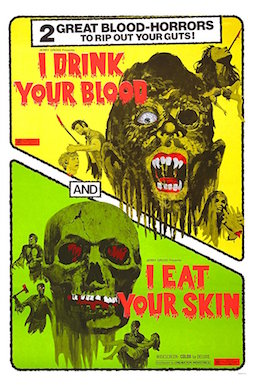
Put yourself in the shoes of the townspeople in 1971’s I Drink Your Blood.
Here you are. You’re minding your own business. Life isn’t great because of the economic downtown. Your town is nearly deserted and is basically full of empty buildings. In fact, it seems like there are currently more construction workers around then townspeople. The workers are working on the dam. Maybe a dam will help the area. Maybe it won’t.
The sexist construction workers are kind of a pain but then, things get even worse when a bunch of hippies show up. Led by the mysterious Horace Bones (played by dancer Bhaskar Roy Chowdhury), these are not your typical (if annoying) peace-and-love hippies. These hippies have more in common with the Manson Family than they do with the commune folks from Easy Rider. They are a remarkably diverse group of hippies. Some of them are young. Some of them are older. Some of them really enjoy attacking other people. Some of them are just along for the ride. For his part, Horace is really into Satanism and human sacrifice and he encourages his followers to feel the same way. Has anyone nice ever been named Horace Bones?
When the cultists assault a local girl named Sylvia (Arlene Farber), they are confronted in the abandoned building in which they are squatting by Sylvia’s grandfather, Doc Banner (Richard Bowler). They proceed to beat up the kindly doctor and they force him to take LSD. Sylvia’s younger brother, Pete (Riley Mills), get revenge by injecting the blood of a rabid dog into several pies and then selling them to Horace and his hippies. Almost all of the hippies eat the pies and soon, they are foaming at the mouth and rampaging through the countryside, infected by and spreading rabies. One of the hippie women ends up having sex with all of the construction workers, which leads to the rabies spreading even more. Soon, it’s hippies vs hardhats as the fights happening across the real world are repeated in small town America. Of course, there’s no police around to break up the fights and, thanks to the rabies, everyone is fighting to the death. Heads are ripped off. Electric knives are used to carve more than just food. People are set on fire. Blood is definitely drank.
Only one hippie didn’t eat the pies. Andy (Tyde Kierney) was never a big fan of Horace’s Manson-like tendencies and he pretty much draws the line at human sacrifice. Andy flees from Horace’s world and finds himself with Sylvia, Pete, and Mildred (Elizabeth Marner-Brooks), the owner of the local bakery. The four of them struggle to survive in a world that has literally gone mad.
I Drink Your Blood was, not surprisingly, controversial when it was first released. It was one of the few films to be given an X-rating for its violence as opposed to its sexual content. It is definitely violent, though it’s really nowhere near as graphic as some of the R-rated horror films that have come out over the past few years.
I Drink Your Blood is a classic grindhouse film, one that takes a fairly ridiculous premise and works wonders with it. The crazed hippies fighting the far more blue collar construction workers stand in for the fanatical soldiers in America’s cultural wars, with innocents like Sylvia, Pete, and Mildred caught in the middle with Andy. Director David Durston mixes horror and satire with a deft hand, suggesting that the rabies is ultimately just allowing people to show their true selves. I Drink Your Blood is an underground classic and thematically, it’s portrayal of a rabid world is just as relevant today as when it was first released.
11 models have been murdered in Los Angeles and Margo (Kimberly Stevens) fears that she could be next. She’s been receiving threatening notes and feels as if someone is watching her and her boyfriend, Bill (Michael Phenicie). She hires a private detective (Mark Derwin) to protect her but it might be too late because Homer (Corey Feldman), the man who has been sending her the notes, has already enrolled in the same acting class of Margo. After Bill turns up dead, Homer is assigned to be Margo’s new scene partner. Is Homer moving in for the kill or is someone else responsible for the murders?
This mix of erotic thriller and horror was one of those movies that used to show up on a late night Cinemax in the 90s, where it could be watched by teenagers who kept one eye on the screen and one eye looking out for their parents. Corey Feldman starred in a lot of these films and in this one, he gives a twitchy and occasionally funny performance as the nerdy Homer. Homer is the most obvious stalker imaginable and it’s hard to believe that Margo, who is so concerned about being stalked that she’s hired a private detective, would not look at Homer and immediately realize that he was the culprit. Feldman overacts but he at least provides the film with the energy that is missing from the performances of Kimberly Stevens and Mark Derwin. Even better is the performance of Brion James as the autocratic and pretentious acting teacher. Watching him, I got the feeling that James probably could have based his performance on any number of Hollywood acting coaches.
Anthony Perkins did not start his career as a horror icon. A talented young actor, Perkins started his career on Broadway and eventually, he started to appear in films. From the start, he was usually cast as nervous young men, the type who awkwardly smiled and struggled to talk to people. Perkins was promoted as a romantic lead, with the Studios and his agents making sure that Perkins was regularly photographed dating Hollywood starlets like Natalie Wood. As witty off-screen as he was nervous on-screen, Perkins was a popular figure in Hollywood. He received his only Oscar nomination for his performance as a young Quaker in 1956’s Friendly Persuasion.
Perkins’s entire career changed when Alfred Hitchcock cast him as the seemingly timid motel owner in 1960’s Psycho. Perkins was reportedly Hitchcock’s first choice for the role, with Hitchcock saying that he felt only Perkins or Dean Stockwell was capable of bringing Norman to life. Perkins was not nominated for Best Actor but the role pretty much defined him in the eyes of many. Perkins spent the rest of his career trying to first escape the shadow of Psycho and then eventually embracing his status as an icon of horror.
Perkins’s performance has been imitated so many times that there’s a tendency to forget just how good he is in the role. In this episode, Perkins-as-Norman discusses his mother with Janet Leigh.
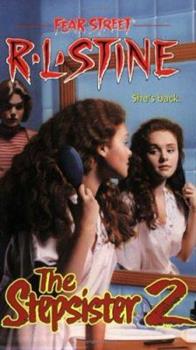
Yes, the annoying family from R.L. Stine’s The Stepsister returns in The Stepsister 2. First published in 1995, The Stepsister 2 picks up a year after The Stepsister. Hugh and Mrs. Wallner are still married and Hugh is still a blowhard. Stepsister Emily and Jessie are now as close as can be, though Emily has yet to fully recover from the events of the previous book and Jessie is still sensitive about the death of her friend Jolie. Jessie’s brother Rich has moved on from reading Stephen King and is now a Clive Barker fan who shoots his own horror movies with his friends. Rich is considerably more rebellious and bratty in this book than he was in the first one. And, of course, Emily is still dating Josh.
As for Emily’s sister, Nancy, she’s spent the last year in a mental hospital, working on the issues that previously led to her killing the family dog and trying to kill her sister as well. (For the record, Nancy blamed Emily for the death of their father and she also never forgave Emily for going out with her ex-boyfriend. Seriously, sisters should not share boyfriends.) However, Nancy is coming home and Emily is a little bit nervous about it.
And really, why wouldn’t Emily be nervous? When Nancy first enters the house, she’s carrying a knife! Nancy explains that she just found the knife in the bushes and that it was left there by Rich’s film crew but seriously, if you had just spent the year in a mental hospital because you tried to kill the members of the your family, would you chose to step through the front door while carrying a bloody knife? Later, Nancy wraps her hands around Emily’s throat but claims that she was only doing so to make Emily realize that she’s still scared of Nancy and that she hasn’t forgiven her. Again, it seems like there are other ways to make that point. I’m going to be scared of anyone wrapping their hands around my throat.
Nancy’s behavior, though, really isn’t as strange as a scene where Emily and Josh go on a date and they end up ice skating on frozen Fear Lake. Didn’t we establish, in the previous book, that Emily’s father drowned in Fear Lake while Emily watched helplessly? I mean, isn’t she worried that she’s going to look down at the ice and see her father’s gray corpse floating by?
Anyway, as you can probably guess, weird things start happening around the house and the stepsisters feels threatened. Is it Nancy? Is it the increasingly angry Rich? Or is it Jessie’s best friend, Cora-Anne? You’ll have to read the book to find out, but I’m going to tell you right now that it’s pretty much the same story as the first Stepsister so you probably won’t be surprised by the final revelation. The first time, you can accept people making dumb decisions. The second time, no one really has an excuse. Personally, after all this drama, I think the Wallners should maybe look for a home away from Fear Street.
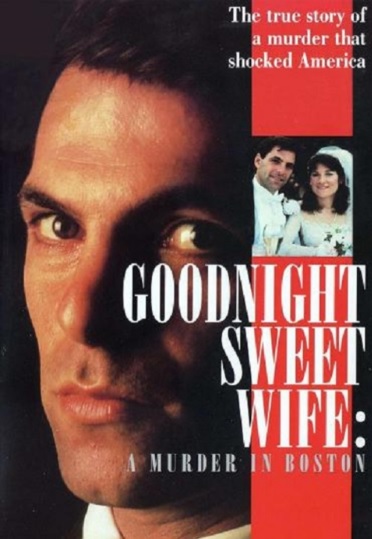
1990’s Goodnight Sweet Wife opens with a frantic 9-11 call.
A man named Charles Stuart (Ken Olin) calls the Boston Police Department and says that he and his pregnant wife have just been shot. He says that he got lost while trying to drive home and that a black man got in the car, made Charles drive to a remote location, robbed Charles and his wife, and then shot them. When the police finally manage to track Charles down, he’s nearly dead as a result of having been shot in the stomach. Carol was shot in the head and is pronounced dead shortly after arriving at the hospital. Her baby, named Christopher, is delivered via C-section but dies a few days later.
The city of Boston is outraged as the crime makes national news. The story that thousands hear is that Charles Stuart, a hard-working and financially successful man who has never had any trouble with the police, took one wrong turn, ended up in a “bad” neighborhood, and lost his wife and his son as a result. As Charles recovers in the hospital, the police make capturing his assailant their number one priority and soon, black men are being stopped and frisked in the streets.
With the entire world mourning the loss of Carol and Christopher Stuart, there are only a few people in Boston who are willing to take a careful look at Charles’s story. There are quite a few inconsistencies in Charles’s story, not the least of which was his claim that he was shot in a nearly deserted area of town when the neighborhood is actually one of Boston’s busiest. Some start to suspect that Charles killed his wife and then shot himself to make it look like a robbery and the fact that Charles nearly died from his wound is not proof that Charles was actually the victim but instead just a sign that Charles didn’t know where to shoot himself in order to not nearly die. However, even with all of the inconsistencies in Charles’s story, the police still announce that they’ve arrested a man for the crime. Charles even identifies the suspect, William Bennett, as being the murderer.
Of course, as is revealed in flashbacks, Charles Stuart is a murderer and he’s not a particularly clever one. He’s the type of murderer who openly talked to people about how he was considering committing a murder. He’s the type who roped his own brother into helping him fake the robbery. Far from being the successful professional that he presented himself as being, Charles was mediocre broker who depended on his wife’s salary to finance his lifestyle. With Carol pregnant and planning on quitting her job to be a full-time mother, Charles decided to kill her for the insurance and he also figured that he would be able to get away with it as long as he blamed the crime on a black man.
Tragically, it turned out that Charles Stuart was almost right. In both the movie and in real life, Charles Stuart was believed because he didn’t look like what most people thought a criminal looked like. He was a young, handsome, middle class white guy and because he couldn’t face the prospect of having to cut back financially, he killed his wife and his son and he nearly put an innocent black man in prison. The film does a good job of depicting the consequences of both Stuart’s crime and the rush to judgment on the part of the police. Ken Olin plays Charles Stuart as being outwardly friendly but empty on the inside, a cold sociopath who is incapable of truly caring about anyone but himself. In real life, Stuart chose to jump into the Mystic River rather than face the consequences of his actions. Stuart’s brother, who helped Charles fake the robbery and later turned Charles into the police, died in a homeless shelter 30 years later. Carol’s family set up a scholarship fund in her name to aid students in Mission Hill, the neighborhood where Charles claimed he had been hijacked. One of the scholarship’s first recipients was the daughter of William Bennett.
It can be argued that 1987’s Opera is one of Dario Argento’s most personal films.
In the mid-80s, Argento was hired to direct an opera, in this case a production Giuseppe Verdi’s Macbeth. Argento described the opportunity to direct an opera as being a case of one of his childhood dreams coming true. Unfortunately, certain people were scandalized with the idea of hiring a director of violent horror films to direct the opera, even though Macbeth is one of the most horrific of Shakespeare’s plays. I mean, if any story seems to be custom-made for a director who is known for his complex set pieces and his willingness to indulge in graphic imagery, it would seem to be Macbeth. Despite this, the production was canceled and Argento was left feeling like an outsider in his own industry.
Along with his disappointment over the canceled production of Macbeth, Argento was also suffering on a personal level when he directed Opera because he had just separated from his long time partner and collaborator, Daria Nicolodi. The two of them had a notoriously volitale relationship, one that led to some of Argento’s best films and reportedly some of his biggest on-set fights. Despite the fact that they had split up, Argento still wrote a role for her in his latest film. At first, Nicolodi refused the role but she changed her mind when Argento promised her the most spectacular death scene in the movie. However, when it came time to shoot the scene, Nicolodi apparently grew paranoid that Argento was planning to kill her for real. Fortunately, Nicolodi was incorrect about that and Argento was totally correct about her scene being one of the best in the film.
Opera takes place during a production of Macbeth, one that is directed by a controversial horror director named Marco (played by Ian Charleson, the star of the Oscar-winning Chariots of Fire). When his star is injured in an auto accident, Marco is forced to cast the young understudy, Beth (Cristina Marsillach), as Lady Macbeth. Despite the doubts of many, Betty gives a strong performance in the role. She stuns the audience. Perhaps the power of her performance is due to her own traumatic memories of her mother being murdered by a never captured assailant.
Speaking of murder, people around Betty start dying as well, often while Betty is forced to watch. The black-gloved killer often come out of nowhere, gags Betty, and ties her to whatever is nearby. The killer always tapes a row of needles under Betty’s eyes, keeping her from being able to close them or to look away as the killer then proceeds to murder her friends. The first victim is Betty’s handsome boyfriend, Stefano (William McNamara). The second murder is a costumer (Barbara Cupisti). Three of the opera’s ravens are killed, leaving the remaining ravens determined to get revenge.
Betty, it should be noted, refuses to go the police about what she has witnesses because she thinks that the killer is the same person who murdered her mother. You have to wonder at her logic or the fact that director Marco agrees with her decision. Personally, if I witnessed a murder as brutal as the murder of Stefano, I would go to the police. It’s hard to really sympathize with Betty’s decision, as much as the film seems to think that I should.
Opera has a lot of fans and it does feature some of Argento’s strongest visuals. Towards the end of the film, there’s an extended raven attack in the opera house that is one of Argento’s greatest set pieces. And, for all of her fears that she was about to be killed for real, Daria Nicolodi’s shocking death scene is Argento at his best. Both Ian Charleson and Urbano Barberini give excellent performance and, even if the genesis of the film was found in Argento’s anger over his canceled version of Macbeth, there’s a lot of affection to be found in the film’s portrayal of what goes into putting on a massive production. One gets the feeling that, for once, Argento actually likes the majority of the characters in the film.
That said, I have to admit that there are a few things that I don’t particularly care for in Opera. If I liked Phenomenamore than most viewers, I like Opera a bit less. After each murder, Argento attacks our ears with heavy metal and I assume the point is to contrast the stateliness of the opera with the chaos of the killer’s actions. But, while I can respect Argento’s logic (assuming that was his logic), the music itself tends to be repetitive and, after the second time that we hear it, it gets kind of boring. And Betty is not a particularly sympathetic protagonist, both due to the way she’s written and also Cristina Marsillach’s less than convincing performance in the role. Reportedly, Argento and Marsillach did not get along during filming and perhaps that explains why her performance never really seems to come alive. Everyone in the film insists the Betty is a revelation of Lady Macbeth but there’s nothing about Marsillach’s performance that makes us believe that. It’s hard not to feel that the film would have been improved if Cristina Marsillach and Barbara Cupisti had switched roles.
(Director Michele Soavi, who has a small role in this film, did later cast Cupisti as the lead in his film StageFrightand watching Cupisti in that film, it’s even easier to imagine her as the lead in Argento’s film.)
The film ends on a strange note, one that seems to serve as a call-back to Phenomena. What I find interesting is that critics who like the film overall tend to be critical of the ending and the idea of Marsillach talking to a lizard. Whereas I, someone who does not like the film quite as much as some others, absolutely loves the ending because it’s just so weird and it comes to use from out-of-nowhere. It’s as if Argento is saying, “You might have kept me from directing an opera but it’s my movie and I’m in control here.”
Opera did well in Italy and the rest of Europe but, as was so often the case, Argento was screwed by his American distributors. Opera was originally supposed to get an American theatrical release but, when the distributor went bankrupt, the film was only given a video release, with much of the gore edited out to ensure that the film received an R-rating and could be carried by Blockbuster. (That’s right. Blockbuster wouldn’t carry anything above an R. Where’s your God now, video nerds?) Fortunately, all that was edited out was put back in when Opera was released on DVD in 2002.
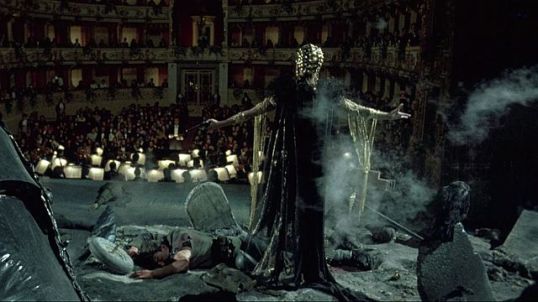
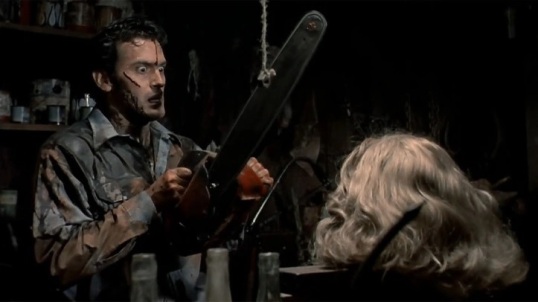
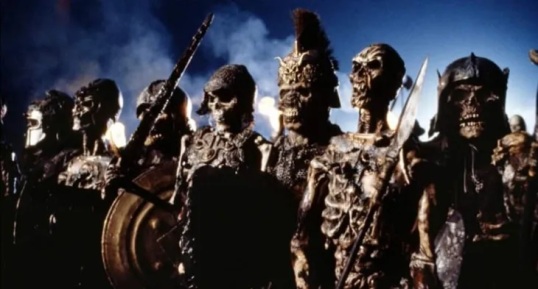
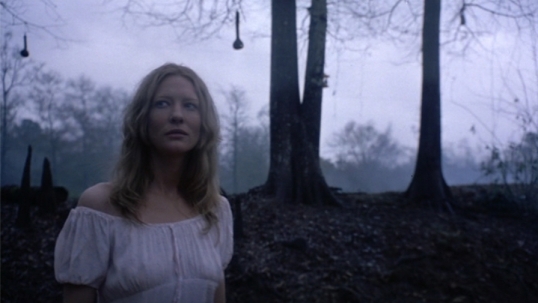
4 Shots From 4 Films is just what it says it is, 4 shots from 4 of our favorite films. As opposed to the reviews and recaps that we usually post, 4 Shots From 4 Films is all about letting the visuals do the talking.
This October, I am going to be using our 4 Shots From 4 Films feature to pay tribute to some of my favorite horror directors, in alphabetical order! That’s right, we’re going from Argento to Zombie in one month!
Today’s director: Sam Raimi!
4 Shots From 4 Sam Raimi Films
The Evil Dead (1981, dir by Sam Raimi, DP: Tim Philo)
Evil Dead II (1987, dir by Sam Raimi, DP: Peter Deming)
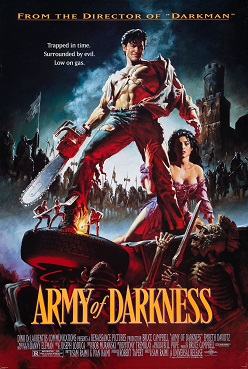
Army of Darkness (1992, dir by Sam Raimi, DP: Bill Pope)
The Gift (2000, dir by Sam Raimi, DP: Jamie Anderson)
This is not going to be a traditional film review because let’s just state the obvious. Army of Darkness is great. Everyone knows that Army of Darkness is great. Everyone loves Army of Darkness. It’s not like you’re reading this review because you need to know whether or not Army of Darkness is a good film.
Now, interestingly enough, not everyone recognized just how good Army of Darkness was when it was first released. A lot of reviewers were confused by director Sam Raimi’s mix of of horror (because the Deadites are scary under any circumstances) and slapstick comedy. Today, we’re used to films and television shows that attempt to mix comedy and horror. Ryan Murphy’s built an entire career out of mixing gore with camp and, as a result, he’s the favorite horror filmmaker of people who think they’re too good for horror. In 1992, when Army ofDarkness was first released, mixing horror and comedy caught critics and audiences off-guard. What’s interesting is that 31 years later, Army of Darkness still feels fresh while many of the comedy horror films that followed feel tired.
I think one reason why the film continues to work is because it’s obvious that both Sam Raimi and Bruce Campbell were truly committed to bringing their demented vision to screen. The film features Campbell as Ash Williams, the S-Mart clerk who, after a night of fighting the Deadites and losing his hand, has found himself in the Middle Ages, captured by Lord Arthur (Marcus Gilbert) and expected to live the life of a medieval slave.
Ash is often described as being one of the dumbest movie heroes of all time but, as this film shows, Ash’s stupidity is also his secret weapon. While others heroes would probably get caught up trying to rationalize or understand the situation in which they’ve found themselves, Ash just accepts it. While others heroes would strategize or try to figure out a clever way to get out of their situation, Ash simply fights back and runs straight into trouble. “This is my boomstick!” Ash yells at one point and, while it establishes himself as being a great warrior, it’s also a case of Ash bragging on himself. Ash is a big fan of bragging and it must be said that it usually works out for him.. When Ash is attacked by evil Ash and several miniature Ashes, the mindless delight that all of these different Ashes take in trying to destroy each other is infectious.
Of course, Ash’s stupidity can also be his biggest downfall. For me, the best part of this film is when Ash tries to recover the Necronomicon from the haunted forest. He is given three simple words that he needs to repeat before taking the book. Before entering the forest, he practices by repeating the words twice but refuses to repeat them a third time because “I’ve got them!” Of course, Ash doesn’t have them so he does what any of us would do. He attempts to mumble the third world. This, of course, raises an army of the dead.
(My second favorite part of the film is that the army of the dead is surprisingly talkative as they rise from their graves. My third favorite part of the movie is Ted Raimi continually popping up as different supporting characters, occasionally even arguing with himself. My fourth favorite part of the movie — well, I’ve got a lot of favorite parts of this movie. Army of Darkness is one of those endlessly quotable movies about which you can spend hours saying, “Remember when….”)
“Shop smart, shop S-mart,” Ash says at one point and it’s tempting to laugh because Ash isn’t smart but he’s determined and his oddly confident and he manages to find a strange sort of joy in every situation that he finds himself. He’s the ultimate blue collar hero and Army of Darkness is the ultimate celebration of Ash Williams, Bruce Campbell, and Sam Raimi.





 Through the Shattered Lens