For today’s horror on the lens, we have a low-budget but undeniably effective film from 1980, The Children. In The Children, a school bus drives through a toxic cloud and, as a result, all of the children on the bus turn into perpetually smiling zombies with black fingernails. Accepting a hug from these children will result in your being burned alive!
I reviewed The Children last year and, when I did, I pointed out that The Children may be low-budget and it may feature some questionable performances but it is still really scary and kind of disturbing.
Here’s your chance to watch it and decide for yourself!
In this episode of The Twilight Zone, the Earth has somehow gotten off of orbit is now being drawn closer and closer to the sun. With humanity on the verge of extinction, two women (Lois Nettleton and Betty Garde) struggle to survive as the heat keeps rising.
Full of haunting images of a deserted and sun-baked city, The Midnight Sun is one of the few episodes of The Twilight Zone that has ever given me nightmares. For some reason, the melting painting always gets to me.
This episode was written by Rod Serling and directed by Anton Leader. It was originally broadcast on November 17th, 1961.
For today’s horror on the lens,we have a film from 1977. I recently watched this film very late at night and — OH MY GOD! Seriously, I had nightmares for two nights straight!
Full Circle opens with the horrifying death of Kate (Sophie Ward), the daughter of Julia (Mia Farrow) and Magnus (Keir Dullea). After Kate’s death, Julia and Magnus divorce and Julia moves into a new house. However, she is haunted by visions of a little girl who looks just like Kate. As well, the house is full of odd noises, creepy toys, and appliances that turn on by themselves. Is Julia seeing the ghost of her daughter or something far more dangerous?
Full Circle is a truly haunting and disturbing haunted house film. Mia Farrow gives a great performance as Julia and the entire film is dominated by a palpable atmosphere of dread. And that final scene — AGCK!
Tonight’s episode of the Twilight Zone was originally broadcast on January 24th, 1963 and it’s one of the rare hour-long episodes of the original Twilight Zone. In He’s Alive, a very young Dennis Hopper plays Peter Vollmer, an aspiring Neo-Nazi who isn’t having much luck bringing fascism to America until he meets a mysterious benefactor who teaches him the tricks of the trade.
It’s a pretty good (if heavy-handed) episode, distinguished by both Dennis Hopper’s lead performance and a message that is probably even more relevant today than when the show was first broadcast.
This episode was written by Rod Serling and directed by Stuart Rosenberg.
For today’s horror on the lens, we have The Beast Must Die. In this 1974 film, millionaire Tom Newcliffe (Calvin Lockhart) invites a group of people to spend the weekend at his mansion. Tom explains that one of them is a werewolf and therefore “must die.”
But who is the werewolf? Tom has come up with several werewolf tests but, actually, it turns out that the easiest way to discover the identity of the werewolf is to just let the werewolf kill everyone who isn’t a werewolf. Or, at least, that’s the way it seems to me.
The best thing about The Beast Must Die is that it features a 30-second werewolf break where the audience is encouraged to announce who they think the werewolf is before the actual solution is revealed!
Seriously, many movies would be greatly improved with a werewolf break.
Tonight’s episode of The Twilight Zone is a political allegory about a communist dictator in Central America who gets a magic mirror that, he believes, will reveal who is plotting against me. It’s undeniably heavy-handed but, at the same time, it’s a lot of fun to watch Peter Falk play Fidel Castro.
This episode was written by Rod Serling and directed by Don Medford. It was originally broadcast on October 20th, 1961.
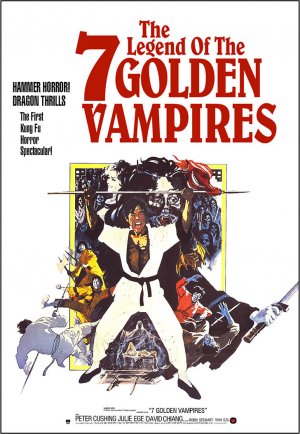
As some of our more frequent readers may remember, I shared the 1974 Dracula-martial arts hybrid The Legend of the 7 Golden Vampires as one of our horrors on the lens last October. Judging from the comments that I got last year, this was apparently one of the more popular films that we featured.
And why not? The film is one of those rather ludicrous movies that really could have only been made in the early 1970s. It combines two genres that really should not go together — martial arts and the Hammer Dracula series — and somehow, it all works. Don’t get me wrong. The film doesn’t make a bit of sense. I’ve seen it a few times and I still have a hard time following just what exactly is going on. But you don’t watch a film called The Legend of the 7 Golden Vampires for the plot. This is one of those movies that you watch for the style. Fortunately, The Legend of the 7 Golden Vampires is all about style.
The Legend of the 7 Golden Vampires is the final entry in Hammer’s Dracula series. Or, at least, it might be. It all depends on whether or not you consider 7 Golden Vampires to actually be a part of the series. I do but quite a few people don’t.
Why the controversy?
Well, first off, Christopher Lee does not appear in this film. Much as he did with Brides of Dracula, Lee read the script and announced that he would not be returning to play Dracula. Of course, when Lee refused to appear in Brides of Dracula, Hammer responded by creating an entirely new vampire for Prof. Van Helsing to battle. This time, however, they simply recast the role. An actor by the name of John Forbes-Robertson took on the role of Dracula and, unfortunately, he gave a rather bland and unmemorable performance. If Lee’s Dracula seemed to be motivated by rage, Forbes-Robertson is merely petulant.
The other issue that purists have with the film is that it violates the continuity of the previous Dracula films. The film opens in 1805 and features Dracula leaving his castle for China, where he will spend the next 100 years as the leader of the infamous 7 Golden Vampires. The problem with this, of course, is that there had already been 7 other films that established that Dracula spent the 19th Century going between England and Eastern Europe.
It would be easy to declare that 7 Golden Vampires has nothing to do with the other Hammer Films except for the fact that Peter Cushing returns of Prof. Van Helsing. When the film opens, Van Helsing is in China, lecturing to skeptical students about the legend of the 7 Golden Vampires. After one lecture, Van Helsing is approached by a man (David Chiang), who explains that the 7 Golden Vampires have been attacking his village. Van Helsing agrees to help the man vanquish the 7 Golden Vampires and, along the way to the village, he even tells some stories about his previous battles with Dracula.
So, here’s my theory. The Legend of the 7 Golden Vampires does take place in the same continuity as the Christopher Lee Dracula films but I do not believe that the vampire played by Forbes-Robertson is actually Dracula. I think he’s just an upstart who has claimed the infamous name while the actual Dracula is inconvenienced.
As for the film itself, it works far better than you might expect. At the time 7 Golden Vampires went into production, Hammer was struggling to survive with their once racy products now seen as being rather tame when compared to what other studios were releasing. 7 Golden Vampires was a co-production between Hammer and the Shaw Brothers, which means that the film was full all of the gothic trappings that I love about Hammer while also featuring all of the martial arts action that fans of the Shaw Brothers would have expected. It’s an odd combination that works exactly because it is so unexpected.
Finally, one word about the 7 Golden Vampires. Not only are they far more desiccated than the average Hammer vampire but whenever they ride up on their horses, they’re filmed in slow motion, just like the zombies from Amando De Ossorio’s Blind Dead films. As a result, those 7 Golden Vampires are pure nightmare fuel.
The Legend of the 7 Golden Vampires may have been the final entry in Hammer’s Dracula franchise but at least the series went out on a memorable note.
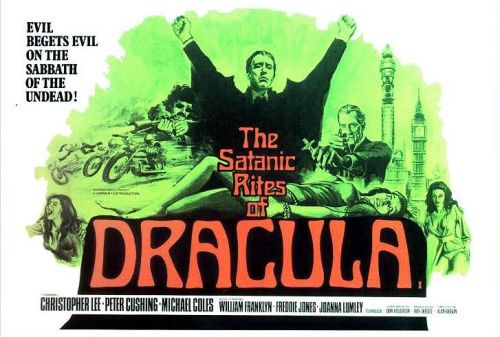
First released in 1973 and, like Dracula A.D. 1972, set in what was then the present day, The Satanic Rites of Dracula was the 8th entry in the Hammer Dracula series. It was also the last to feature Christopher Lee in the role of Dracula and that perhaps is why, judging by some of the other reviews that I’ve read online, The Satanic Rites is one of the more reviled entries in the series.
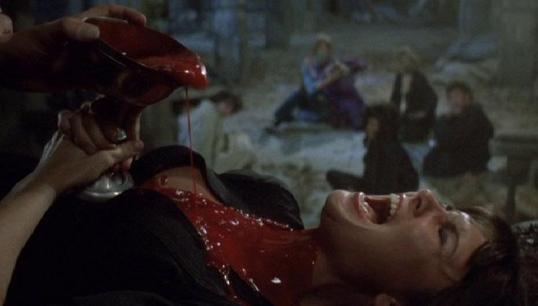
Judging from a lot of those reviews, the attitude seems to be that The Satanic Rites of Dracula was so bad that it was the film that made Christopher Lee say, “No more!” Reportedly, Lee felt that the film itself was both poorly written and that it was too violent. And, even though the film is rather tame by the standards of today’s horror films, The Satanic Rites is still probably one of the more extreme entries in the series. The film features a graphic and drawn-out flashback in which we see a naked woman sacrificed by a Satanic cult, a scene that’s bloody even by the standards of Hammer. Later, when Jessica Van Helsing (played by Joanna Lumley, who took the role over from Dracula A.D. 1972‘s Stephanie Beacham) is menaced by a pack of female vampires, the vampires literally claw at her body like wild animals. And finally, when one of Dracula’s brides is staked, blood literally splashes across the screen.
Christopher Lee was not a fan of The Satanic Rites of Dracula and neither are a lot of critics but you know what? I think The Satanic Rites of Dracula is actually rather underrated. If nothing else, it’s certainly far more unpredictable than some of the far more critically embraced Dracula films.
Satanic Rites opens with a British secret agent (Maurice O’Connell) escaping from a country house in which he had previously been held prisoner. Though he’s fatally wounded during the escape, the agent manages to tell his superiors that, at the house, he witnessed a Satanic ritual that involved some of the most important people in the British government. Since one of the accused occultists is a government minister, the secret service passes the case on to Scotland Yard’s Inspector Murray (Michael Coles, reprising his role from Dracula A.D. 1972) and then provide him with clandestine assistance. (Or something like that. To be honest, I get the feeling that the main reason Murray was called in was to maintain some continuity between Dracula A.D. 1972 and The Satanic Rites of Dracula.) Murray suspects that vampires may be involved so he calls in Lorrimar Van Helsing (Peter Cushing).
After discovering that his old friend, scientist Julian Keeley (Freddie Jones), is a part of the cult, Van Helsing deduces that it’s all part of huge conspiracy headed by none other than Dracula himself. The plan is to release a mutated form of bubonic plague and wipe out humanity.
Why is Dracula planning on destroying humanity?
Van Helsing theorizes that this might be Dracula’s way of committing suicide. By wiping out humanity, Dracula will no longer have anyone to feed upon and his undead existence will finally end. And, if nothing else, you have to admit that is a pretty interesting motivation!
How can you not enjoy a film that’s as strange as The Satanic Rites of Dracula? It may not be a typical Hammer Dracula film and it may be a bit too obviously an attempt to revitalize a fading franchise by tossing everything that was then trendy at it but so what? This is one of those movies that could have only been made at a certain point in time by a certain group of filmmakers and, as such, it’s valuable as both history and entertainment.
Christopher Lee may have hated The Satanic Rites of Dracula but he’s being way too hard on the film. If nothing else, it provided a nice excuse for Christopher Lee and Peter Cushing to face off and how can you not appreciate that?
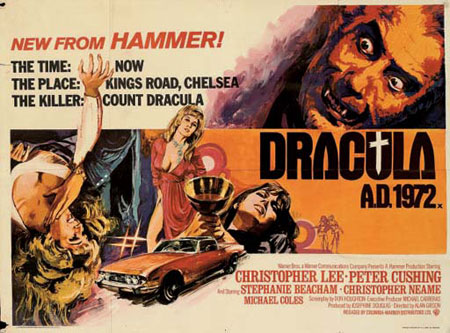
Dracula A.D. 1972 opens in 1872 with a genuinely exciting fight on a runaway carriage that ends with the death of both Count Dracula (Christopher Lee) and his nemesis, Prof. Van Helsing (Peter Cushing). However, as Van Helsing is buried, we see one of Dracula’s disciples (played by Christopher Neame, who had an appealingly off-kilter smile) burying Dracula’s ashes nearby. The camera pans up to the clear Victorian sky and, in a sudden and genuinely effective jumpcut, we suddenly see an airplane screeching across the sky.
Well, it’s all pretty much downhill from there. Suddenly, we discover that a hundred years have passed and we are now in “swinging” London. The city is full of red tourist buses, hippies wearing love beads, and upright policemen who always appear to be on the verge of saying, “What’s all this, then?” We are introduced to a group of hippies that are led by a creepy guy named Johnny Alculard (also played — quite well, actually — by Christopher Neame). One of those hippies (Stephanie Beacham) just happens to be the great-great-granddaughter of Prof. Van Helsing. Apparently, she’s not really big on the family history because she doesn’t notice that Alculard spells Dracula backwards. Then again, her father (played by Peter Cushing, of course) doesn’t either until he actually writes the name down a few times on a piece of a paper.
Anyway, the film meanders about a bit until finally, Alculard convinces all of his hippie friends to come take part in a black mass. “Sure, why not?” everyone replies. Well, I don’t have to tell you how things can sometimes get out-of-hand at black mass. In this case, Dracula comes back to life, kills a young Caroline Munro, and eventually turns Johnny into a vampire before then setting his sights on the modern-day Van Helsings.
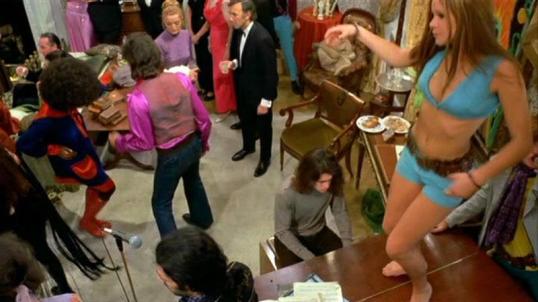
Dracula A.D. 1972 was Hammer’s attempt to breathe some new life into one of its oldest franchises and, as usually happens with a reboot, its critical and (especially) commercial failure ended up helping to end the series. Among even the most devoted and forgiving of Hammer fans, Dracula A.D. 1972 has a terrible reputation. Christopher Lee is on record as regarding it as his least favorite Dracula film. And the film definitely has some serious flaws. Once you get past the relatively exciting pre-credits sequence, the movie seriously drags. There’s a hippie party sequence that, honest to God, seems to last for about 5 hours. As for the hippies themselves, they are some of the least convincing middle-aged hippies in the history of fake hippies. You find yourself eagerly awaiting their demise, especially the awkward-looking one who — for some reason — is always dressed like a monk. (Those crazy hippies!) But yet…nothing happens. All the fake hippies simply vanish from the film. Yet, they’re so annoying in just a limited amount of screen time that the viewer is left demanding blood. Add to that, just how difficult is it to notice that Alculard is Dracula spelled backwards? I mean, seriously…
To a large extent, the charm of the old school Hammer films comes from the fact that they’re essentially very naughty but never truly decadent. At their heart, they were always very old-fashioned and actually quite conservative. The Hammer films — erudite yet campy, risqué yet repressed — mirrors the view that many of my fellow Americans have of the English. For some reason, however, that Hammer naughtiness only works when there’s the sound of hooves on cobblestone streets and when the screen is populated by actors in three-piece suits and actresses spilling out of corsets. Dracula A.D. 1972 did away with the support of the corset and as a result, the film is revealed as a formless mess with all the flab revealed to the world.
Still, the film isn’t quite as bad as you may have heard. First off, the film — with its middle-aged hippies — has a lot of camp appeal. It’s the type of film that, once its over, you’re convinced that the term “groovy” was uttered in every other scene even though it wasn’t. As with even the worst Hammer films, the film features a handful of striking images and Christopher Neame is surprisingly charismatic as Alculard.
As with the majority of the Hammer Dracula films, the film is enjoyable if just to watch the chemistry between Christopher Lee and Peter Cushing. Both of these actors — so very different in image but also so very stereotypically English — obviously loved acting opposite of each other and whenever you see them on-screen together, it’s difficult not to enjoy watching as each one tried to top the other with a smoldering glare or a melodramatic line reading. As actors, they brought out the best in each other, even when they were doing it in a film like Dracula A.D. 1972. In this film, Cushing is like the father you always you wished you had — the stern but loving one who protected you from all the world’s monsters (both real and cinematic).
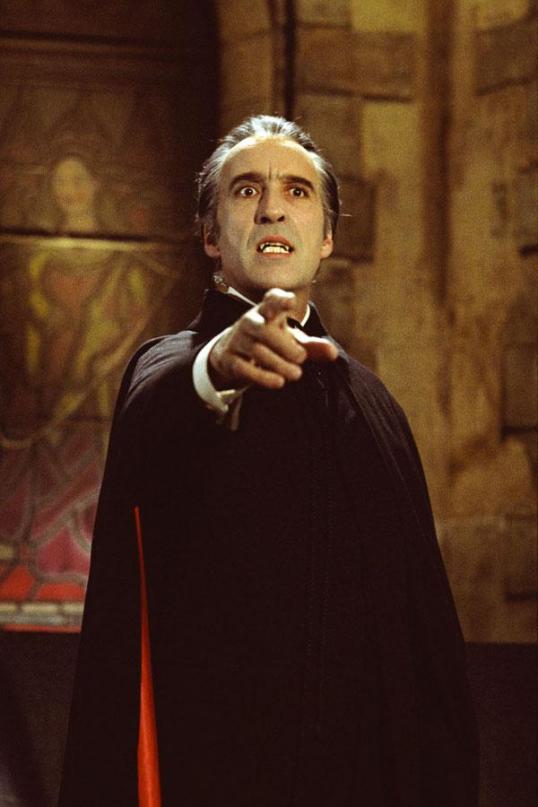
As for Lee, he’s only in six or seven scenes and he has even fewer lines but, since you spend the entire film wondering where he is, he actually dominates the entire movie. Lee apparently was quite contemptuous of the later Hammer Dracula films and, oddly enough, that obvious contempt is probably why, of all the Draculas there have been over the years, Lee’s version is the only one who was and is actually scary. F0rget all of that tortured soul and reluctant bloodsucker crap. Christopher Lee’s Dracula is obviously pissed off from the minute he first appears on-screen, the embodiment of pure destructive evil. And, for whatever odd reason, the purity of his evil brings a sexual jolt to his interpretation of Dracula that those littleTwilight vampires can only dream about. Even in a lesser films like Dracula A.D. 1972, Christopher Lee kicks some serious ass.
So, in conclusion, I really can’t call Dracula A.D. 1972 a good film nor can I really suggest that you should go out of your way to see it.. I mean, I love this stuff and I still frequently found my mind wandering whenever Cushing or Lee wasn’t on-screen. However, it’s not a terrible movie to watch if you happen to find yourself trapped in the house with 90 minutes to kill.
As I watched the opening of 1970’s Scars of Dracula, I found myself wondering several things.
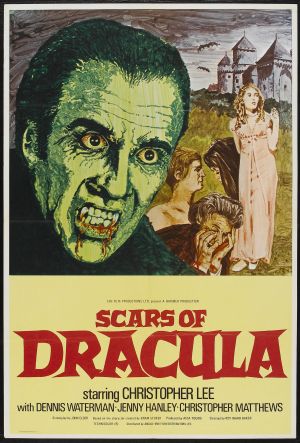
First off, why do people even bother with trying to kill Dracula? At the end of every Hammer film, Dracula would end up dying but then, just as surely, he would be revived in the sequel. Now, I do think that Hammer deserves some credit for, at the very least, trying to maintain some sort of continuity over the course of its 9 Dracula films. At least they didn’t have Dracula just mysteriously show up alive at the beginning of each sequel. Instead, there was always someone or something who would show up at the beginning of the film for the exact purpose of bringing Dracula back to life. Scars of Dracula, for instance, opens with a rubber bat hovering over the red dust that was once Dracula. The bat spits up some blood and, before you know it, Dracula’s back and, once again, he’s being played by Christopher Lee.
Secondly, what happens to old vampire hunters? Dracula shows up in film after film but, for the most part, his antagonists only show up once and then disappear, with the notable exception, of course, of Peter Cushing’s Van Helsing. Then again, seeing as how they probably know that Dracula never stays dead for more than two years, it’s totally understandable that his enemies would probably leave town while they had the chance.
I mentioned Peter Cushing’s Van Helsing. Interestingly enough, Cushing doesn’t appear in as many Dracula films as you probably think. However, whenever we think of Christopher Lee’s Dracula, we also think of Cushing’s Van Helsing. Peter Cushing was one of the few Hammer actors who had a screen presence as memorable as Christopher Lee’s. As a result, Cushing’s Van Helsing was always seen as a worthy and credible opponent.
The downside of that is that is, when you watch a Dracula film that doesn’t feature Cushing, you find yourself very much aware of just how boring and bland most of Dracula’s other opponents truly were. For the most part, Lee’s Dracula had to deal with an increasingly generic band of “nice” young men and women, none of whom could come close to matching Lee’s dominance of the screen.
Sometimes, of course, that didn’t matter. But often times, as with Scars of Dracula, it’s really hard not to wish that Dracula was spending his time dealing with another Van Helsing instead of the film’s forgettable heroes.
In Scars of Dracula, Simon Carlson (Dennis Waterman) drops by Dracula’s castle while searching for his missing brother Paul (Christopher Matthews). Accompanying Simon is Paul’s fiancee, Sarah (Jenny Hanley). Naturally, Dracula wants to make Sarah into his bride. Complicating matters is the fact that Dracula’s servant, Klove (Patrick Troughton), has also fallen in love with Sarah. There’s plentiful gore, a little nudity, a lot of rubber bats, and Hammer mainstay Michael Ripper shows up playing yet another inn keeper. Christopher Lee is, as always, an intimidating and cruel presence of Dracula and Patrick Troughton has a lot of fun as Klove. But whenever the film focuses on its bland young leads, it comes to a halt.
Scars of Dracula is okay without being particularly memorable. It’s not one of the best of the Christopher Lee’s Dracula films but it has enough of the Hammer style to, if you’re in the right mood, enjoyable.

 Through the Shattered Lens