From 1963’s The Birds and directed by Alfred Hitchcock, this is one of the best horror endings ever.
The birds have won. Or, at least they have until Birdemic….
From 1963’s The Birds and directed by Alfred Hitchcock, this is one of the best horror endings ever.
The birds have won. Or, at least they have until Birdemic….

R.L. Stine’s 1997 YA novel, Killer’s Kiss, tells the story of Karina and Delia.
Karina and Delia have always been rivals. If one gets a good grade, the other has to get a better grade. If there’s a competition for a prestigious prize, you can bet that Karina and Delia will be at the center of it. You can’t be friends with Karina if you’re going to be friends with Delia, that’s just a given. And, since this is an R.L. Stine book, Karina and Delia are especially competitive when it comes to boys!
That’s where Vincent comes in. When the book open, Vincent is making out with Delia and Delia mentions how happy she is that Vincent chose her over Karina. Well, it turns out that Vincent is either totally wishy washy or just has a bad sense of humor because guess what? He didn’t chose Delia over Karina. Instead, he chose both of them! Vincent is secretly seeing both girls but you know how it is on Fear Street. You can’t keep a secret for long.
Soon, Delia and Karina are competing for more than the Conklin Award (which is one of those weird high school prizes that always end up leading to murderous drama on Fear Street). They’re competing for Vincent, who really doesn’t seem like he deserves all the attention but again, it’s an R.L. Stine book. When Vincent turns up dead, it not only means that prom night is going to have to be replanned. It also means that either Delia or Karina is the murderer! Karina accuses Delia! Delia accuses Karina! Who is the guilty party!?
As you may have guessed from my strained attempts to fake some enthusiasm while discussing the plot of this novel, Killer’s Kiss is not one of the better Fear Street entires. Basically, it’s a book about two rivals competing for the chance to date a complete jerk. It’s hard to get emotionally involved in something like that. Beyond that, the whole rivalry between Delia and Karina just feels exaggerated and fake. They’re both kind of annoying. I wouldn’t want to know either one of them. Finally, the mystery itself is pretty easy to figure out. The novel does end with a bit of deus ex machina that simply has to be read to believed but, otherwise, this is lesser Stine.
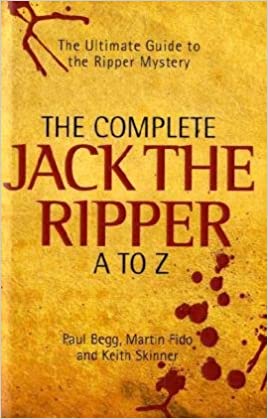
We will never actually know who Jack the Ripper actually was.
People will always be offering up theories, of course. His crimes were so terrible and his nickname was so memorable and the fact that he was never caught is, to modern audiences spoiled by true crime shows and detective movies, so improbable that there’s a tendency to assume that Jack the Ripper must have been someone significant in his everyday life. Everyone from Queen Victoria’s son to Lewis Carroll to Oscar Wilde has been accused over the years.
My personal theory is that Jack the Ripper was a nobody. He didn’t have any medical training. He wasn’t a part of a grand conspiracy. He had no motive beyond his own hatred of women. He stalked prostitutes because they were easy targets. His murders were savage because he was a sadist who wanted to show off the power that he felt he had over his victims. He got away with his crimes not because he was clever or protected but just because, in 1888, the police had no experience with a serial killer like Jack the Ripper. In all probability, the killer was some anonymous loser, one of the many strange and angry men who could probably be spotted in Whitechapel on any foggy night.
Unfortunately, after more than a 130 years of mystery, no one wants to admit that Jack the Ripper was probably some guy that no one’s ever heard of. There’s a tendency to assume that he had to be someone important or, at the very least, someone who was at least mentioned in a handful of books about the Whitechapel murders. Sadly, far too many people are under the impression that Patricia Cornwell solved the case in 2002. In Portrait of a Killer, Cornwell accused the painter Walter Sickert of being the murderer. Her main argument consisted of an inconclusive DNA test and an apparent inability to appreciate Victorian-era art. Cornwell didn’t care much for Sickert’s paintings and therefore, Sickert had to be history’s most notorious murderer. It’s a bit silly but a lot of people bought into it because it was Patricia Cornwell making the accusation.
To those people who insist that the murderer had to be a Victorian celebrity, I would point them to The Complete Jack the Ripper: A to Z. Published in 2010, this book is the definitive guide to the Ripper murders. It contains entries for every suspect, every victim, every policeman, every clue, and every theory. There’s a lot of information to be found in this book. In fact, there’s so much information that it’s easy to see how the actual killer could slip through the cracks and, unseen by the overwhelmed and underprepared legal authorities, disappear into the dark shadows of history. Along with presenting a clear-eyed and nonbiased look at the suspects and the theories, the book is also to be commended for what it tells us about Jack the Ripper’s victims, who are too often forgotten when it comes to discussing the crimes. So much time is spent on Jack’s identity that the women he murdered are often pushed to the side. This book does not make that mistake.
This is the definitive book on Jack the Ripper, whoever he may have been.
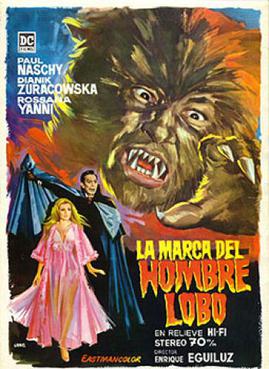
The 1968 Spanish film, The Mark of the Wolfman, is a strange one.
Just try to keep this straight:
In Eastern Europe, two gypsies accidentally bring back to life a feared werewolf named Imre Wolfstein. (Beware any supernatural creature who has an ironic name.) Wolfstein proceeds to terrorize the countryside, attacking both the good and the bad alike. He also finds the time to attack a Polish nobleman named Waldemer Danisky (Paul Naschy). Danisky survives the attack but now he’s a werewolf! Unlike Wolfstein, Danisky is not happy about being a werewolf, especially when he discovers that he’s been killing innocent people while transformed. So, Danisky decides to go to a local scientist named Dr. Janos Mikhelov (Julian Ugarte). Unfortunately, it turns out that Dr. Mikhelov is a vampire and so is his wife! They’ve got special plans for both of the werewolves!
The Mark of the Wolfman was the first of many films in which Naschy would play Count Danisky. They were extremely popular in Europe and Paul Naschy became a big star in Spain. In fact, he was sometimes called the Spanish Lon Chaney and given that Naschy often talked about how The Wolf Man (starring Lon Chaney, Jr.) was one of his favorite films when he was a child, that undoubtedly brought him a lot of pleasure. And indeed, Naschy’s performance as Danisky did owe a bit to Lon Chaney Jr’s performance as Larry Talbot. They’re both tortured souls, desperately seeking an escape from their curse and continually being brought back to life against their will. The main difference between the two was that Danisky never got quite as whiny as Talbot. Whereas Lon Chaney Jr. played Larry Talbot as being just a big dumb lug, Naschy played Danisky as being a far more aggressive character. Danisky wasn’t just depressed over being a werewolf. He was pissed off about it.
The plot of Mark of the Wolfman may sound complicated but, by the standards of Naschy’s other films, it’s actually rather straight-forward and uncomplicated. Of course, it can be difficult for an American to judge Naschy’s films because many of them were never released here in the United States and those that were can usually only be found in poorly dubbed and crudely edited versions. For instance, Mark of the Wolfman was released in the United States as Frankenstein’s Bloody Terror, despite the fact that neither Frankenstein nor his monster were anywhere to be found in the original film. However, the distributors needed a film to go on a double bill with another Frankenstein movie. To justify the title change, narration was added to the start of the film that established that Wolfstein was a descendant of Frankenstein. Apparently, the price for playing God was to be cursed with lycanthropy. It’s actually kind of charming in a drive-in sort of way.
Even if you know nothing about the subsequent career of Paul Naschy or the many sequels that followed this film, The Mark of the Wolfman holds up well as an entertaining horror film. It’s only 88 minutes long and it manages to pack drunken gypsies, tortured werewolves, devious vampires, and a dungeon into its brief running time. As a result, it’s never boring. Visually, the film is a treat, with the camera swiftly moving across the wilderness or tracking through gothic castles. (Mark of the Wolfman was originally filmed in 3D and, watching the film, I found myself thinking that it probably looked pretty damn impressive to audiences in 1968.) Because the version that I saw was badly dubbed into English, it wasn’t always easy to judge the performances but Naschy played Danisky with a properly haunted look.
The Mark of the Wolfman is an enjoyable work of Spanish horror, one that undoubtedly helped to revitalize Spanish horror just as assuredly at the Blind Dead and Jess Franco.
4 Shots From 4 Films is just what it says it is, 4 shots from 4 of our favorite films. As opposed to the reviews and recaps that we usually post, 4 Shots From 4 Films lets the visuals do the talking.
Today, we honor the master of suspense, Alfred Hitchcock. Not all of his film were horror films, of course. In fact, the majority were not. But his influence on the genre cannot be overstated. Just try to keep track of how many horror films owe a debt to Psycho or The Birds.
It’s time for….
4 Shots From 4 Alfred Hitchcock Films
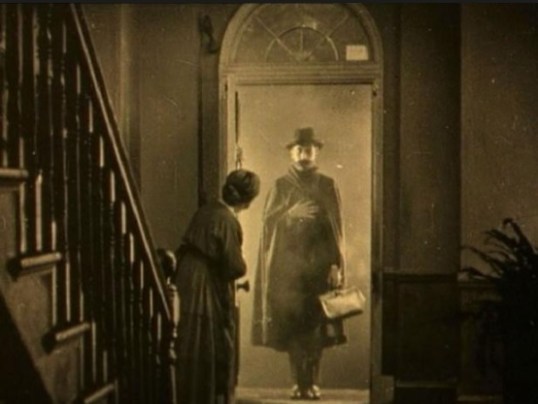
The Lodger (1926, dir by Alfred Hitchcock, DP: Gaetano di Ventimiglia)
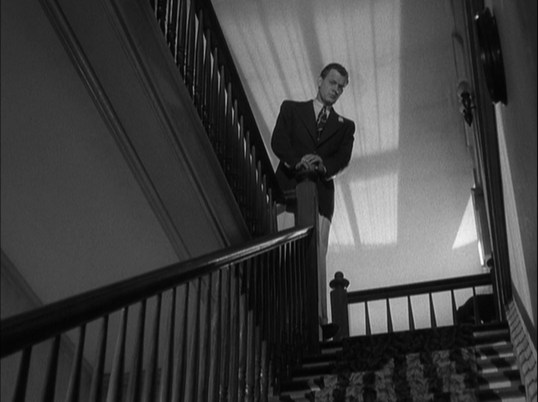
Shadow of a Doubt (1943, dir by Alfred Hitchcock, DP: Joseph A.Valetine))
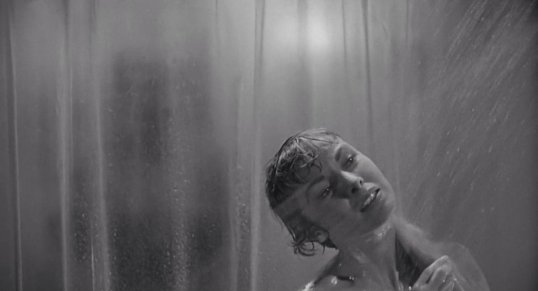
Psycho (1960, dir by Alfred Hitchcock, DP: John L. Russell)
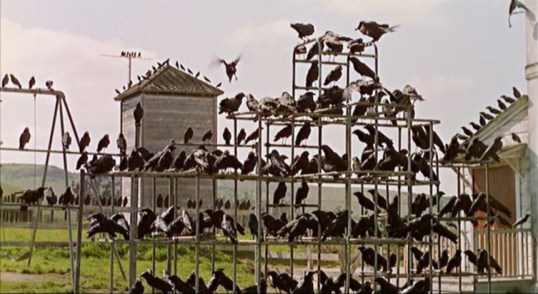
The Birds (1963, dir by Alfred Hitchcock, DP: Robert Burks)


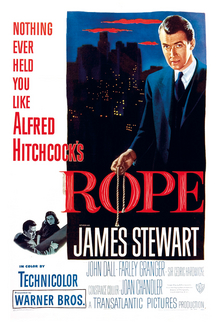
Rope, an odd little 1948 experiment from Alfred Hitchcock, opens with a murder.
Two wealthy young men, Brandon (John Dall) and Philip (Farley Granger), invite their friend, David Kentley (Dick Hogan), up to their apartment. When David arrives, they strangle him and hide his body in a wooden chest. As quickly becomes obvious, Brandon and Philip killed David largely to see if they could pull off the perfect murder. Brandon is sure that they did and, that by doing so, they proved the concept of Nietzsche’s Übermensch, The alcoholic Philip is less sure and starts drinking.
Brandon and Philip don’t just have murder planned for the day. They’re also planning on throwing a little dinner party and, among those on the guest list, are David’s parents, his girlfriend, and his girlfriend’s former boyfriend. Also attending will be Brandon and Philip’s former teacher and housemaster, Rupert Cadell (James Stewart). In fact, Brandon regularly claims that he got the idea to commit the perfect murder as a result of discussing philosophy with Rupert. Apparently, Rupert turned Brandon onto Nietzsche….
AGCK! JIMMY STEWART LEADING YOUNG MEN TO FASCISM!? SAY IT’S NOT SO!
Well, fortunately, the dinner party conversations reveals that Brandon and Philip misunderstood what Rupert was trying to tell them. They assumed, using the same type of logic that currently fuels most debate today, that just because Rupert mentioned something that meant that he approved of it. As it becomes clear that Rupert would not approve of what his students have done and as Rupert himself starts to suspect that something bad has happened at the apartment, Brandon and Philip start to plot against their former mentor….
Now, it can be argued that Rope is not a horror movie. And indeed, if your definition of horror is ghosts, vampires, werewolves, or any other type of paranormal creature than yes, Rope has none of those. Instead, the horror of Rope is the horror of human cruelty. It’s the horror of two privileged young men who have so twisted the words of their mentor that they’ve become monsters. The horror in Rope comes from the fact that, in 1948, Brandon and Philip have embraced the same philosophy that, only a few years earlier, had plunged the entire world into war. While families mourned their dead and Europe struggled to rebuild, Brandon and Philip showed that they had no understanding of or concern for the trauma that humanity had just suffered. And making it even more disturbing is that they found the justification for their crimes in the lessons taught by the epitome of American decency, Jimmy Stewart. The idea of that is more terrifying than any Hammer vampire flick.
Of course, Rope is best known for being a bit of an experiment. Hitchcock edited the film to make it appear as if it was all shot in one take and events, therefore, played out in real time. It’s an interesting idea and, as always, you have to admire Hitchcock’s ingenuity and, even in a film as grim as this one, his playfulness. At the same time, Hitchcock’s technique makes an already stagey story feel even stagier. Some of the actors — like James Stewart, John Dall, and Cedric Hardwicke in the role of David’s father — are able to give naturalistic and convincing performances despite the staginess of the material. Others, like poor Farley Granger, find themselves overshadowed by the film’s one-shot gimmick.
Rope is an experiment that doesn’t quite work but flawed Hitchcock is still a pleasure to watch. The final few minutes, with Stewart and Dall finally confronting each other, are among the best that Hitchcock ever put together. I appreciate Rope, even if it doesn’t quite succeed.
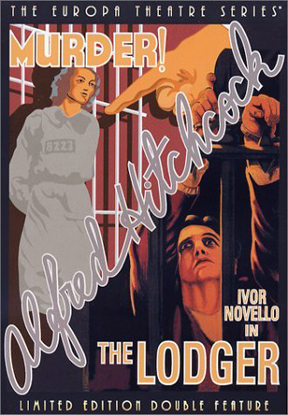
A serial killer known as “The Avenger” is murdering blonde women in London (which, once again, proves that its better to be a redhead). And while nobody knows the identity of the Avenger, they do know that the enigmatic stranger (Ivor Novello), who has just recently rented a room at boarding house, happens to fit his description. They also know that the lodger’s landlord’s daughter happens to be a blonde…
Released in 1927, the silent The Lodger was Alfred Hitchcock’s third film but, according to the director, this was the first true “Hitchcock film.” Certainly it shows that even at the start of his career, Hitchcock’s famous obsessions were already present — the stranger accused of a crime, the blonde victims, and the link between sex and violence.
Also of note, the credited assistant director — Alma Reville — would become Alma Hitchcock shortly before The Lodger was released.

This is from 1979. I love the old school camera.
With the final week of horrorthon starting in just a few hours, it can be easy to panic. Here to help soothe those impulses is our latest AMV of the Day!
Anime: HighRise Invasion , Another , Blood C
Song: Panic Room (Au/Ra)
Creator: CrazyDolphinJC
(As always, please consider subscribing to this creator’s YouTube channel!)
Past AMVs of the Day
 Through the Shattered Lens