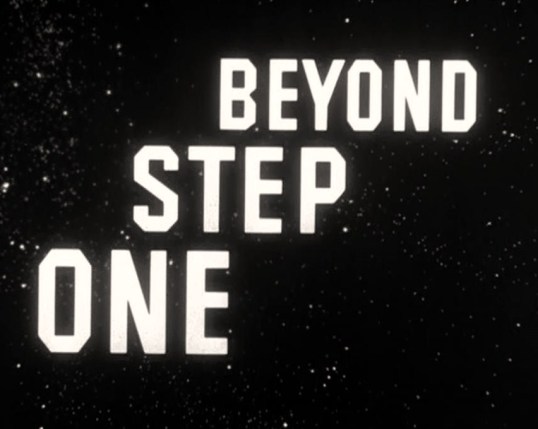
On tonight’s episode of One Step Beyond, Cloris Leachman plays Rita Wallace, an American photographer in France. She’s looking for a model whose face will serve as the ultimate symbol of the country. One day, a haunted-looking man (Marel Dalio) shows up at her apartment. She thinks he’s a model. The truth, needless to say, is something quite different….
This episode features good performances from both Leachman and Dalio. In real life, Dalio was an icon of French cinema and a favorite of Jean Renoir’s. When the Nazis invaded France, the Jewish Dalio fled Paris and, after a harrowing journey, eventually made it to America. In America, he played the croupier in Casablanca and appeared in several other films. Tragically, the rest of his family did not escape and were murdered by the Nazis. Dalio returned to France after the end of the war and remained an in-demand character actor for several more decades, making his final film appearance in 1980.
The Darkroom originally aired on February 10th, 1959.
As we started to watch 1984’s Splatter University, Jeff warned me that, “This is not a great movie.”
I laughed. “Hey,” I said, “I just watched Satan’s Children. How bad can it be?”
I looked at the screen and was immediately confronted by a poorly animated picture of the New York Skyline.
“Oh crap,” I said.
Four words appeared on screen: “A Troma Team Release”
“Oh, no!” I shouted….
Still, I’m not one to stop watching a film once it starts so I watched the entirety of Splatter University. Fortunately, it was only 78 minutes long and, regardless of what else one might say about it, it did not waste much time getting to the murders. Within the opening few minutes, an orderly in a mental hospital got stabbed in the crotch, with the camera zooming in on the blood spurting out from his groin, The patient who stabbed him took the orderly’s clothes (which, quite frankly, should have been covered in blood so I’m not sure that they would actually be the ideal disguise) and makes his escape.
Three years later, a sociology professor is brutally stabbed to death in her classroom at St. Trinian’s College and again, the camera zooms in on the spurting blood, as if to make sure that no one accuses the film of lying about the “splatter” part. Her quickly-hired replacement is Julie Parker (Forbes Riley), who soon notices that someone seems to be murdering her students. Being a good teacher, Julie decides to protect her students by figuring out who the murderer is at St. Trinian’s College. Fortunately, there aren’t that many suspects, for two reasons. Number one, the students and faculty die with such frequency that it’s easy to guess who is responsible by process of elimination. Number two, it appears that the makers of this film could only afford a handful of actors. St. Trinian’s appears to have about twenty students and most of them appear to be in their early forties.
On the one hand, as I mentioned previously, Splatter University does live up to its name. It’s obvious that the production didn’t have a huge budget but it appears that the majority of what the filmmakers did have was spent on fake blood and entrails because a lot of blood is spilled and one particularly gruesome scene even involves intestines spilling out of a body. Agck! (Seriously, the sight of the large intestine always freaks me out.) I really can’t fault the film as a slasher flick, even if the killer’s identity is obvious. That said, this was still a Troma release and, as such, there’s a lot about it that sucks. Apparently, the original film was too short so Troma added some badly acted, “comedic” scenes of the students acting stupid. Those scenes pad out the film’s length but they also screw with the pacing and they distract the viewer from what is otherwise a crudely affective, low-budget American giallo film. But that’s Troma for you!
(And, let’s be honest — how can you not love Lloyd Kaufman?)
The 1974 film, Satan’s Children, tells the story of unfortunate Bobby Douglas (Stephen White).
Bobby is a teenager who lives in a hideous suburban house with his stepfather (Eldon Mecham) and his stepsister (Joyce Molloy), who looks old enough to be Bobby’s mother. Bobby’s a rebellious kid who doesn’t understand why he should always have to cut the grass while his stepsister hangs out by the pool. Bobby is sick of the whole scene, man. When his stepfather yells at Bobby for having a small stash of marijuana in his room, Bobby decides to run away from home. Seriously, that scene was totally melvin so I don’t blame Bobby.
Bobby goes to a bar, where an old man tries to talk to him until Jake (Bob Barcour) tells the old man to get lost. Jake tells Bobby that he has to be careful because there are perverts all over the place. Bobby nods and laughs because Bobby’s not a square. He knows what’s up. Jake invites Bobby to come hang out at his place and Bobby is like, “Cool, way too friendly stranger, I’ll get you in your rape van.” Bobby goes home with Jake and is promptly raped. With Bobby naked and bound, Jake calls all of his friends over and Bobby is then gang raped. The scene where Jake and his friends drive the bound Bobby around is pure nightmare fuel and I can only imagine how audiences in 1974 reacted to it.
The next morning, a group of hippies found Bobby lying in a field and they take him back to their commune. Of course, these folks aren’t just hippies. They’re also Satanists! Sherry (Kathleen Marie Archer) wants to let Bobby stay with them while she nurses him back to health. Joshua (John Edwards), an older member of the group, says that Bobby isn’t welcome because Bobby is probably “queer.” Simon (Robert C. Ray II), the turtleneck-wearing leader of the group, is also hesitant to allow Bobby to stay and again, it’s because Simon assumes Bobby must be gay. Simon also makes it clear that he doesn’t want any lesbians in his Satanic cult either. He just wants people who are prepared to carry out a blood sacrifice….
(I swear, that Satan. Not only is he the ruler of Hell and the tormenter of souls and the fallen angel responsible for getting Adam and Eve kicked out of the Garden and bringing sin into the world, he’s also apparently a massive homophobe!)
While the Satanists torture Sherry for displeasing Simon, Bobby tries to figure out a way to escape. Fair warning: the majority of the film’s finale involves Bobby running around in tighty-whities, which get progressively more and more mud-stained as the movie goes on. Seriously, ew! On the other hand, not one but two people manage to die as a result of accidentally wandering into quicksand. If nothing else, it’s a reminder that Bobby isn’t the only incredibly stupid person in the movie.
This is a weird movie. I imagine it was made to capitalize on the notoriety of the Manson Family but, with its extended opening scenes in the suburbs, it instead becomes an ennui-drenched look at how far people will go to escape conventional society. Despite all the of the truly terrible things that happen to him, Bobby is not a sympathetic or likable character. In fact, he comes across as being just the type of idiot who probably would get sucked into a cult. That said, the film is truly a unique (if rather slow) experience and the brutal ending took me totally by surprise. Like many grindhouse film, Satan’s Children is an oddity that you truly can’t look away from.
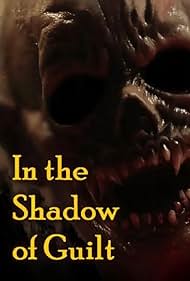
An alcoholic writer is driving drunk when she runs over a little girl. At first, she gets out to help but when she sees that the girl is dead, she just apologizes and drives off. Later, she and another writer are at a rustic retreat. The drunk writer has writer’s block. The other writer has a secret. A neighbor tells a story about another little girl who was killed mysteriously. Eventually, a ghost shows up because the alcoholic has been living in the shadow of guilt.
I liked the idea behind this one but the action moved slowly and the two main actresses were not convincing. It’s only a 62 minute film but it seemed like an eternity. The ghost special effects were effective enough, though there were a few times when it looked like the ghost’s mask was about to fall off. Brian Stewart, as the neighbor, did a good job in his one big scene. They should have made the entire movie about him. Main message: Don’t drive drunk and things like this movie won’t happen to you.
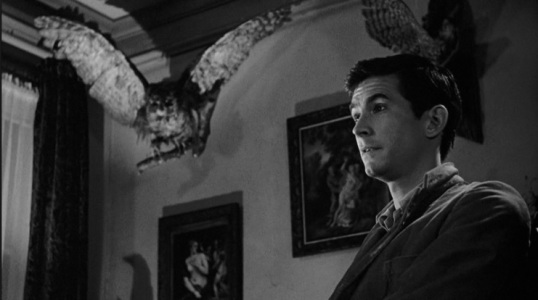
You have to feel a bit bad for Anthony Perkins, who was an Oscar-nominated star of film and Broadway and something of a teen idol before he was cast as Norman Bates in Alfred Hitchcock’s 1960 masterpiece, Psycho. Perkins was so convincing in the role that he pretty much spent the majority of his career either playing variations of the character or appearing in small roles where his macabre screen image would not be too much of a problem. Perkins gave one of the best film performances of all time and his career never really recovered from it.
Unfortunately, there’s a tendency to overlook just how good Anthony Perkins was in this first Psycho. People look at his later, less-compelling performances and they make the mistake of thinking those performance were the best that Perkins was capable of giving. Perkins was a fine actor and never better than when he played Norman. The scene below highlight how Perkins managed to make Norman Bates both poignant and creepy at the same time.
Released this year, Gacy: Serial Killer Next Door tells the story of two neighbors in the 70s.
Bobby (Mason McNulty) is a typical 7os teenager, with long hair and a laid back attitude. He’s what my grandparents used to call a “good kid.” He helps out his neighbors and he only charges 50 cents an hour. When he sees someone new moving in, he immediately offers to help the man unload all of his furniture. He gets along with his parents. He’s popular with his friends. Bobby seems destined to grow up to become the type of guy who you would want living next door to you.
His new neighbor is named John (Mike Korich). John is a small businessman with local political ambitions. He entertains at parties under the name Pogo the Clown. He has a loud and, if we’re going to be honest, somewhat grating laugh. He’s a dorky guy but he seems to be super-friendly. In fact, he’s a bit too friendly. He’s very quick to invite young men like Bobby to come home with him. Bobby can’t help but notice that John’s new friends enter the house but they don’t ever seem to leave.
“I’ve never met anyone named John Wayne before,” Bobby says, when he first meets John.
“My mother named me after a cowboy,” John Wayne Gacy replies.
Soon, Bobby’s curiosity gets the better of him and he starts investigating Gacy on his own. He comes to believe that Gacy is murdering the men that he brings home and then keeping their bodies in the house. Unfortunately, no one wants to believe Bobby. John, a murderer? Friendly, clownish, buffoonish John? “He works for the Democrats!” Bobby’s mother says at one point, a line that genuinely made me laugh.
There’s a lot of laughter to be found in Gacy: Serial Killer Next Door. John Wayne Gacy loves to put on his clown makeup, kill people, and laugh. The laughing gets old pretty quickly, to be honest. The real-life John Wayne Gacy was executed after less than 20 years on Death Row. If his real-life laugh was anything like his laugh in the movie, I’m surprised that they weren’t any quicker about doing away with him.
The real-life John Wayne Gacy was one of the worst serial killers in American history. He killed dozens, so much so that he’s still considered to be a suspect in several unsolved murders. He tortured his victims in the worst ways imaginable. And he never even bothered to fake any sort of remorse for his crimes. Instead, after he was jailed, he sold Gacy merchandise to morbid collectors. His last words, before being put to death, were reportedly, “Kiss my ass.” John Wayne Gacy is the type of murderer who makes people like me, who are against the death penalty in general, seriously reconsider their feelings.
Considering how terrible Gacy and his crimes were, it’s a bit odd that Gacy: Serial Killer Next Door almost plays out like a comedy at time. The film portrays Gacy as being so openly evil that it’s hard not to smile whenever an adult refuses to believe Bobby’s claim that there might be something wrong with the man who enjoys wearing clown makeup and carrying around a set of handcuffs. A scene where Gacy comes over to Bobby’s house and asks if he can use the phone is pure cringe comedy. The problem is that I don’t think that the scene was meant to be comedic.
Gacy: Serial Killer Next Door is a bit of a misfire as a true crime film, as it gets the majority of the facts wrong. (That said, it was correct about John Wayne Gacy being a Democrat.) It works as a comedy but one could argue that a film about John Wayne Gacy should not be a comedy, even if it is largely unintentional on the part of the filmmakers. Mason McNulty gave a good and sympathetic performance as Bobby and Mike Korich was properly creepy as Gacy.
In the end, we should probably just be happy that John Wayne Gacy is dead.
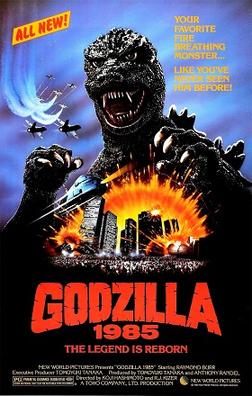
Nine years after The Terror of Mechagodzilla, Godzilla finally returned to Japanese movie screens in The Return of Godzilla!
One year later, Raymond Burr joined him when The Return of Godzilla was released in the United States as Godzilla 1985.
The film’s plot is a simple one, though it does have an interesting subtext. Godzilla is once again roaming the planet and, after spending the last few years as humanity’s champion, he is once again destroying everything in his path. (This is a rare later Godzilla film that features only Godzilla. Mothra, Rodan, Ghidorah, and that weird armadillo that always used to follow Godzilla around, none of them are present. The son of Godzilla is not mentioned, to the regret of no one.) Looking to prevent a mass panic, the Prime Minister of Japan tries to cover up the news of Godzilla’s return. But when a Russian submarine is destroyed by Godzilla and the Russians blame the Americans and bring the world to the verge of atomic war, the Prime Minister is forced to reveal the truth. The Super X, an experimental new airplane, is deployed to take Godzilla out but it turns out that Godzilla is not that easy to get rid of.
Now, as I said, there is an interesting subtext here. If the first Godzilla films were all about the trauma of Hiroshima and Nagasaki, this version of Godzilla is all about being trapped between the whims of two super powers. For the most part, Godzilla only attacks Japan. At the time this movie came out, he had been attacking Japan for nearly 30 years and the rest of the world was content to allow Japan to deal with the consequences alone. However, when Godzilla sinks that Russian sub, both the Russians and the Americans blame each other and bring the world to the brink of annihilation. Japan, like the rest of the world, finds itself caught in the middle. In the end, it’s up to Japan to not only defeat Godzilla but to keep the Americans and Russians from blowing up the rest of the world. Godzilla may be bad, this movie tells us, but he’s nowhere near as bad as the idiots with all of the atomic missiles.
Of course, when The Return of Godzilla came to America, extra scenes were shot to make it clear that America had Japan’s back. For that reason, Raymond Burr returns as journalist Steve Martin. Martin is called in to share his first-hand knowledge of what Godzilla is capable of. One has to wonder who thought that was a good idea as Martin basically comes across as being a grouchy crank who just wants to tell everyone to get off his lawn. As opposed to the first Americanized Godzilla film, which was edited to make it appear as if Burr was actually talking to characters from Gojira, Godzilla 1985 just features a lot of scenes of Burr staring at a screen in the Pentagon and making ominous comments about what Godzilla is capable of doing. It’s a wasted cameo but I guess the film’s American distributors didn’t have faith that Godzilla could pull in the audiences on his own.
Fortunately, Raymond Burr’s time-consuming cameo can’t keep this film from being a lot of fun. It’s a Godzilla film, after all. Godzilla stomps on a lot of buildings and breathes a lot of fire and wisely, the film doesn’t wait too long before allowing him to go on his rampage. After spending several films as an almost comic character, this film reminds audiences that Godzilla was always meant to be frightening. Of course, lest anyone take this film too seriously, the size of the Super X changes from scene to scene, depending on which miniature was being used. Godzilla loses his temper and falls into a volcano but there’s never any doubt that he’ll be back. You can’t stop Godzilla!
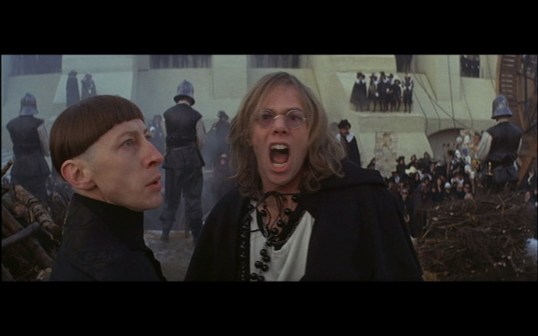
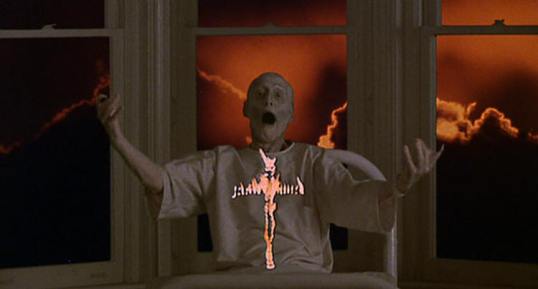
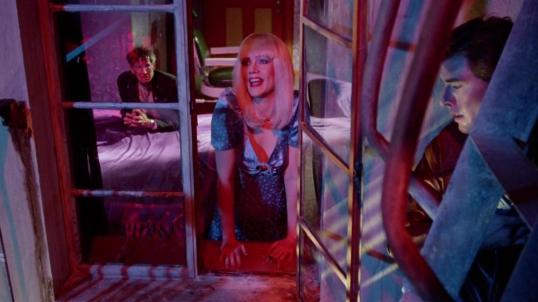
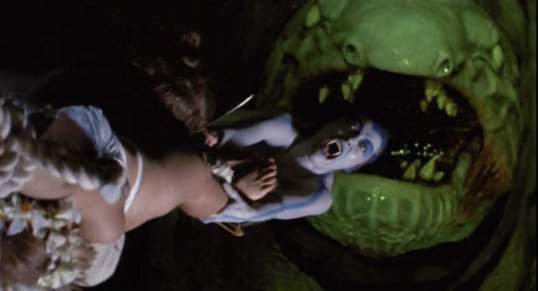
4 (or more) Shots From 4 (or more) Films is just what it says it is, 4 (or more) shots from 4 (or more) of our favorite films. As opposed to the reviews and recaps that we usually post, 4 (or more) Shots From 4 (or more) Films lets the visuals do the talking.
Today, we pay tribute to the iconoclastic British director Ken Russell with….
4 Shots From 4 Ken Russell Films
The Devils (1971, directed by Ken Russell, DP: David Watkin)
Altered States (1980, dir by Ken Russell, DP: Jordan S. Croneweth)
Crimes of Passion (1984, dir by Ken Russell, DP: Dick Bush)
The Lair of the White Worm (1988, dir by Ken Russell, DP: Dick Bush)
The 1984 film, Crimes of Passion, tells the story of three people and their adventures on the fringes of society. One is just visiting the fringes. One chooses to work there while living elsewhere. And the other is a viscous demon of repressed sexuality.
Bobby Grady (John Laughlin) has what would appear to be an ideal life. He has a nice house in the suburbs. He appears to have a good job. He has a lovely wife (Annie Potts) and he has friends who all remember what a wild guy Bobby used to be when he was younger. Bobby’s grown up and it appears that he’s matured into a life of comfort. In reality, though, Bobby is frustrated. He worries that he’s become a boring old suburbanite. He and his wife rarely have sex. The commercials on television, all inviting him to dive into the life of middle class ennui, seem to taunt him. In order to help pay the bills, he has a second job as a surveillance expert.
He’s hired to follow Joanna Crane (Kathleen Turner), an employee at a fashion house who is suspected of stealing her employer’s designs and selling them. Joanna is describe to Bobby as being cool, ambitious, and always professional. At work, she always keep her emotions to herself and no one seems to know anything about what she does outside of the office. There’s no real evidence that Joanna is stealing designs. Her employer just suspects her because Joanna always seem to be keeping a secret.
Bobby follows Joanna and he discovers that she’s not stealing designs. Instead, she’s leading a secret life as Chyna Blue, a high-priced prostitute who wears a platinum wig and who tends to talk to like a cynical femme fatale in a film noir. Bobby becomes obsessed with Chyna, following her as she deals with different johns, the majority of whom are middle class and respected members of society. Chyna has the ability to know exactly what the men who come to her are secretly looking for. A cop wants to be humiliated. A dying man needs someone to care about him. And one persistent and sweaty customer is obsessed with saving her.
The Reverend Peter Shayne (Anthony Perkins, in twitchy Psycho mode) hangs out on Sunset Strip and tries to save souls. Those who he can’t save, he kills. He carries the tools of his trade with him, a bible, a sex doll, and a sharpened dildo. After Chyna tells him that she doesn’t want anything to do with him or his money or his religion, Shayne grows increasingly more and more obsessed and unbalanced.
The plot is actually pretty simple and not that much different from what one might find in a straight-to-video neo-noir. What sets Crimes of Passion apart from other films of the genre is the fearless performance of Kathleen Turner and the over-the-top direction of Ken Russell. Never one to shy away from confusing and potentially offending his audience, Russell fills the film with shocking and frequently surreal imagery. Grady’s wife would rather watch insanely crass commercials than have sex with him. (“We just got the cable,” she explains.) When Shayne first approaches Chyna, the scene plays out in black-and-white and at a pace that would seem more appropriate for a screwball comedy than a graphic horror film. When Shayne commits one of his first murders, his victim is temporarily transformed into a blow-up doll. The sex-obsessed dialogue alternates between lines of surprising honesty and moments that are so crudely explicit that it’s clear they were meant to parody what Russell viewed as being America’s puritanical culture.
It’s not a film for everyone, which won’t shock anyone who has ever seen a Ken Russell film. The film works best when it focuses of Kathleen Turner and her performances as Chyna and Joanna. John Laughlin is a bit bland as the film’s male lead but that blandness actually provides some grounding for Russell’s more over-the-top impulses. As for Anthony Perkins, he was reportedly struggling with his own addictions when he appeared in this film and he plays Peter Shayne as being a junkie looking for his next fix. There’s nothing subtle about Perkins’s performance but then again, there’s nothing subtle about Ken Russell’s vision.
Crimes of Passion has some major pacing issues and, for all of Russell’s flamboyance, his visuals here are not as consistently interesting as they were in films like Altered Statesand The Devils. Still, Crimes of Passion is worth seeing for Kathleen Turner’s performance and as a portrait of life on the fringes. Even a minor Ken Russell film is worth watching at least once.
As some of our regular readers undoubtedly know, I am involved in a few weekly live tweets on Twitter and Mastodon. I host #FridayNightFlix every Friday, I co-host #ScarySocial on Saturday, and I am one of the five hosts of #MondayActionMovie! Every week, we get together. We watch a movie. We tweet our way through it.
Tonight, at 10 pm et, #FridayNightFlix presents 1988’s Jack’s Back, starring James Spader!
If you want to join us this Friday, just hop onto twitter, start the movie at 10 pm et, and use the #FridayNightFlix hashtag! It’s a friendly group and welcoming of newcomers so don’t be shy.
Jack’s Back is available on Prime and Tubi! See you there!
 Through the Shattered Lens