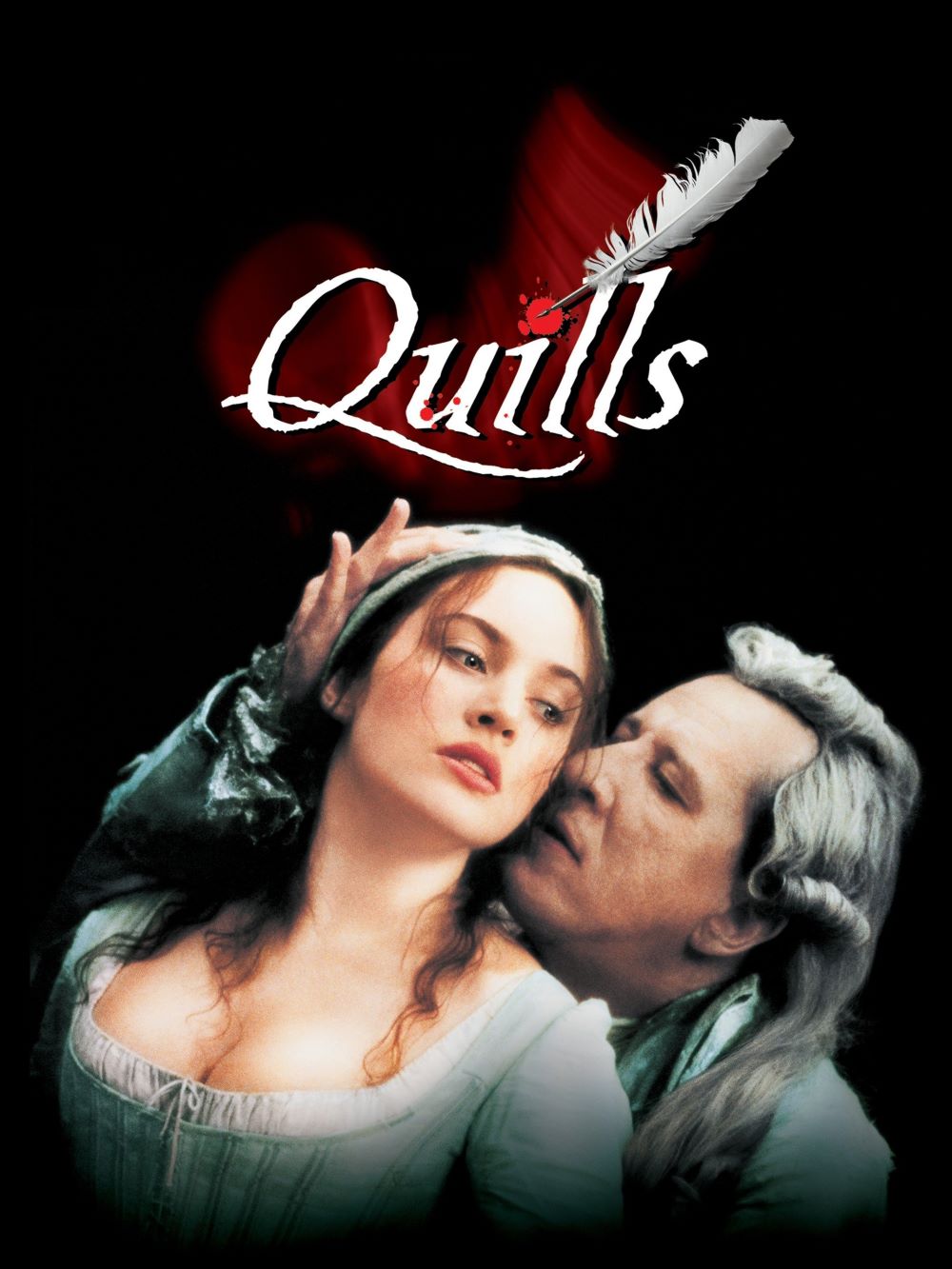
“In order to know virtue, we must acquaint ourselves with vice. Only then can we know the true measure of a man.” — Marquis de Sade
Quills, Philip Kaufman’s 2000 take on the infamous Marquis de Sade, dives headfirst into the messy clash between artistic freedom and societal repression. It’s a film that doesn’t shy away from the dark, provocative world of its subject, blending historical drama with a touch of theatrical flair. While it takes liberties with the facts, it captures the spirit of de Sade’s defiance in a way that’s both entertaining and thought-provoking.
Right from the start, Quills sets up its world inside the Charenton Asylum for the Insane, where the aging Marquis de Sade, played with gleeful abandon by Geoffrey Rush, is holed up under the watch of the kindly Abbé de Coulmier (Joaquin Phoenix). De Sade’s been churning out his scandalous writings—think Justine and other works that shocked 18th-century France—and smuggling them out via laundry baskets to a young laundress named Madeleine LeClerc (Kate Winslet). Napoleon’s regime isn’t thrilled, so they dispatch the stern Dr. Royer-Collard (Michael Caine) to tighten the screws and silence the madman once and for all. The stage is set for a battle of wills, with de Sade’s pen as his weapon against the forces of censorship.
Geoffrey Rush owns the screen as de Sade, turning what could have been a one-note villain into a complex, charismatic force of nature. He’s sly, unrepentant, and hilariously vulgar, spitting barbs that cut deep into hypocrisy and piety. Rush balances the man’s depravity with a genuine passion for expression, making you root for him even as his ideas repulse. It’s a performance that’s equal parts showman and philosopher, and it anchors the film’s energy. Joaquin Phoenix brings a quiet intensity to the Abbé, a man torn between his faith, his compassion, and the stirrings of forbidden desire—especially toward Madeleine. Phoenix nails the internal conflict, his wide eyes conveying a soul on the brink.
Kate Winslet shines as Madeleine, the innocent conduit for de Sade’s words, whose curiosity pulls her into his orbit. She’s got that Winslet spark—earnest yet fiery—and her scenes smuggling manuscripts or reading aloud add a layer of warmth to the asylum’s chill. Michael Caine, meanwhile, chews scenery as the pompous doctor, a hypocritical sadist in his own right, obsessed with his young bride Simone (Amelia Warner). Caine’s Royer-Collard is deliciously smarmy, a foil to de Sade who mirrors his cruelty under the guise of order. The ensemble clicks, with supporting turns like Tony Berthaud as the asylum’s rougemont adding comic relief amid the tension.
Kaufman’s direction keeps things visually striking without overwhelming the story. The asylum feels alive—claustrophobic cells contrast with grand halls where inmates stage de Sade’s plays under the Abbé’s misguided therapy. Cinematographer Rogier Stoffers bathes everything in earthy tones, with candlelit shadows that amp up the gothic vibe. The score by Angelo Badalamenti weaves eerie strings and harpsichord flourishes, underscoring the film’s blend of horror and humor. It’s not afraid to get graphic: scenes of self-mutilation and bodily fluids as writing tools push boundaries, but they’re more about desperation than shock value.
Thematically, Quills grapples with freedom of speech in a way that’s timeless. De Sade isn’t portrayed as a hero—his writings celebrate excess and cruelty—but as an indomitable spirit who won’t be silenced. Even stripped of paper, ink, clothes, and eventually his voice, he finds ways to provoke, dictating stories through inmates or scratching words into his skin. It’s a middle finger to censorship, questioning who the real monsters are: the libertine or the repressors enforcing “morality.” The Abbé represents liberal tolerance stretched to breaking, Royer-Collard conservative control gone tyrannical. Madeleine embodies the allure of forbidden ideas, her tragic arc highlighting how words can liberate or destroy.
That said, the film isn’t perfect—it’s a fictionalized riff on history, not a biopic. The real de Sade spent years at Charenton, but the timeline compresses events, amps up the drama, and softens his edges for modern tastes. He wasn’t quite the defiant artist Kaufman paints; his later years were more pathetic than poetic. Critics have noted it sanitizes Justine‘s true extremity—no orgies or murders here, just innuendo. Some see it as romanticizing a monster, turning him into a free-speech martyr rather than the predator he was. Fair point; the movie sympathizes more with his pen than his philosophy. Still, as entertainment, it works because it doesn’t pretend to be a documentary.
Humor peppers the darkness, keeping Quills from wallowing in gloom. De Sade’s quips land like punches—”There’s no sin in writing!”—and absurd moments, like inmates reenacting his tales or the doctor’s failed inventions, add levity. One standout sequence has de Sade dictating a racy novel through a chain of whispering patients, turning the asylum into a underground press. It’s One Flew Over the Cuckoo’s Nest meets Dangerous Liaisons, with inmates running wild in a riot of liberation gone wrong. The film’s pace builds masterfully to its brutal climax, where de Sade’s final “victory” leaves you unsettled, pondering if ideas can truly be killed.
Performances aside, the script by Doug Wright (adapted from his play) crackles with wit and insight. Dialogue zings without feeling stagey, and it probes hypocrisy head-on: the pious Abbé lusting after Madeleine, Royer-Collard bedding his teen bride while torturing others. Christianity takes hits—de Sade devours a crucifix, mocks scripture—but it’s broad satire, not preachy atheism. The ending, with its ironic twist on legacy, sticks with you, echoing how de Sade’s name endures despite efforts to erase him.
For fans of period dramas with bite, Quills delivers. It’s provocative without being pornographic, smart without being stuffy. At 124 minutes, it never drags, balancing spectacle and substance. Sure, it glamorizes a controversial figure, and history buffs might nitpick inaccuracies—like the Abbé’s real-life tolerance or Charenton’s theater program. But Kaufman’s track record (The Right Stuff, The Unbearable Lightness of Being) shows he knows how to humanize extremes. Rated R for good reason—nudity, violence, profanity—it’s adult fare that rewards attention.
Visually, the costumes pop: de Sade’s velvet robes give way to rags, symbolizing his fall, while Madeleine’s simple smocks highlight her purity amid corruption. Production design nails early 19th-century France, from ornate asylum architecture to the doctor’s sterile gadgets. Badalamenti’s music swells during key confrontations, heightening emotional stakes without overpowering.
In the end, Quills asks tough questions about art’s power and limits. Does provocation justify excess? Can society silence dangerous minds without becoming monstrous itself? It doesn’t provide easy answers, which is its strength. Rush’s tour-de-force makes de Sade magnetic, flaws and all, while the supporting cast elevates the ensemble. Not for the faint-hearted, but if you appreciate bold cinema that stirs debate, it’s a gem. Rewatch value is high—themes resonate in our cancel-culture age. Philip Kaufman crafted a film that’s as unruly as its protagonist: unapologetic, alive, and impossible to ignore.

 Through the Shattered Lens