The Unnominated #15: Touch of Evil (dir by Orson Welles)


Though the Academy of Motion Picture Arts and Sciences claim that the Oscars honor the best of the year, we all know that there are always worthy films and performances that end up getting overlooked.  Sometimes, it’s because the competition too fierce.  Sometimes, it’s because the film itself was too controversial.  Often, it’s just a case of a film’s quality not being fully recognized until years after its initial released.  This series of reviews takes a look at the films and performances that should have been nominated but were, for whatever reason, overlooked.  These are the Unnominated.

I come here to defend Charlton Heston.

1994’s Ed Wood is a great film that has one unfortunate line.  Towards the end of the film, director Ed Wood (Johnny Depp) meets his hero, Orson Welles (Vincent D’Onoforio), in a bar.  They talk about the difficulties of directing a film.  Wood talks about the trouble that he’s having with Plan 9 From Outer Space.  Welles says that he can understand what Wood is going through because the studio is forcing him to cast Charlton Heston as a Mexican in his next movie.

And look, I get it.  It is true that Charlton Heston does play a Mexican prosecutor named Mike Vargas in Welles’s 1958 film, Touch of Evil.  And it is true that Heston is not the most convincing Mexican to ever appear in a film.  And I understand that there are people who enjoy taking cheap shots at Charlton Heston because he did have a tendency to come across as being a bit full of himself and he was a conservative in a industry dominated by Leftists. There are people who actually think Michael Moore doesn’t come across like a self-righteous prick when he confronts Heaton in Bowling for Columbine.  I get the joke.
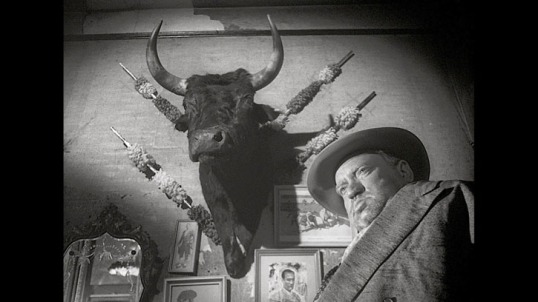
But it’s not true and it’s not fair.  When Touch of Evil was first put into production by Universal, Welles was not hired to direct.  He was hired to play Hank Quinlan, the formerly honest cop with a habit of planting evidence on those who he believed to be guilty.  When Charlton Heston was offered the role of Vargas, he asked who had been hired to direct.  When he was told that a director hadn’t been selected, Heston was the one who suggested Welles be given the job.  When, as often happened with Welles’s film, the studio decided to take the film out of Welles’s hands, Heston argued for Welles’s vision while Welles was off trying to set up his long-dreamed of film of Don Quixote.  Say what you will about Charlton Heston’s career, he fought for Orson Welles, just as he later fought for Sam Peckinpah during the making of Major Dundee.  Heston may not have agreed with either Welles or Peckinpah politically but he fought for them when few people were willing to do so.
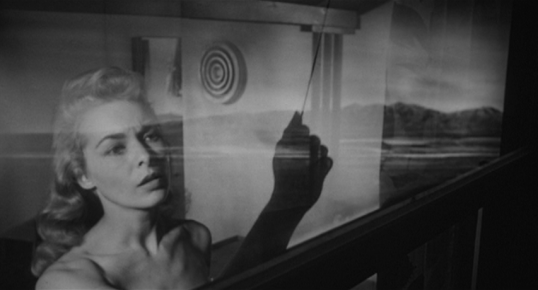
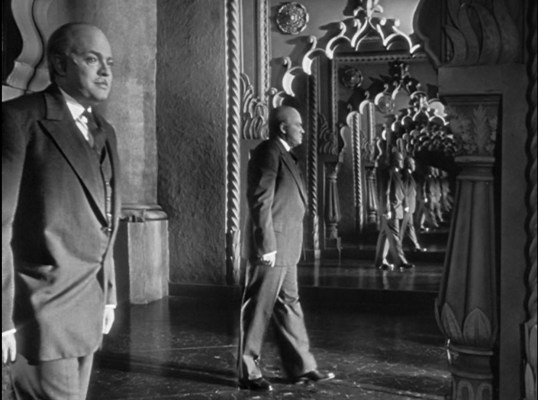
That Touch of Evil is a brilliant film is pretty much entirely due to Welles’s directorial vision.  The story is pure pulp.  While investigating the murder of an American businessman in Mexico, Vargas comes to believe that Quinlan is attempting to frame a young Mexican for the crime.  While Vargas watches Quinlan, his wife Susie (Janet Leigh) is menaced by the crime lord Joe Grandi (Akim Tamiroff), who has his own issues with both Vargas and Quinlan.  The plot may be the stuff of a B-programmer but, as directed by Welles, Touch of Evil plays out like a surreal nightmare, a journey into the heart of darkness that is full of eccentric characters, shadowy images, memorably askew camera angles, and lively dialogue.  Welles and cinematographer Russell Metty create a world that feels alien despite being familiar.  Just as he did with Gregg Toland in Citizen Kane, Welles shapes a film that shows us what’s happening in the shadows that most people try to ignore.

There’s really not a boring character to be found in Touch of Evil and the cast is full of old colleagues and friends of Welles.  Marlene Dietrich shows up as Quinlan’s former lover.  Mercedes McCambridge plays a leather-clad gang leader.  Dennis Weaver is the creepy owner of a remote motel.  (Two years before Psycho, Touch of Evil featured Janet Leigh being menaced in a motel.  Mort Mills, who played Psycho’s frightening highway patrolman, plays a member of law enforcement here as well.)  Zsa Zsa Gabor shows up for a few brief seconds and it makes a strange sort of sense.  Why shouldn’t she be here?  Everyone else is.  Joseph Cotten plays a coroner.  Ray Collins plays a local official.   In the film’s skewered world, Charlton Heston as Mike Vargas works.  His upright performance grounds this film and keeps it from getting buried in its own idiosyncrasies.   Big personalites are everywhere and yet the film is stolen by Joseph Calleia, playing Quinlan’s quiet but observant partner.  Calleia’s performance is the heart of the film.

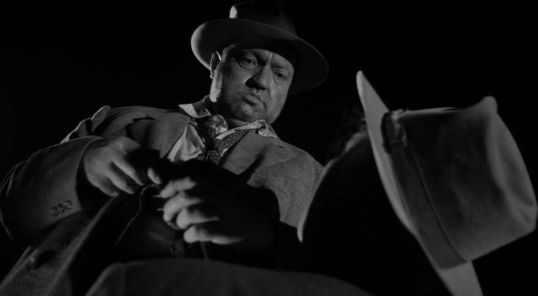
Touch of Evil was not nominated for a single Oscar and that’s not surprising.  It’s not really the type of film that was noticed by the Academy in the 50s.  It was too pulpy and surreal and, with its story of a crooked cop framing someone who might very well be guilty anyway, it was probably too subversive for the Academy of the 1950s.  It would take a while for Touch of Evil to be recognized for being the noir masterpiece that it is.  In a perfect world, Welles would have been nominated for directing and for his larger-than-life performance as Quinlan.  Joseph Calleia would have been nominated for Supporting Actor and perhaps both Janet Leigh and Marlene Dietrtich would have been mentioned for Supporting Actress.  That didn’t happen but it would have been nice if it had.
Previous entries in The Unnominated:
  1. Auto Focus 
  2. Star 80
  3. Monty Python and The Holy Grail
  4. Johnny Got His Gun
  5. Saint Jack
  6. Office Space
  7. Play Misty For Me
  8. The Long Riders
  9. Mean Streets
  10. The Long Goodbye
  11. The General
  12. Tombstone
  13. Heat
  14. Kansas City Bomber

Lisa Marie Reviews An Oscar Winner: Citizen Kane (dir by Orson Welles)


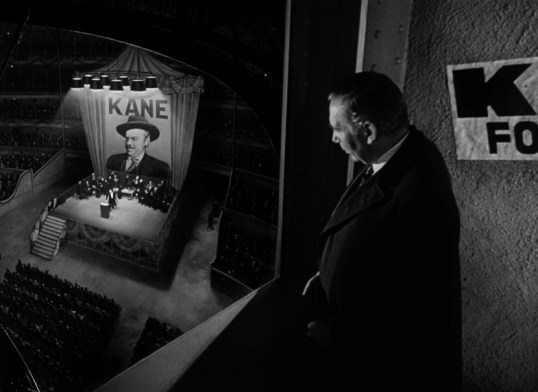
For some reason, certain people seem to feel the need to try to reduce what Orson Welles accomplished with 1941’s Citizen Kane.

In 1971, the famous film critic Pauline Kael published an essay called Raising Kane, in which she argued that screenwriter Herman J. Mankiewicz deserved the majority of the credit for Citizen Kane.  This was Kael’s shot at rival Andrew Sarris and his embrace of the auteur theory.  (1971 was the same year that Kael described Dirty Harry as being  a “fascist work of art” so I guess even the best film critics can have a bad year.)  David Fincher’s father, after reading Kael’s essay, wrote the screenplay for Mank, which not only made the case that Mankiewicz deserved the credit but which portrayed Orson Welles in such a negative fashion that you really did have to wonder if maybe Orson had owed old Jack Fincher money or something.  Herman J.  Mankiewicz himself always claimed that he deserved the majority of the credit for Citizen Kane but then he would, wouldn’t he?

The truth of the matter is that Mankiewicz did write the screenplay for Citizen Kane and he did base the character of Charles Foster Kane on William Randolph Hearst and the character of Kane’s second wife on Hearst’s mistress, Marion Davies.  There’s some debate over how much of the film’s narrative structure belongs to Mankiewicz and how much of it was a result of Welles rewriting the script.  Mankiewicz played his part in the making of Citizen Kane but he played that part largely because Orson Welles allowed him to.  Like all great directors, Welles surrounded himself with people who could help to bring his vision to life.  (That’s something that would think David Fincher, of all people, would understand.  Aaron Sorkin may have written The Social Network but the reason why the film touched so many is because it was a David Fincher film.)

Make no mistake about it.  Citizen Kane is Orson Welles’s vision and Welles is the one who deserves the majority of the credit for the film.  The themes of Citizen Kane are ones to which Welles would frequently return and the cast, all of whom bring their characters to vivid life, is made up of largely of the members of Welles’s Mercury Theatre.  The tracking camera shots, the dark cinematography, and the satiric moments are all pure Welles.  As the Fincher film argues, Mankiewicz may have very well meant to use the film to attack Hearst for his personal hypocrisy and for opposing the political ambitions of Upton Sinclair.  If so, let us be thankful that Orson Welles, as a director, was smart enough to realize that such didacticism is often deadly dull.

And there’s nothing dull about Citizen Kane.  It’s a great film but it’s also an undeniably fun film, full of unforgettable imagery and scenes that play like their coming to us in a dream.  It’s a film that grabs your interest and proves itself to be worthy of every minute that it takes to watch it.  I was lucky enough to first see Citizen Kane at a repertory theater and on the big screen and really, that’s the best way to watch it.  It’s a big film that’s full of bigger-than-life characters who are ultimately revealed to be full of the same human longings and regrets as all of us.  As a young man, the fabulously wealthy Charles Foster Kane thinks that it would be “fun” to run a newspaper.  Later, he thinks that he’s found love by marrying the niece of the President.  He runs for governor of New York and, watching Welles in these scenes, you can see why FDR tried to recruit him to run for the Senate.  Welles has the charisma of a born politician.  When Welles first meets Susan Alexander (Dorothy Comingore) it’s easy to laugh.  The great man has just been splashed by a taxi.  Susan laughs but then winces in pain due to a tooth ache.  Later, Kane insists on trying to turn her into an opera star.  He runs a negative review written by his friend (Joseph Cotten) and then he promptly fires him.  As in all of Welles’s films, it’s all about personal loyalty.  Kane may betray his wife and the voters but he’s ultimately just as betrayed by those around him.  In the end, you get the feeling that Kane was desperately trying to not be alone and yet, that’s how he ended up.

There are so many stand-out moments in Citizen Kane that it’s hard to list them all.  The opening — MIGHTY XANADU! — comes to mind.  The satirically overdramatic newsreel is another.  (Citizen Kane can be a very funny film.)  Joseph Cotten’s performance continues to charm.  Orson Welles’s performance continues to amaze.  Who can forget Agnes Moorehead as Kane’s mother or Everett Sloane as Mr. Bernstein, haunted by that one woman he once saw on a street corner?  Myself, I’ve always liked the performances of Ray Collins (as the sleazy but strangely reasonable Boss Gettys), Paul Stewart (as the subtly menacing butler), and Ruth Warrick (as Kane’s first wife).  Mankiewicz may have put the characters on paper but Welles is the one who selected the amazing cast that brought them to life.

Citizen Kane was nominated for nine Oscars and it won one, for the screenplay written by Welles and Mankiewicz.  Best Picture went to How Green Was My Valley.  When was the last time anyone debated who should be given credit for that movie?

Horror Film Review: The Mummy’s Ghost (dir by Reginald Le Borg)


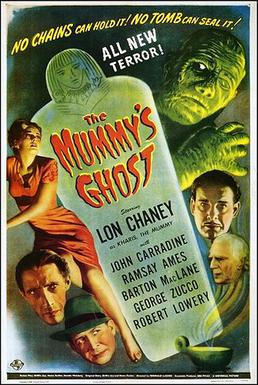
When we last checked in with Kharis the Mummy, he was trapped in the middle of an inferno in Massachusetts.  Having come to America to kill the members of the expedition that discovered the Tomb of Ananka and who brought Princess Ananka’s body to the United States, Kharis (Lon Chaney, Jr.) was trapped by the citizens of the town of Mapleton who, in the best tradition of Universal horror, cornered Kharis in a house and then set the place on fire.

1944’s The Mummy’s Ghost begins with the revelation that Kharis did not die in that inferno.  Somehow, he managed to escape and, rather improbably, he’s spent the last few years wandering around town without anyone ever noticing him.  The film presents Kharis as being largely a nocturnal creature but, even if he is only coming out at night, it still seems strange that no one would notice a mummy wandering around, especially since the entire town was traumatized by Kharis’s previous reign of terror.  As well, it’s also been established that Kharis owes his eternal life to an ancient Egyptian plant.  One reason why Kharis has always needed a “minder” is because Kharis needed someone who could keep him supplied with the plant.  So, if Kharis has been wandering around Massachusetts for the past few years, from where has he been getting the plant?

The Mummy’s Ghost also established that, in Egypt, High Priest Andoheb (Georg Zucco) is still alive.  This is somewhat surprising, considering that Andoheb died in both The Mummy’s Hand and The Mummy’s Tomb.  But no matter!  Andoheb is apparently still alive.  He’s really old and his hands shake but he’s still alive and he’s still determined to bring both Kharis and Princess Ananka back to Egypt.  This time, he sends Yousef Bey (John Carradine) to Massachusetts.

Yusef Bey takes over managing Kharis and he’s even able to supply Kharis with more of the special plant the keeps him alive.  However, Kharis grows upset when it discovers that Bey has tracked down the reincarnation of Ananka in the person of Amina (Ramsay Ames) and that, rather than return her safely to Egypt, Bey wants to give her eternal life with the help of the plant and then marry her.  This leads to Kharis going on a rampage and carrying Amina into a nearby swamp while Amina’s boyfriend, Tom Hervey (Robert Lowery), chases after them.

Full of plot holes and inconsistencies, The Mummy’s Ghost is about as silly as a mummy film can be.  If the previous films about Kharis managed to create a feeling of tragic inevitability as Kharis tracked down all of the people who had entered Ananka’s tomb, The Mummy’s Ghost presents Kharis as being something more akin to Frankenstein’s Monster, an inarticulate and easily frustrated creature who does things with little rhyme or reason.  That said, the film does make good use of Lon Chaney Jr’s hulking physicality as Kharis.  He’s still an intimidating figure when he goes after someone.  And John Carradine’s pained expression as Yousef Bey is memorable as a reminder of how much Carradine disliked most of the Universal monster films in which he found himself.  Otherwise, The Mummy’s Ghost is fairly forgettable.

Previous Universal Horror Reviews:

  1. Dracula (1931)
  2. Dracula (Spanish Language Version) (1931)
  3. Frankenstein (1931)
  4. Island of Lost Souls (1932)
  5. The Mummy (1932)
  6. The Invisible Man (1933)
  7. The Bride of Frankenstein (1935)
  8. Dracula’s Daughter (1936)
  9. Son of Frankenstein (1939)
  10. Black Friday (1940)
  11. The Invisible Man Returns (1940)
  12. The Mummy’s Hand (1940)
  13. The Wolf Man (1941)
  14. Ghost of Frankenstein (1942)
  15. Invisible Agent (1942)
  16. The Mummy’s Tomb (1942)
  17. Frankenstein Meets The Wolf Man (1943)
  18. Son of Dracula (1943)
  19. House of Frankenstein (1944)
  20. The Invisible Man’s Revenge (1944)
  21. House of Dracula (1945) 
  22. Creature From The Black Lagoon (1954)

At Gunpoint (1955, directed by Alfred L. Werker)


When a gang of outlaws attempt to rob a bank in the small frontier town of Plainview, the local sheriff is one of the first people to get gunned down.  It falls upon two local men, George Henderson (Frank Ferguson) and storeowner Jack Wright (Fred MacMurray), to run the outlaws out of town.  While most of the gang escapes, Jack and Henderson manage to kill the gang’s leader, Alvin Dennis.

At first, Jack and Henderson are declared to be heroes and Henderson is appointed sheriff.  However, when Henderson is found murdered, the town realizes that Alvin’s brother, Bob (Skip Homeier), has returned to get revenge.  The inevitable confrontation is delayed by the arrival of a U.S. marshal who stays in town for two weeks to maintain the peace but everyone knows that, once he leaves, Bob is going to be coming after the mild-manned Jack.  The townspeople go from treating Jack like a hero to shunning him.  They even offer Jack and his wife (Dorothy Malone) money to leave town but Jack refuses to give up his store or to surrender to everyone else’s fear.

At Gunpoint is a diverting variation on High Noon, with Fred MacMurray stepping into Gary Cooper’s role as the upstanding man who the town refuses to stand behind.  What sets At Gunpoint apart from High Noon is that, unlike Cooper’s Will Kane, MacMurray’s Jack Wright isn’t even an experienced gunslinger.  Instead, he’s a mild-mannered store owner, the old west’s equivalent of an intellectual, who just managed to get off a lucky shot.  If he can’t find a way to get the cowardly town to back him up, there’s no way that he’s going to be able to defeat Bob and his gang.

At Gunpoint features an excellent cast of Western character actors, including John Qualen, Irving Bacon and Whit Bissell.  Especially good is Walter Brennan, playing one of the only townspeople to have any integrity.  While this western may not have the strong political subtext or the historical significance of High Noon, it’s still a well-made example of the genre.  It’s a western that even people who don’t normally enjoy westerns might like.

Lisa Cleans Out Her DVR: High Noon (dir by Fred Zinnemann)


(I am currently in the process of cleaning out my DVR!  I recorded the 1952 best picture nominee, High Noon, off of Retroplex on January 28th.  This review is scheduled to posted at 12 noon, central time.  Clever, no?)

High Noon is a testament to the power of simplicity.

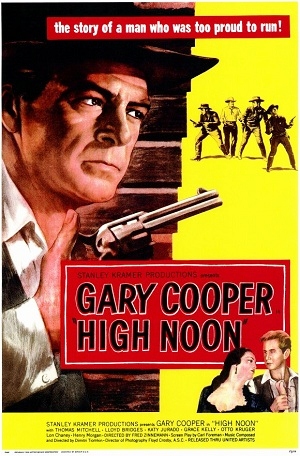
It’s a famous film, one that continues to be influential and which is still studied today.  It’s known for being one of the greatest westerns ever made but it’s also a powerful political allegory.  Even people who haven’t seen the film know that High Noon is the moment of the day when someone shows their true character.  Just as everyone knows the plot of Star Wars, regardless of whether they’ve actually watched the film, everyone knows that High Noon is about a town marshal who, after the entire town deserts him, is forced to face down a gang of gunmen on his own.

And yet, it really is a surprisingly simple movie.  It’s the quintessential western, filmed in black-and-white and taking place in the type of frontier town that you would expect to find hiding on the back lot of an old movie studio.  Though wonderfully brought to life by a talented cast, the majority of the characters are familiar western archetypes.

There’s the aging town marshal, a simple man of integrity.  Gary Cooper won an Oscar for playing the role of Will Kane.  When we first see Will, he’s getting married in a frontier courtroom.  All of the town leaders have come to his wedding and all of them wish him luck in the future.  Will is retiring and everyone agrees that the town would never have survived and prospered if not for Will Kane.  After all, Will is the one who captured the notorious outlaw, Frank Miller.  When the news comes that Miller has been pardoned and will be arriving back in town on the noon train, everyone tells Will that he should just leave town and go on his honeymoon.  However, the new marshal will not be arriving for another day and Will is not willing to abandon the town.  However, the town is more than willing to abandon him.

Will’s new wife is Amy Fowler (Grace Kelly).  Amy is a Quaker and a pacifist.  Amy begs Kane to leave town but Kane says that he’s never run from a fight.  Amy tells him that she’ll be leaving on that noon train, with or without him.  Helen Ramirez (Katy Jurado) is the former girlfriend of both Kane and Miller.  She is one of the few people in town to call out everyone else’s cowardice but she is still planning to leave before Miller arrives.  As she explains it to Amy, she would never abandon Kane if he were her man but he’s not her man anymore.

The townspeople, who first appear to be so friendly and honest, soon prove themselves to be cowards.  None of them are willing to stand behind Will.  The Mayor (Thomas Mitchell) publicly castigates Will for staying in town and putting everyone else in danger.  Deputy Harvey Pell (Lloyd Bridges) says that he’ll only help Will if Will recommends him as his replacement.  The town minister (Morgan Farley) is more concerned with why Will was married by the justice of the peace, instead of in the church.  The town judge (Otto Kruger) leaves early, saying he can be a judge in some other town.  One of the few people to show Will any sympathy is the former marshal (Lon Chaney, Jr.) but, unfortunately, he is too old and crippled by arthritis to provide any help.

Though it all, Frank’s gang sits at the train station and waits for Frank to arrive.  One gang member is played be Lee Van Cleef.  He looks really mean!

With a brisk running time of 84 minutes, High Noon unfolds in real time.  Throughout the film, as Kane grows increasingly desperate in his attempt to find anyone brave enough to stand with him, we see clocks in the background of nearly every scene.  We hear the ticking.  We know that both noon and Frank Miller are getting closer and closer.  We know that, soon, Will will have no other option but to stand on the street by himself and defend a town that doesn’t deserve him.

It’s simple but it’s undeniably powerful.

It’s been said that High Noon was meant to be a metaphor for the blacklist.  Frank Miller and his gang were the fascists that, having been defeated in World War II, were now coming back to power.  Will Kane was a stand-in for all the men and women of integrity who found themselves blacklisted.  The townspeople represented the studio execs who refused to challenge the blacklist.  That’s the theory and it’s probably true.  But, honestly, the political metaphor of High Noon works because it can be applied to any situation.  Will Kane is anyone who has ever had to face down the forces of totalitarianism.  He is anyone who has ever had the courage to take a lonely stand while everyone else cowered in the corner.

It’s a powerful metaphor and it’s also a genuinely entertaining movie.  The gunfight is thrilling.  The romance between Will and Amy feels real.  Even the town feels like an actual place, one that has its own history and culture.  It’s a simple film but it’s a great film.

Like a lot of great films, High Noon was nominated for best picture.  And, like a lot of great films, it lost.  In High Noon‘s case, it lost to a film that is almost its exact opposite, The Greatest Show on Earth.  However, Gary Cooper did win an Oscar for his unforgettable performance as Will Kane.

I think we tend to take classic films for granted.  Don’t do that with High Noon.  See it the next chance you get.

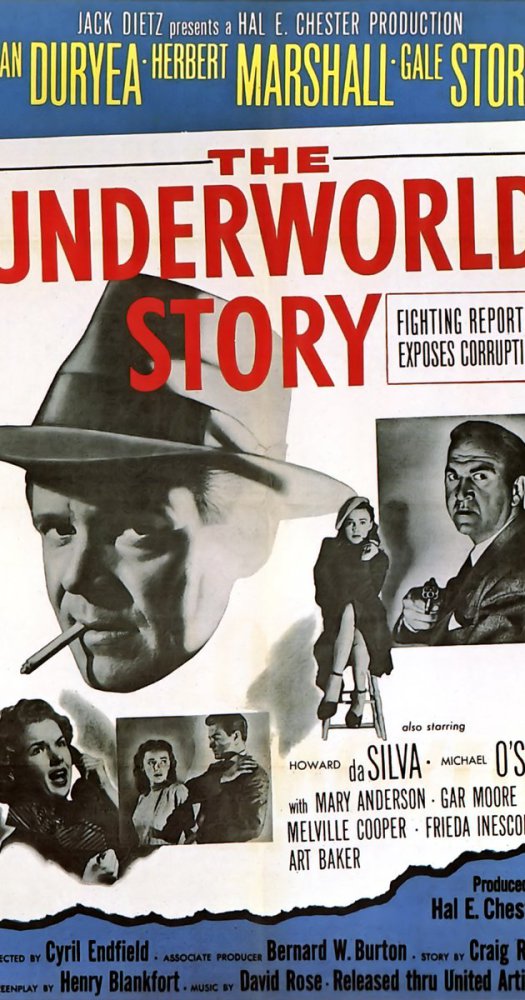
Heel with a Heart: Dan Duryea in THE UNDERWORLD STORY (United Artists 1950)


gary loggins's avatarcracked rear viewer

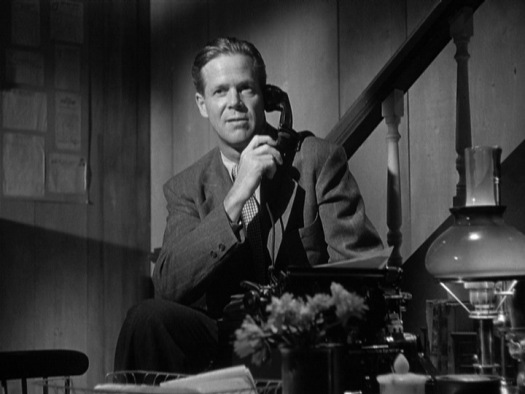
Hollywood’s favorite heel Dan Duryea got a rare starring role in THE UNDERWORLD STORY, a 1950 crime drama in which he plays… you guessed it, a heel! But this heel redeems himself at the film’s conclusion, and Duryea even wins the girl. Since that girl is played by my not-so-secret crush Gale Storm , you just know I had to watch this one!

The part of muckraking tabloid journalist Mike Reese is tailor-made for Duryea’s sleazy charms. He’s a big-city reporter who breaks a story about gangster Turk Meyers spilling to the D.A., resulting in the thug ending up murdered on the courthouse steps in a hail of bullets. DA Ralph Monroe (Michael O’Shea )  puts the pressure on Mike’s editor, and Reese becomes persona non grata in the newspaper game. Seeing an ad for a partner at a small town newspaper, Mike gets a $5,000 “loan” from crime boss Carl…

View original post 451 more words

The Fabulous Forties #7: The Red House (dir by Delmer Daves)


40s

Last week, I started on my latest project — watching all 50 of the movies included in Mill Creek’s Fabulous Forties box set!  I started things off with Port of New York and then I was lucky enough to discover two excellent low-budget gems: The Black Book and Trapped.

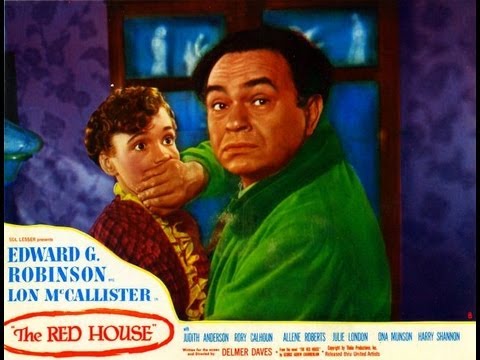
And now, we come the 7th film in the Fabulous Forties box set: 1947’s The Red House.

Redhouseposter

The Red House takes place is one of those small and seemingly idyllic country towns that always seem to harbor so many dark secrets and past crimes.  Everyone in town is friendly, cheerful, and quick to greet the world with a smile.

Well, almost everyone.

Pete Morgan (Edward G. Robinson) is the exception to the rule.  A farmer who moves with a pronounced limp, Pete lives on an isolated farm and refuses to have much to do with any of the other townspeople.  He lives with his wife, Ellen (Judith Anderson), and his niece, 17 year-old Meg (Allene Roberts).  Pete and Ellen are extremely overprotective of Meg.  Pete, especially, is always quick to tell her not to associate with any of boys in the town and not to enter the dark woods that sit next to the farm.  He tells her that there’s a red house hidden away in the woods and the house is haunted.  Going into the red house can only lead to death.

Despite Pete’s eccentricities, Meg is finally able to convince him to hire one of her classmates to help do chores around the farm.  Nath (Lon McAllister) is a good and hard worker and soon, even Pete starts to like him.  Meg, meanwhile, is falling in love with Nath.  However, Nath already has a girlfriend, the manipulative Tibby (Julie London), who cannot wait until they graduate high school so that she and Nath can leave town together.  When Nath starts to also develop feelings for Meg, Tibby responds by flirting with the local criminal, Teller (Rory Calhoun).

Though things seem to be getting better on the Morgan Farm, Nath eventually makes the mistake of admitting that, when he goes home, he takes a short cut through the old woods.  Pete angrily forbids Nath from entering the woods.  Of course, this has the opposite effect.  Soon, Nath and Meg are spending all day sneaking away into the woods so that they can look for the red house.

Once Pete learns of what they’re doing, he decides to hire Teller to keep them from even finding and entering the red house.  Needless to say, love, melodrama, murder, and tragedy all follow…

Despite the fact that the DVD suffered from a typically murky Mill Creek transfer, I enjoyed The Red House.  It’s one of those films that is just so over the top with all of the small town melodrama that you can’t help but enjoy it.  (If M. Night Shyamalan had been a 1940s filmmaker, he probably would have ended up directing The Red House.)  Nath and Meg were kind of boring but Julie London was a lot of fun as Tibby.  If I had ever starred in production of The Red House, I would want to play Tibby.

Plus, the film’s got Edward G. Robinson doing what he does best!  Robinson was an interesting actor, in that he could be both totally menacing and totally sympathetic at the same time.  He has some scary scenes as Pete but they’re also poignant because Robinson suggests that Pete hates his behavior just as much as Ellen and Meg.  Robimson was a powerhouse actor, the type who could elevate almost any film.

And that’s certainly what he does in The Red House!

red