4 Shots From 4 Films is just what it says it is, 4 shots from 4 of our favorite films. As opposed to the reviews and recaps that we usually post, 4 Shots From 4 Films lets the visuals do the talking.
Today, we pay tribute to the TSL’s favorite British studio with….
4 Shots From 4 Hammer Films
The Plague of the Zombies (1966, dir by John Gilling)
Frankenstein Created Woman (1967, dir by Terence Fisher)
The Mummy’s Shroud (1967, dir by John Gilling)
The Satanic Rites of Dracula (1973, dir by Alan Gibson)
In turn of the century Russia, there lived a man named Grigori Rasputin.
He was a monk, though some considered him to be more a servant of the devil than of God. Legend has it that he was a man who rarely bathed and who made it a point to live in the wild, a part of nature. His hair was long and unkempt and he was known for his wild eyes. Depending on who is telling the story, Rasputin’s stare is described as either being seductive or frightening. Rasputin had a reputation for being a great healer, as well as a great seducer. (It is said that Rasputin offered up as his defense that it was necessary to sin so that he could be forgiven by God.)
Despite being a controversial figure (and, in the eyes of same, an instrument of the devil), the charismatic Rasputin became well-known in Russian social circles. In fact, the stories of his powers as a healer eventually reached the household the Tsar. The Tsar’s son suffered from hemophilia and was frequently ill. Rasputin was brought into the royal palace to cure him and, according to contemporary accounts, he was somehow able to do just that. It was said that only Rasputin could stop the boy’s bleeding.
It was also said that Rasputin grow to have a good deal of influence over the Tsarina. In fact, he was seen as having so much influence that certain members of the royal court started to view him as being a threat to their own power. On December 30th, 1916, Rasputin was murdered. There are many stories about how Rasputin was murdered but it’s generally agreed that the conspirators first tried to poison him, just to discover that Rasputin was apparently immune to cyanide! Eventually, Rasputin was shot twice and then dumped in the Malaya Nevka River. Stories about how difficult it had been to kill Rasputin only added to his legend.
After his death (and the subsequent communist revolution that led to the murders of the Tsar and his family), Rasputin became a legendary figure. Because of his connection to the occult, it’s perhaps not surprising that he’s also been the subject of a number of biopics. Everyone from Klaus Kinski to Lionel Barrymore to Alan Rickman has played the mad monk. (Apparently, Leonardo DiCaprio has been attached to an up coming film about Rasputin.)
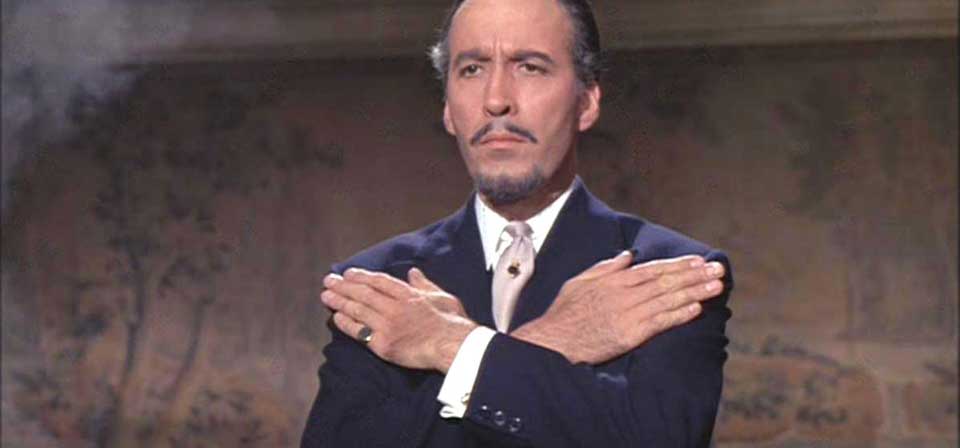
And then there’s Christopher Lee. Christopher Lee played Rasputin in the 1966 Hammer Film, Rasputin, The Mad Monk. It’s probably one of Lee’s best performances, as well as one of his most lively. Lee plays Rasputin as being a cunning charlatan, one who may act like a madman but who always know exactly what he’s doing. The film makes perfect use of Lee’s imposing physical presence and, when Rasputin uses his powers of hypnotism, Lee stares with such intensity that you never doubt that he’s a man who knows how to get exactly what he wants. Lee makes you believe that, through sheer willpower, Grigori Rasputin very well could have become one of the most important men in Russia.
As for the film itself, it’s a briskly paced retelling of Rasputin’s final years, hitting all of the expected points without ever digging too far beneath the surface. Rasputin cures the sick and seduces their mothers, wives, and sisters and uses his powers of hypnotism to hold most of St. Petersburg under his control. Many of the usual Hammer performers (including Barbara Shelley, as the Tsarina’s servant and Joss Ackland as a bishop) make an appearance and the fact that no one makes the least bit of effort to sound Russian just adds to the film’s charm. It’s an entertaining look at a fascinating historical story and, most importantly, it features Christopher Lee at his chilling best.
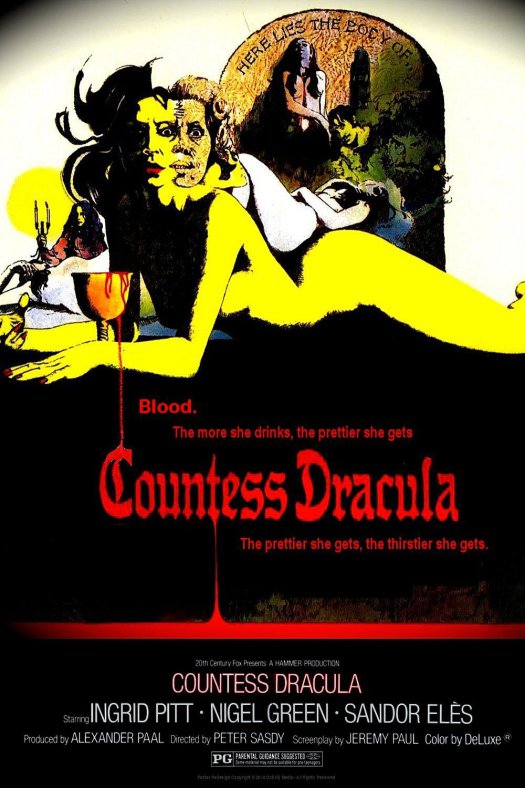
Iconic Ingrid Pitt became a horror fan favorite for her vampire roles in the early 1970’s. The Polish-born actress, who survived the horrors of a Nazi concentration camp as a child during WWII, played bloodsucking lesbian Carmilla in Hammer’s THE VAMPIRE LOVERS, based on the classic story by J. Sheridan LeFanu, and was a participant in the Amicus anthology THE HOUSE THAT DRIPPED BLOOD opposite Jon Pertwee in that film’s best segment. Finally, Ingrid sunk her teeth into the title role of COUNTESS DRACULA, a juicy part where she’s not really a vampire, but a noblewoman who gets off on bathing in blood, loosely based on the real life events of Hungarian Countess Elizabeth Bathory.
Portrait of the real Elizabeth Bathory
Bathory (1560-1614) was the most infamous female serial killer in history, officially found guilty of 80 murders, yet a diary allegedly found puts the count as high as 650!…
So I’ve been laid up with the flu/early stage pneumonia/whateverthehellitis for the past few days, which seemed like a good excuse to clean out the DVR by watching a bunch of random movies:
Bette Davis & Jimmy Cagney in “Jimmy the Gent”
JIMMY THE GENT (Warner Brothers 1934; D: Michael Curtiz ) – Fast paced James Cagney vehicle has Jimmy as the head of a shady “missing heir” racket, with Bette Davis as his ex-girl, now working for his classy (but grabby!) rival Alan Dinehart. Allen Jenkins returns once again as Cagney’s sidekick, and Alice White is a riot as Jenkins’s ditzy dame. Some funny dialog by Bertram Milhauser in this one, coming in at the tail-end of the Pre-Code era. Cagney’s always worth watching, even in minor fare like this one. Fun Fact: Cagney’s battles with boss Jack Warner over better roles were legendary, and the actor went out…
If you love horror films, you have to love Hammer Films, the British studio that was responsible for some of the best horror films of the 50s, 60s, and 70s. It was Hammer who brought Dracula, Frankenstein, and the Mummy back to life and who introduced a splash of color to the formerly black and white world of horror. It was Hammer that first brought horror together with pop art. And, of course, it was Hammer that made stars out of actors like Christopher Lee and Peter Cushing.
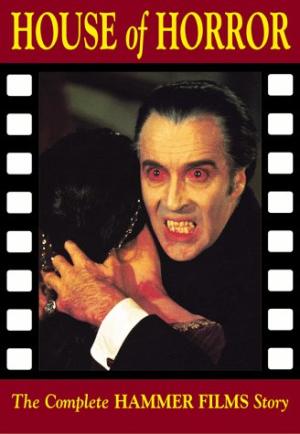
House of Horror was originally published in 1973, as a tribute to Hammer in its waning days. The copy that I own is a revised edition, one that was published in 2000. I found it at Recycled Books in Denton, Texas. (That was quite a shopping trip, by the way. Not only did I buy House of Horror but I also bought A Taste of Blood: The Films of Herschell Gordon Lewis.)
Anyway, if you’re a fan of Hammer Films, then this is one of those books that you simply have to own. Not only does it contain interviews with the big four of Hammer (Peter Cushing, Christopher Lee, Terence Fisher, and Michael Carreras) but it also provides a in-depth analysis of Hammer’s Dracula series, its Frankenstein series, and its lesser known science fiction productions.
At the end of the book, there are biographies of some of the members of Hammer’s stock company. There’s also not only a full list of every film that Hammer ever produced but even a list of Hammer project that never reached the filming stage. If, as I am, you’re obsessed with film trivia, this book is a must have.
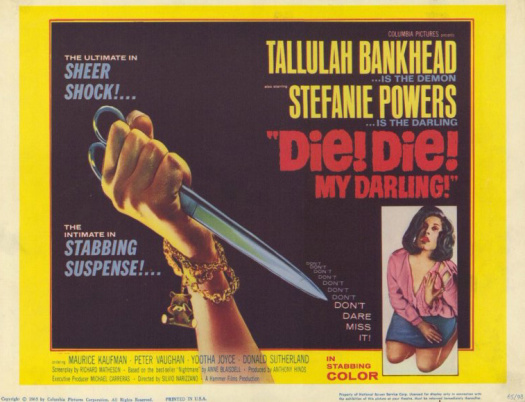
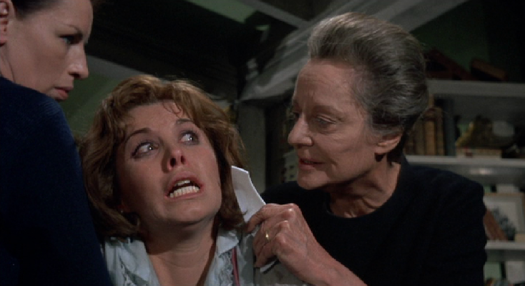
Miss Tallulah Bankhead jumped on the “Older Women Do Horror” bandwagon with 1965’s DIE! DIE! MY DARLING!, a deliciously dark piece of British horror from the good folks at Hammer. It was Tallulah’s first screen appearance since 1953’s MAIN STREET TO BROADWAY, and the veteran actress is a ball of fire and brimstone playing the mad Mrs. Trefoile, a feisty religious fanatic who locks up her late son’s former fiancé in an attic room in order to save her mortal soul.
Things start out innocently enough, as American Patricia Carroll (Stefanie Powers) travels to England to be with her new fiancé Alan Glentower (Maurice Kaufman). She’s received a letter from her deceased ex’s mother and agrees to pay her a visit, despite Alan’s protestations. Driving to Mrs. Trefoile’s ramshackle old farmhouse, Pat discovers the old woman’s more than a bit odd, holding daily church service for her servants, dressing all…
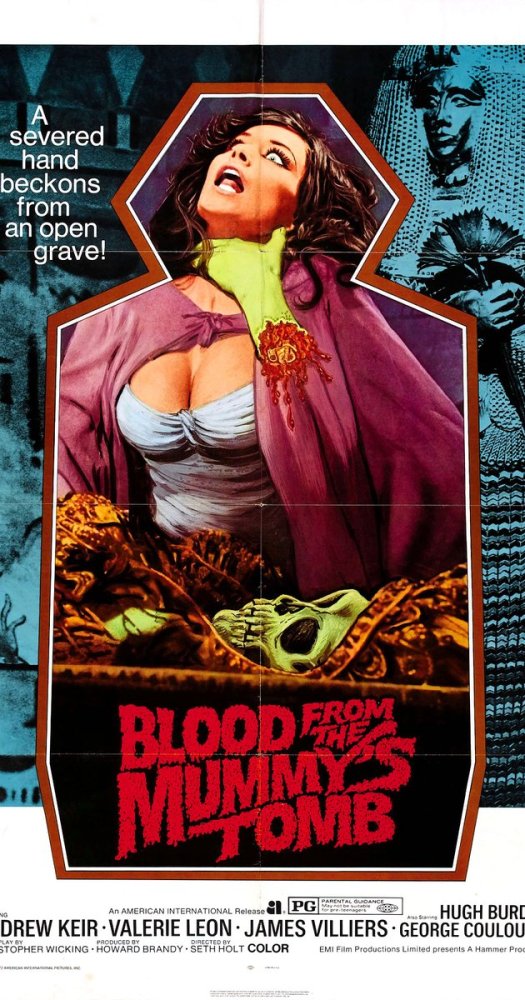
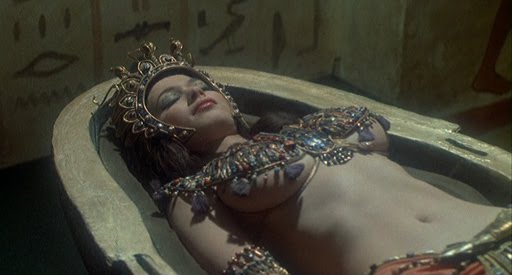
Hammer’s ‘Mummy’ movies never really did it for me, but BLOOD FROM THE MUMMY’S TOMB is a shroud of a different colour. Adapted from Bram Stoker’s novel “The Jewel of the Seven Stars”, the movie suffered some behind the scenes setbacks, which contribute to its choppy nature. The backstage chaos began when original star Peter Cushing’s wife passed away after only a day’s filming. He was replaced by Andrew Keir (QUARTERMASS AND THE PIT). Then before shooting was complete, director Seth Holt (TASTE OF FEAR, THE NANNY) died of a heart attack, and Hammer veteran Michael Carreras had to step in to finish the film. Despite all this, BLOOD FROM THE MUMMY’S TOMB is one of the better latter-day Hammers, picking up steam as it goes along, with a great performance by sexy star Valerie Leon.
Leon plays Margaret Fuchs, who was born the same day her father Professor Julian Fuchs…
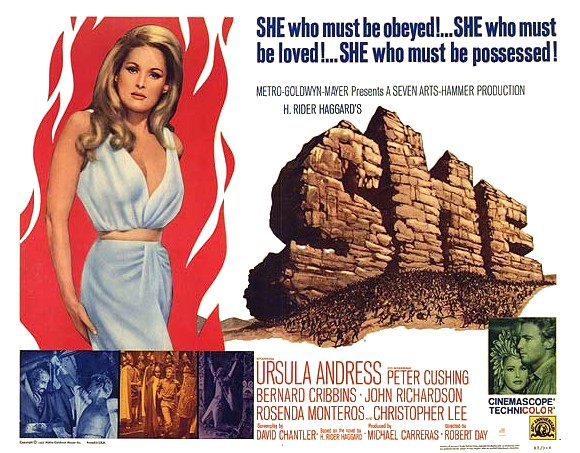
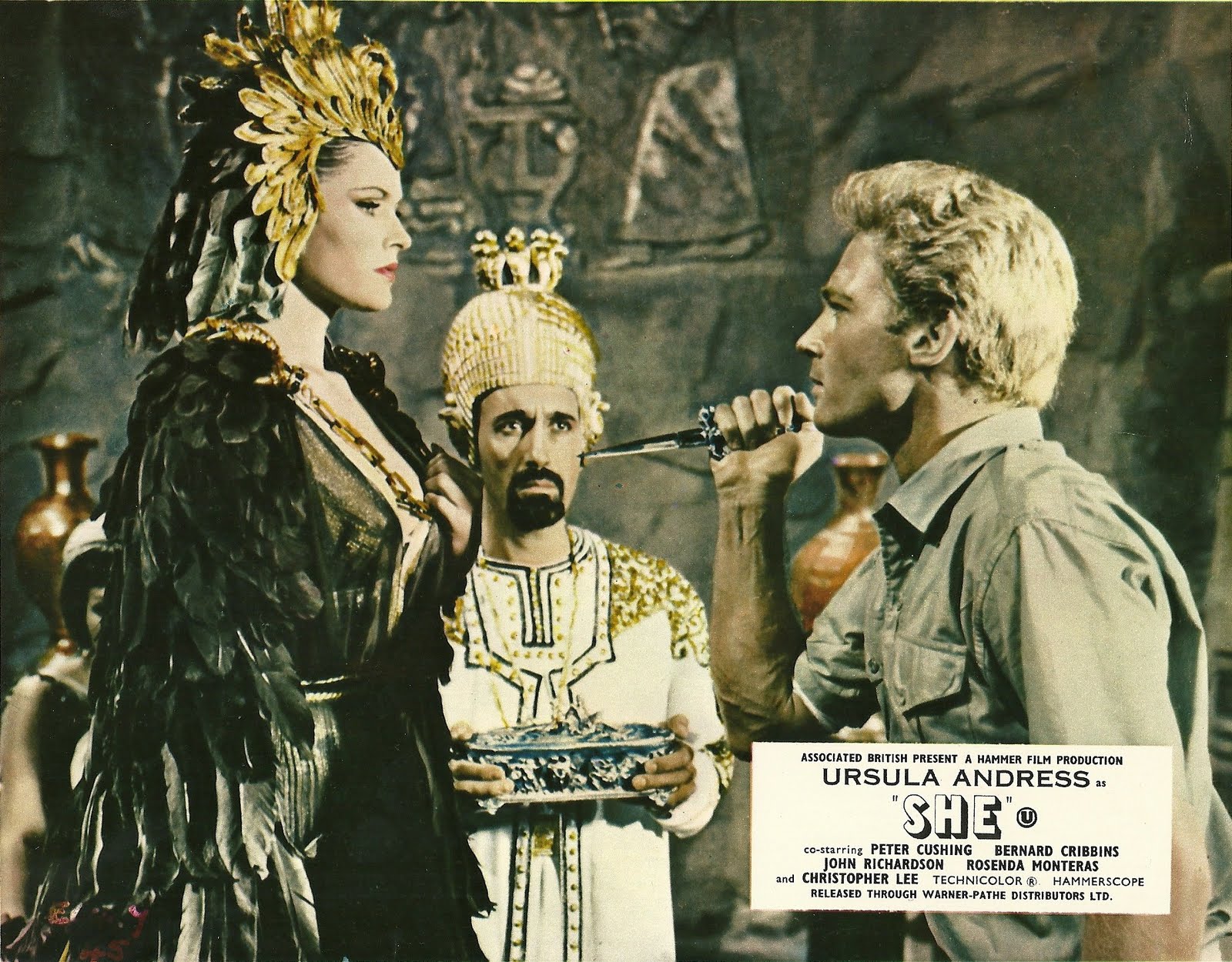
…didn’t manage to keep me awake, that is! That’s right, I actually dozed off in the middle of SHE for a good fifteen minutes! This so-called adventure film, a remake of the rousing 1935 Merian C. Cooper production starring Helen Gahagan and Randolph Scott, is based on a novel by H. Rider Haggard, a pretty big-deal adventure novelist back in the day, who also wrote the novels KING SOLOMAN’S MINES and ALLAN QUARTERMAIN. The ’35 version was filled with sumptuous Art Deco sets and a dynamic score by Max Steiner, and proved popular with moviegoers of the day.
But the times, they do a-change, and so do tastes. Hammer Films decided to do this remake thirty years later, with Ursula Andress in the title role. ONE MILLION YEARS B.C. caveman John Richardson plays Leo Vincey, who’s the spitting image of Queen Ayesha’s long-lost love Kallilkrates. Hammer’s top tag-team Peter Cushing and Christopher Lee are in the cast…
Halloween has come and gone, though most people have plenty of leftovers on hand, including your Cracked Rear Viewer. Here are some treats (and a few tricks) that didn’t quite make the cut this year:
ISLE OF THE DEAD (RKO 1945, D: Mark Robson)
Typically atmospheric Val Lewton production stars Boris Karloff as a Greek general trapped on a plague-ridden island along with a young girl (Ellen Drew) who may or may not be a vorvolaka (vampire-like spirit). This film features one of Lewton’s patented tropes, as Drew wanders through the woods alone, with the howling wind and ominous sounds of the creatures of the night. Very creepy, with another excellent Karloff performance and strong support from Lewton regulars Alan Napier, Jason Robards Sr, and Skelton Knaggs. Fun Fact: Like BEDLAM , this was inspired by a painting, Arnold Bocklin’s “Isle of the Dead”.
THE BOWERY BOYS MEET THE MONSTERS (Allied Artists 1954, D: Edward…
Satan worship was all over the big screen back in 1968. There was ROSEMARY’S BABY of course, that Oscar-winning fright fest from Roman Polanski and William Castle. WITCHFINDER GENERAL found Vincent Price on the hunt for daughters of the devil, while CURSE OF THE CRIMSON ALTAR boasted an all-star horror cast of Boris Karloff, Christopher Lee, Barbara Steele, and Michael Gough. Lee starred in a Hammer tale of satanism that year titled THE DEVIL’S BRIDE, as an occult expert pitted against a cult led by Charles Gray. That’s right- it’s Dracula vs Blofeld in a battle for souls!
Sir Christopher’s on the side of the angels for a change as the Duc de Richleau, who along with army buddy Rex Van Ryn, find their late chum’s son Simon Aron. Simon’s been “meddling with black magic” in a coven of devil worshippers led by Mocata, an adept Satanist. They manage to spirit Simon away…






 Through the Shattered Lens