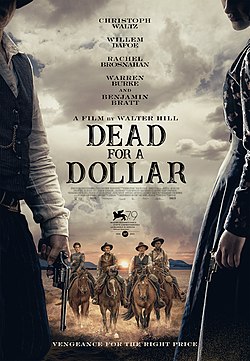
In 1897, bounty hunter Max Borlund (Christoph Waltz) is hired by wealthy Martin Kidd (Hamish Linklater) to track down Elijah Jones (Brandon Scott), the man who Martin says has kidnapped his wife. Accompanying Max is Alonzo Poe (Warren Burke), who served with Elijah in the Army.
From the start, Max suspects that Martin is not being completely forthright about the kidnapping and it does turn out that Rachel Kidd (Rachel Brosnahan) voluntarily left with Elijah and is planning on traveling to Cuba with him. Martin has hired crime baron Tiberio Vargas (Benjamin Bratt) to have Rachel raped and murdered because Martin thinks that the tragedy will help him launch his political career. Because Martin suspects that Max might not be trustworthy, he has hired Max’s rival, Joe Cribbens (Willem DaFoe), to track down Rachel as well.
This film has a cast that is full of talented people and it’s a western directed by someone who has proven himself to be one of the masters of genre, Walter Hill. I wanted to like Dead For A Dollar but the movie just didn’t work. Waltz and DaFoe are great actors but they just seem to be going through the motions and Rachel Bsonahan is miscast. Benjamin Bratt and Hamish Linklater are forgettable villains. Even worse, Dead For A Dollar has a washed-out visual style that you would never expect from a director like Walter Hill.
That’s question that is at the heart of Peacock’s new miniseries, Angelyne. The obvious answer is that Angelyne (played, quite well, by Emmy Rossum) is a Los Angeles icon who, in the 80s and 90s, was known for having her image plastered on billboards across the city. The billboards usually featured a provocative picture of Angelyne, her name, and a phone number that one could call. Billboards, of course, are used for advertising and Angelyne was advertising herself. What service did Angelyne provide? She provided the service of being a celebrity that people might actually run into while walking or driving around the city. She drove her pink Corvette across Los Angeles, waved at tourists, and sold merchandise to her fans. She even twice ran for governor. Before the Kardashians and the explosion of social media, Angelyne was famous for being famous. And when people asked who Angelyne was before she became Angelyne, she replied that she had always been Angelyne. Sometimes, she said she was someone who had come to Los Angeles from another state. Sometimes, she said that she was a literal angel, sent down to spread peace and help people believe in themselves. Other times, she suggested that she was an extra-terrestrial. Perhaps her most honest response was that she was whatever the person looking at her wanted to be. People saw Angelyne and they projected their own feelings onto her.
Filmed in a manner that combines faux documentary footage with flashbacks, each of Angelyne‘s five episodes focuses on someone from Angelyne’s past as they talk about their role in Angelyne’s enigmatic life. Often times, they seem to be struggling to come to terms with the fact that they’re obsessed with someone about whom they actually know very little. A smarmy reporter (Alex Karpovsky) and a twerpy filmmaker (Max Allen) both investigate Angelyne’s past and it’s hard not to resent their efforts to bring her down to Earth. (The reporter, at one point, actually says that Angelyne lost her right to privacy when she ran for governor, as if anyone seriously believed Angelyne was going to be the next governor of California. Seriously, most viewers will want to smack him.) Cory Hunt (Philip Ettinger), the lead singer of a band that Angelyne was briefly a member of, tries to take credit for creating her persona but he’s never credible and Angelyne even interupts their flashbacks to say that he’s lying. Wendy Wallace (played by Molly Ephraim) struggles to come to terms with the fact that her father, Harold (Martin Freeman), not only bankrolled Angelyne’s billboards but also neglected his family to “manage” Angelyne’s career. Angelyne’s assistant, Rick (Hamish Linklater), devotes his life to supporting and protecting Angelyne but sometimes, even he has to take a break.
All of them get their chance to tell their story and, as played by Rossum, Angelyne gets to tell her story. Not surprisingly, Angelyne’s story often differs from the stories being told about her. Frequently, a flashback will come to a halt as soon as Angelyne announces, “That’s not what happened.” When the twerpy filmmaker claims that he got Angelyne to admit the truth about who she was before she remade herself as Angelyne, Angelyne pops up to tell us that it never happened. Even after the “truth” of Angelyne’s past has been revealed, Angelyne shows up to assure that the story isn’t true and, if it is true, it’s only halfway true and it’s impossible not to respect Angelyne’s refusal to accept or admit to being anyone other than a Los Angeles icon named Angelyne. The miniseries suggests that Angelyne is someone who dealt with unimaginable pain and trauma by creating herself as almost a cartoon of what it means to be a celebrity. The miniseries also suggests that, at the very least, Los Angeles should be thankful that she did.
In many ways, Angelyne feels like a superior companion piece to Hulu’s Pam & Tommy. Both miniseries are about the curious nature of fame and the America’s bizarre celebrity culture. The main difference is that while Pam & Tommy was thuddingly literal and featured Seth Rogen wandering around with that stupid mullet, Angelyne is stylish and imaginative and there’s not a mullet in sight. Whereas Pam & Tommy struggled to justify its existence, Angelyne features a scene where the title character flies a UFO over Los Angeles. Whereas Pam & Tommy presented Hugh Hefner as being a benevolent father figure, Angelyne features a scene where Angelyne tells off a smug Hefner and informs him that there’s nothing his magazine can do for her that she can’t do for herself. For that scene alone, Angelyne deserves to be seen.
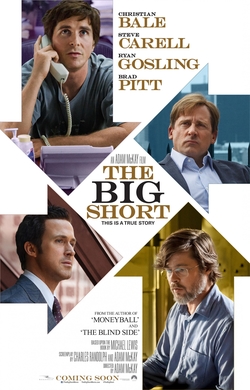
The Big Short is a film that is so critically acclaimed and that has been so passionately embraced by those who enjoyed it that it’s a bit intimidating to admit that it really didn’t do much for me. (It’s even more intimidating for me to admit that I nearly included it on my list of the 16 worst films of 2015.) It’s a big, angry movie and, even though it’s not really that good, it definitely taps into the zeitgeist. It captures the anger, the frustration, and the fears that people (including me) are feeling right now. It didn’t do much for me but I can understand why others have so passionately embraced it.
As for the film itself, it’s about the housing collapse and the financial crisis of 2008. The main characters are all people who realized that the economy was about to collapse and who managed to make a profit off of the crisis. For the most part, everyone gets at least two scenes where they get to rail about how angry they are that they’re making a profit off of other people’s misery. However, they all still collect their money at the end of the film.
For the most part, our main characters are the type of quirky eccentrics who always tend to pop up in ensemble films like this. They’re all played by recognizable actors and they all have an identifiable trait or two so we can keep them straight. For instance, Christian Bale has trouble relating to people socially, plays drums, and looks like he probably has terrible body odor. Steve Carell has a bad haircut and spends a lot of time yelling at people. He’s also haunted by the suicide of his brother and he’s married to Marisa Tomei but she only gets to appear in two scenes and doesn’t really do much because this is a film about menfolk, dagnabit. (I love Steve Carell but this is probably the least interesting performance that he’s ever given.) John Magaro and Finn Wittrock are two young investors and they especially get upset when they realize that the economy is about to collapse. Their mentor is played by Brad Pitt. Since this is an important film, Brad Pitt plays his role with his important actor beard.
And then there’s Ryan Gosling. Gosling plays a trader and he also narrates the film. And really, Gosling probably gives the best performance in the film, perhaps because his character is the only one who is actually allowed to enjoy making money. I think we’re supposed to be outraged when he brags about making money while people lose their houses but Gosling’s so charismatic and the character is so cheerful that it’s hard to dislike him.
(Of course, listening to Gosling’s narration, it’s impossible not to be reminded of The Wolf of Wall Street. And it’s appropriate because The Big Short is kind of like The Wolf of Wall Street for people who don’t want to have to deal with ambiguity or nuance.)
The film has gotten a lot of attention for Adam McKay’s direction, which is flashy and always watchable but, at the same time, also rather shallow. For the most part, McKay’s directorial tricks only served to remind me of other movies. The narration, of course, made me think about The Wolf of Wall Street. The scenes where characters look straight at the camera and say, “This isn’t the way it really happened,” only reminded me of how much more effective it was when the same thing happened in Michael Winterbottom’s 24 Hour Party People.
And then there’s the celebrity cameos. These are the scenes where a special guest celebrity is brought on screen to explain to us how Wall Street actually works. The first time, it’s Margot Robbie in a bubble bath and it works well because it admits the debt that The Big Short owes to Wolf of Wall Street. (Plus, it ends with Robbie telling the viewers to “fuck off,” which is probably what I would do if a huge group of strangers interrupted my bubble bath.) If McKay had limited himself to just doing it once, it would have been brilliant. But McKay drags out three more celebs and, with repeated use, the technique gets less and less interesting.
But I guess it’s debatable whether any of that matters. The Big Short taps into the way people are feeling now. It’s a zeitgeist film. People are rightfully angry and The Big Short is all about that anger. A decade from now, it’ll probably be as forgotten as Gabriel Over The White House. But for now, it’s definitely the film of the moment.
 In 1897, bounty hunter Max Borlund (Christoph Waltz) is hired by wealthy Martin Kidd (Hamish Linklater) to track down Elijah Jones (Brandon Scott), the man who Martin says has kidnapped his wife. Accompanying Max is Alonzo Poe (Warren Burke), who served with Elijah in the Army.
 Through the Shattered Lens