The TSL Horror Grindhouse: Maniac (dir by William Lustig)


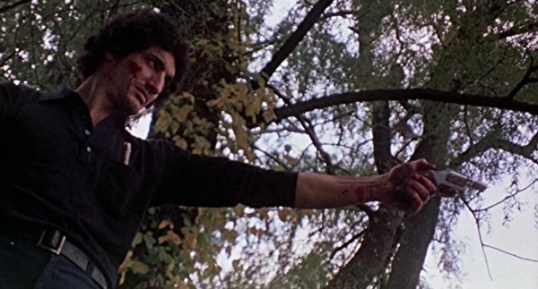
 First released in 1980, Maniac stars Joe Spinell as Frank Zito.

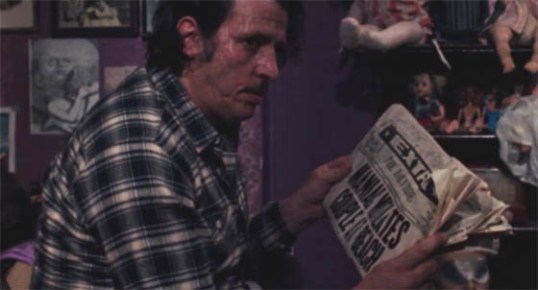
Frank lives in a run-down New York apartment.  The grimy walls are covered with pictures that appear to have been cut out of magazines.  The sheets on the bed look like they haven’t been washed in over a year and, for that matter, the sweaty and greasy Frank Zito looks like he could definitely use a shower as well.  Frank lives alone but he has several blood-stained mannequins.  He talks to the mannequins, cooing about how he just wants them to be nice to him and to stop abusing him.  Just looking at the apartment, one can imagine the nauseating odor of sweet, blood, and who knows what else that seeps out whenever Frank Zito opens his door.

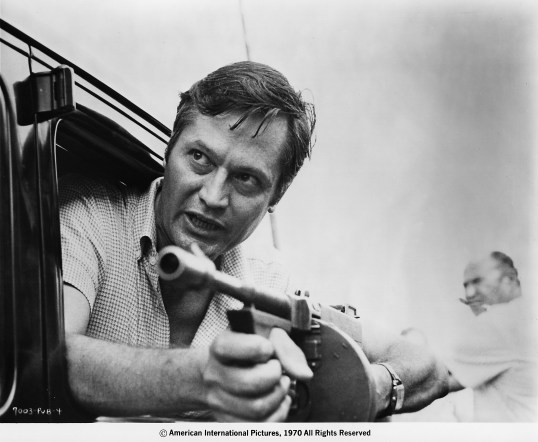
Frank Zito is also a murderer.  The majority of the film is taken up with scenes of him stalking his victims.  One extended sequences features him stalking a nurse through a subway station.  Another scene features a rather nightmarish moment in which Frank, in slow motion, jumps on the hood of a car and shoots a man point blank with a shotgun.  (The man is played by Tom Savini, who was also responsible for the film’s gore effects.)  An innocent model is killed after Frank breaks into her apartment.  “I just want to talk to you,” he says and maybe he actually believes that at first.

Frank has a chance meeting with a glamorous and beautiful photographer named Anna (Caroline Munro, playing a role that was rejected by Daria Nicolodi).  Somewhat improbably, Anna is charmed by the socially awkward Frank and even agrees to go out with him.  She’s touched when Frank shows up at the funeral of the model that he killed.  “She didn’t have many friends,” Anna tells Frank.

Meanwhile, at the cemetery, Frank’s fate awaits….

Maniac is one of the most infamous and controversial grindhouse films ever made.  The film’s atmosphere and the bleak visuals are the equivalent of being forced to look at New York while wearing glasses that somebody found floating in the sewer.  The deaths are drawn out and Savini’s gore effects are disturbingly convincing.  It’s a nearly plotless film about a man who hates women and what makes it scary as opposed to just exploitive is the fact that there are men like Frank Zito out there.  Joe Spinell, who was one of the great character actors of the 70s, appeared in everything from The Godfather to Taxi Driver to Rocky but, in the end, it’s his performance as Frank Zito that he seems to be destined to be most-remembered for.  Spinell is frightening, convincing, and disturbing as Frank Zito.  Spinell was planning on doing a sequel before his untimely death, at the age of 52, in 1989.

(Spinell was a hemophiliac who bled to death after slipping in the shower.  According to Maniac director William Lustig, when the police entered Spinell’s apartment, the first thing they saw was a huge amount of blood.  The second thing they saw was a life-like replica of Spinell’s head sitting on top of the television.  The head was a prop from Maniac and so convincing that the police originally assumed someone had broken into the apartment and decapitated him.  Spinell’s death not only prevented him from playing Frank Zito for a second time but also kept him from reprising his role as Willie Cicci in The Godfather Part III.)

Maniac is not an easy film to defend but, if I had to, I would point out that Frank Zito is portrayed as being an unsympathetic loser throughout the entire film.  He’s not some evil genius like Hannibal Lecter.  He’s not a nonstop quip machine like Freddy Krueger.  He’s not even enigmatic or superhuman like Michael Myers or Jason Voorhees.  Instead, he’s a pathetic loser who can’t even win an argument with the voices in his head.  Horror films all too often glorify or make excuses for serial killers.  (Just look at all of the Ted Bundy films.)  Maniac does not present Frank Zito as being anything other than a pathetic and twisted man and, as such, it’s probably one of the most realistic portrayals of a serial killer to be found on film.  Frank Zito is not meant to be glorified, though I’m sure that went over the heads of more than a few people who saw this film when it first opened.  It’s an ugly film but it’s about an ugly subject.  It’s exploitive but ultimately it’s on the side of Zito’s victims.

The film was an early directorial credit of William Lustig, who worked as a production assistant on Dario Argento’s Inferno in order to see how Argento deal with shooting on location in New York.  It was while working on Inferno that Lustig met Daria Nicolodi and offered her the part of Anna in Maniac.  (Anna’s last name is D’Antoni, a clear nod to Nicolodi’s Italian roots.)  Nicolodi was disgusted by the script and turned it down.  (Caroline Munro accepted the role and was reunited with her Starcrash co-star, Joe Spinnell.  Interestingly enough, even after all of the controversy created by Maniac, Munro and Spinell went on to co-star in The Last Horror Movie.)  Lustig based his serial killer on David “Son of Sam” Berkowitz and named him after director Joe Zito, who would go on to direct Friday the 13th — The Final Chapter.

For all the controversy that has dogged Maniac over the years, it’s easy to forget that the film itself is surprisingly well-directed and acted.  Caroline Munro bring some much needed class to the proceedings, even if the script requires her character to make some truly dumb decisions.  And Joe Spinell was simply horrifying as Frank Zito.  It’s not a pleasant film and if you ever find yourself in a home where the owner has a Maniac poster on the wall, I would suggest leaving immediately.  It is, however, a landmark of grindhouse filmmaking.
(Be sure to read Arleigh’s thoughts on Maniac here!)

The TSL Horror Grindhouse: The Last House On The Left (dir by Wes Craven)


The year is 1972 and the news is grim.  The fighting continues in Vietnam.  The protests continue at home.  Crime is rising.  The economy is struggling.  Groups like the Weathermen and the SLA are talking about taking the revolution to the streets.  In New York, the notorious murderers Krug Stillo (David Hess) and Fred “Weasel” Podowksi (Fred Lincoln) have broken out of prison and are one the run.  They are believed to be traveling with Krug’s drug-addicted son, Junior (Marc Sheffler), and a woman named Sadie (Jeramie Rain), who is said to be feral and bloodthirsty.

However, Mari Collingwood (Sandra Cassel) doesn’t care about any of that.  She’s just turned seventeen and she can’t wait to go to her first concert with her best friend, Phyllis (Lucy Grantham).  Mari is naive, optimistic, and comes from from a comfortably middle-class family.  Phyllis is a bit more worldly and tougher.  As she explains it, her family works in “iron and steel.”  “My mother irons, my father steals.”

While Mari’s parents (Richard Towers and Eleanor Shaw, though they were credited as Gaylord St. James and Cynthia Carr) bake a cake and prepare for Mari’s birthday party, Mari heads into the city with Phyllis.  Before they go to the concert, they want to buy some weed.  When they see Junior Stillo hanging out on a street corner, they assume he must be a dealer and they approach him.  Junior takes them to an apartment, where they are grabbed by Weasel and Krug.

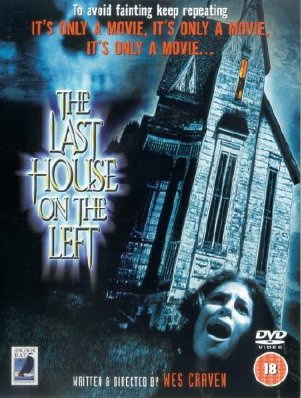
1972’s The Last House On The Left was advertised with the classic (and much-repeated line), “To avoid fainting, keep repeating, ‘It’s only a movie …. it’s only a movie…. it’s only a movie….”  That advice is easy to remember during the first part of the film because, up until Mari and Phyllis approach Junior, the movie is fairly cartoonish, with Richard Towers giving an incredibly bad performance as Mari’s father.  This film was Wes Craven’s debut as both a director and a writer.  By his own admission, Craven had no idea what teenage girls would talk about and, as such, he just wrote a lot of dialogue in which Mari talked about her breasts and Mari’s mother complaining that young women no longer wore bras.  (On the commentary that he recorded for the film’s DVD release, Craven succinctly explained, “I guess I was obsessed with breasts.”)  This part of the film plays out like a weird counter-culture comedy.  Even when we first meet Krug, he’s using his cigar to pop a little kid’s balloon.

The Last House On The Left (1972, dir by Wes Craven, DP: Victor Hurwitz)

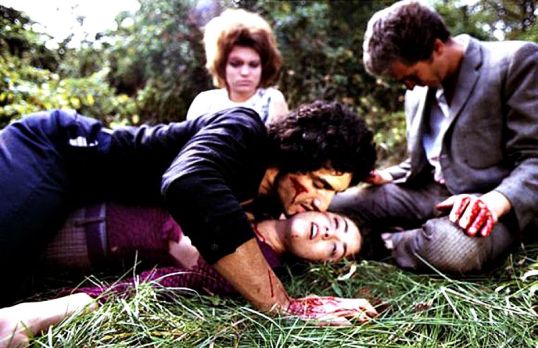
The tone of the film jarringly shifts the minute that Mari and Phyllis step into that apartment.  That’s largely due to the performances of David Hess and Fred Lincoln, who are both so convincing in their roles that it can be difficult to watch them.  In real life, Fred Lincoln was a stuntman (he’s in The French Connection) and an adult film actor.  David Hess, meanwhile, was a songwriter who was looking to break into acting.  (Hess’s songs — some of which are beautifully sad and some of which are disturbingly jaunty — are heard throughout the movie.)  Hess, in particular, is so frightening as Krug that he spent the rest of his career typecast as sociopathic murderers.  The middle part of the film alternates between disturbingly realistic scenes of Mari and Phyllis being tortured and humiliated and cartoonish scenes involving two incompetent cops (one whom is played by Martin Kove) and Mari’s parents.  Phyllis is murdered and dismembered in a graveyard and the gore effects remains disturbingly realistic even when seen today.  Mari, after being raped by Krug, recites a prayer, and then wades into a nearby lake.  Krug shoots her three times.  Afterwards, Krug, Weasel, and Sadie try to wash the blood off of themselves, the expression on their faces indicating that even they understand that they’ve gone too far.

Eventually, Krug, Weasel, Sadie, and Junior stop off at a nearby house, claiming to be salespeople who just had a little car trouble.  What they don’t realize is that the people who are generously welcoming them to spend the night are also the parents of Mari Collingwood….

Basing his script on Ingmar Bergman’s The Virgin Spring, Wes Craven has often said that The Last House On The Left was meant to be a commentary on the Vietnam War and the way that other films had glamourized violence.  That may or may not be true.  (Craven has also said that, at the time, he was so desperate to direct a movie that he would have filmed almost anything.)  What is true is that the violence in Last House On The Left is not easy to watch.  Once it starts, it’s relentless and, at no point, is the audience given an escape.  David Hess is so committed to playing a sadist that he never takes a moment to wink at the audience and say, “Hey, we’re just playacting here!”  Craven shot the film in a guerilla style and the shaky camera, the natural light, and the grainy images leave you feeling as if you’re watching some sicko’s home movies.  At the end of the movie, when Mari’s parents take the same joy in attacking her killers as Krug took in attacking their daughter, it’s hard not to feel that Mari has been forgotten.  Everyone has been consumed by the violence that has erupted around them.  Even though Richard Towers’s nearly blows the ending with a few hammy line readings, the film still leaves you exhausted.

The Last House on the Left (1972, dir. by Wes Craven, DP: Victor Hurwitz)

Not surprisingly, The Last House On The Left was attacked by most reviewers when it was originally released.  The movie played the drive-in and grindhouse circuit for three years, with producer Sean Cunningham often taking out advertisements in local newspapers that read: “You will hate the people who perpetrate these outrages—and you should! But if a movie—and it is only a movie—can arouse you to such extreme emotion then the film director has succeeded … The movie makes a plea for an end to all the senseless violence and inhuman cruelty that has become so much a part of the times in which we live.”  The film’s advertisements also contained a warning that no one under 30 should see the movie.  Needless to say, The Last House On The Left was a huge hit, especially with viewers under 30.

(One of the great ironies of film criticism is that one of the few critics to defend Last House On The Left was Roger Ebert.  Ebert, who would later be one of the slasher genre’s biggest attackers, gave Last House On The Left a very complimentary review and praised it for its political subtext.)

Seen today, The Last House On The Left still packs a punch.  It’s a shocking and shamelessly sordid film, one that shows hints of the talent that would make Wes Craven one of the most important directors to work in the horror genre.  It’s flawed, it’s exploitive, it’s thoroughly unpleasant, and yet it’s also a film that sticks with you.  It’s powerful almost despite itself.  It’s not a movie that I would necessarily chose to watch on a regular basis but, at the same time, I can recognize it as being a historically important film.  For better or worse, much of modern American horror owes a debt to Wes Craven’s Last House On The Left.  Even today, when one is regularly bombarded with horrific images, Last House On The Left still has the power to shock.

6 Trailers For The First Day Of Horrorthon


Today is the first day of our annual October Horrorthon!  In honor of our favorite time of the year, here is a special edition of Lisa Marie’s Favorite Grindhouse and Exploitation Film Trailers.

The six trailers below all have one thing in common!  Can you spot it?

Enjoy and happy Horrorthon!

  1. Lisa (1989)

2. Lisa Lisa (1977)

3. A Black Veil For Lisa (1968)

4. The Haunting of Lisa (1996)

5. I Am Lisa (2020)

6. Lisa Frankenstein (2024)

The TSL Grindhouse: Bummer (dir by William Alan Castleman)


The 1973 film Bummer tells the story of a California rock band known as The Group.

The Group plays groovy music with a mellow feel.  The music they play doesn’t sound so much like actual 70s California rock as much as it sounds like what someone from the big band era would have assumed mellow 70s California rock sounded like.  The Group is led by the charismatic Duke (Kipp Whitman).  The lead guitarist and the drummer look like groovy dudes as well.  But then there’s Butts (played by the great character actor, Dennis Burkley), the bass player.  Butts is a big fat slop with a beard, unwashed hair, and a genuine aura of grime.  Duke’s girlfriend tells Duke that he really should kick Butts out of the band.  The problem is that Duke owns the van that the Group travels around in.  It’s the type of 70s van that was probably nicknamed “The Second Base Mobile.”

Well, Duke really should have considered kicking Butts out of the band because it turns out that Butts is crazy.  He’s a sociopath with a mother fixation and, when he realizes that he’s the only member of the band who isn’t getting laid on a regular basis, he goes crazy and starts assaulting and murdering groupies.

It’s a bummer!

This film was produced by David Friedman, the genial sexploitation producer who is best-known for his collaborations with Herschell Gordon Lewis.  Lewis did not direct Bummer and I have to say that I was a little bit surprised to discover that because there’s a scene at a strip club that goes on for so long and which features so many pointless close-ups of pervy men staring up at the dancers that I immediately assumed that Lewis must have, at the very least, snuck onto the set and supervised it.  Instead, the film was directed by William Allen Castleman, who also did directed Johnny Firecloud and The Erotic Adventures of Zorro.  So be it.  I’m still convinced that Lewis has something to do with this movie.

Bummer is one of those films about how wasteful the younger generation is, with their mellow rock music and their bongs and their groupies.  The film’s main message seems to be that anyone under the age of 30 is intellectually vapid and spiritually empty but at least they look good without their clothes on.  It’s a mix of exploitation and nostalgia.  “You know who didn’t murder groupies?” the film seems to be saying, “Glenn Miller, that’s who.”

The film is pretty dull.  Scenes drag.  It takes forever for any sort of plot to develop.  Most of the cast is forgettable but Dennis Burkley makes an impression as the unhinged bass player and watching him in this, it’s easy to understand why be became such a busy character actor.  There’s an authentic edge to Burkley, one that comes through even in this film.  One of the groupies is played by Carol Speed, who would later appear in Disco Godfather and warn people about the dangers of “whack attack.”  Oddly enough, the film looks surprisingly good.  Cinematographer Gary Graver worked on films like this in between working on Orson Welles’s The Other Side Of The Wind.

In the end, Bummer lives up to its title.

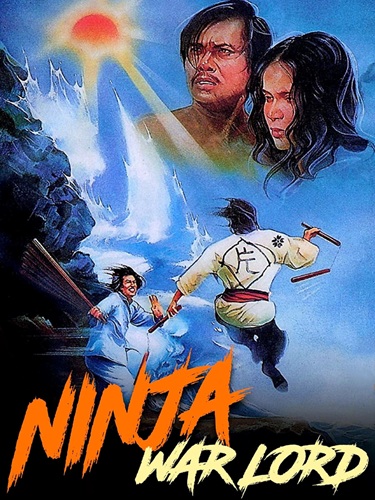
The TSL Grindhouse: Rage of Wind (a.k.a. Ninja War Lord) (dir by Ng See-Yuen)


Also known as Ninja War Lord, 1973’s Rage of Wind takes place during the Japanese occupation of China during the Second World War.

A Chinese fishing village is controlled by the ruthless Taka (Yasuaki Kurata), who terrorizes the town with his Hawaiian-shirt wearing henchmen and who deals with dissent by hanging people in the town square and then refusing to allow their loved ones to take down the bodies.  When boxer Chan Kwong (Chan Sing) returns to the village after pursuing a successful fighting career in the United States, the village rejoices.  Finally, there is someone who can stand up to Taka!  And the villages needs help because Taka has just instituted a new fishing tax!

Oh, Taka, you fool!  Don’t you realize that raising taxes never solves anything?  I realize that this film is taking place at a time when Milton Friedman was still working for the government and also long before the Laffer Curve was drawn on that napkin but still, raising taxes is always the last refuge of the unimaginative.  When the people in the village express their displeasure at having to pay more in taxes, Taka decides to seize their boats.  Hey, Taka, you dumbass commie — how are they going to make the money to pay your taxes if they don’t have their boats!?  Fortunately, Chan Kwong isn’t going to let the taxman get away with this.

(It’s interesting that this film features a Chinese hero fighting on the side of free enterprise.)

Here’s a few things that I liked about Rage of Wind.

First of all, it didn’t waste anytime getting to the good stuff.  The film’s first fight broke out within the first five minutes of its running time and, from that moment on, people were either fighting or preparing to fight.  This film didn’t feature any slow spots.  The fights were exciting to watch and, even more importantly, they distracted the viewer from asking too many questions about the plot.  At times, it felt like everyone in the film would have been well-served to just stop fighting and negotiate but that wouldn’t have been as much fun to watch.

Second, Taka wore a cape.  His henchmen may have dressed like tourists in Hawaii but Take wore a red cape!  And what’s even more impressive is that Taka totally pulled off the look.  Seriously, if someone can wear a cape and not look like an idiot, that’s when you know that person is a total badass.

Third, both the bad guys and the good guys got their own annoying sidekick.  The bad sidekick was constantly popping up and laughing.  The good sidekick had no teeth.  Both sidekicks died, which is an example of this film giving the viewers what they want.

Fourth, the musical score was made up of stolen riffs from Pink Floyd and the Theme From Shaft.  (I didn’t recognize the Pink Floyd riffs but everyone that I was watching the film with was like, “How did they get Pink Floyd!?”)  Apparently, the film “borrowed” the music without paying.  I love the shamelessness of old school Hong Kong cinema.

Fifth, the final fight between Taka and Chan Kwong is absolutely brutal!  Seriously, when you’re watching a film about people who are incapable of settling their conflicts through talking, this is exactly the type of fight you want to see.

Finally, once again, all of the conflict could have been avoided if they hadn’t tried to tax everyone to death!  I love films that are anti-taxation.  Watching a double feature of Rage of Wind and Harry’s War might become my new Tax Day tradition!


The TSL Grindhouse: Mitchell (dir by Andrew V. McLaglen)


I come here to defend Mitchell.

First released in 1975, Mitchell does not have a great reputation.  It’s often described as being one of the worst of the 70s cop films and Joe Don Baker’s performance in the lead role is often held up to ridicule.  A lot of that is due to the fact that Mitchell was featured on an episode of Mystery Science Theatre 3000.  Last year, for my birthday, my friend Pat McCurry actually hosted a showing of the MST 3K version of Mitchell.  I laughed all the way through it.  It was a funny show and most of the jokes uttered by Joel and the Bots landed.  That said, I wish they hadn’t been so hard on Joe Don Baker.  Baker was an outstanding character actor, one whose good ol’ boy persona sometimes kept people from realizing just how fiercely talented he actually was.

Here’s the thing with Mitchell.  Just because a film is snarkable, that doesn’t mean that it’s a bad film.  Just because there are moments in a film that inspire you to talk back to the screen, that doesn’t make it a bad film.  Some of the most enjoyable films that I’ve ever watched were enjoyable specifically because they were made to inspire the audience to talk back to the characters.  Whatever flaws you may want to find in Mitchell, it’s an entertaining film.  The plot may be impossible to follow but who cares?  When you’ve got Joe Don Baker, John Saxon, and Martin Balsam all in the same film, does the plot really matter?

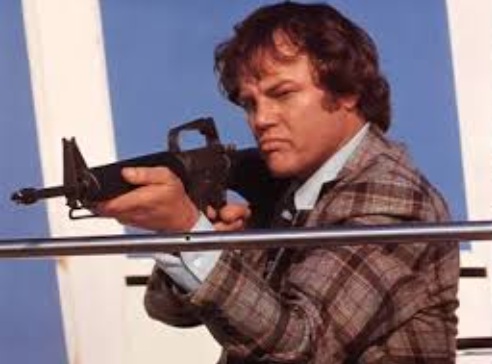
This is a film that you watch for the personalities involved.  Balsam plays a wannabe drug lord who always seems to be somewhat annoyed.  Someone once describes Bernie Sanders as always coming across as if he was about send his meal back to the kitchen because it was too cold and that’s a perfect description of Balsam’s performance in Mitchell.  John Saxon plays a sleazy rich guy who murders a burglar and then tries to cover up his crime.  Saxon is calm, cool, collected, and completely confident that his wealth will get him out of anything.  And then you’ve got Joe Don Baker as Mitchell, wearing an ugly plaid suit, drinking beer the way that I drink Diet Coke, and continually pretending to be dumber than he actually is.  There’s an interesting subtext to these three characters and how they interact.  Saxon and Balsam play criminals who are both rich and who both think they can get away with anything because they’ve got money.  Mitchell is a complete and total slob, a guy with a cheap apartment, a cheap suit, and absolutely no refinement at all.  Mitchell uses his good old boy persona to get the bad guys to continually underestimate him.  He ultimately turns out to be smarter and actually more ruthless than any of them.

Joe Don Baker throws himself into the role of Mitchell and there’ actually a lot of intentional humor to be found in his performance.  Baker doesn’t play Mitchell as being a supercop.  Instead, he plays Mitchell as being a blue collar guy who gets absolutely no respect.  Even when he’s on a stakeout, a random kid starts arguing with him.  (Mitchell loses the argument.)  Mitchell’s a jerk who busts his hooker girlfriend (Linda Evans) for having weed on her but he’s also the only one who could stop Balsam from doing whatever it is that Balsam thinks he’s trying to do.  (Again, don’t spend too much time trying to understand the plot.)  Mitchell’s super power is that he’s a slob who doesn’t give up.  To paraphrase Road House‘s Dalton, he plays dumb until it’s time not to be dumb.

As I said, it’s an entertaining film.  Where else are you going to see a not particularly high-speed chase between two station wagons?  Where else are you going to see John Saxon in a dune buggy or Joe Don Baker in a helicopter or Martin Balsam as the captain of a yacht?  Where else are you going to see a film that features its hero saying, “Yep, that’s grass,” before arresting his lover?  Mitchell is fun and entertaining and I’ll always defend both the movie and its star.

The TSL Grindhouse: Rebel Rousers (dir by Martin B. Cohen)


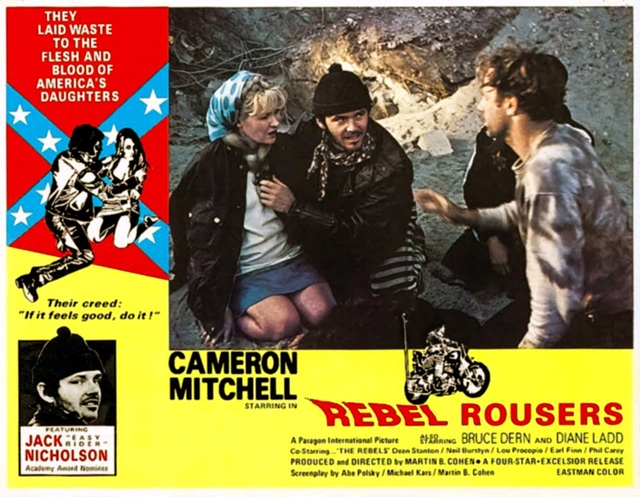
1970’s Rebel Rousers tell the story of what happens when Paul Collier (Cameron Mitchell) arrives in a small desert town, searching for his girlfriend, Karen (Diane Ladd).  Karen ran away when she discovered she was pregnant because she was scared that Paul would attempt to force her to get an abortion.  While Paul talks to Karen in a cheap motel, a motorcycle gang rides into town.  The members of the gang include Randolph (Harry Dean Stanton) and Bunny (Jack Nicholson), who wears striped prison pants and a stocking hat.  The leader of the gang is J.J. Weston (Bruce Dern), who went to high school with Paul.  They even played on the same football team but their lives have since followed differing paths.  (How exactly 30ish Bruce Dern and 50ish Cameron Mitchell could have been in the same high school class is not an issue that the film chooses to explore.)

Paul reunites with Karen and swears his love for her.  However, when Paul and Karen run into the motorcycle gang, Karen is kidnapped.  Bunny wants to force himself on Karen but J.J. wants to set her free.  J.J. challenges Bunny to a series of motorcycle games on the beach.  The winner decides what happens to Karen.  Meanwhile, Paul heads back to the town in search of help but discovers that almost everyone is too much of a coward to help him out.  Only Miguel (Robert Dix), the leader of a rival gang is willing to step up and save the community from the Rebels!

Rebel Rousers was filmed in 1967 but was considered to be so bad that it was put on a shelf and forgotten about until Jack Nicholson suddenly became a star in Easy RiderRebel Rousers was released on the drive-in circuit as a Jack Nicholson movie, even though Nicholson is barely in the film and he gives a pretty one-note performance as Bunny.  The movie’s star is Cameron Mitchell, who usually played villains and doesn’t seem to be too invested in this film.  (Mitchell has such a naturally sinister screen presence that I was actually worried about Paul finding Karen.  Bruce Dern and Diane Ladd are the sole members of the cast who really stand out, with Dern taking on the type of cool rebel role that was usually played by Peter Fonda while Ladd (pregnant at the time with Laura Dern) actually manages to bring some real emotional depth to her character. The movie itself was obviously made for next to nothing and it seems like it was shot in a hurry.  Everything feels like a first take or, even worse, like a rehearsal that was deemed “good enough.”  The competition between Bunny and J.J. ultimately feels mostly like filler than anything else.

Rebel Rousers is one of the more obscure entries in Jack Nicholson’s filmography.  If not for the success of Easy Rider, it never would have been released at all.  By the time Rebel Rousers did come out, Jack Nicholson was too busy establishing himself as one of the best leading men of the 70s to spend too much time looking back.  Today, watching this film can make it easier to understand why Nicholson was considering dropping out of Hollywood all together before he was cast in Easy Rider.  That said, the film today serves as a reminder that everyone started somewhere and sometimes, the somewhere is the second feature at the grindhouse.

The TSL Grindhouse: Nomads (dir by John McTiernan)


1986’s Nomads opens with anthropologist Jean-Charles Pommier being rushed into an emergency room, badly beaten and struggling for his life.  Despite the best efforts of Dr. Eileen Flax (Lesley-Anne Down), Pommier dies in the ER.  Flax is shocked by Pommier’s death and, naturally, she’s upset that she couldn’t save him.  But, at the same time, people die in hospitals.  It happens to the best of doctors.

Except soon, Flax is seeing flashes of the events that led to Pommier’s death.  Pommier has somehow entered her mind and soon, she’s reliving his investigation into the origins of a group of destructive, urban nomads that Pommier witnessed causing havoc throughout Los Angeles.  Pommier often felt like he was the only person who was capable of seeing the nomads and he grew to be tortured by his fear that they were specifically stalking him.  We soon learn that there was reason for that….

Now, based on his name, you’re probably assuming that Pommier is meant to be French.  And he is!  He’s from France, though he considers himself to be a citizen of the world.  He’s traveled everywhere, taking pictures of different cultural rituals across the globe.  However, in Nomads, the very French Jean-Charles Pommier is played by Pierce Brosnan.  Pierce Brosnan is, needless to say, not French.  He’s Irish, even though a lot of people seem to be shocked when they first learn that.  Brosnan normally speaks with an accent that could best be described as a mix of posh London and mid-Atlantic American.  Everything about him screams the UK.  In short, Pierce Brosnan is one of the least convincing French people ever seen on film and he delivers his lines in an accent that sounds like every accent other than the French accent.  Watching this film, I found myself thinking about the Monty Python skit where Terry Jones and Carol Cleveland starred in a French movie.  (“I see you have a cabbage.”  “Oui.”)  Brosnan is not a bad actor and it’s entertaining to watch him overact in Nomads.  But there’s nothing French about him and every time that someone referred to him as being French, it totally took me out of the movie.

Which is a shame because Nomads may be narratively incoherent but it’s got some memorably surreal visuals and it does a good job of generating a properly ominous atmosphere.  Director John McTiernan (who later went on to do Predator, Die Hard, and The Hunt For Red October) makes smart use of slow motion and a handheld camera to keep the audience off-balance.  At its best, Nomads achieves a dream-like intensity that makes up for the fact that the story doesn’t make the least bit of sense.  The nomads themselves are a memorable and creepy.  While Adam Ant plays their leader (and the scene where he smiles as Brosnan attempts to throw him off a building is truly disturbing), the most frightening of the nomads is Mary Woronov as Dancing Mary.  Seriously, after I watched this film, I checked all the locks in the house.  No urban nomads were going to interrupt me in my sleep!

My suggestion to everyone is to do a Nomads/Nomadland double feature.  You’ll never get in another van.

The TSL Grindhouse: The Wild Angels (dir by Roger Corman)


“What is it exactly that you want?” a preacher (Frank Maxwell) asks a congregation of leather-clad bikers.

“We want to get loaded!” Heavenly Blues (Peter Fonda) replies, “And we want to have a good time!”

And have a good time, they proceed to have.  Of course, it’s a good time for them.  Everyone else who meets the bikers at the center of 1966’s The Wild Angels are horrified by this collection of rebellious and violent outsiders.  Sure, Heavenly Blues might actually be a soulful guy who mistakenly believes that he can control the gang’s more excessive tendencies.  His girlfriend, Mike (Nancy Sinatra), actually seems rather reserved and conservative when compared to the rest of the gang.  But make no mistake about it, the majority of the members of the gang are into violence for its own sake.  They are bullies who couldn’t make the football team so, instead, they hopped on a motorcycle and formed their own society.  They’re self-styled rebels  but what are they rebelling against?  What have you got?

I know, I know.  That famous line comes from Marlon Brando and it was uttered in The Wild One.  Peter Fonda, to put it lightly, was no Marlon Brando and, as directed by Roger Corman, The Wild Angels doesn’t have the societal concerns that lay at the hear of The Wild One.  As Corman was often the first to admit, his main concern when it came to making movies was to make money.  Corman wasn’t necessarily against message films.  He often stated that, as a director, 1962’s The Intruder was the film in which he took the most pride.  The Intruder took a firm stand against racism and it let everyone know where Corman stood on when it came to the Civil Rights Movement.  It was also one of his few films to lose money.  The Wild Angels celebrates rebellion but one gets the feeling that celebration is motivated by the fact that younger filmgoers would be happy to pay to see a movie about a bunch of “youngish” people telling the old folks to shut up and get out of the way.  The Wild Angels themselves don’t seem to be motivated by any sort of grand ideology.  Heavenly Blues preaches about getting loaded and having a good time and celebrating freedom but he also allows the members of the gang to drape a Nazi flag over a casket.  What does Heavenly Blues actually believe in?

Heavenly Blues believes in loyalty to his friends.  For all the fights and the orgies and the scenes of motorcycles roaring down country roads, this is ultimately just a film about a guy who wants to give his best friend a decent burial.  The Loser (Bruce Dern) dies about halfway through the film and one gets the feeling that he probably would have lived if the gang hadn’t kidnapped him from the hospital.  Heavenly Blues wants to give The Loser the type of wild funeral that Blues thinks he would have wanted though I think The Loser probably would have been happier not have been killed by the actions of his idiot friends.  Diane Ladd, who was married to Bruce Dern at the time and who has said Laura Dern was conceived during the filming of The Wild Angels, is heart-breaking as The Loser’s girlfriend, Gaysh.  Gaysh wants to mourn her boyfriend while the rest of the gang is more concerned with figuring out who her next boyfriend is going to be.

Does Heavenly Blues ever realize that he’s traveling with a bunch of animals?  He does but one gets the feeling that he’s accepted his fate.  There’s no going back.  The past can’t change and the future cannot be controlled so Heavenly Blues is content to live in the present.  All he can do is try to give his friend a decent burial while the sirens of cops shriek in the distance.

The Wild Angels was a controversial film when it was first released.  It also made a lot of money and led to a whole cycle of outlaw biker films, culminating with Easy Rider.  Seen today, it’s a portrait of a society coming apart, with the establishment and the bikers not even willing to stop fighting long enough to allow for a simple burial.  It’s definitely a time capsule film, one of those productions that epitomizes an era.  There’s not much going on underneath the surface and most of the film’s bikers really are awful people but there is something touching about Blues giving it all up just to try to give his friend a decent burial.

6 Trailers For Roger Corman’s Birthday


Today, on what would have been his birthday, we pay tribute to the legacy of the legendary Roger Corman with a special edition of Lisa Marie’s Favorite Grindhouse and Exploitation Film Trailers.

1. The Day The World Ended (1955)

Though Corman worked in almost every type of film genre imaginable, he’s probably best remembered for his science fiction and horror films.  This was one of the first of them.

2. Bucket of Blood (1959)

In Bucket of Blood, Roger Corman gave Dick Miller a starring role and also mixed comedy and horror in a way that influence many future horror directors.

3. Little Shop of Horrors (1960)

Roger Corman famously shot Little Shop of Horrors in just two days.  The end result was a mix of comedy and horror that continues to be influential to this day.  The musical is very good but I still prefer the cheerful low-budget aesthetic of the Corman original.

4. The Terror (1963)

Corman was famous for his ability to spot new talent.  His 1963 film The Terror starred a then unknown actor named Jack Nicholson.

5. The Masque of the Red Death (1964)

In the 60s, Corman was also well-known for his Edgar Allan Poe adaptations, the majority of which starred Vincent Price.  With these colorful and flamboyant films, Corman showed himself to be a pop artist at heart.

6. Frankenstein Unbound (1990)

In the 1970s, Corman retired from directing and instead focused on producing and distributing movies.  In 1990, he briefly came out of retirement and gave us his final directorial effort, Frankenstein Unbound.