Brad reviews STRAIGHT TALK (1992), starring Dolly Parton and James Woods! 


STRAIGHT TALK opens with Shirlee Kenyon (Dolly Parton) having a bad day in the town of Flat River, Arkansas. First, she gets fired from her job at a dance studio because she likes to talk to the customers more about their problems than she does teaching them to dance. Then she goes home to her lazy, unemployed boyfriend Steve (Michael Madsen), who’s more interested in drinking beer and bowling than talking to her. She tells him she wants to leave town and go to Chicago for a fresh start. He heads to the bar, so she packs her bags and heads to the Windy City. Upon arriving, she finds a job as a receptionist at a local radio station. Through a case of mistaken identity that can only happen in the movies, Shirlee finds herself on air as “Dr. Shirlee,” where she begins fielding calls from people with all kinds of problems. With her homespun wisdom, Dr. Shirlee soon finds herself to be the toast of Chicago. Feeling guilty that the station is advertising her as a “Doctor” when she’s not, Shirlee reluctantly continues on when her boss Alan (Griffin Dunne) convinces her she’s a “doctor of the heart.” Alan takes that simple lie and creates an entire fake public identity for Shirlee. When reporter Jack Russell (James Woods), in serious need of a story, senses that something’s not adding up with Dr. Shirlee, he convinces his editor Milo Jacoby (Jerry Orbach) to let him try to get close to the city’s new star to see if he can dig up some dirt. As he gets to know her, however, he’s charmed just like the rest of city and the two begin to fall in love. With Shirlee feeling guilty about being marketed as someone she’s not, and with Jack feeling bad about deceiving her for a scoop, is there any chance that their love can survive when the truth finally comes out?

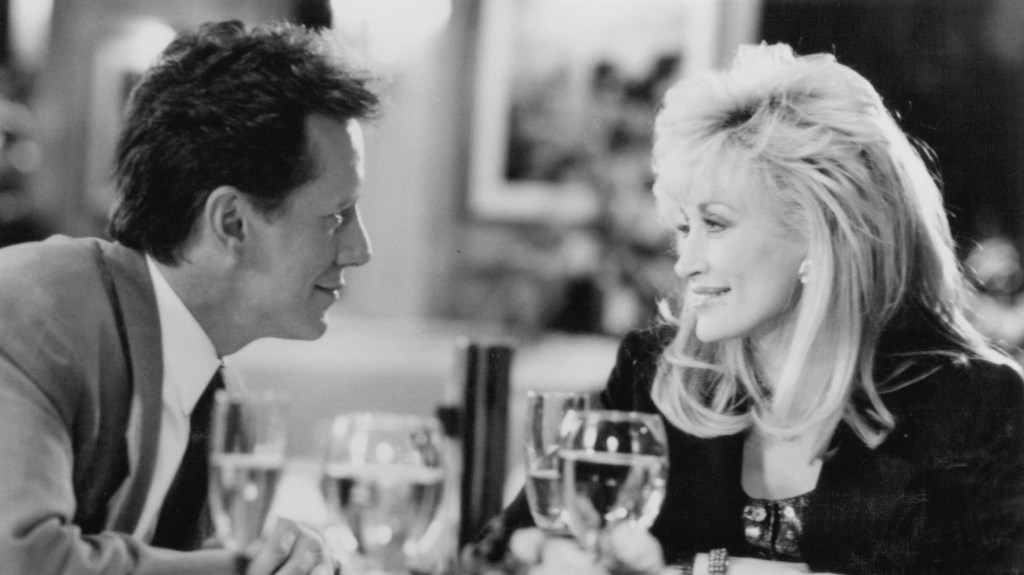
STRAIGHT TALK is one of those movies that lives or dies based on whether or not you like its stars. This early 90’s romantic comedy was made for Dolly Parton’s fans, of which there are many. She looks beautiful, she has a great wardrobe, she sings the catchy soundtrack tunes, and she dispenses down-home country wisdom in a way that only Dolly can. And then there’s James Woods as the cynical reporter / love interest. Not traditionally handsome or known for his performances in romantic comedies, he brings his unique style to the role, and somehow it really works. As a huge fan of Woods, I may be a little biased, but I think that he has a great chemistry with Dolly. There does seem to be some basis for my claim as the two seemed to really enjoy each other on the set. Dolly has been quoted as saying that he’s “a great kisser” and a “thrill to be around.” Woods recently posted on social media that “Dolly Parton is the nicest person I’ve ever worked with…. She’s everything you imagine and so much more. Anybody who’s ever spent any time with her absolutely adores her.” I think these genuine feelings show through on the screen and provide levels of entertainment that transcend what’s on the pages of the script.

Aside from the excellent chemistry of its leads, STRAIGHT TALK does lean hard into romantic comedy cliches, and honestly that’s okay with me. I enjoyed the familiar plot lines… Will Shirlee become a star in the big city? Will reporter Jack expose her past? Will the two fall in love? Will her old boyfriend Steve show up? Will her “on-air” advice cause some unexpected problems? Well, of course, on all accounts! As these well worn stories play out against the backdrop of an early 90’s movie version of Chicago, I enjoy the movie for what it is, an entertaining fluff piece. The interesting supporting cast (Griffin Dunne, Michael Madsen, Jerry Orbach, John Sayles, Spalding Gray, etc.) do their jobs well, further enhancing my appreciation of the movie. 

With all that said, I do recognize that the joy of movies is purely a subjective experience, and if you’re not a fan of Dolly Parton, you probably won’t enjoy STRAIGHT TALK. It’s not a great movie in traditional terms, but it is a great “Dolly Parton” movie. I like Dolly, and I especially enjoy her relationship with James Woods within the film, so this is another one of those movies from my youth that I like to watch every few years. I enjoy it every single time. 

4 Books For The Weekend (10/3/25)


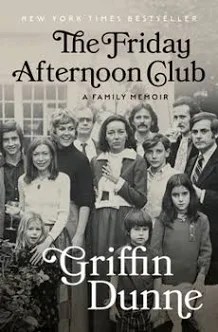
I want to start by recommending The Friday Afternoon Club, Griffin Dunne’s memoir of growing up amongst the rich and famous in Hollywood and Manhattan.  The son of Dominick Dunne and the nephew of John Gregory Dunne, Griffin Dunne came of age in the 60s and the 70s.  Reading his memoir, it’s easy to wonder if there’s anyone who he didn’t rub shoulders with at one time or another.  Sean Connery saves him from drowning when he’s just eight.  He attends one of Ken Kesey’s acid tests with John Gregory Dunne and Joan Didion.  A pre-stardom Harrison Ford does carpentry work at the Dunne family home and shares his weed with the young Griffin.  In New York, Griffin’s roommate and (for the most part) platonic best friend is a hyperactive young actress named Carrie Fisher.  While Griffin tries to find himself in Hollywood and New York, his father Dominick drops in and out of the film business.

For it’s first half, The Friday Afternoon Club is, at times, a laugh-out-loud memoir.  Griffin Dunne is a very funny storyteller and his command of language reveals a bright and insightful mind.  However, the second half of the book takes a dark turn with the murder of his sister, Dominique.  Dominique, who had just appeared in Poltergeist, was strangled by her abusive boyfriend, a chef named John Thomas Sweeney.  Griffin Dunne writes unsparingly of the horror of watching as Sweeney’s lawyers tried to present Dominique as somehow being to blame for her own death.  After the judge refused to allow the prosecution to introduce evidence showing that Sweeney had a history of abusing and choking women, the jury found Sweeney guilty of manslaughter.  (The jury foreman later said that, if the jury had been allowed to hear the evidence of Sweeney’s past abusive behavior, they would have found Sweeney guilty of murder.)  Sweeney was sentenced to six years in prison and was paroled after only 30 months.  Griffin Dunne writes of the years that both he and his father spent obsessing on Sweeney’s whereabouts.  (Sweeney, for those curious, continued to find work as a chef even after his prison sentence.  He currently goes by the name of John Maura.)

It’s a powerful memoir.  Griffin writes honestly about his dysfunctional family, describing even their conflicts with a good deal of love.  Probably the most touching passages in the book are about his relationship with his brother Alex, the one member of the family to see through Sweeney from the start.  Those looking for Hollywood gossip will find plenty, though Griffin is never malicious.  Those looking for details about the filming of An American Werewolf in London and After Hours will find those as well.

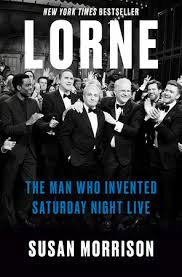
Published earlier this year, Susan Morrison’s Lorne is a biography of Lorne Michaels, the man behind Saturday Night Live.  Lorne has actually produced quite a few other shows and movies but, as this book makes clear, his legacy will always be Saturday Night Live.  The book follows Lorne from his beginnings in Canada to his time as a counter-culture tastemaker to his current position as a senior member of America’s cultural establishment.  Lorne went from being a rebel to being a member of the club and, reading about the process, one comes to suspect that he was always more comfortable in the club than outside of it.  It’s an interesting journey and the Lorne Michaels who emerges is occasionally idealistic, occasionally pragmatic, and — even after 595 pages — rather enigmatic.  It’s a fascinating story, one that provides insight into American culture has changed and developed over the past 50 years.  There’s certainly more insight to be found in this book than in Jason Reitman’s Saturday Night.

On a similar note, Todd S. Purdum’s Desi Arnaz: The Man Who Invented Television argues that Arnaz deserves far more credit for …. well, inventing television than he’s usually given.  Often dismissively described as being Lucille Ball’s less talented husband, Purdom persuasively argues that Arnaz deserves far more credit for the success of I Love Lucy than he is commonly given.  The book details how Arnaz’s family lost their fortune in one of Cuba’s many revolutions, how Arnaz came to America and built a career for himself, and how Arnaz revolutionized television as the producer of I Love Lucy.  The book deals with both the good and the bad of Lucy and Desi’s marriage.  Desi emerges as a complex and flawed character, one whose career never really recovered after his divorce from Lucille Ball.

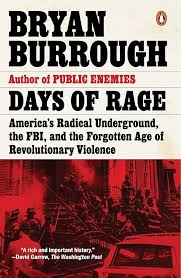
Finally, an old friend recommended that I read Bryan Burrough’s 2015 book, Days of RageDays of Rage takes a look at the the domestic terrorism of the 70s, the bombings, kidnappings, and even murders that were committed by members of such groups as the Weatherman, the BLA, the SLA (they kidnapped Patty Hearst), and the FALN.  Along with taking a look at the motivations of the terrorists themselves, Burrough also writes about how the FBI reacted.  In the end, it’s a book without any heroes.  The FBI frequently violated the law in their pursuit of domestic enemies.  Meanwhile, the radicals often come across as being a collection of hypocrites who were essentially more interested in playing revolution than actually accomplishing anything.  The Weathermen, in particular, come across as being a bunch of smug and overly privileged LARPers.  It’s an interesting book and one that feels very relevant in our current cultural moment.

Check out my previous book recommendations here!

Film Review: After Hours (dir by Martin Scorsese)


Directed by Martin Scorsese, 1985’s After Hours opens in an office.  This isn’t the type of office that one might expect a Scorsese movie to open with.  It’s not a wild, hedonistic playground like the office in The Wolf of Wall Street.  Nor is it a place where an aging man with connections keeps his eye on the business for his friends back home, like Ace Rothstein’s office in Casino.  Instead, it’s a boring and anonymous office, one that is full of boring and anonymous people.  Scorsese’s camera moves around the office almost frantically, as if it’s as trapped as the people who work there.

Paul Hackett (Griffin Dunne) works in the office, at a job that bores him but presumably pays him enough to live in New York.  Paul is not a typical Scorsese protagonist.  He’s not a fast-talker or a fearsome fighter.  He’s not an artist consumed by his own passion or an amoral figure eager to tell his own story.  Instead, he’s just a guy who wears a tie to work and who spends his day doing data entry.  He’s a New Yorker but he doesn’t seem to really know the city.  (He certainly doesn’t know how much it costs to ride the subway.)  He stays in his protected world, even though it doesn’t seem satisfy him.  Paul Hackett is not Travis Bickle.  Instead, Paul is one of the guys who would get into Travis’s cab and, after spending the drive listening to Travis talk about how a storm needs to wash away all of New York’s sin, swear that he will never again take another taxi in New York.

One day, after work, Paul has a chance meeting with a seemingly shy woman named Marcy (Rosanna Arquette).  Marcy lives in SoHo, with an artist named Kiki (Linda Fiorentino) who sells plaster-of-Paris paperweights that are made to look like bagels.  Marcy gives Paul her number and eventually, Paul ends up traveling to SoHo.  He takes a taxi and, while the driver is not Travis Bickle, he’s still not amused when Paul’s last twenty dollar bill blows out the window of the cab.

Paul’s trip to SoHo doesn’t goes as he planned.  Kiki is not impressed with him.  Marcy tells him disturbing stories that may or may not be true while a search through the apartment (not cool, Paul!) leads Paul to suspect that Marcy might have disfiguring burn scars.  Paul decides to end the date but he then discovers that he doesn’t have enough change on him to take the subway home.  As Paul attempts to escape SoHo, he meets a collection of strange people and finds himself being hunted by a mob that is convinced that he’s a burglar.  Teri Garr plays a sinister waitress with a beehive hairdo and an apartment that is full of mousetraps.  Catherine O’Hara chases Paul in an ice cream truck.  Cheech and Chong play two burglars who randomly show up through the film.  John Heard plays a bartender who appears to be helpful but who also has his own connection to Marcy.  Even Martin Scorsese appears, holding a spotlight while a bunch of punks attempt to forcibly give Paul a mohawk.  The more that Paul attempts to escape SoHo, the more trapped he becomes.

Martin Scorsese directed After Hours at a time when he was still struggling to get his adaptation of The Last Temptation of Christ into production.  If Paul feels trapped by SoHo, Scorsese felt trapped by Hollywood.  After Hours is one of the most nightmarish comedies ever made. It’s easy to laugh at Paul desperately hiding in the shadows from Catherine O’Hara driving an ice cream truck but, at the same time, it’s impossible not to relate to Paul’s horror as he continually finds himself returning again and again to the same ominous locations.  In many scenes, he resembles a man being hunted by torch-wielding villagers in an old Universal horror film, running through the shadows while villager after villager takes to the streets.  Paul’s a stranger in a strange part of the city and he has absolutely no way to get home.  I think everyone’s had that dream at least once.

Paul is not written to be a particularly deep character.  He’s just a somewhat shallow office drone who wanted to get laid and now just wants to go home.  Fortunately, he’s played by Griffin Dunne, who is likable enough that the viewer is willing to stick with Paul even after Paul makes some very questionable decisions and does a few things that make him a bit less than sympathetic.  Dunne and John Heard keep the film grounded in reality, which allows Rosanne Arquette, Linda Fiorentino, Catherine O’Hara, and especially Teri Garr to totally play up the bizarre quirks of their character.  Teri Garr especially does a good job in this film, revealing a rather frightening side of the type of quirky eccentric that she usually played.

Scorsese’s sense of humor has been evident in almost all of his films but he still doesn’t get enough credit for his ability to direct comedy.  (One need only compare After Hours to one of Brian De Palma’s “comedies” to see just how adroitly Scorsese mixes laughs and horror.)  After Hours is one of Scorsese’s more underrated films and it’s one that everyone should see.  After Hours is a comedy of anxiety.  I laughed while I watched it, even while my heart was racing.

An Offer You Can’t Refuse #9: Rob the Mob (dir by Raymond De Felitta)


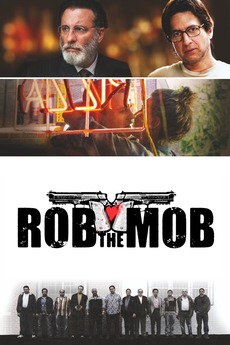
The 2014 film, Rob the Mob, tells the true story of a young couple in love who became minor celebrities when they robbed the mob.  Of course, they also ended up with a huge target on their back, which tends to happen when you repeatedly humiliate a bunch of angry men who have weapons at their disposal.

The year is 1992 and Tommy Uva (Michael Pitt) and his wife, Rosemarie (Nina Arianda) are professional criminals who, after getting busted for trying to rob a florist on Valentine’s Day, end up working at a debt collection agency.  Their boss (played by Griffin Dunne) spent time in prison for insider trading and he believes in giving convicts a second chance.  The problem is that Tommy doesn’t really want a second chance.  He’s actually pretty happy being a criminal.

Tommy has some issues with the Mafia, largely due to the fact that his father borrowed money from the mob to open up a shop and spent the rest of his short life being beaten and humiliated by loan sharks.  Tommy believes that the pressure is what led his father to an early grave.  Tommy’s mother (Cathy Moriarty), on the other hand, claims that it was the stress caused by Tommy being a criminal.  Regardless, seeing his father repeatedly mistreated has definitely left Tommy with some anger issues.

Even though Tommy claims that he hates the Mafia, he still seems to be rather obsessed with them.  At times, it’s hard to tell if Tommy is angry with the Mafia or if he’s just jealous about the fact that he’ll never be as rich or as powerful as the local neighborhood mobster.  Tommy starts to skip work so that he can observe the trial of John Gotti.  It’s while doing this that Tommy hears that guns are not allowed in Mafia social clubs.

Soon, Tommy is robbing those same clubs, taking all of the money that he can and humiliating the mobsters at the same time.  (He forces one group of paunchy gangsters to march outside in their underwear.)  With Rosemarie serving as his getaway driver, Tommy soon becomes something of a legend.  The mobsters even nickname the pair “Bonnie and Clyde.”  Because the Mafia doesn’t want to attract any unnecessary attention during the Gotti trial, Tommy and Rosemarie are able to get away with their activities for a while.  But then they make the mistake of stealing a list that could bring down the entire New York Mafia….

Rob the Mob is a bit of an uneven film.  The film starts with Tommy and Rosemarie getting high and then attempting to rob a florist and, in that scene, they both seemed like such idiots that I really wasn’t sure that I wanted to spend 104 minutes of my life watching a film about them.  Even after Tommy got out of a prison and got a legitimate job, he still seemed like such an unsympathetic loser that I found myself wondering why I should care.

However, once Tommy and Rosemarie start actually robbing the mob, the film picks up.  We meet Big Al, the temporary head of the New York mafia, and he’s played by Andy Garcia, who gives an intelligent and understated performance.  Big Al may be a mobster but he’s not an unsympathetic character.  The film presents him as being someone who has been unexpectedly thrust into a position of power and who is doing his best to keep everything from falling apart.  Then, as the robberies continue, Ray Romano shows up as Jerry Cardozo, a reporter who makes “Bonnie and Clyde” famous but who realizes too late that he’s also put their lives in even greater danger than they were before.  Over the past few years, Romano has gone from being a former sitcom star to being a surprisingly effective character actor and his performance here gives Rob the Mob its conscience.

Perhaps even more importantly, during the second half of the film, the chemistry of Michael Pitt and Nina Arianda finally won me over and I actually started to care about what would happen to Tommy and Rosemarie.  Tommy and Rosemarie find a reason for living in their criminal activities.  They go from being losers to being minor New York celebrities, even if they can’t reveal their actual identities.  They may be idiots but their love is real and there’s something very touching about how much they actually do care about each other.  It’s hard not to be happy for them, even if it’s obvious from the start that their story is not going to have a happy ending.

Rob the Mob is uneven but, in the end, it’s more than worth watching.  This is an offer you should not refuse.

Previous Offers You Can’t (or Can) Refuse:

  1. The Public Enemy
  2. Scarface
  3. The Purple Gang
  4. The Gang That Could’t Shoot Straight
  5. The Happening
  6. King of the Roaring Twenties: The Story of Arnold Rothstein 
  7. The Roaring Twenties
  8. Force of Evil

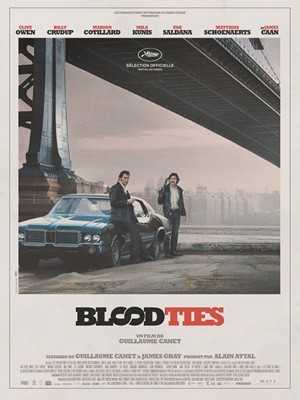
Film Review: Blood Ties (dir by Guillame Canet)


So, there’s this fucking movie called Blood Ties and it’s about a lot of fucking guys who live in fucking New York City in the fucking 70s and they’re all kind of a bunch of fuck-ups but they all know how to fucking use the word fuck as both an adjective and an adverb.  That’s the main impression that I took away from Blood Ties, a film that feels a lot like a mash-up of Place Beyond The Pines and every Martin Scorsese film ever made.

The year is 1974.  After serving several years on a murder conviction, 50 year-old Chris (Clive Owen) has been released from prison.  Chris’s transition back into society is a bumpy one.  For one thing, his ex-girlfriend (Marion Cotillard) is now a prostitute and refuses to let Chris see his children.  Though he gets a new girlfriend (Mila Kunis), he still finds himself struggling to hold down a job and he soon finds himself tempted to once again pursue a life of crime.

What might make that difficult for him is the fact that his younger brother, Frank (Billy Crudup), is now a cop with an old school porn star mustache.  Frank makes little secret of how much he resents his older brother and it isn’t long before the two of them are constantly fighting.  However, Frank has problems beyond Chris.  For one thing, he’s romantically pursuing Vanessa (Zoe Saldana), despite the fact that he earlier put her husband, Anthony (Matthias Schoenaerts), in prison.

In order to keep their dying father (James Caan) happy, Chris and Frank try to put aside their differences.  However, when Frank sees Chris fleeing from the scene of a robbery, it becomes harder and harder for him to ignore his brother’s activities.  Meanwhile, Chris has to decide whether or not to potentially sacrifice his freedom to keep his brother safe from a vengeful Anthony…

When Blood Ties was originally released at the beginning of the year, I considered seeing it but — for some reason — I ended up seeing The Legend of Hercules instead.  (Don’t you hate it when that happens!)  And I have to admit that I had forgotten about Blood Ties until I discovered that we were getting EPIX for free this holiday weekend.  Blood Ties is one of the films that’s currently showing on EPIX and, when I saw it was available, I thought to myself, “I can’t wait to see A Most Violent Year but until that opens up down here in Dallas, why not watch another violent New York period piece?”

And so I watched Blood Ties and … well, bleh.  Actually, bleh may be too harsh of a judgment.  The film is full of fun period details and Billy Crudup gives a really good performance as Frank.  There are some well done action scenes and I appreciated the fact that, for the most part, the film did not try to make violence look glamorous or fun.  The film has a great soundtrack though, for the most part, most of the songs here can also be heard in a countless number of superior Scorsese films.

But, ultimately, Blood Ties is never as good as you want it to be.  The film’s plot is about as predictable as can be and, far too often, scenes that start out interesting quickly degenerate to various characters standing around and yelling at each other.  And while that may often be what happens in real life, it still doesn’t make it particularly interesting to watch.  And then you’ve got poor Clive Owen, a good actor who is seriously miscast here.  Casting Clive Owen as a streetwise New York gangster is a bit like casting Ray Liotta as a member of the Queen’s Guard.  It just doesn’t work.

For those of us hoping for a great New York City crime epic — well, we’re just going to have to keep hoping that A Most Violent Year turns out to be just as good as everyone says it is…

Blood_Ties_poster


Embracing the Melodrama #56: Fierce People (dir by Griffin Dunne)


Fierce People

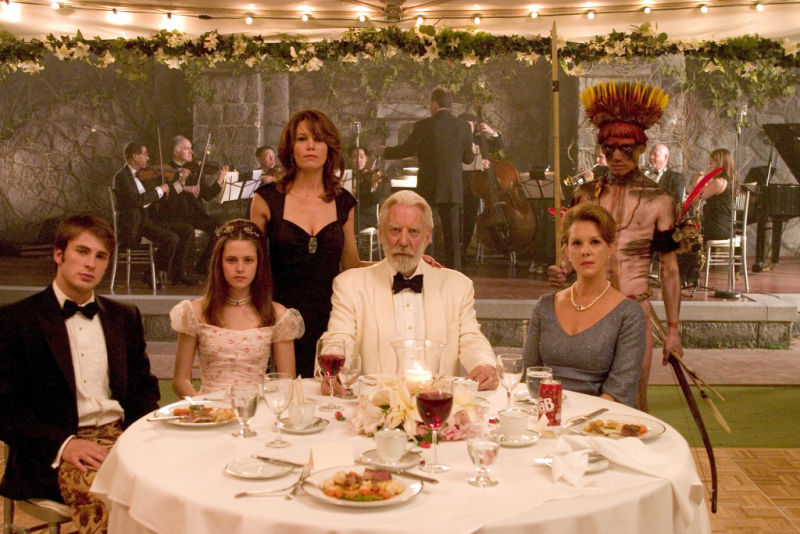
Much as how Inside Out is a perfect example of how one bad plot twist can ruin an otherwise good film, the 2007 sin-among-the-wealthy melodrama Fierce People shows how one good actor can partially redeem a really bad movie.  That actor’s name is Donald Sutherland and Fierce People is worth seeing for one reason: his performance.

Fierce People tells the story of a teenager named Finn Earl (Anton Yelchin).  As a character, Finn Earl is almost as annoying as his cutesy name.  He’s a permanently sarcastic 16 year-old who goes through life with the same judgmental smirk on his face, while the whole time delivering some of the smuggest narration ever recorded for a voice over in an American film.  Finn’s mother is Liz (Diane Lane), a massage therapist with a drug problem.  Finn’s father is some jerk who spends all of his time in South America, studying cannibal tribes.  (Actually, he’s studying a real-life Indian tribe known as the Yanomami, or the Fierce People.  However, I prefer to assume that he was actually studying a cannibal tribe because that means it’s entirely possible that he was eaten at some point and therefore, Finn will never get a chance to spend any time with father.  That’s the type of reaction that Finn, as a character, inspires.)

Liz and Finn are invited to spend the summer living the guesthouse of the fabulously wealthy Ogden Osburne (Donald Sutherland).  At first, Finn is weary of Ogden and assumes that he must be sleeping with Liz.  However, in a scene that works only because of the performance of Donald Sutherland, Ogden very graphically shows Finn why he’s not interested in having an affair with Liz.  Instead, Ogden is just a nice, rich eccentric.  Unfortunately, the other wealthy people who live around Ogden are not quite as nice and they soon, they start to resent the presence of Finn and his mother.  Finn does manages to befriend Ogden’s decadent grandson (played by Chris Evans) and even starts a tentative romance with Ogden’s granddaughter (Kristen Stewart) but the rest of the Osburne clan is not prepared to be so accepting.  Soon, the film goes from being an annoying comedy to being an annoying drama with a burst of violence and murder.

Fierce People is not a very good movie.  It’s based on a novel and, even if you didn’t know that beforehand, you would guess just from the way that the film tries and fails to present a lot of themes that undoubtedly work better on the page than on the screen.  The film’s attempts to draw parallels between the Yanomami and the wealthy (They’re two tribes and they’re both fierce — OH MY GOD, MIND BLOWN!) are way too obvious and the film’s sudden lurch into drama is handled rather clumsily.  It’s interesting to see Chris Evans before he became Capt. America and Kristen Stewart before she became Bella (and both of them, by the way, give good performances) but Anton Yelchin’s performance as Finn alternates between being smug and being whiny.  (In Yelchin’s defense, he’s developed into a pretty good actor and I loved him in Like Crazy.)

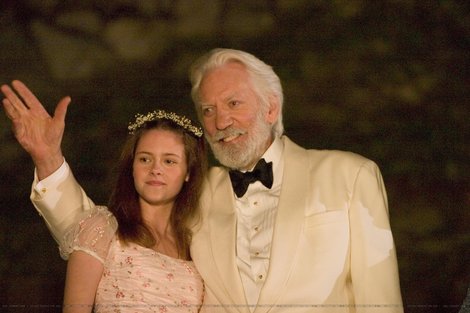
And yet, Fierce People works as an example of what a truly great actor can do with so-so material.  As played by Donald Sutherland, Ogden becomes the jaded moral center of the universe.  Sutherland plays Ogden with a perversely regal air and yet also makes us totally believe that Ogden actually could be helping the Earls out of the kindness of his heart.  It’s a great performance and every minute that Sutherland is on screen, Fierce People works.

If the film had simply been called Fierce Ogden, it would have been a hundred times better.

Donald Sutherland and Kristen Stewart

Is It Too Late To Hate On Movie 43?


Originally,  I wasn’t planning on ever seeing Movie 43.

Remember Movie 43?  That’s the comedy with the huge ensemble cast that came out in January and stayed in theaters for about a week.  The trailers looked terrible, the commercials looked terrible, and finally, the reviews were terrible.  In fact, the reviews were so terrible (Richard Roeper called it the Citizen Kane of bad movies) that, at first, I was perfectly content never to see it.

However, as time passed, I continually heard Movie 43 referred to as being one of the worst films ever made.  Every 12 months, I post my picks for the 26 worst films of the year and I knew that Movie 43 was one of those films that would either appear on that list or, if it didn’t, I would have to be willing to defend the title’s absence.

I realized that before I could either defend or condemn, I would have to sit through the movie.  After all, I figured, it’s only 90 minutes of my life.

90 minutes that I’ll never get back, I might add.

Movie 43 is an anthology film in which 13 separate comedic sketches are loosely linked together by one overarching story.  For the most part, this is a film that was presumably made both for adolescent boys and for men who still think like adolescent boys.  Most of the humor is derived from bodily functions and there’s a real strain of misogyny running through the entire film.  However, the film’s problem is not that it’s crude and misogynistic but that it manages to be so dull about being crude and misogynistic.  If you think its hilarious when Meg is insulted on Family Guy or when Seth McFarlane smirks after making an anti-Semitic comment, you might enjoy Movie 43 but the rest of us are going to find far less to enjoy.

Oddly enough, there are actually two different versions of Movie 43 in circulation.  In the version that was released in U.S. theaters, the various vignettes are tied together by a story in which an insane director (Dennis Quaid) pitches scene after scene to a callous movie executive (Greg Kinnear).  In the version that was released in the UK, they’re linked together by a story about 3 teenagers searching for the most offensive film ever made.  To be honest, both versions are pretty stupid but I prefer the one about the 3 teenagers, if just because that way I can pretend that neither Dennis Quaid nor Greg Kinnear had anything to do with this movie.

As for the sketches themselves, there’s 13 of them and they are a mixed bag as far as both humor and quality are concerned:

1)      The Catch (dir by Peter Farrelly)

Kate Winslet and Hugh Jackman go on a blind date.  Jackman has testicles hanging from his neck and only Winslet thinks this is an odd thing.  This skit goes on forever.

2)      Homeschooled (dir by Will Graham)

Liev Schreiber and Naomi Watts explain how they’re making sure that their teenage son is getting the full high school experience despite the fact that he’s being homeschooled.  They do this through a combination of hazing and incest.  This skit worked pretty well, mostly because of the dedication that Schreiber and Watts brought to their absurd roles.

3)      The Proposition (dir by Steve Carr)

Uhmm…yeah.  So, this is the skit that opens with Anna Faris asking Chris Pratt to defecate on her.  I skipped over it because, quite frankly, life is too short.

4)      Veronica (dir by Griffin Dunne)

Neil (Kieran Culkin) is working the night shift at a depressing grocery store when his ex-girlfriend Veronica (Emma Stone) comes in.  They argue about who infected who with an STD.  Little do they realize that Neil has accidentally turned on the intercom and everyone in the store can hear them.  I actually kind of liked this short skit.  Culkin and Stone had a lot of chemistry and it was well-directed by Griffin Dunne.  Plus, it only lasted 2 minutes and, therefore, ended before the joke got old.

5)      iBabe (dir by Stephen Brill)

The iBabe is an MP3 player that happens to look like a life-size nude woman.  Unfortunately, a fan was built into the iBabe’s vagina and now, teenage boys are being dismembered while fingering and fucking iBabe.  Richard Gere plays the President of the company that makes iBabe.  I’ve never thought of Richard Gere as being a comedic actor and his performance here does nothing to change that.

6)      Superhero Speed Dating (directed by James Duffy)

Robin (Justin Long) goes speed dating and Batman (Jason Sudekis) tries to mess things up for him.  This skit – which also features (and wastes) Uma Thurman, Kristen Bell, and Bobby Cannavale – is so incredibly bad that I don’t even know where to begin.  Between this film and his appearance in last year’s The Conspirator, I’m having to rethink my slight crush on Justin Long.

7)      Machine Kids (directed by Jonathan Von Tulleken)

This commercial parody asks us to consider the children who work inside copiers and vending machines and how they are effected when we criticize those machines for not accepting our dollar.  This was actually so weird that I couldn’t help but love it.

8)      Middleschool Date (dir by Elizabeth Banks)

7th grader Amanda (Chloe Moretz) is having her first “middle school” date with Nathan (Jimmy Bennett) when she starts her first period.  In response, Nathan and his older brother (Christopher Mintz-Plasse) panic.  Believe it or not, this was actually one of the better parts of Movie 43, if just because the scene’s humor comes not from Amanda getting her period but instead from how every male around her descends into histrionics as a result.   It helps that this was the only part of Movie 43 that was both written and directed by women.  It also helps that director Elizabeth Banks is so clearly on Amanda’s side.  The end result is one of the few moments in Movie 43 that doesn’t feel misogynistic. 

9)      Tampax (dir by Patrik Forsberg)

This is another fake commercial.  Two girls are at the beach.  One uses tampax tampons and the other doesn’t.  Guess which one gets eaten by a shark?  As opposed to the previous skit, this bit of menstrual humor was obviously written and directed by a man (and the message, not surprisingly, is “Ewww!  Girls are scary and dangerous!”) but I’m going to have to admit that this one made me laugh if just because, like Middleschool Date, it reminded me of some of the period horror stories that I used to hear (and believe) back when I was younger.  (Though I was raised to be more concerned about bears than sharks…)

10)  Happy Birthday (dir by that noted comedian, Brett Ratner)

Pete (Johnny Knoxville) kidnaps an angry leprechaun (Gerard Butler) and gives it to Brian (Seann William Scott).  The leprechaun’s equally angry brother (also played by Gerard Butler) shows up and violence ensues.  Watching this skit was like being told a joke by someone who has no sense of humor.

11)  Truth or Dare (dir by Peter Farelly and Patrik Forsberg)

Halle Berry and Stephen Merchant are on a first date and Merchant has testicles on his neck…oh wait.  Sorry, that was Hugh Jackman and Kate Winslet’s skit.  In this skit, Berry challenges Merchant to game of truth or dare.  It escalates as the dares get continually more and more outrageous.  Whoops?  Did I say outrageous?  I meant to say stupid and oddly dull.  Watching this skit was like listening to a someone who has no sense of humor continue to tell a joke even though everyone else has already guessed the punchline.

12)  Victory’s Glory (dir by Rusty Cundieff)

In this parody of “inspirational” sports movies, Coach Jackson (Terrence Howard) speaks to his basketball team before they play their first game against an all-white team.  The gist of the speech is that Jackson’s team is going to win because they’re black and the other team is white.  This skit started out strong but, like a lot of Movie 43, it ran on for a bit too long.

13)  Beezel (dir by James Gunn)

This was actually my favorite part of Movie 43.  Unfortunately, since Beezel shows up in the middle of the end credits, I get the feeling that a lot of disappointed audience members had probably already walked out of the theater before it even began.  Beezel is a cartoon cat who has an unhealthy obsession with his owner (Josh Duhamel).  When Duhamel’s girlfriend (played by Elizabeth Banks) catches Beezel masturbating to pictures of Duhamel in a swimsuit, Beezel responds by plotting her demise.  Beezel was actually the only part of Movie 43 that truly felt edgy and unpredictable.  This is largely because this segment was directed by James Gunn, one of the few truly transgressive artists currently working in mainstream film.

So, here’s the question: is Movie 43 the worst film of 2013 as so many critics have claimed?  A few isolated moments aside, Movie 43 is pretty bad.  Even the parts of the film that do work can’t hope to compete with the pure horrifying incompetence of that parts that don’t.  However, thanks largely to James Gunn and Elizabeth Banks, it’s still a smidgen or so better than Tyler Perry’s Temptation.  (For all of its failings, Movie 43 never suggests that AIDS is God’s way of punishing wives who stray.  Nope, for that message, you have to go to Tyler Perry.)

Movie 43 is not the worst film of 2013.

It just seems like it.
Horror Film Review: An American Werewolf in London (dir. by John Landis)


I resisted seeing An American Werewolf in London for quite some time because 1) I kept mixing the film up with its “sequel,” An American Werewolf in Paris (which is seriously one of the worst films ever made) and 2) werewolves scare me in a way that vampires and zombies don’t.  Seriously, what is a werewolf other than a really big pit bull and to say that I’m not a dog person is an understatement.  However, this Halloween season, several people on twitter suggested that I give the film a chance so, reluctantly, I watched it and I’m glad that I did.  Good call, twitter.

Originally released way back in 1981, An American Werewolf in London starts with two nice guys from New York (played by David Naughton and Griffin Dunne) backpacking across England.  They stop in one of those proverbial, fog-drenched English villages where they are told, by the secretive town folk, to stay off the moors.  Naughton and Dunne promptly wander into the moors.  “Whoops,” they literally say as the full moon shines behind them.  Suddenly, they are attacked by some sort of wild animal.  Dunne is killed and a severely wounded Naughton wakes up days later in a London hospital.

While recovering in the hospital, Naughton meets and starts up a tentative romance with his nurse (Jenny Agutter) even as he finds himself haunted by disturbing graphic nightmares in which he sees his family being massacred by humanoid wolves dressed up like storm troopers.  (Seriously, these genuinely disturbing nightmares were so seamlessly worked into film that they took me totally by surprise.)  Even worse, Dunne’s progressively decaying corpse keeps popping up in his hospital room and telling him that 1) they were attacked by a werewolf, 2) Dunne’s spirit is trapped on Earth until the werewolf’s bloodline is extinguished, and 3) that bloodline is currently being carried on by Naughton.  Fearing for his sanity, Naughton moves into Agutter’s flat after he’s released from the hospital and, for a brief moment, it actually seems like he might actually be okay.

And then, inevitably, a full moon rises and soon, there’s an American werewolf in London…

An American Werewolf in London is an oddly succesful hybrid of genres that don’t always mix well: it’s scarier than Paranormal Activity, funnier than Scream, and ultimately more romantic than any of the Twilight films.  David Naughton and Jenny Agutter are both so appealing in this film that you actually get invested in their relationship and, as a result, the inevitably of the film’s conclusion becomes all the more tragic.  As this film was pre-CGI, Naughton actually had to act out the process of transforming into a werewolf and, as a result, An American Werewolf in London feels real in a way that most werewolf films do not.

Director John Landis manages to maintain a perfect balance between the horror and the comedy and, as a result, I found myself both laughing out loud and hiding my eyes throughout this entire film.  For me, the scariest scene in the film comes when an unfortunate commuter finds himself being tracked through a nearly deserted tube station by our werewolf.  Landis  wisely draws the sequence out, with the camera taking on the point-of-view of the prowling werewolf.  Seriously, this growls heard during this whole sequence reminded me of why I’m so scared of big dogs.  The other stand-out sequence comes towards the end of the film, in which Naughton takes refuge in a filthy porno theater and talks to Dunne (who, by this point, is just a skeleton).  Dunne, it turns out, has brought with him the spirits of all the people who Naughton killed during the last full moon.  So, while Dunne and his new friends encourage Naughton to commit suicide and Naughton starts to painfully transform into a werewolf, the worst porno film ever made is playing in front of them.  The scene — with its perfect mix of tragedy, comedy, and horror — epitomizes everything that makes An American Werewolf in London work as a film.

One final note: one of the problems that I have with a whole lot of horror films is that they rarely make good use of their setting.  Whether it’s that old deserted building or that piece of wilderness that’s not on anyone’s map, horror locations often feel as a generic as horror plots.  However, Landis makes good use of both London and the English countryside here and this is a film that really should serve as a lesson for aspiring horror filmmakers todays.  Of course, it helps that the location in question happens to be London with all of its gothic traditions and old school horror heritage.  Let’s face it — An American Werewolf in St. Louis* just doesn’t carry the same punch. 

—-

* Or, God Forbid, Vermont.