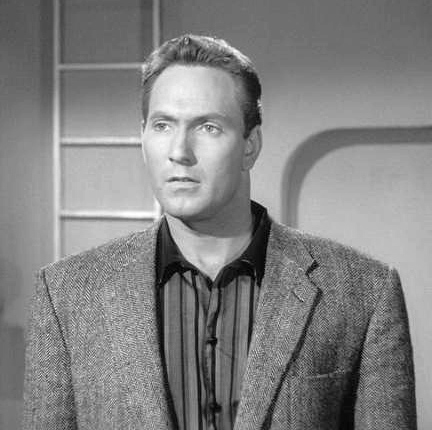
Gregory Walcott, who was born 100 years today, appeared in a lot of good films over the course of his long career. He had supporting roles in major blockbusters. He was a friend and frequent collaborator of Clint Eastwood’s. In 1979, he played the sheriff in the Oscar-nominated Norma Rae.
That said, he will probably always be most remembered for playing Jeff, the patriotic pilot, in Ed Wood’s 1957 masterpiece, Plan Nine From Outer Space. Walcott gave probably as good a performance as anyone could in Plan 9, though that didn’t prevent the film from wrong being declared one of the worst ever made. Walcott, for most of his career, was not a fan of Plan 9 but, in the years before he passed away in 2015, Walcott’s attitude towards the film mellowed considerably. He even appeared in Tim Burton’s Ed Wood.
In this scene from Plan 9, Walcott shows how to deal with a snooty extra-terrestrial invader. Never has Earth had been a better defender!
Gregory Walcott appeared in a lot of good films over the course of his long career. He had supporting roles in major blockbusters. He was a friend and frequent collaborator of Clint Eastwood’s. In 1979, he played the sheriff in the Oscar-nominated Norma Rae.
That said, he will probably always be most remembered for playing Jeff, the patriotic pilot, in Ed Wood’s 1957 masterpiece, Plan Nine From Outer Space. Walcott gave probably as good a performance as anyone could in Plan 9, though that didn’t prevent the film from wrong being declared one of the worst ever made. Walcott, for most of his career, was not a fan of Plan 9 but, in the years before he passed away in 2015, Walcott’s attitude towards the film mellowed considerably. He even appeared in Tim Burton’s Ed Wood.
In this scene from Plan 9, Walcott shows how to deal with a smug alien.
Today, we pay respect to Edward D. Wood, Jr. on the date of his birth. He was born 101 years ago today.
Some films need no introduction and that’s certainly the case with Wood’s 1957 masterpiece, Plan 9 From Outer Space.
Plan9 is a film like no other, a film that mixes UFOs with zombies and which ends with a rather sincere plea for world peace. When Eros the Alien explains that the Solarnite bomb could destroy the entire universe, the film’s hero, airline pilot Jeff, doesn’t point out that Eros’s logic doesn’t make sense. Instead, he just says that he’s glad that America is the one that has the bomb. “You’re stupid! Stupid minds!” Eros shouts before Jeff flattens him with one punch. Go Jeff! Don’t take any backtalk from that judgmental alien!
From Criswell’s introduction to Tor Johnson’s rise from the dead to Lyle Talbot casually standing with his hands in his pockets while a UFO explodes above him, Plan9 is a true classic of some sort.
In 1978’s Every Which Way But Loose, Clint Eastwood plays Philo Beddoe.
Philo’s an ordinary guy with beautiful hair and a way with throwing punches. He’s a truck driver. He enjoys a cold beer. He enjoys country music. He makes some extra money by taking part in bare-knuckle brawls. Everyone says that he could be the next Tank Murdock, a legendary fighter. Philo is just a simple, blue collar guy who lives in a small house, next door to his best friend Orville (Geoffrey Lewis) and Orville’s profanity-loving mother (Ruth Gordon). Philo also owns an orangutan named Clyde. He saved Clyde from being sent to live in a “desert zoo.”
(Actually, now that I think about it, most blue collar guys don’t own monkeys but whatever. Clyde’s cute and Eastwood’s Eastwood.)
When Philo meets a country singer named Lynn Halsey-Taylor (Sondra Locke), he is immediately smitten. When Lynn disappears and leaves Philo a cryptic note, Philo decides to go looking for her. Clyde, Orville, and Philo hit the road. Along the way, Orville meets and picks up a woman named Echo (Beverly D’Angelo). This is a road movie so, of course, Clyde, Orville, Philo, and Echo have their adventures on the way to Colorado. They end running afoul both a corrupt cop and a gang of buffoonish bikers. Philo enters a fight whenever they need money and one occasionally gets the feeling that Eastwood took this role to show off the fact that, for someone approaching 50, he still looked good without a shirt on. And good for him! Because, seriously, Clint does look good in this movie….
I have to admit that, for all of my attempts at sophistication, my roots are in the country and I’ve traveled down enough dirt roads that I find it hard to resist a good redneck story. And really, there aren’t many films that as proudly and unashamedly redneck than EveryWhich Way But Loose. It’s a film that has a laid back, take-it-as-it-comes vibe to it. Philo may be looking for Lynn but he seems to be okay with taking a few detour along the way. There’s no real sense of urgency to any part of the movie. Instead, EveryWhichWay But Loose was made for people who like a cold beer at the end of the day and who find Ruth Gordon to be hilarious when she curses. Myself, I don’t drink. That’s one part of the country lifestyle that passed me over. But I did enjoy seeing Ruth Gordon cuss out the Nazi biker gang.
Eastwood, Lewis, and D’Angelo have a likable chemistry and the monkey’s cute. Unfortunately, Sondra Locke isn’t particularly well-cast in the role of Lynn. (Considering that she was in a relationship with Eastwood, it’s amazing how little chemistry they have in this movie.) As I watched the film, it occurred to me that it probably would have worked better if Locke and D’Angelo had switched roles. Locke’s character is supposed to be a femme fatale type but she gives a boring performance and, as a result, the revelation that Philo has misjudged her doesn’t really carry any emotional weight.
That said, this film features some beautiful shots of the wilderness, a charming romance between Lewis and D’Angelo, and a shirtless Clint Eastwood beating folks up. That’s more than enough to please this secret country girl.
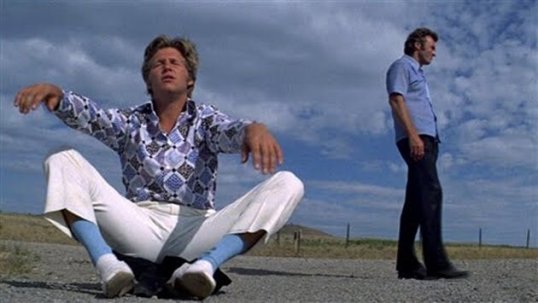
1974’s Thunderbolt and Lightfoot opens with two men, one young and one middle-aged, facing a moment of truth.
The younger of the two is Lightfoot (Jeff Bridges), a wild and hyperactive rich kid who is in his 20s and who steals a corvette right off of a used car lot. The other man is simply known by his nickname, Thunderbolt (Clint Eastwood). When we first see Thunderbolt, he’s giving a sermon in a small Montana church. When a gun-wielding man steps into the church and promptly starts firing at Thunderbolt, he takes off running. Pursued by his attacker, Thunderbolt runs through a field and just happens to jump onto Lightfoot’s speeding corvette. Lightfoot runs over the Thunderbolt’s pursuer. Thunderbolt slips into the car and Lightfoot drives on for a bit. Lightfoot is excited and talkative. Thunderbolt is more concerned with popping his shoulder back into its socket. A stop at a gas station leads to the men stealing someone else’s car.
And so it goes for a good deal of the movie. Thunderbolt and Lightfoot is a road movie, the majority of which is taken up with scenes of the two men just hanging out. Thunderbolt and Lightfoot take an instant liking to each other. When Lightfoot picks up a prostitute (Catherine Bach), he makes sure to ask that she bring along a friend for Thunderbolt. When a criminal punches Lightfoot, Thunderbolt is quick to punch back. “That’s for the kid,” Thunderbolt says. That’s the type of friendship that they have. Jeff Bridges is handsome and full of energy as Lightfoot and Clint Eastwood smiles more in this film than I think I’ve seen him smile in any other film. For once, Eastwood is not playing a perpetually grumpy stranger or a supercop. Instead, he’s just a blue collar guy who enjoys having a friend to travel with.
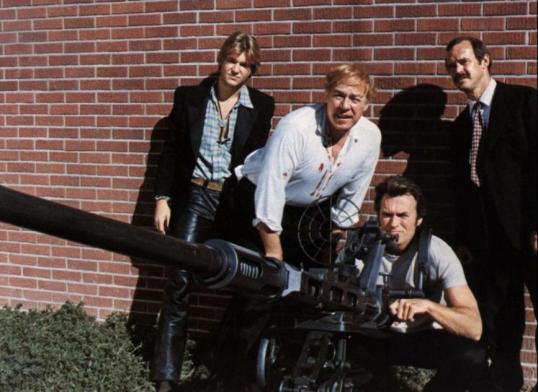
Eventually, Thunderbolt and Lightfoot meet up with two of Thunderbolt’s former associates. Red (George Kennedy) is a brutal brawler who, it is suggested, served with Thunderbolt in the Korean War. Goody (Geoffrey Lewis) is a gentle soul who takes orders from Red but still can’t bring himself to shoot anyone, no matter how much Red demands that he pull the trigger. Red and Goody have always assumed that Thunderbolt stole the loot from a bank robbery that they pulled off. Thunderbolt explains that he didn’t steal the money. He just got arrested after hiding it. Lightfoot suggests that maybe the four of them could pull off another bank heist….
Kennedy and Lewis are perfectly cast as the two criminals who end up working with Thunderbolt and Lightfoot. In many ways, the relationship between Red and Goody mirrors the relationship between our lead characters. The main difference is that Red is sadistic and quick to loose his temper, whereas Thunderbolt controls his emotions and tries not to hurt anyone while committing his crimes. Lightfoot looks up to Thunderbolt and Goody looks up to Red. Again, the difference is that Thunderbolt actually cares about Lightfoot, whereas Red is incapable of truly caring about anyone but himself. Eastwood, Bridges, Kennedy, and Lewis make quite a team and it’s hard not to worry about all four of them, especially when the film takes an unexpectedly dramatic turn during its third act.
I really wasn’t expecting Thunderbolt and Lightfoot to make me cry but the final thirty minutes of the film brought tears to my eyes as what started out as a buddy comedy turned into a tragedy. (I shouldn’t have been surprised. I’ve seen enough 70s movies that I really should have known better than to have expected a happy ending.) Thanks to the perceptive script by Michael Cimino (who would go on to make The Deer Hunter and Heaven’s Gate) and the performances of Eastwood and Bridges, the movie’s final moments carry quite a punch and they leave you wondering if Thunderbolt and Lightfoot’s road trip was worth the price that was ultimately paid. The film works as not only a tribute to friendship but also as a fatalistic portrait of life on the backroads of America.
Thunderbolt and Lightfoot was the first Eastwood film to receive an Oscar nomination, with Jeff Bridges competing for Best Supporting Actor. (He lost to Robert De Niro’s star turn in The Godfather, Part II.) Eastwood, reportedly, felt that he deserved a nomination for his performance as Thunderbolt and, considering that that Oscar itself was won by Art Carney for his pleasant but hardly revelatory work in Harry and Tonto, Eastwood was correct. Instead, Eastwood would have to wait for another 18 years before he finally received Academy recognition for starring in, producing, and directing Unforgiven.
1972’s JoeKidd opens with the title character (played by Clint Eastwood) in jail. Joe is a New Mexico rancher and apparently, someone with a long history of getting in trouble with the law. This time, he’s been arrested for poaching and disturbing the peace. Given a choice between a fine and ten days in jail, Joe goes for the ten days. Cowardly Sheriff Mitchell (Gregory Walcott) says he’s going to put Joe to work. Joe Kidd snarls in response.
However, that’s before Luis Chama (John Saxon), a Mexican revolutionary, raids the courthouse and demands that all of his people’s ancestral land be returned to them. Local landowner Frank Harlan (Robert Duvall) forms a posse to track Chama down. Joe says that he has nothing against Chama but that changes once he discovers that Chama raided his ranch and beat up one of his ranchhands. Joe joins the posse but he soon discovers that Harlan and his men are sadists who are more interested in killing Mexicans than actually capturing Chama.
I was actually pretty excited about watching JoeKidd. Clint Eastwood, Robert Duvall, and John Saxon, three of my favorite actors in the same movie! How couldn’t I be excited? Unfortunately, neither Duvall nor Saxon are at their best in this film. Frank Harlan is a one-dimensional villain and Duvall doesn’t make much of an effort to bring any sort of unexpected nuance to the character. Duvall doesn’t give a bad performance but it’s hard not to feel that Harlan is a character who could have been played by any forty-something actor. It feels like waste to cast such a good actor in such a thin role. (Add to that, I prefer Duvall when he plays a good guy as opposed to when he plays a bad guy.) As for Saxon, this is probably one of his worst performances but his character is also rather underwritten and the film can’t seem to decide if it wants the viewer to be on his side or not. Saxon delivers his lines in an exaggerated Mexican accent that makes it difficult to take Louis Chama seriously. Gregory Sierra would have made a good Louis Chama but Saxon just seems miscast.
Fortunately, Clint Eastwood is always a badass, even in an uneven film like this. Eastwood is at his best in the early scenes, when he’s grouchy and hungover and annoyed at finding himself in the jail. He is believably outraged by Harlan’s tactics and, in typical Eastwood fashion, he delivers every pithy one-liner with just enough style to keep things interesting. That said, Eastwood is let down by a script that never really makes it clear why Joe Kidd stays with the posse once it becomes clear that he’s traveling with a bunch of sociopaths. Joe’s motivations are never really clear. In the end, he seems like he goes through a lot of trouble to protect his farmland and get revenge for one of his ranch hands (who is just beaten up), just to then desert it all once all the shooting is over.
That said, JoeKidd is a gorgeous film to look at and Joe makes creative use of a steam engine. This isn’t the film to show anyone who isn’t already an Eastwood fan. But, for those of us who are already fans of Clint, it’s enjoyable to watch him snarl, even if it is in a lesser film.
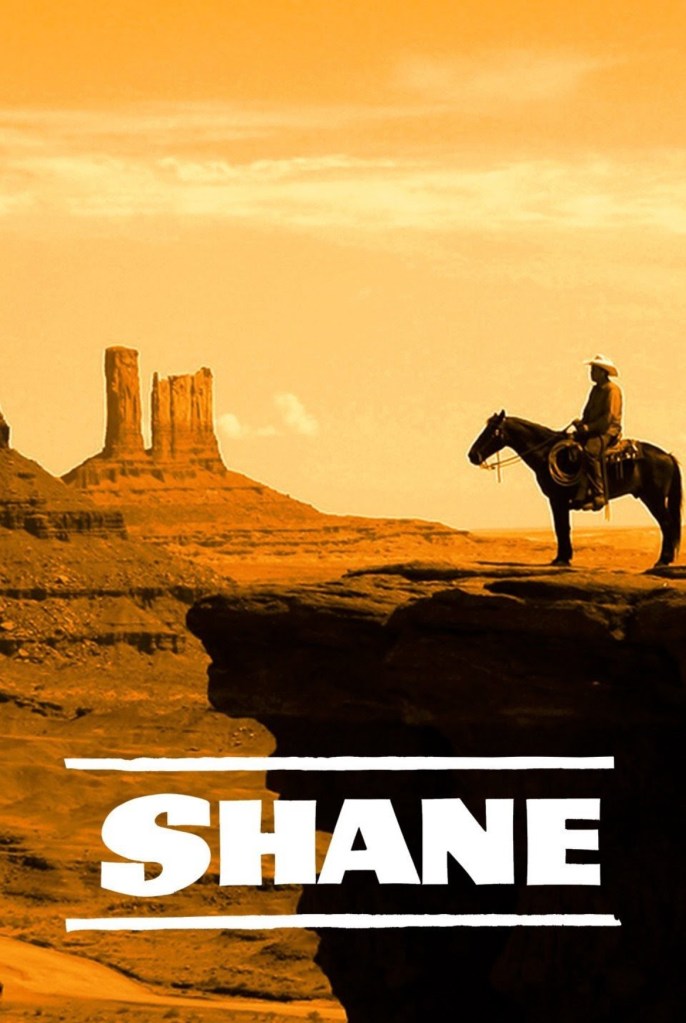
Episode 7 begins with two drunk cowboys, who work for Rufe Ryker (Bert Freed), raising cane and deciding they’ll go harass some sodbusters just for the hell of it. On this day, they ride over to Ira Jackson’s (Jason Wingreen) ranch, where Marian Starett (Jill Ireland) is there visiting Ira’s daughter Elizabeth (Catherine Ferrar). As the cowboys ride around the house, hooping and hollering and shooting off their guns, a frustrated Ira opens the door and fires a blast from his shotgun. The cowboys shoot back toward the house, hitting a kerosene lamp in the kitchen and starting a fire. Ira gets the ladies out of the house and then commences to fighting with the cowboys, who now realize what they’ve done and are wanting to help put out the fire. While the men and Marian are distracted with the fight, Elizabeth runs back into the house to try to save her calico cat, where she is engulfed by the flames and dies.
We move on to Elizabeth’s funeral and see Shane (David Carradine) ride up with Reverend Harry Himber (James Whitmore). Rufe Ryker is there and he tells Shane and the Reverend that he’s sorry about what happened, that he had nothing to do with it, and that he doesn’t want any trouble. Shane isn’t in much mood to listen to Ryker so he moves on. Reverend Himber, who we will come to find out is a pacifist, begins the service by saying that Elizabeth would want everyone there to remember the good times they had together with her, as well as look inward to find forgiveness and understanding. Hellbent on revenge, Ira just screams “No!”
That night, after chewing his two cowhands out, Ryker decides he’s going to pay them two months wages and send them out of town. He would rather lose a couple of good cowboys as fight a war with Ira. As one of the men, the young Hoke (Dee Pollock), is on his way out of town, Ira shoots him down from the hillside with his rifle. The remainder of the episode consists of Shane and Tom Starett (Tom Tully) trying to protect Ira and the other local farmers from the wrath of Ryker and his men, while Reverend Himber tries to get everyone to talk it out to avoid more killings in the valley.
In episode 7, the character of Rufe Ryker takes center stage, along with Shane and the visiting Reverend Himber, played here by guest star James Whitmore in an incredible performance. This is probably the deepest episode we’ve dealt with thus far, with each character showing some level of moral complexity. Neither Shane or Ryker want a fight, but they both prepare to get bloody for different reasons. Ryker makes it clear that he will protect his men and fight for them even when they’re wrong. Shane makes it clear that he will fight for the sodbusters against powerful men like Ryker even when he thinks they’re wrong. And then there’s Reverend Himber, the pacifist who is willing to do whatever it takes to stop a fight. During the episode we find out that he had been forced to kill six enemy soldiers when they raided the hospital he was working at during the war. This episode drives home the fact that a man’s ideals will at times contrast harshly with the realities of the positions they find themselves in. Each of these three men finds himself in a situation that has grown bigger than him, with both Ryker and Shane recognizing the deal and preparing for the worst. Reverend Himber, on the other hand, tries to take control of the situation, only to be the catalyst for more tragedy. We have all been in situations where we hope for the best, but we’re smart enough to prepare for the worst, because some of the biggest fools alive are the ones who think they can control other people.
Overall, the “Day of the Hawk” is a strong episode that has a surprisingly powerful and emotional conclusion. The storyline belongs to Shane, Ryker and the Reverend, so Shane’s relationship with Marian takes a back seat this time around. I don’t think they look at each other longingly a single time, which did make me a little sad. Here’s hoping they’ll double that up in Episode 8!
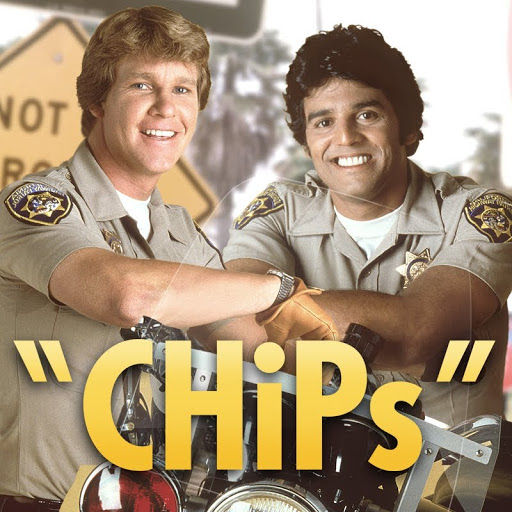
Welcome to Late Night Retro Television Reviews, a feature where we review some of our favorite and least favorite shows of the past! On Mondays, I will be reviewing CHiPs, which ran on NBC from 1977 to 1983. The entire show is currently streaming on Freevee!
This week, Jon and Ponch play matchmaker!
Episode 2.17 “The Matchmakers”
(Dir by Harvey S. Landman, originally aired on January 27th, 1979)
Cora (Jenny O’Hara) is an eccentric woman who lives in an old farmhouse with a bunch of animals. Her landlord is evicting her and the county is planning to not only bulldoze her home but also take and possibly destroy all of her animals unless she can find a new place for them. Twice, she tries to commit suicide by driving her truck recklessly. Both times, she is saved by Ponch and Baker.
Dirk Hutchins (Gregory Walcott) is a crotchety old man who has served with the Highway Patrol for 30 years and is now on the verge of forced retirement. He doesn’t know what he’s going to do with himself once he’s no longer on the job. Hutchins spends his last work week taking outrageous risks, leading Ponch and Baker to worry that he’s trying to go out in a blaze of suicidal glory.
What solution do Ponch and Baker come up with for Cora and Dirk? They decide to play matchmaker! Cora ends up moving onto Dirk’s property (and brings along all of her animals) and maybe Dirk will end up falling in love with Cora. And then, they’ll both have a reason to live!
Listen, this episode’s heart is in the right place. I’m certainly not going to fault the intentions of any episode that features Ponch and Baker trying to help two suicidal people. But, seriously, Cora was such an annoying character! The show portrayed her as being so unhinged and so emotionally unstable that you couldn’t help but wonder if having her move in with grumpy old Dirk was really the best way to go about things. Cora really did seem like she needed professional help, the type that went way beyond having a place to keep her animals.
As for Dirk, I was happy to see that he was played by Gregory Walcott. As many of you already know, Walcott’s greatest claim to fame was starring in Ed Wood’s Plan Nine From Outer Space. Walcott survived Plan Nine and went on to become a durable character actor, appearing in westerns and war films. Walcott gives a believably ruggedly performance as Dirk, even if the character himself is not exactly someone you would want to get stuck on an elevator with.
There is a subplot involving a private investigator (Danny Wells) who had been hired to kidnap a kid and bring him back to his no-good father. And there’s a fairly well-done scene where Dirk and Getraer work to keep a truck from turning over on top of a car. There is a little action but still, this episode didn’t quite work.
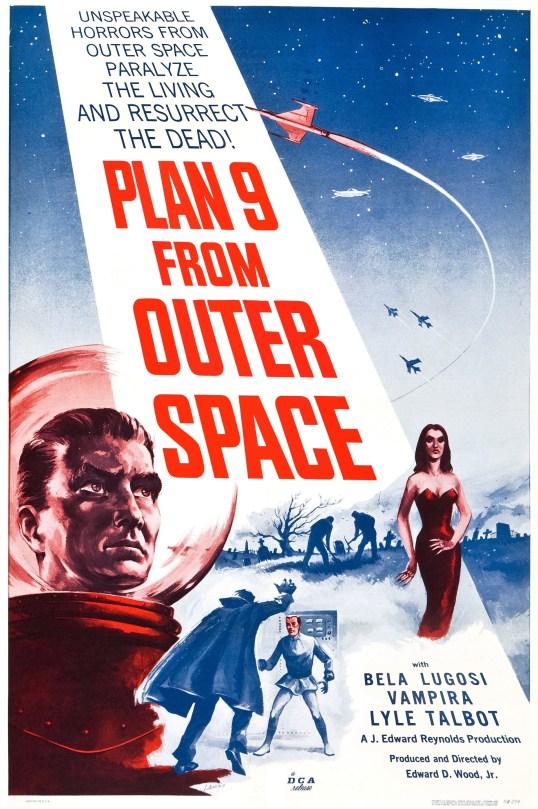
Viewing Plan 9 From Outer Space during October is a bit of a tradition around these parts and here at the Shattered Lens, we’re all about tradition. And since the 100th anniversary of the birth of Ed Wood, Jr. is just a five days away, it just seems appropriate to watch his best-known film.
Speaking of tradition, this 1959 sci-fi/horror flick is traditionally cited as the worst film ever made but I don’t quite agree. For one thing, the film is way too low-budget to be fairly judged against other big budget fiascoes. If I have to watch a bad movie, I’ll always go for the low budget, independent feature as opposed to the big studio production. To attack Ed Wood for making a bad film is to let every other bad filmmaker off the hook. Ed Wood had his problems but he also had a lot of ambition and a lot of determination and, eventually, a lot of addictions. One thing that is often forgotten by those who mock Ed Wood is that he drank himself to death and died living in squalor. The least we can do is cut the tragic figure some slack.
Plan 9 From Outer Space is a ludicrous film but it’s also a surprisingly ambitious one and it’s got an anti-war, anti-military message so all of you folks who have hopped down the progressive rabbit hole over the past few years should have a new appreciation for this film. I mean, do you want the government to blow up a Solarnite bomb? DO YOU!?
Also, Gregory Walcott actually did a pretty good job in the lead role. He was one of the few members of the cast to have a mainstream film career after Plan 9.
Finally, Plan 9 is a tribute to one man’s determination to bring his vision to life. Ed Wood tried and refused to surrender and made a film with a message that he believed in and, for that, he deserves to be remembered.
Now, sit back, and enjoy a little Halloween tradition. Take it away, Criswell!
Gregory Walcott, who was born 98 years today, appeared in a lot of good films over the course of his long career. He had supporting roles in major blockbusters. He was a friend and frequent collaborator of Clint Eastwood’s. In 1979, he played the sheriff in the Oscar-nominated Norma Rae.
That said, he will probably always be most remembered for playing Jeff, the patriotic pilot, in Ed Wood’s 1957 masterpiece, Plan Nine From Outer Space. Walcott gave probably as good a performance as anyone could in Plan 9, though that didn’t prevent the film from wrong being declared one of the worst ever made. Walcott, for most of his career, was not a fan of Plan 9 but, in the years before he passed away in 2015, Walcott’s attitude towards the film mellowed considerably. He even appeared in Tim Burton’s Ed Wood.
In this scene from Plan 9, Walcott shows how to deal with a smug alien.

 Through the Shattered Lens